
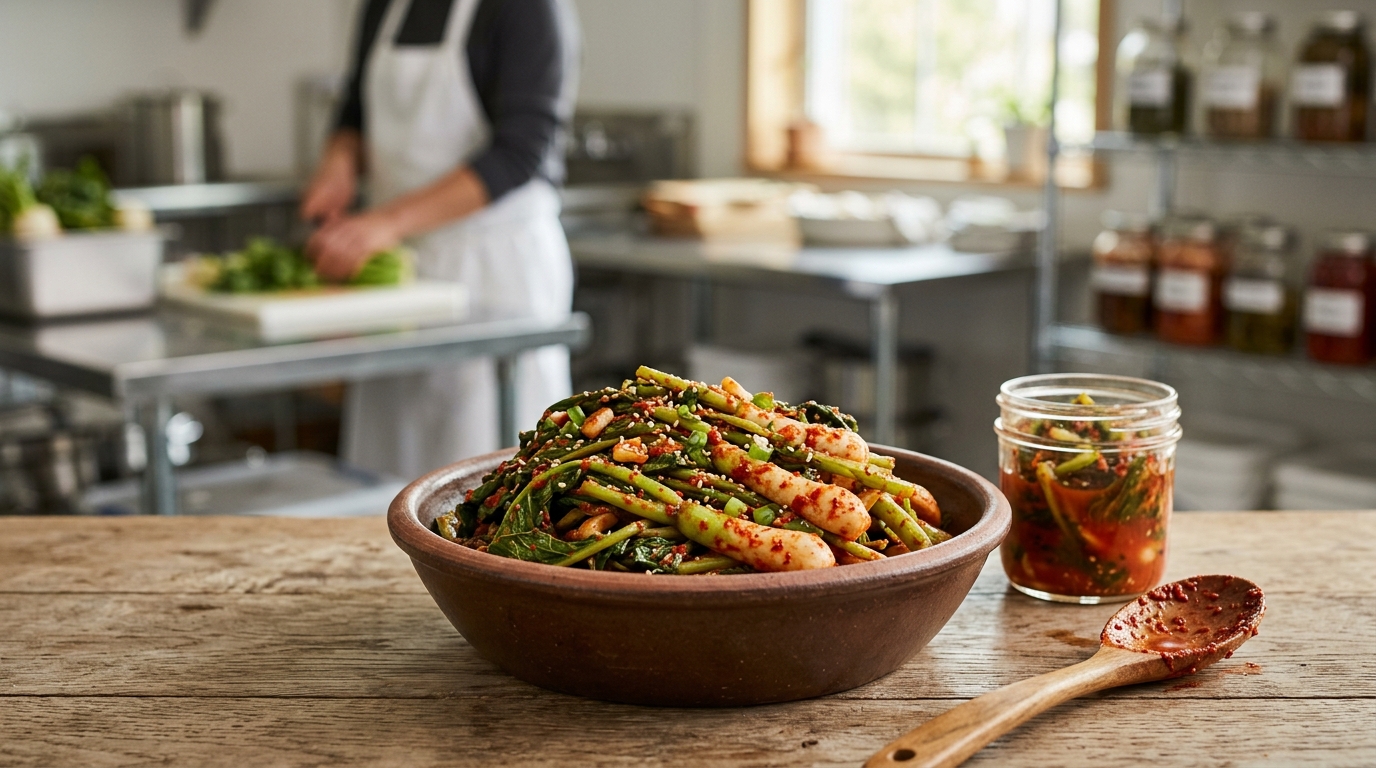
Young-radish-kimchi (yeolmu kimchi) looks like a simple veg-based SKU, but procurement outcomes are dictated by biology (fermentation kinetics) and physics (water loss, CO2 pressure, temperature history). This guide maps the physical chain and highlights where cost and claims become “structural,” so sourcing leaders can contract and govern the category like a chilled, living product—not a static condiment.
Young-radish-kimchi (yeolmu kimchi) is a chilled, actively fermenting vegetable product. The supply chain is physically constrained by three realities: (1) raw radish tenderness and water content drive yield and texture, (2) fermentation is a time–temperature process that keeps changing the product after packing, and (3) cold-chain performance is part of product quality, not just distribution.
Insight: Costs are “locked in” early (at farm + primary prep) through raw-material variability and trim/drain loss, then “compounded” later by fermentation control, packaging performance under CO2 pressure, and refrigerated handling.
Data (validated/clarified): Food-safety guidance for kimchi commonly expects the product to reach final pH ≤4.6 within a defined time window (e.g., a few days depending on temperature), reinforcing that pH is a measurable control point—not just a sensory attribute. [1]
Procurement Impact: Even with stable ingredient pricing, landed cost and claims can swing batch-to-batch because physical yield, fermentation trajectory, and temperature excursions change what you can ship, how long it lasts, and how often it gets rejected.

Insight: Yeolmu kimchi’s cost stack is less about exotic inputs and more about (a) labor + water-intensive preparation, (b) controlled fermentation capacity (space, energy, time), and (c) packaging + cold chain engineered to manage CO2 and sensory drift.
Data (validated): Peer-reviewed packaging work on radish-kimchi explicitly measures headspace gases and package volume expansion (swelling) under dynamic temperature conditions, and evaluates gas-permeable films to enable CO2 release and reduce swelling. [2]
Procurement Impact: Node-level cost understanding is necessary to interpret supplier quotes: two products with the same ingredient list can have very different total costs depending on yield loss, fermentation control, and packaging/cold-chain design.

| Supply Chain Node | Cost Ratio (% of Final Cost) | Notes |
|---|---|---|
| Raw Material Cost | 30–40% | Radish + aromatics; variability drives yield and consistency more than recipe complexity. |
| Primary Processing | 15–22% | Labor, water, sanitation, trim/drain shrink. |
| Secondary Processing | 10–18% | Fermentation staging, cooling energy, working capital time. |
| Packaging & QA | 12–20% | Gas/odor management, leak resistance, labels, testing/holds. |
| Chilled Logistics & Distribution | 10–18% | Refrigerated storage/transport; shrink and returns sit here. |
| Wholesale/Retail Margin | 8–15% | Channel-dependent; higher for mainstream retail than direct-to-foodservice. |
| Supply Chain Node | Cost Ratio (% of Final Cost) | Notes |
|---|---|---|
| Raw Material Cost | 32–45% | Ingredient share rises because packaging per kg is lower. |
| Primary Processing | 16–24% | Similar labor intensity; yield still dominates. |
| Secondary Processing | 8–16% | Often shipped at a defined fermentation stage to fit restaurant usage. |
| Packaging & QA | 7–14% | Lower unit packaging cost, but stronger seal/leak control needed. |
| Chilled Logistics & Distribution | 12–20% | More LTL/route delivery exposure; temperature abuse risk increases. |
| Distributor Margin | 6–12% | Foodservice distribution economics. |
| Supply Chain Node | Cost Ratio (% of Final Cost) | Notes |
|---|---|---|
| Raw Material Cost | 25–38% | Origin sourcing; quality specs can tighten to reduce claims. |
| Primary Processing | 12–20% | Higher QA/sanitation burden for export programs. |
| Secondary Processing | 10–18% | Fermentation staging tuned for transit time. |
| Packaging & QA | 12–22% | Swelling/leak risk is amplified by long transit; packaging becomes “insurance.” |
| Chilled Logistics (incl. reefer) | 18–28% | Reefer container/airfreight, cold storage, handling, and variability buffers. |
| Import/Channel Margin | 8–15% | Importer + retail/wholesale structure. |
Insight: Three structural constraints shape yeolmu kimchi economics regardless of supplier or country: yield loss is inherent, fermentation never fully “stops,” and packaging/cold chain must be engineered as part of product design.
Data (validated/clarified): Multiple credible references converge on (1) pH ≤4.6 as a key safety-relevant boundary used in fermented/acidified-food guidance, and (2) kimchi “optimum” eating quality often discussed around pH ~4.2–4.5 and 0.4–0.8% lactic acid; packaging research focuses on CO2 release/management to reduce swelling. [3]
Procurement Impact: These are not “supplier issues”—they are physics/biology constraints that should be reflected in specs, QA release criteria, packaging qualification, and lane qualification.
Key Takeaways: The most durable cost drivers are (a) agricultural variability and yield loss, (b) fermentation control capacity (space/energy/time), and (c) packaging + cold-chain performance under CO2 pressure.
(Analyzed at: Jul, 2026)
Put a ship-stage specification into the commercial contract—not just a recipe spec: require a defined pH window at pack-out, a documented time–temperature profile through delivery, and a pack performance standard (swelling/leak tolerance) tied to corrective actions. This works because the biggest avoidable losses in yeolmu kimchi sit at the interface of fermentation staging and packaging/cold-chain performance, where CO2 and temperature swings turn into leaks, claims, and short code-life. In the current market—where vegetable input costs can swing sharply with weather and peak-season dynamics—this kind of spec discipline typically protects more P&L than squeezing another 1–2% off ingredient price, because it reduces write-offs and chargebacks that often land as “logistics” or “quality” noise. [2]


