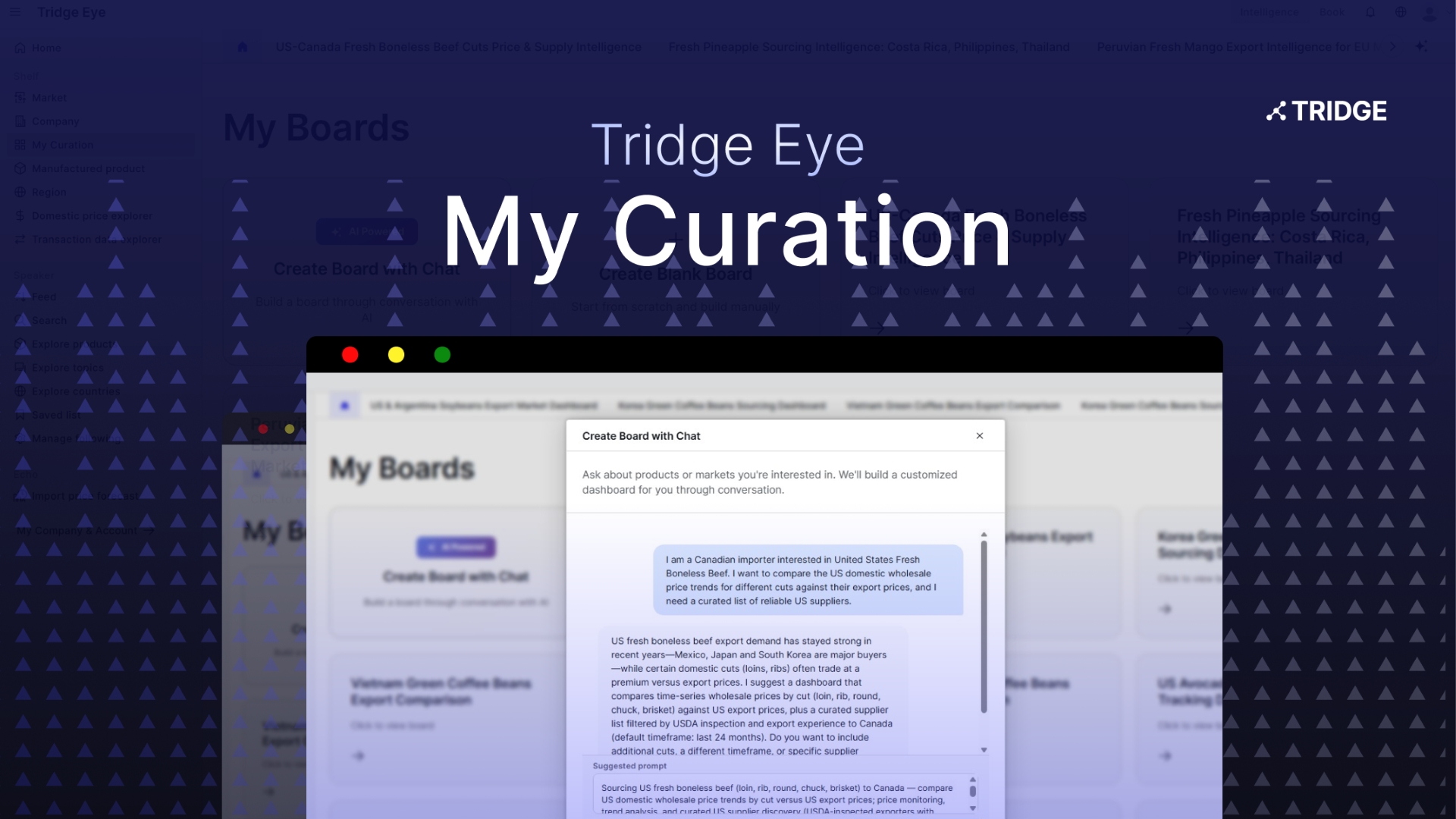

This report is powered by Tridge Eye Data Intelligence.
Every data point, price signal, and supply risk insight in this analysis comes from the same platform that procurement and sourcing leaders worldwide rely on daily. As you read, consider what this level of market intelligence could do for your sourcing decisions.
Yogurt-drinks are one of the easiest categories to misread if you come from shelf-stable or ambient CPG: the biggest “surprises” usually don’t come from milk price alone—they come from time (code life), cold-chain execution, packaging continuity, and real available line slots (fermentation + hygienic filling). This guide maps the end-to-end supply chain, shows where procurement levers really work, and highlights what to govern so savings don’t turn into waste, claims, or stockouts.
Analyzed at: Apr, 2026
Reefer spot volatility has recently shown sharp seasonal/weather-driven moves, and EPR-driven packaging reporting/fees are expanding across multiple U.S. states—both can create sudden cost step-ups if you wait until renewal. [3]
Yogurt-drinks look like “just dairy in a bottle,” but procurement outcomes are shaped by short shelf life, cold-chain dependency, and plant-capacity bottlenecks more than by raw milk price alone.

Below is a procurement-oriented view of how cost accumulates—and where margin and risk hide.
Key insight: In yogurt-drinks, milk cost volatility matters, but it’s not the only driver of margin swings—because packaging, conversion yield, and refrigerated logistics can move faster than milk contracts.
USDA AMS publishes Class and component prices and calculation worksheets that procurement teams often use as anchors in indexing discussions. [5]
Key insight: Cultures are usually a small share of BOM cost but a large share of performance risk (fermentation kinetics, taste, texture, claims).
Key insight: This node is where spec complexity quietly destroys sourcing optionality. Every unique fruit prep, clean-label stabilizer choice, and allergen constraint narrows your supplier bench.
Key insight: Packaging is often the second-largest controllable cost bucket after dairy inputs—and a major continuity risk when you have custom molds, unique caps, or limited qualified converters.
Packaging EPR requirements are actively rolling out across multiple U.S. states, with expanding compliance and fee timelines through 2026. Treat this as a packaging-risk input to your spec roadmap and supplier strategy. [6]
Key insight: Your biggest hidden cost is often yield + downtime, not the quoted conversion rate.
Key insight: Reefer capacity and spot-rate volatility can erase input savings quickly—especially when shelf life forces faster replenishment and higher service frequency.

Modeled % of final delivered cost to a retailer/DC. These are directional to show where cost concentrates; actual ratios vary by formulation, pack format, region, and whether you manufacture in-house or via co-man.
| Supply Chain Node | Cost Ratio (% of Final Cost) | Notes |
|---|---|---|
| Upstream dairy inputs | 30% | Milk base + solids balancing; volatility exposure depends on contract/indexing |
| Cultures/probiotics | 3% | Low cost share, high performance risk |
| Sweeteners/fruit/stabilizers | 12% | Spec complexity drives supplier optionality |
| Conversion (manufacturing/co-man) | 18% | Yield, downtime, labor, utilities |
| Packaging & QA | 20% | Bottle/cap/label + testing, coding, seal integrity |
| Refrigerated logistics & distribution | 10% | Reefer linehaul + cold storage |
| Wholesale/retail margin & trade | 7% | Highly variable by channel and promo intensity |
| Supply Chain Node | Cost Ratio (% of Final Cost) | Notes |
|---|---|---|
| Upstream dairy inputs | 28% | Often uses higher solids; may add concentrates |
| Cultures/probiotics | 5% | More specialty strains, tighter documentation |
| Sweeteners/fruit/stabilizers | 10% | Clean-label systems can increase cost |
| Conversion (manufacturing/co-man) | 20% | Tighter process windows; more QC holds |
| Packaging & QA | 20% | Similar packaging burden; more claim-related QA controls |
| Refrigerated logistics & distribution | 10% | Same cold-chain dependency |
| Wholesale/retail margin & trade | 7% | Premium pricing can increase trade complexity |
| Supply Chain Node | Cost Ratio (% of Final Cost) | Notes |
|---|---|---|
| Upstream dairy inputs | 26% | Base inputs similar; formulation may differ |
| Cultures/probiotics | 2% | Some SKUs reduce live-culture emphasis |
| Sweeteners/fruit/stabilizers | 12% | Thermal stability requirements can change stabilizer system |
| Conversion (UHT/aseptic) | 22% | Higher process control and specialized line costs |
| Packaging & QA | 25% | Aseptic packaging premium + sterility assurance |
| Logistics & distribution | 5% | Lower cold-chain cost, but different warehousing profile |
| Wholesale/retail margin & trade | 8% | Often broader distribution, different promo mechanics |
Yogurt-drinks are a capacity-and-time business, not just a commodity milk business.
That means procurement performance is often decided by:
A useful U.S. indicator of ongoing capacity investment: IDFA has highlighted ~$11B in dairy processing investments across projects planned between 2025 and early 2028—evidence that processing capacity is strategically contested. [4]
Procurement teams often expect finished-goods cost to track milk indices closely. In practice, yogurt-drink costs frequently disconnect because:
Procurement implication: Negotiating “milk-minus” is necessary but insufficient. You need a total landed cost + risk-adjusted view by SKU family.
These are common patterns when a procurement leader is strong in other categories but newer to refrigerated dairy:
This isn’t about dashboards. It’s about making a few core decisions more defensible.
Assumption to validate internally: what data you already have (claims, holds, waste, OTIF, chargebacks) and how clean it is—because that determines how quickly you can convert signals into governance.
The same intelligence logic applies whenever time + quality + logistics dominate outcomes:
In all of these, “cheapest input” is rarely the same as “lowest risk-adjusted landed cost.”
Yogurt-drinks force cross-functional procurement discipline because:
Teams that build an intelligence-driven operating rhythm here typically get better at:
That combination is what turns procurement from “price negotiation” into category resilience management—without losing cost discipline.
Make Faster, Data-Driven Sourcing Decisions
The insights in this report are just the starting point. Tridge Eye is the data intelligence solution that gives procurement and sourcing leaders real-time market signals, price benchmarks, and supply risk alerts — so you can act before the market moves.