
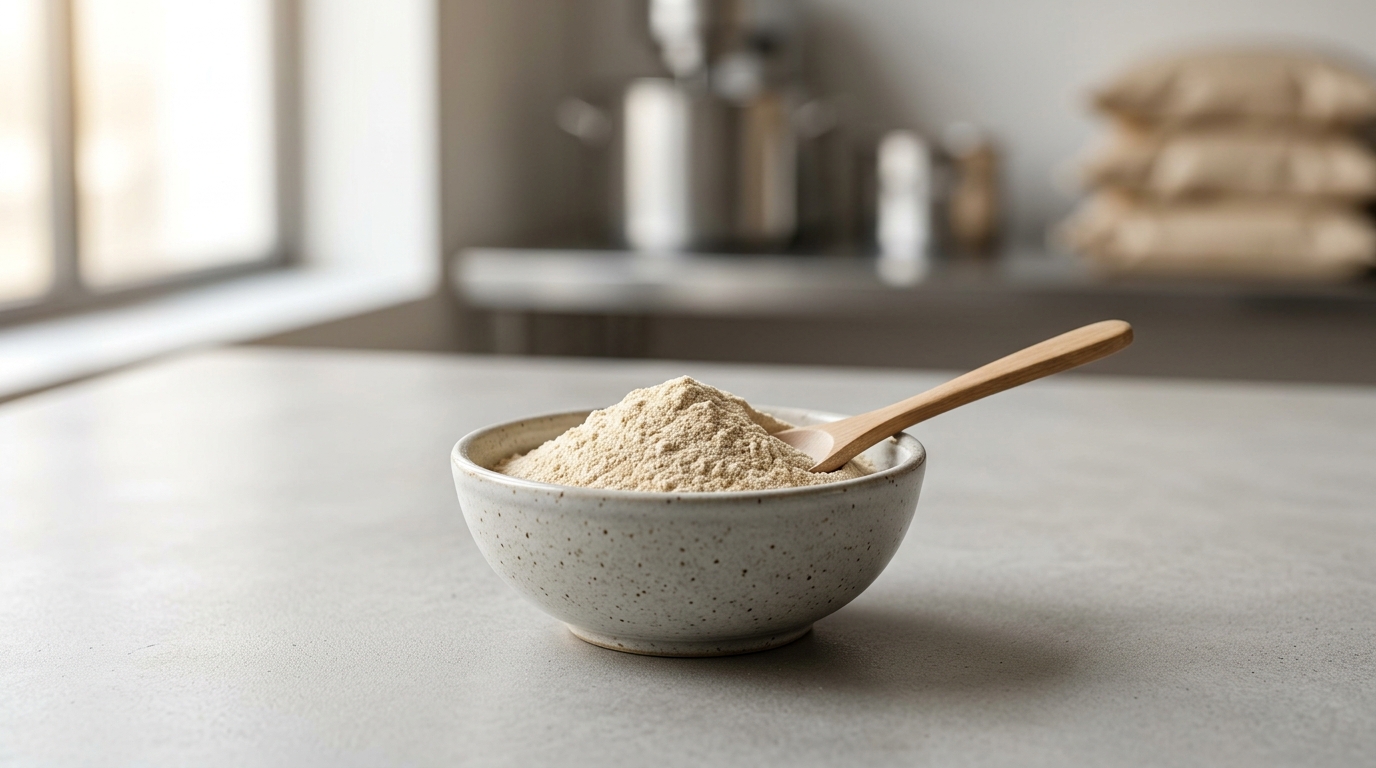
This guide maps the physical supply chain behind witloof (chicory) root powder so Purchase owners for Quality, Safety, and Compliance can make defensible decisions on supplier approval, spec setting, and controls—without confusing “powder” with “simple milling.” It focuses on where yield, energy, and engineered hygiene controls lock in cost and risk.
Witloof chicory root powder is structurally a crop-year agricultural input that becomes a hygroscopic, spec-sensitive powder through energy-intensive drying and high-dust milling. The “hard” cost drivers don’t sit in one place—they accumulate at each physical node where yield is lost (trim, drying shrink, sieving rejects) and where controls must be engineered (micro reduction, foreign-matter prevention, moisture management).
Insight: The chain is built to convert a seasonal, variable root into a stable powder—so the fixed cost drivers are yield, energy, and QA controls rather than “simple milling.”
Typical unit operations include washing/trim, slicing/chipping, drying (often the energy peak), milling/sieving (throughput-limited), optional heat/steam treatment (additional energy + yield/flowability impact), then moisture-protective packaging. Note: some “chicory powders” on the market are extract-based and spray-dried (more like an inulin/extract powder value chain) rather than simply dried/milled whole root—procurement should confirm which you are buying.
Procurement Impact: The most defensible way to understand supplier cost structure is to map which party owns (1) drying energy, (2) microbial reduction, (3) standardization/blending to hit fiber/inulin targets (or extract concentration), and (4) packaging/environmental controls—because those choices dictate both landed cost and spec stability.

Insight: Chicory root powder cost is a “yield-and-energy” story: every step that removes water, removes defects, or tightens particle size adds cost and can reduce sellable yield.
The highest structural cost drivers are (1) agricultural yield + dry-matter variability, (2) drying/roasting energy, (3) milling/sieving throughput and rejects, and (4) QA/testing + controlled packaging for a moisture-sensitive powder.
Procurement Impact: When two suppliers quote the “same” chicory powder, cost differences often trace back to different physical realities—crop-year dry matter, drying technology, degree of sieving, whether micro reduction is applied, and how tightly the powder is protected from moisture post-process.

| Supply Chain Node | Cost Ratio (% of Final Cost) | Notes |
|---|---|---|
| Upstream raw roots (farmgate + aggregation) | 22% | Driven by yield, dry matter, crop-year variability. |
| Primary processing (wash/trim/slice/dry) | 26% | Drying energy + yield loss are core drivers. |
| Secondary processing (mill/sieve/metal detect) | 18% | Throughput + particle size rejects + dust controls. |
| Packaging & QA release | 12% | Lined bags, sampling, routine testing, COA. |
| Logistics & distribution | 10% | Ambient freight + humidity protection practices. |
| Processor/packer margin | 12% | Varies with capacity utilization and spec tightness. |
| Supply Chain Node | Cost Ratio (% of Final Cost) | Notes |
|---|---|---|
| Upstream raw roots | 19% | Same agronomy base, but higher downstream value-add. |
| Primary processing (drying) | 23% | Often requires tighter moisture control pre/post treatment. |
| Secondary processing + micro reduction | 28% | Added thermal step + potential re-dry/cool + validation. |
| Packaging & QA release | 14% | More frequent micro verification and lot release controls. |
| Logistics & distribution | 8% | Similar freight; sometimes better packaging spec. |
| Processor/packer margin | 8% | Margin may compress if treatment capacity is constrained. |
| Supply Chain Node | Cost Ratio (% of Final Cost) | Notes |
|---|---|---|
| Upstream raw roots | 20% | Root quality affects roast consistency and off-notes. |
| Primary processing + roasting | 32% | Roasting energy + additional shrink/yield impacts. |
| Secondary processing (mill/sieve) | 16% | PSD matters for beverage solubility/mouthfeel. |
| Packaging & QA release | 12% | Odor protection becomes more important post-roast. |
| Logistics & distribution | 8% | Odor transfer risk in shared warehouses/containers. |
| Processor/packer margin | 12% | Higher value-add; depends on roast profile control. |
Insight: The biggest “constants” in chicory root powder are agricultural seasonality, engineered control requirements for powders, and the fact that spec language often hides materially different products.
Across suppliers, the same label (“chicory root powder”) can span different physical realities: whole-root dried/milled vs. extract-based powders, roasted vs. non-roasted, untreated vs. micro-reduced, and wide vs. tight particle size distributions.
Procurement Impact: Structural constraints shape what is realistically achievable on moisture, micro, and functional consistency—so your internal spec and test methods must reflect the physical product you are actually buying.
(Analyzed at: Aug, 2026)
Lock in a packaging + moisture-control addendum as a contract deliverable—not a “nice to have”: specify liner construction and seal expectations, a storage RH/temperature window, and require the supplier to document any post-process heat/steam treatment plus the associated re-dry/cool controls and lot-release criteria.
This works because, in 2025–2026, EU-based chicory/inulin supply chains have remained structurally exposed to energy-driven drying costs and seasonal throughput constraints, so suppliers will optimize where they can—often at the edges (pack-out environment, dwell time, and rework).
The stakes are usually not a dramatic per-kg price swing, but on high-volume programs it’s realistic to protect low-single-digit to ~10% equivalent value through fewer caking-related write-offs, fewer holds, and faster disposition—without changing the powder’s nominal spec.


