
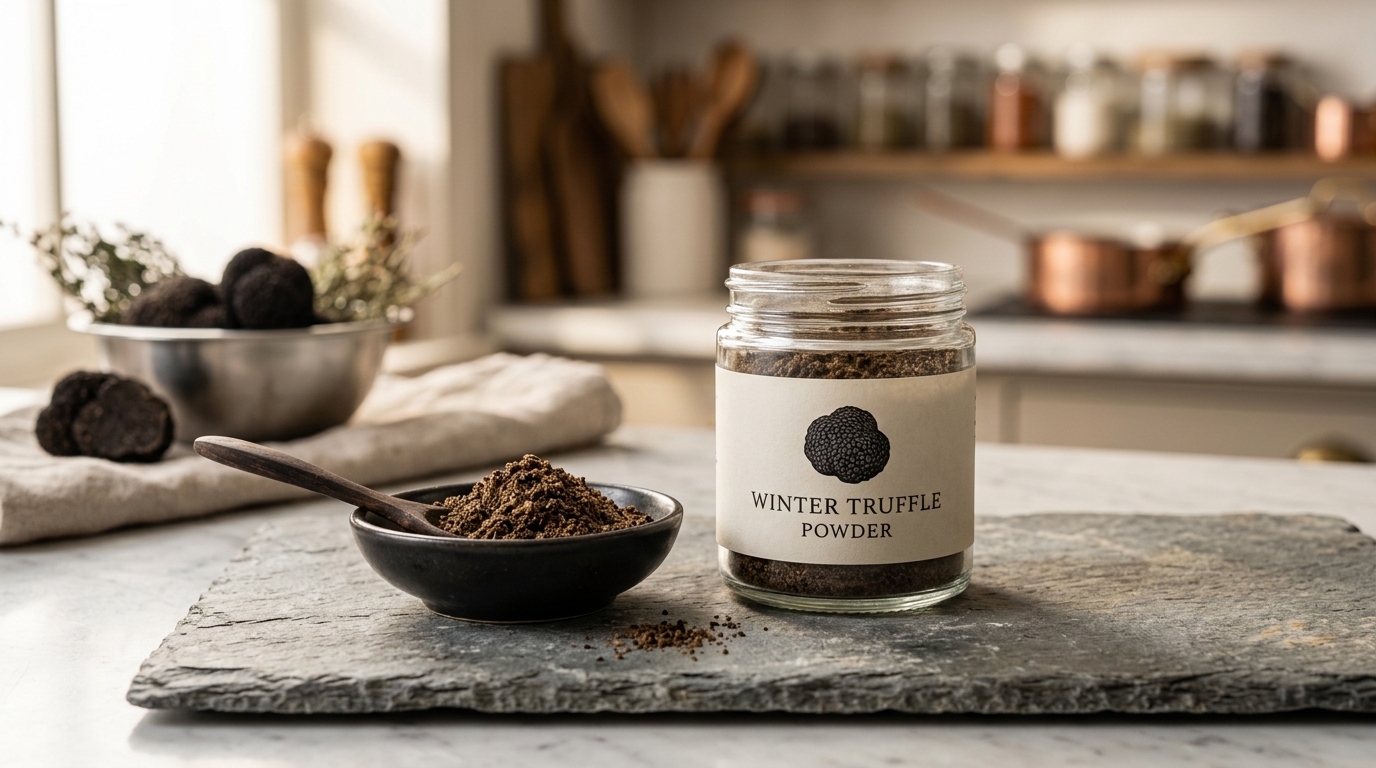
Winter truffle powder is a deceptively high-risk ingredient: the same label can hide very different realities (species, % truffle, added flavoring, and traceability strength). This decision-tree briefing is written for Risk & Contract Management teams who need enforceable controls—not just supplier “trust”—and who must align Procurement, QA, and Legal on evidence, thresholds, and remedies.
Insight: Your core decision is not “who has truffle powder,” but what level of authenticity assurance and continuity control you need—and how to encode that into supplier selection and enforceable contract obligations.
Data (validated): Winter black truffle (Tuber melanosporum) is a seasonal raw material, and official/industry calendars commonly place the main window in late fall through winter into early spring (often roughly Nov–Mar, depending on region and year). [1] Substitution with lower-value species (including Tuber indicum) is a recognized fraud pattern in France’s consumer protection enforcement. [2]

Procurement Impact: If you treat winter-truffle-powder like a generic dried ingredient, you’ll overpay for weak evidence or under-control a high-claim category—leading to disputes that are hard to win (spec ambiguity), higher nonconformance/returns (sensory variability), and allocation risk (seasonality).
Quick Win: Reframe the category internally as “identity + sensory performance + allocation risk” (not just “spice/seasoning”), and require the same three pillars in every supplier bid package.
Insight: A structured decision tree prevents two common failures: (1) buying “truffle powder” that is really flavoring/carrier with minimal truffle, and (2) locking volume into a seasonal supply chain without continuity clauses.
Data (corrected/strengthened): For EU markets, the baseline is Regulation (EU) 1169/2011 on food information to consumers (ingredient list/labeling framework). [5] Separately, France has a specific decree governing “truffé” claims: the term “truffé” is reserved for foods containing at least 3% truffle from certain species and requiring the usual name of the species to be indicated. [6] (This is a France-specific rule; do not assume it applies identically in all countries.)
Procurement Impact: Your risk posture should determine whether you buy (A) single-origin/species-verified powder, (B) multi-origin but analytically controlled powder, or (C) blend/seasoning formats with explicit labeling and claim controls.
Quick Win: Separate your sourcing strategy into two SKUs in governance terms: (1) “claim-critical” truffle powder (highest controls), and (2) “flavor-support” truffle ingredient (controlled but less stringent).
Insight: The right strategy depends on whether you’re buying identity (species/origin), performance (aroma potency), or availability (continuity)—and which one is non-negotiable.
Data (validated):T. melanosporum is seasonal; substitution risk exists because enforcement bodies explicitly cite substitution with cheaper species (including T. indicum) and the use of “truffle” aroma to mask immaturity/quality issues. [2]
Procurement Impact: Use the tree to pick a control tier, then encode it into supplier qualification gates, clause thresholds, and monitoring triggers.

Quick Win: Put change control in writing: any change to species/origin, drying method, carrier/flavoring, or packing site triggers pre-approval + new COA schema.
Insight: Most failures happen when teams pick a sourcing path that doesn’t match their claim exposure or disruption cost.
Data (validated): UNECE’s FFV-53 standard recognizes commercial quality control context for truffles and supports the idea that multiple truffle species exist in trade (which is why species clarity matters). [8]
Procurement Impact: Use these walkthroughs to pressure-test whether your current contract controls are proportional.
Quick Win: For each SKU, write a one-line “what must never change” rule (species, origin, carrier/flavoring, or sensory performance). That single sentence drives the right contract controls.
Insight: Different buyer profiles require different control tiers; forcing one template across all truffle buys either wastes money or leaves gaps.
Data (validated): France’s decree on “truffé” and DGCCRF enforcement commentary illustrate why claim language and minimum content/species naming can become compliance and dispute issues. [6]
Procurement Impact: Use this table to align Procurement, QA, and Legal on what “good” looks like for each use case.
| Buyer Profile | Key Factors | Recommended Strategy | Expected Outcome |
|---|---|---|---|
| Premium retail brand (claim-critical) | High claim exposure; low tolerance for substitution; moderate volume | A1 + E1: Species/origin lock + enhanced verification + process-controlled suppliers | Lower fraud/claim risk; fewer disputes; stronger audit trail |
| Industrial high-volume (cost + continuity) | Scale; budget pressure; high disruption cost | B1 + C1: Controlled blend + allocation language + alternates | Higher availability; predictable performance; reduced stockout risk |
| Foodservice distributor (audit exposure) | B2B spec scrutiny; multi-origin needed | A2 + E2: Species lock + routine verification + standardized COA | Reduced mislabeling risk; faster sourcing flexibility |
| New product launch (<6 weeks) | Urgency; limited time to qualify | D1 + C1-lite: Temporary approval + heightened incoming QC + exit rights | Faster launch with guardrails; controlled downside |
| R&D / pilot volumes (<500 kg/year) | Low volume; learning phase | B2 (light): Dual-source sampling + baseline verification | Faster learning; avoids single-supplier dependency |
Quick Win: Tie each profile to a control tier (Baseline / Enhanced / Claim-Critical) and require suppliers to bid against the tier—not against an ambiguous “truffle powder” spec.
Insight: Winter-truffle-powder risk is manageable if you monitor the right leading indicators and connect them to contractual triggers.
Data (validated): Seasonality is predictable (winter window), and the economic incentive to substitute is reinforced by high fresh-truffle price levels reported by FranceAgriMer. [1]
Procurement Impact: You reduce disruption exposure and disputes by defining early warning signs → contingency actions → clause-based triggers.
Quick Win: Put three thresholds into governance: (1) identity failure (immediate stop-ship), (2) OTIF deterioration (probation + recovery plan), (3) unapproved change (chargeable requalification + right to terminate for cause).
Insight: The highest-leverage move is to treat authenticity as a measurable control system (spec + evidence + remedies), not a brand story or a supplier “trust” exercise.
Data (validated): France’s enforcement commentary explicitly calls out substitution and “truffé” claim requirements; this supports making claim language and species naming a contract-controlled variable. [2]
Procurement Impact: You can reduce disputes and disruption exposure by standardizing specs and verification across suppliers, then tying performance to contractual triggers.
Logical Next Step (non-promotional): The procurement bottleneck in winter-truffle-powder is rarely “finding a supplier”—it’s proving equivalence across suppliers (spec, identity evidence, and performance) fast enough to keep optionality during the harvest-driven pricing and allocation cycle. Teams that can continuously normalize COAs/specs, track origin/species signals, and maintain a pre-qualified alternate bench make faster, more defensible contract decisions when the season turns.
(Analyzed at: Aug, 2026)
Treat your next winter-truffle-powder renewal as an identity-and-allocation contract, not a commodity re-buy: lock the species definition in the spec, require objective verification early in the relationship (DNA-based species differentiation is well-established in food authentication literature), and add explicit allocation/notification SLAs that match the winter harvest cycle. [3] The incentive to substitute remains real because fresh melanosporum pricing is still commonly discussed in high bands (FranceAgriMer cites ~€500–€1,000/kg sale prices depending on season/variety), so a weak spec can turn into a write-off via relabeling, customer claims, or a forced spot buy at the worst time. [4] Put bluntly: a few pages of tighter evidence and remedies can be cheaper than one failed lot.


