INDUSTRY TRENDS

Wild Rice Flour Sourcing (Apr 2026): A Procurement Playbook for Cost, Risk, Resilience, and Governance

Author
Team Tridge
DATE
April 9, 2026
8 min read
wild-rice-flour Cover
Tridge Eye Data Intelligence Solution

This report is powered by Tridge Eye Data Intelligence.

Every data point, price signal, and supply risk insight in this analysis comes from the same platform that procurement and sourcing leaders worldwide rely on daily. As you read, consider what this level of market intelligence could do for your sourcing decisions.

Explore Tridge Eye →

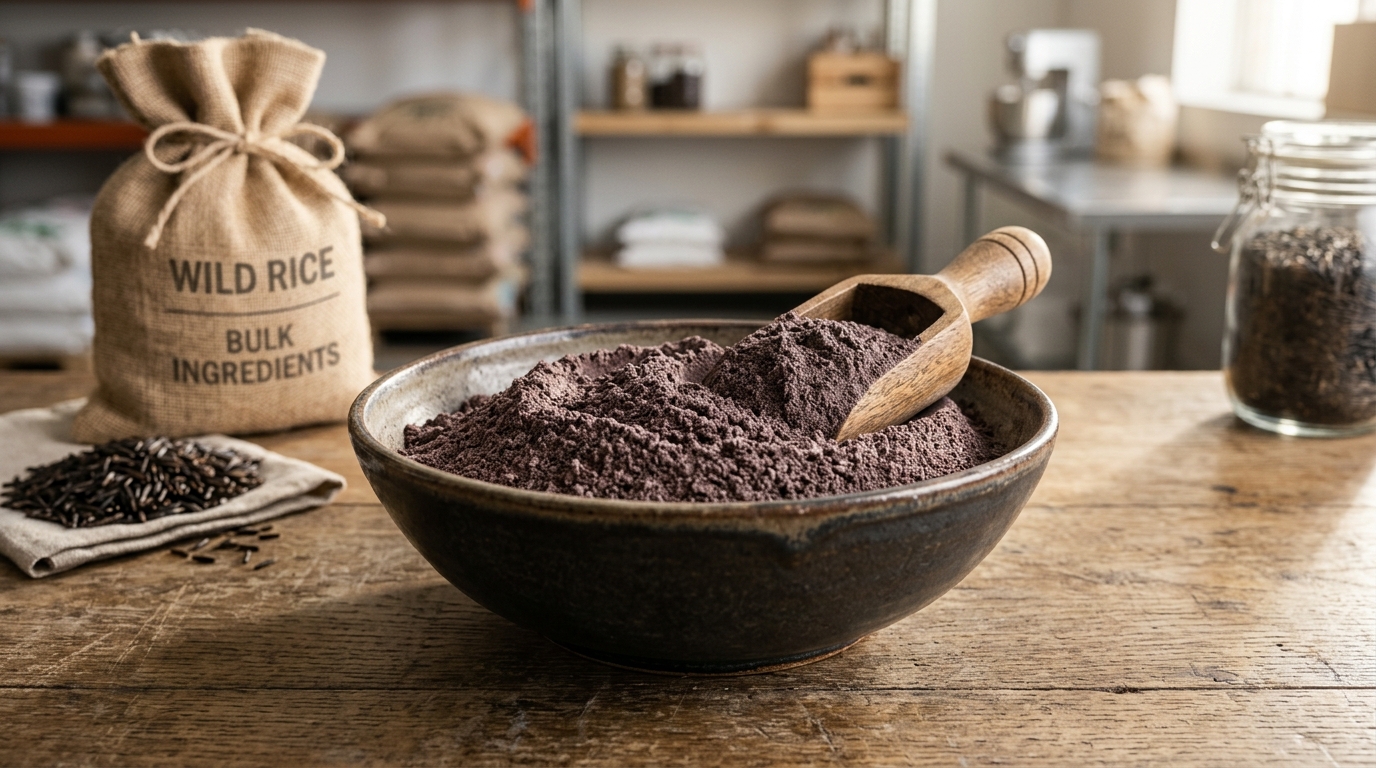
Wild-rice-flour looks like “just another gluten-free flour” on a spec sheet, but it behaves like a specialty, harvest-driven ingredient with a comparatively narrow qualified supplier bench. This guide is written for procurement and sourcing managers who are strong operators in other categories and want a practical, decision-first way to source wild-rice-flour with fewer surprises—across total cost, continuity of supply, resilience, and audit-ready governance.

Executive Summary

  • Not a commodity: Wild-rice-flour is typically North America–concentrated with a smaller scalable processor/miller base than commodity flours, so supplier concentration risk is structurally higher.
  • Harvest + inventory governs the year: Wild rice is harvested in a narrow seasonal window (commonly mid-August through mid-September in Minnesota guidance), and the market runs on year-long inventory thereafter. [1]
  • Minnesota cultivated scale (order-of-magnitude): University of Minnesota plant pathology content describes Minnesota cultivated wild rice at about 11,000 acres producing around 15 million pounds of finished grain annually (illustrative; not a guaranteed annual output). [2]
  • Price transmission is “lumpy”: Farmgate signals do not map cleanly to flour pricing because of inventory lag, yield/grade math, and milling/segregation capacity constraints.
  • Low-moisture food safety is real: FDA has investigated Salmonella outbreaks linked to flour (e.g., an April 2023 outbreak tied to recalled flour). Procurement should treat kill-step expectations, COA discipline, and preventive controls as part of TCO. [3]
  • Best-practice operating model: Dual-source feasibility, spec rationalization, and pre-qualified alternates typically deliver the biggest resilience gains—often more than chasing small unit-price deltas.

Key Insights

(Analyzed at: Apr, 2026)

  • Strategy: Hold
  • Reliability: Medium
  • Potential Saving: 4% ~ 10%
  • Insight:Use the post-harvest / pre-next-harvest window to convert risk into leverage without over-promising savings. In practical terms: (1) lock minimum coverage (contracted or reserved capacity) for your core spec; (2) immediately pre-qualify 1–2 alternates with slightly wider particle-size and packaging tolerances; and (3) negotiate with a should-cost narrative that separates raw-rice tightness from milling/segregation and small-lot logistics. The annual harvest pattern in Minnesota (mid-August to mid-September) means suppliers are managing inventory positions for the full year—so your biggest avoidable cost is usually expedites + line stoppages, not just price/MT. [1]

1) What You’re Actually Buying: The Ground Truth of the Wild-Rice-Flour Flow

Wild-rice-flour is not a commodity flour with a deep global supplier bench. It’s a niche, North America–concentrated ingredient whose availability and cost are shaped by:

  • Single annual harvest cycle (most supply is carried as inventory for the year)
  • Processing intensity (drying/parching/curing/hulling + milling + segregation controls)
  • Spec and claim sensitivity (gluten-free controls, organic/non-GMO documentation, micro expectations)
  • A relatively small number of scalable processors/millers—which amplifies concentration risk

The practical supply chain flow (what procurement should visualize)

  1. Upstream / Raw material: paddy/green wild rice (cultivated paddies and/or natural waters)
  2. Primary processing: cleaning, drying, curing/parching, hulling, grading into finished grain
  3. Secondary processing: milling into flour/meal; sometimes heat treatment or microbial reduction steps
  4. Packaging & QA: bags/totes/retail formats; COAs; claim documentation
  5. Logistics & distribution: ambient but moisture-sensitive; often LTL for smaller volumes
  6. End markets: gluten-free mixes, baking, coatings, premium grain blends
A left-to-right supply chain flow for wild rice flour showing upstream raw material sources (cultivated paddies and/or natural waters) to primary processing (cleaning, drying, curing/parching, hulling, grading), secondary processing (milling to flour/meal with optional microbial reduction/heat treatment), packaging & QA (COA, lot traceability, GF/organic claim documentation), logistics & distribution (ambient, moisture-sensitive; LTL vs TL), and end markets (GF mixes, baking, coatings, premium blends), with a seasonality banner ‘Harvest window (mid-Aug–mid-Sep) → Year-long inventory drawdown’ and a callout that supplier capacity/segregation can be a constraint independent of raw grain availability.

Reality check on supply concentration (cultivated side): University of Minnesota sources describe Minnesota as the top cultivated wild rice producing state, with cultivated production on ~11,000 acres yielding around ~15 million pounds of finished grain annually (order-of-magnitude indicator, not a guaranteed yearly output). [2]

2) Where the Money Really Goes: Cost & Margin Build-Up by Supply Chain Node

Key insight

For wild-rice-flour, processing and compliance costs are not “overhead”—they are structural. Your delivered price is often less about farmgate alone and more about:

  • Drying/parching/curing energy + yield losses
  • Milling throughput constraints (fine grind reduces throughput)
  • Segregation and sanitation downtime for gluten-free / allergen control
  • Testing/documentation frequency
  • Packaging and smaller-lot logistics

Below is an illustrative cost build-up to help procurement leaders reason about negotiations and should-cost. Actual ratios vary by spec tightness, claims (organic/GF), packaging format, and whether you buy direct or via distribution.

2.1 Upstream / Raw Material (Paddy/Green Wild Rice)

  • What happens: cultivation/harvest; moisture at harvest drives breakage and downstream yield.
  • Cost drivers
  • Yield variability (weather/water management)
  • Harvest labor/mechanization
  • On-farm drying/handling readiness (or need to move quickly to primary processor)
  • Commercial reality: farmgate shocks often transmit with a lag because processors work through stored inventory.

2.2 Primary Processing (Clean–Dry–Cure/Parch–Hull–Grade)

  • What happens: turning harvested rice into stable, storable finished grain.
  • Cost drivers
  • Drying/parching energy (materially impacts cost)
  • Cleaning/grading labor and foreign material removal
  • Yield loss from hulling and grading out broken kernels
  • Margin logic: this node often captures margin through grade differentiation and inventory timing.

2.3 Secondary Processing (Milling into Flour/Meal)

  • What happens: milling to target particle size distribution; sometimes microbial reduction/heat treatment.
  • Cost drivers
  • Milling energy + wear parts
  • Fine grind = lower throughput + higher loss
  • Segregation controls (dedicated lines or validated changeovers)
  • More frequent QA sampling and holds

2.4 Packaging & QA (Where “Small Volume” Gets Expensive)

  • What happens: packing into 5–25 lb bags, 50 lb bags, or totes; labeling/traceability.
  • Cost drivers
  • Barrier packaging to protect against moisture pickup
  • COA generation, claim support (GF/organic), documentation management
  • Lot traceability and retention samples

2.5 Logistics & Distribution (Ambient, But Not Simple)

  • What happens: inbound rural hauling; outbound LTL/parcel for specialty; export where relevant.
  • Cost drivers
  • LTL premiums and accessorials
  • Moisture/condensation risk in transit and warehousing
  • Inventory carrying costs (because the supply cycle is annual)

2.6 End-Market Margin (Distributor / Blender / Brand)

  • What happens: distributors add service level and break-bulk; blenders may formulate mixes.
  • Cost drivers
  • Service-level expectations (short lead time, smaller MOQs)
  • Working capital and obsolescence risk for niche inventory

Product-level cost breakdown (illustrative % of delivered cost)

Modeled to show where costs concentrate by product form, not to imply a universal benchmark.

A stacked bar chart with three bars comparing delivered cost build-up by supply chain node for (A) Whole Grain / Standard Industrial Bag, (B) Fine/Sifted + Gluten-Free Controlled Program, and (C) Wild Rice Flour Blend. Each bar is segmented into upstream raw materials, primary processing, secondary processing (milling/blending), packaging & QA, logistics & distribution, and supplier/distributor margin, using the illustrative percentages (A: 40/18/15/8/9/10; B: 32/18/22/10/8/10; C: 38/10/20/10/10/12), with callouts noting that fine grind increases milling and sanitation share and blends shift drivers to multi-input sourcing and batching.

A) Wild Rice Flour (Whole Grain, Standard Industrial Bag)

Supply Chain Node Cost Ratio (% of Delivered Cost) What moves it most
Upstream raw rice 40% Harvest outcome; inventory tightness
Primary processing 18% Drying/parching energy; yield losses
Secondary processing (milling) 15% Grind size; throughput; segregation
Packaging & QA 8% COAs, claim documentation, barrier bags
Logistics & distribution 9% LTL vs truckload; distance; warehousing
Supplier/distributor margin 10% Service level, MOQ flexibility

B) Wild Rice Flour (Fine/Sifted, Gluten-Free Controlled Program)

Supply Chain Node Cost Ratio (% of Delivered Cost) What moves it most
Upstream raw rice 32% Raw availability, but diluted by processing overhead
Primary processing 18% Energy + grading stringency
Secondary processing (milling) 22% Fine grind losses + sanitation/changeovers
Packaging & QA 10% Higher testing cadence; GF documentation
Logistics & distribution 8% Specialty lanes, smaller drops
Supplier/distributor margin 10% Risk premium, capacity constraints

C) Wild Rice Flour Blend (Wild Rice + Other GF Flours)

Supply Chain Node Cost Ratio (% of Delivered Cost) What moves it most
Upstream raw materials (multi-grain) 38% Prices of blend components
Primary processing 10% Less wild-rice-specific processing share
Secondary processing (milling/blending) 20% Blend accuracy, segregation, batching
Packaging & QA 10% Allergen/GF controls across inputs
Logistics & distribution 10% More nodes, more inbound lines
Manufacturer/distributor margin 12% Formulation + service level

3) The Structural Fact That Governs Everything: Annual Harvest + Year-Long Inventory

If you remember one structural reality for wild-rice-flour sourcing, it’s this:

  • Wild rice is harvested in a narrow seasonal window, and buyers live off stored inventory for the rest of the year.
  • For Minnesota, public sources describe harvesting as occurring roughly mid-August through mid-September (exact dates vary by waterbody/management and year). [1]

Procurement implication

  • Your “spot” purchase is often not truly spot—it’s a drawdown of someone’s annual coverage position.
  • When supply tightens, suppliers ration by:
  • tightening MOQs and lead times
  • prioritizing contracted customers
  • repricing quickly on limited lots

4) The Critical Insight Procurement Misses: Why Farmgate Signals Don’t Map Cleanly to Flour Prices

Wild-rice-flour pricing can appear “sticky” or disconnected from upstream conditions because:

  1. Inventory lag: processors may be selling flour milled from rice bought months earlier.
  2. Yield math dominates: small changes in breakage, moisture, or grading can swing effective cost per usable pound.
  3. Capacity is a hidden constraint: milling and segregation time can be scarcer than raw rice.
  4. Risk premium shows up downstream: GF controls, documentation, and recall risk are priced into flour more than into raw grain.

Food safety is not theoretical for flour

Flour is widely treated as a raw food and has been linked to Salmonella outbreaks, including an FDA-investigated outbreak tied to recalled flour (April 2023). [3]

Even though wild-rice-flour is a different input than wheat flour, the procurement takeaway is the same: low-moisture powders can carry pathogen risk, and thermal inactivation can be more challenging at low water activity than teams intuitively expect. [4]

5) Where Procurement Teams Commonly Get Burned (and Why)

Mistake 1: Treating wild-rice-flour like a commodity flour

  • Running a pure unit-price RFP can unintentionally select suppliers with:
  • weak segregation controls
  • limited surge capacity
  • less robust documentation discipline

Mistake 2: Over-tight specs that collapse the supplier pool

Common “silent single-source” spec traps:

  • very tight particle size distribution with no tolerance bands
  • unusually low micro limits without clarifying test method/hold-and-release
  • packaging constraints (e.g., only one bag spec, no alternates)
  • claim stacking (GF + organic + specific origin + specific color) without market mapping

Mistake 3: No pre-qualified alternate when a disruption hits

  • QA qualification becomes the critical path.
  • Procurement negotiates under time pressure (expedites + unfavorable terms).

Mistake 4: Ignoring the distributor vs direct-mill trade-off

  • Direct can reduce unit cost but increase continuity risk.
  • Distribution can add margin but reduce operational friction (stocking, break-bulk, faster ship).

6) What Changes When Decisions Are Intelligence-Driven (Not Spreadsheet-Driven)

Start from the decision you’re making, then use intelligence to shorten cycle time and reduce “unknown unknowns.”

Decision frame: “Can we safely dual-source without breaking the product?”

An intelligence-driven workflow typically improves outcomes by:

  • Specification-to-market translation
  • Convert your spec into market constraints (how many suppliers can truly meet it?)
  • Identify which spec lines are negotiable vs non-negotiable with QA/R&D
  • Supplier benchmarking for qualification readiness
  • Compare suppliers on: segregation controls, certifications, lead times, MOQs, historical reliability signals
  • Price-driver and should-cost logic
  • Separate: raw rice signal vs processing/capacity premiums vs logistics effects
  • Build negotiation guardrails tied to observable drivers (energy, packaging, lead time, lot size)
  • Risk monitoring that triggers action early
  • Harvest outcome indicators and regional climate events
  • Supplier operational disruptions and certification status changes

Outcome impact (what leadership cares about):

  • fewer emergency buys and expediting
  • reduced concentration risk (supplier/region)
  • better auditability (documented rationale)
  • faster alignment across Procurement–QA–Ops–Finance

7) Strategic Use Cases Procurement Leaders Can Operationalize

Use case A: Reduce volatility without increasing stockout risk

  • Put in place:
  • contract cadence (indexed vs fixed vs collar)
  • forward coverage targets aligned to harvest cycle
  • escalation triggers based on risk signals
  • Measure:
  • budget variance vs last year
  • expedite spend
  • service-level adherence

Use case B: Pre-qualify alternates (so switching is a process, not a crisis)

  • Build a “ready bench” of 2–3 alternates mapped by:
  • spec fit bands (what they meet exactly vs with minor spec adjustments)
  • GF/allergen controls and documentation readiness
  • realistic lead times and MOQs
  • Measure:
  • time-to-switch (days)
  • % volume with qualified backup

Use case C: Spec rationalization to expand supplier pool (without changing product performance)

  • Run scenarios:
  • widen particle size tolerance
  • allow packaging alternates
  • define acceptable color/moisture ranges
  • Measure:
  • number of qualified suppliers
  • concentration risk (HHI or top-1/top-3 share)

Use case D: Governance reporting for specialty ingredients

  • Standardize reporting:
  • contract coverage
  • supplier performance signals
  • risk register status and mitigation actions
  • Measure:
  • audit cycle time
  • time to leadership decision (days)

8) Why This Matters Beyond Wild Rice Flour (Comparable Patterns in Adjacent Ingredients)

Procurement teams sourcing wild-rice-flour often also touch other “specialty + claim-sensitive” categories with similar structural dynamics:

  • Gluten-free oats
  • Similar issue: segregation controls, testing cadence, claim integrity, and recall exposure.
  • Almond flour
  • Similar issue: crop-year variability, food safety governance, and processing capacity constraints.
  • Buckwheat flour / Sorghum flour
  • Similar issue: narrower supplier base than wheat, spec variability, and smaller-lot logistics.
  • Spice powders (e.g., cinnamon, paprika)
  • Similar issue: adulteration/compliance risk and need for supplier verification and documentation.

The transferable lesson: in specialty ingredients, resilience and governance are part of unit cost—ignoring them usually increases total cost of ownership.

9) Why This Example Works as a “Procurement Intelligence Proof Point”

Wild-rice-flour is a clean test case because it forces the behaviors that separate high-performing procurement organizations:

  • You can’t “buy your way out” of a tight supplier pool with an RFP alone.
  • The best outcomes come from explicit trade-off management:
  • price vs continuity
  • spec tightness vs supplier optionality
  • direct sourcing efficiency vs distributor-enabled resilience
  • Governance is measurable:
  • documented spec decisions
  • qualified alternates on file
  • risk triggers tied to actions

If procurement leadership can build a repeatable, intelligence-driven operating model here, it typically generalizes well to other specialty, claim-sensitive ingredients where cost, risk, resilience, and auditability all matter at once.
Tridge Eye Data Intelligence Solution

Make Faster, Data-Driven Sourcing Decisions

The insights in this report are just the starting point. Tridge Eye is the data intelligence solution that gives procurement and sourcing leaders real-time market signals, price benchmarks, and supply risk alerts — so you can act before the market moves.
Explore Tridge Eye →

References

  1. health.mn.gov
  2. plpa.cfans.umn.edu
  3. fda.gov
  4. nal.usda.gov
Subscribe
By subscribing you agree to with our Privacy Policy and provide consent to receive updates from our company.
Thank you! Your submission has been received!
Oops! Something went wrong while submitting the form.
Subscribe to receive the latest blog posts, updates, promotions, and announcements from Tridge.