
This report is powered by Tridge market intelligence.
Every data point, price signal, and supply chain insight in this analysis is drawn from the same engine that procurement teams worldwide rely on daily. As you read, consider what this level of visibility could do for your category.
Analyzed at: Mar, 2026
Vanilla is not a “normal” spice supply chain. It behaves more like a specialty crop with:
Practical implication for category managers: your continuity risk is not only “supplier risk.” It’s origin + processing-capacity + governance risk across multiple handoffs (collector → curer → exporter → importer → extractor/flavor house).

Key insight: Vanilla cost is “sticky” upstream (labor + time + yield risk) and “amplified” downstream (working capital, quality losses, compliance, and inventory carry). This is why price shocks propagate—then disconnect—between beans and extracts.
| Supply chain node | Cost ratio (% of delivered cost) | What drives it |
|---|---|---|
| Farming (green pods) | 35–45% | labor + yield + security |
| Primary processing (curing/grading) | 20–30% | time, shrink, sorting |
| Secondary processing | 0% | N/A |
| Packaging & QA | 5–10% | moisture control, COA/testing |
| Logistics & distribution | 8–15% | freight, insurance, warehousing |
| Importer/wholesale margin | 10–20% | financing + risk premium |
| Supply chain node | Cost ratio (% of delivered cost) | What drives it |
|---|---|---|
| Farming (green pods) | 30–40% | selective harvest, yield risk |
| Primary processing (curing/grading) | 25–35% | higher rejection rates, tighter sorting |
| Secondary processing | 0% | N/A |
| Packaging & QA | 8–15% | premium packs, tighter moisture/spec control |
| Logistics & distribution | 8–12% | security, handling, claims risk |
| Importer/wholesale margin | 10–20% | scarcity + service level |
| Supply chain node | Cost ratio (% of delivered cost) | What drives it |
|---|---|---|
| Bean input (embedded in raw + primary) | 35–55% | bean market + yield-to-extract |
| Secondary processing (extraction/blending) | 15–25% | alcohol/solvent, energy, blending |
| Packaging & QA | 8–12% | drums/IBCs, analytical testing |
| Logistics & distribution | 8–12% | heavier freight, hazmat/handling in some lanes |
| Processor + distribution margin | 10–20% | working capital + contract structure |
| Supply chain node | Cost ratio (% of delivered cost) | What drives it |
|---|---|---|
| Bean + extract inputs | 30–50% | spec for seeds/specks + base extract |
| Secondary processing | 15–25% | formulation, viscosity control |
| Packaging & QA | 10–15% | jars/pails, visual QC |
| Logistics & distribution | 8–12% | handling, shelf-life management |
| Processor + distribution margin | 10–20% | service level + customization |
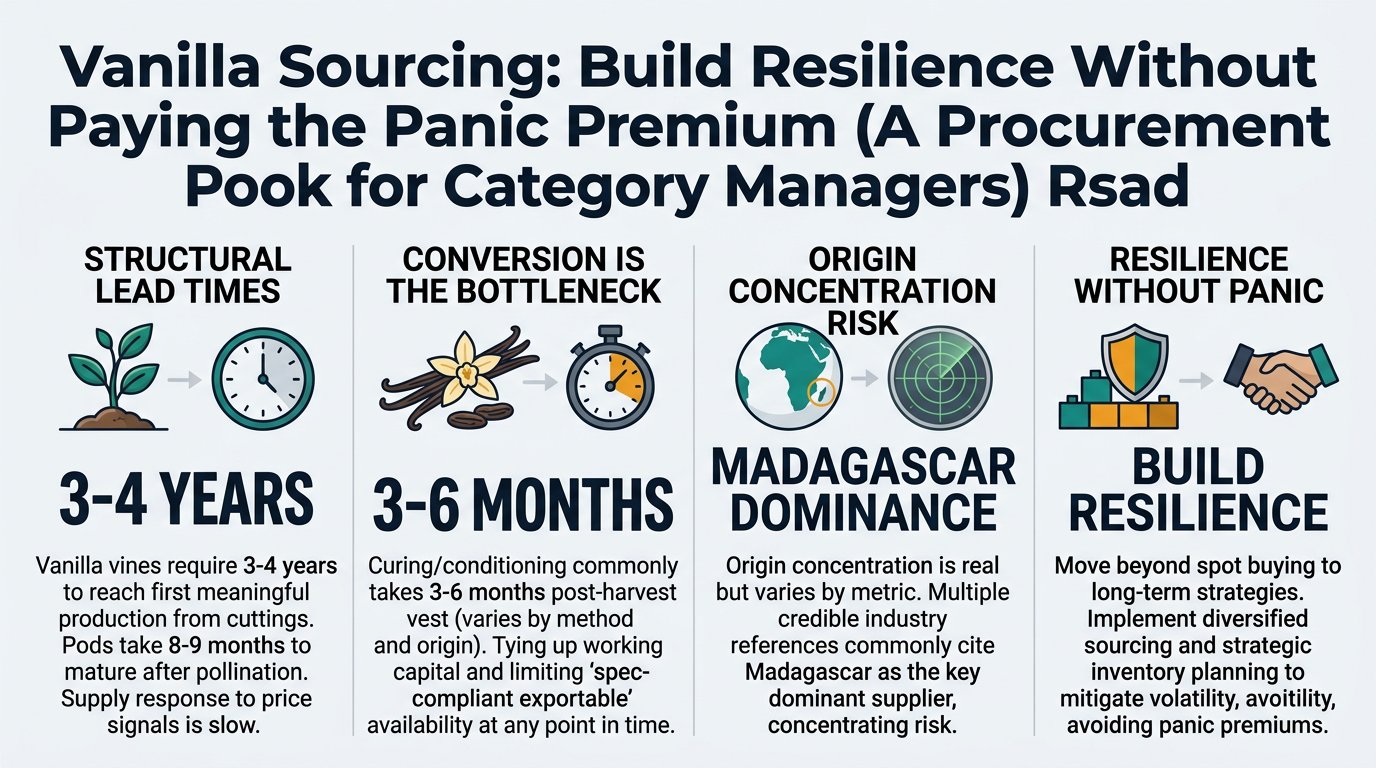
Vanilla’s real constraint is not acreage—it’s conversion capacity + time + risk.
Procurement translation: resilience is built by managing spec flexibility + supplier portfolio + inventory posture, not by negotiating harder with one incumbent.
Category teams often expect a neat pass-through: “beans up → extract up immediately” or “beans down → extract down immediately.” In vanilla, the linkage is delayed and asymmetric.
Procurement translation: you need separate fact bases for:
This is not about “more data.” It’s about changing the sequence and defensibility of category decisions.
Boundaries (important): intelligence supports better decisions; it does not replace QA lab testing, guarantee allocation, or remove market volatility.
Vanilla is an extreme example of patterns that show up across other “high-scrutiny, high-volatility” inputs:
The transferable lesson: resilience is built when procurement manages spec flexibility, supplier optionality, and trigger-based actions—not just annual price events.
Vanilla forces a category team to operate at a higher level because:
If you can run vanilla with discipline—supplier portfolio design, spec governance, contracting mix, and early-warning actioning—you can replicate that operating model across many other critical ingredients.
Take Your Sourcing Intelligence to the Next Level
The insights in this report are just the starting point. Tridge Eye gives you real-time market signals, origin risk alerts, and price benchmarks — so you can act before the market moves.