
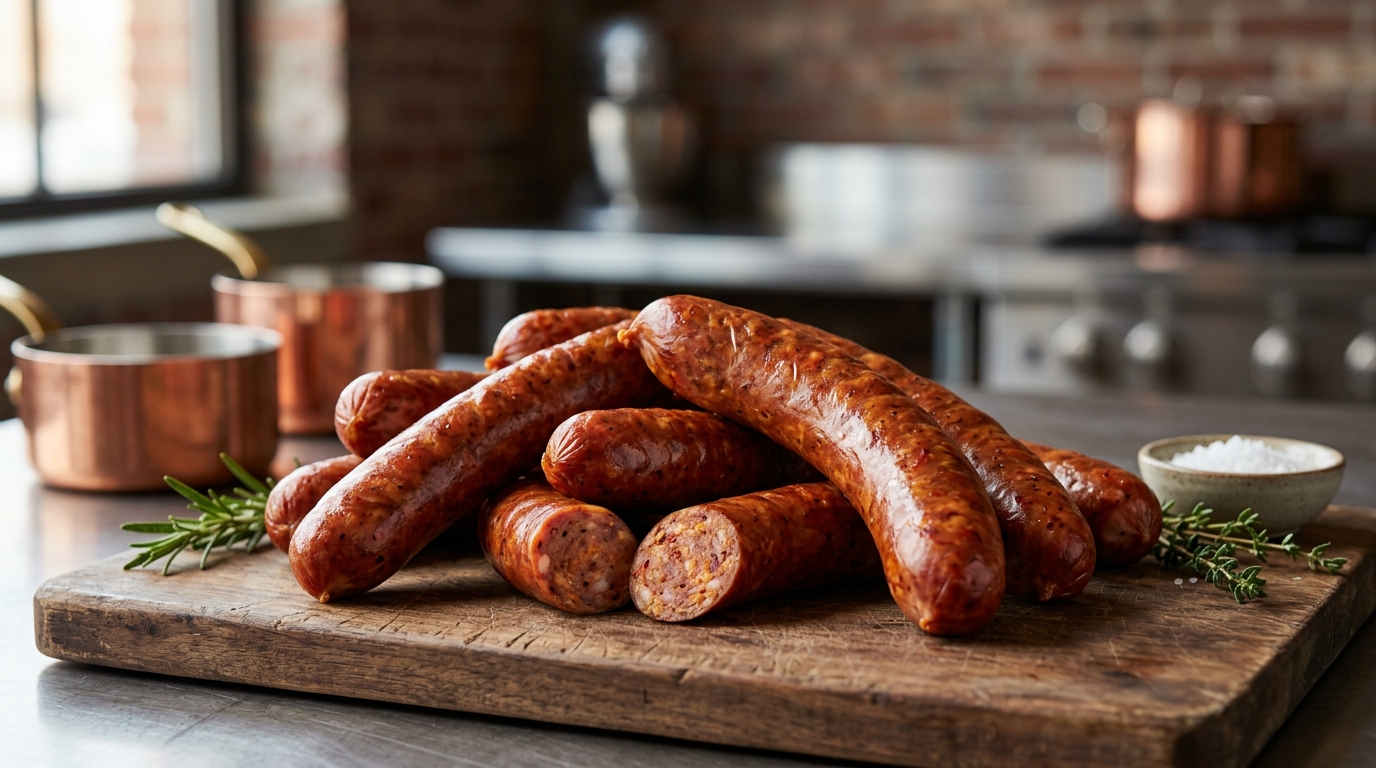
This comparison is designed for category and product managers who don’t live in processed-meat sourcing every day, but still have to make a defensible call on cost vs continuity. The goal is to separate what’s truly “origin-driven” (pork economics, regulatory eligibility, logistics) from what’s actually “plant-driven” (smoke/cook/chill capacity, RTE controls, spec fidelity) so you can place volume and contingencies with fewer surprises.
Insight: For spicy andouille sausage, “origin” is really a proxy for three procurement levers—raw pork economics, plant capability (smoke/cook/chill + RTE controls), and cold-chain logistics reliability—so comparing US vs Canada vs EU supply is the fastest way to de-risk cost and service decisions.
Data: Pork availability and pricing is cyclical, and USDA/ERS analysis tied to the June Hogs and Pigs report lowered market hog inventories and reduced pork production forecasts in the second half of 2026; at the same time, refrigerated capacity and rates remain seasonal/volatile, which directly hits landed cost for chilled sausage. [1]
Procurement Impact: If you treat andouille like a simple “processed meat buy,” you’ll miss the real drivers of variance: (1) pork trim moves, (2) smokehouse/cook-line capacity constraints, (3) post-lethality (RTE) compliance burden, and (4) reefer lane risk—each of which changes what you should dual-source and how you should contract.
Insight: US sourcing typically wins on lead time and operational agility; Canada often competes on comparable standards with cross-border flexibility; EU can work for frozen/strategic diversification but usually loses on lead time, documentation complexity, and cold-chain risk.
Data: Export/import eligibility is formal and establishment-specific. FSIS maintains an equivalence/eligibility framework for imports, and Canada-to-US shipments require that the Canadian establishment is certified for FSIS export (CFIA points buyers to Annex W for eligible establishments). [2]
Procurement Impact: Your “best” option depends on whether your constraint is (1) service level and short lead time, (2) price volatility and negotiation leverage, or (3) concentration risk and contingency coverage.
| Option (origin) | Cost (landed) | Quality / spec control | Risk (supply + compliance) | Lead time | Availability |
|---|---|---|---|---|---|
| US domestic processors | Medium | High (best for spec-tight, fast changeovers) | Medium (plant concentration + RTE controls) | Short | High |
| Canada processors (export to US) | Medium | High (often comparable systems; strong for dual-source) | Medium (border + eligibility + lane risk) | Short–Medium | Medium–High |
| EU processors (import to US) | Low–Medium (unit price can look attractive) | Medium (style differences; spec translation risk) | High (documentation, transit, cold chain, delist risk) | Long | Medium |

Insight: In andouille, the hidden costs that swing TCO are yield loss (cook shrink/purge), QA/testing intensity (RTE), packaging format, and reefer freight volatility—not just quoted $/lb.
Data: Refrigerated freight is structurally seasonal and can move quickly; for procurement decisioning, the key is to treat freight as a variable cost driver (by lane and temperature class) rather than a fixed surcharge.
Procurement Impact: If you don’t separate (a) pork-driven moves, (b) packaging-driven moves, and (c) freight-driven moves, you’ll negotiate the wrong lever and get “savings” that reappear as expedited freight, shrink, or claims.
Insight: “Andouille” is a spec-sensitive sausage where small process differences (smokehouse control, grind, casing, spice bloom) create outsized consumer and operator feedback—especially when you switch plants.
Data: For post-lethality exposed RTE meat and poultry products, establishments must comply with FSIS’s Listeria control requirements under 9 CFR Part 430 (often discussed operationally as the “Listeria Rule”), and FSIS guidance emphasizes controls for post-lethality exposed RTE products. [3]
Procurement Impact: Treat spec translation as a qualification project, not a paperwork exercise—otherwise you’ll pay twice (first in onboarding, then in complaints/chargebacks or reformulation).
Insight: The biggest practical risk in andouille is not “country risk” alone—it’s node concentration: one smokehouse, one cook line, one chilling constraint, one casing source, one key spice blend.
Data: US import eligibility is governed through FSIS equivalence/eligibility rules (9 CFR 327.2), and FSIS maintains lists of eligible countries/process categories and eligible foreign establishments; eligibility can be withdrawn if equivalence cannot be relied upon. [4]
Procurement Impact: Diversification should be designed around critical constraints (smokehouse/cook/chill + RTE controls), not around “number of suppliers” on paper.
Insight: Lead time is not just transit time; it’s the sum of production scheduling + QA release + border/customs + cold storage handoffs.
Data: FSIS import guidance emphasizes that commercial shipments must originate in eligible foreign countries and establishments and be properly certified; Canada’s CFIA guidance similarly ties Canada-to-US exports to FSIS jurisdiction and Annex W-listed eligible establishments. [2]
Procurement Impact: If your business needs “recover in 2–7 days,” EU-origin is structurally mismatched; Canada can be viable if you pre-clear eligibility and run a stable lane plan.
Insight: Scaling andouille is usually constrained by smokehouse time, cook capacity, chilling, and labor—so “available pork” alone doesn’t guarantee incremental finished-goods capacity.
Data: ERS commentary linked to the June inventory report reduced second-half 2026 pork production forecasts, which can tighten the system when combined with downstream capacity bottlenecks. [1]
Procurement Impact: If you need growth, prioritize suppliers with (a) redundant smoke/cook assets or (b) multi-plant networks that can run the same spec under validated controls.
Insight: For processed meat, the most audit-ready sustainability wins often come from measurable operational controls—traceability depth, waste/yield, and logistics efficiency—rather than broad claims.
Data: Cross-border programs are documentation-driven: for Canada-to-US, CFIA guidance states only establishments certified to FSIS by CFIA can produce meat products intended for export (Annex W is the reference list). [5]
Procurement Impact: Build governance artifacts that survive an audit: documented supplier eligibility checks, lot-level traceability expectations, and decision logs tying awards to risk controls (not slogans).
Insight: The right comparison is “delivered, usable product that holds spec and service,” so scoring must blend cost, quality risk, and logistics risk.
Data: Eligibility requirements and equivalence frameworks are externalities you can’t negotiate away; you can only design around them with qualification sequencing and lane planning. [2]
Procurement Impact: Use a two-table method: (1) cost ratio bands for modeling, (2) risk scoring to decide where to place volume and what to qualify next.

| Option | Typical landed cost ratio vs US (US = 100) | What usually drives the delta | Hidden cost watch-outs |
|---|---|---|---|
| US | 100 | Baseline | Reefer lane volatility; plant concentration |
| Canada | 98–108 | Similar conversion costs; cross-border freight + admin | Border variability; eligibility/documentation overhead |
| EU | 90–115 | Unit price may be lower; ocean freight can be efficient for frozen | Long lead time; cold-chain handoffs; customs/port risk; higher working capital |
| Dimension | US | Canada | EU |
|---|---|---|---|
| Food safety / RTE compliance execution risk | Medium | Medium | Medium–High |
| Regulatory/eligibility gating risk | Low | Medium | High |
| Cold-chain logistics disruption risk | Medium | Medium | High |
| Spec drift when switching facilities | Medium | Medium | High |
| Recovery speed (time-to-recover from outage) | Low risk (fast) | Medium | High risk (slow) |
Insight: The “best” origin depends on whether you’re buying continuity, cost, or governance simplicity—and you can’t optimize all three at once.
Data: Cross-border trade is constrained by establishment eligibility and certification requirements; FSIS import guidance makes clear commercial shipments must originate in eligible foreign countries and establishments and be properly certified. [2]
Procurement Impact: Make the decision by scenario, not preference—then codify it into sourcing policy (what volume goes where, and why).
| Buyer priority | Recommended option | Why |
|---|---|---|
| Lowest operational risk this quarter | US | Fastest recovery and simplest governance |
| Reduce single-country concentration | US + Canada | Best resilience-to-complexity ratio |
| Lowest modeled unit price (planned buys) | EU (often frozen) | Potential unit advantage if lead time is acceptable |
| Tight sensory/spec fidelity | US (primary) + Canada (secondary after trials) | Lowest spec-translation risk |
| Strong auditability | US (or Canada with disciplined eligibility tracking) | Fewer border variables; clearer oversight |
Insight: The highest-leverage move is to design a two-tier supply strategy (fast-turn chilled + planned frozen buffer) and qualify suppliers against the true bottlenecks (RTE controls + smoke/cook/chill + cold-chain lanes).
Data: ERS market-outlook commentary tied to June inventory data points to reduced second-half 2026 production forecasts; and FSIS continues to maintain specific Listeria control requirements for post-lethality exposed RTE products under 9 CFR Part 430. [1] [3]
Procurement Impact: This approach typically reduces expedite spend, lowers outage probability, and improves negotiation leverage because you’re not forced into last-minute buys when a plant or lane tightens.
The hardest part to operationalize is timing—knowing when a price increase is commodity-driven vs supplier-driven, and when a reefer lane tightening is about to turn into service failures. Without near-real-time visibility into pork cost drivers, plant disruption signals, and cold-chain lane conditions, most teams only learn after shortages or expedite invoices arrive.
(Analyzed at: Jul, 2026)
If you’re supplying a chilled, spec-tight andouille program, keep US domestic as the core award and use Canada as the fastest resilience add—but only after you’ve verified the plant is actually eligible for US export at the time of production (Annex W) and you’ve trialed the spec translation. That recommendation is more important in 2H 2026 because ERS commentary tied to the June inventory data reduced production forecasts, which is exactly when capacity and pork inputs tighten and “spot buying” gets expensive. Teams that pre-place 15–30% of volume into a qualified second source typically avoid the real tax of disruption—expedites, short-ships, and customer penalties—which can easily erase a few cents per pound in unit-price wins. [1]


