
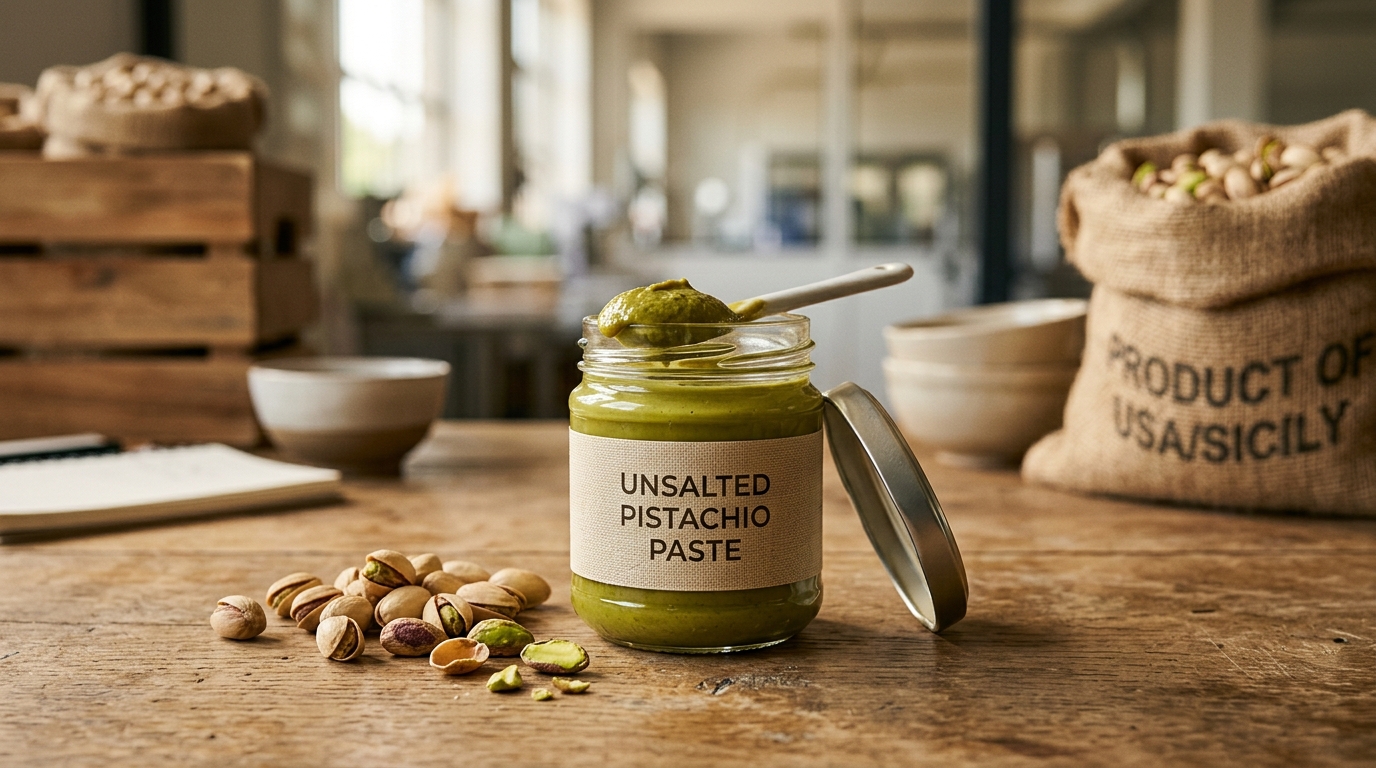
Unsalted pistachio paste looks like a simple “100% nut” ingredient, but for Quality, Safety, and Compliance (QSC) purchasing it behaves like a controlled system: upstream defect/yield decisions, aflatoxin governance, and oxygen/temperature exposure determine most of the cost and most of the downstream complaints.
Unsalted pistachio paste is essentially high-grade pistachio kernels converted into a fat-rich, oxidation-sensitive semi-finished ingredient. The economics are structurally dominated by (1) kernel yield and defect rejection upstream, and (2) secondary processing controls that protect color/flavor from oxygen and heat.
The paste supply chain is “short” in number of steps, but each step has hard, non-substitutable cost drivers (sorting yield, lab testing, oxygen control, and temperature discipline).
The physical flow is typically: orchard harvest → hulling/drying (hours-to-days critical) → shelling/sorting (high reject sensitivity) → optional blanch/roast → grinding/refining to particle size → metal detection + packaging under barrier (often nitrogen) → ambient or temperature-managed distribution.
Most downstream variability you experience (color drift, oil separation, rancidity claims, COA inconsistency) is usually pre-determined by upstream defect control and oxidation management, not by “blending magic” at the end.

In pistachio paste, cost builds less from “many intermediaries” and more from yield loss + quality protection at a few nodes.
Pistachios are a seasonal orchard crop; quality is shaped by harvest timing and immediate post-harvest handling (mold prevention, moisture control).
Aflatoxin risk is associated with mold growth; the earliest control points are rapid hulling/drying and preventing damaged nuts from entering storage streams. In the U.S., FDA guidance and compliance policy references commonly cite 20 µg/kg (ppb) total aflatoxins as the regulatory action guidance level for pistachio nuts [1].
The “cost base” is set here: irrigation/energy/labor and orchard yield determine kernel availability, while early moisture/mold management determines how much material survives later sorting without downgrades.
This is the largest structural value-add node for paste because it determines usable kernel yield and contaminant/defect removal.
Shelling and sorting remove stained, insect-damaged, mold-suspect, foreign material, and off-color kernels. Every % of reject is a direct cost amplifier because paste is ~100% kernel input (no salt/sugar to dilute). Aflatoxin control is typically a combination of preventive handling + defect removal + sampling/testing; maximum levels vary by market. For example, EU maximum levels for certain categories of pistachios include 10 µg/kg aflatoxin B1 and 15 µg/kg total aflatoxins (category-dependent), and Codex materials have referenced 10 µg/kg total aflatoxins for certain ready-to-eat nut categories [2].
If you buy “paste-grade” vs “snack-grade” kernels, you are buying a different yield curve. Your downstream paste price and consistency are structurally tied to how aggressively this node sorts for color/defects.
Paste manufacturing is a thermal + mechanical transformation where oxidation and color loss can be created faster than they can be fixed.
Roasting (if specified) changes flavor volatiles and can darken color; grinding generates heat and exposes fresh oil surface area, accelerating oxidation if oxygen control is weak. Peroxide value is widely used as an indicator of primary lipid oxidation in pistachio research, and studies specifically on pistachio paste/spreads and paste packaging/storage evaluate oxidation development and color drift under storage stress [4].
This node explains why two “100% pistachio” pastes can behave differently in your plant: particle size distribution, process temperature, and roast profile drive viscosity, oil separation tendency, and color stability.
Packaging is not a commodity step for pistachio paste; it’s a quality preservation system.
Exposure to oxygen/light and warm dwell time accelerates rancidity and pigment degradation; suppliers commonly use high-barrier pails/drums and may nitrogen-flush. QA release typically includes COA items for microbiology, chemical contaminants (notably aflatoxins by market expectation), moisture, and sometimes oxidation indicators depending on buyer specs. FDA references maintain aflatoxin action levels for pistachios in the U.S. [1].
Packaging/QA cost is a “fixed tax” for stable paste performance. Cutting barrier packaging, headspace control, or COA rigor tends to reappear later as shelf-life claims, color drift, or higher incoming rejection.
Logistics is where quality silently degrades—especially on summer lanes—because paste is fat-rich and oxidation-sensitive.
Temperature excursions increase oxidation rate and can worsen oil separation; research on pistachio paste packaging/storage shows storage temperature and packaging materially affect oxidation indicators (including peroxide value) and other quality measures [3].
Freight mode and transit time are not just service variables; they are spec variables. If your internal spec is tight on color/oxidation, logistics becomes part of the manufacturing process window.
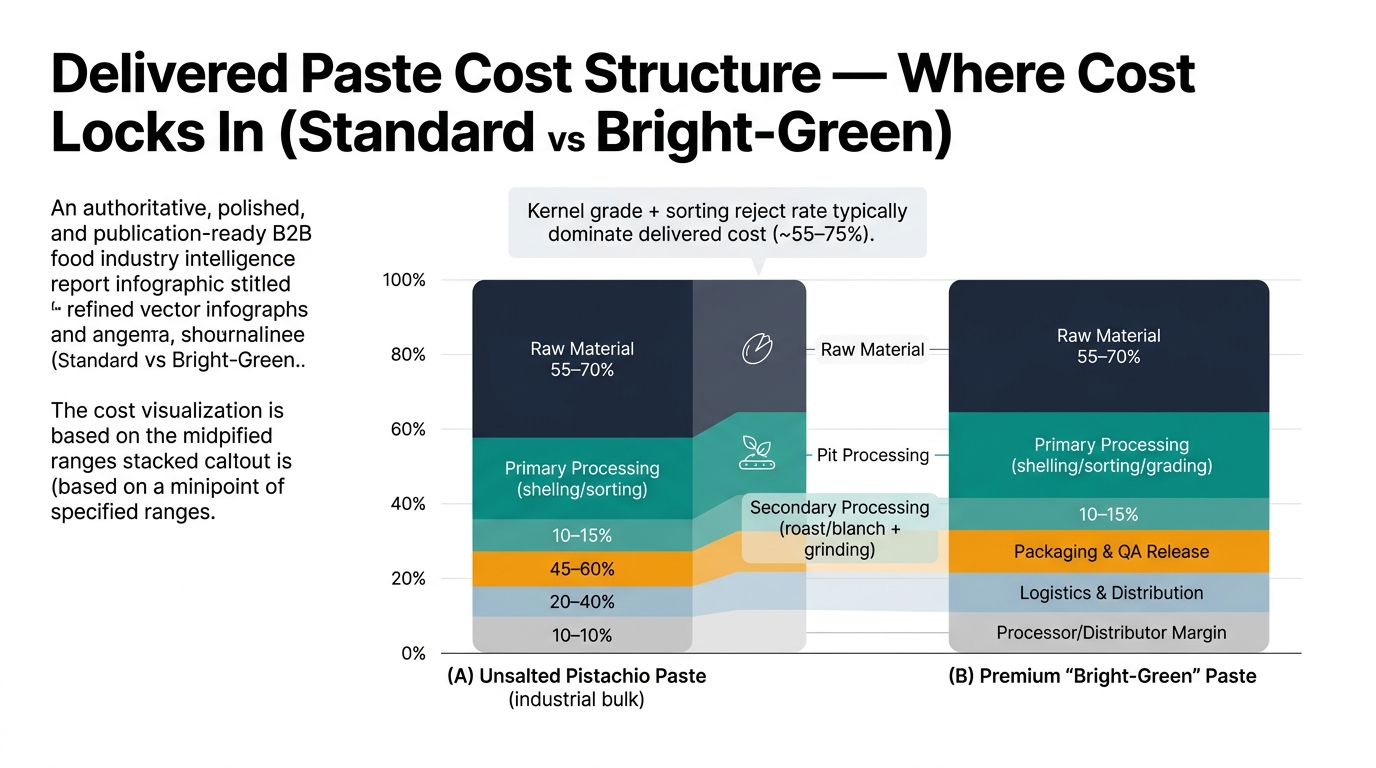
| Supply Chain Node | Cost Ratio (% of Final Cost) | Notes |
|---|---|---|
| Raw Material (orchard + kernel value) | 55–70% | Dominated by kernel grade availability and yield. |
| Primary Processing (shelling/sorting/grading) | 10–18% | Optical sorting + reject yield is the key cost lever. |
| Secondary Processing (roast/blanch + grinding) | 6–12% | Energy + throughput + heat/oxygen control during milling. |
| Packaging & QA release | 4–8% | Barrier packs, nitrogen, metal detection, lab testing/COA. |
| Logistics & Distribution | 4–10% | Heat exposure risk; chilled lanes increase cost. |
| Processor/Distributor Margin | 5–12% | Varies by specialty spec tightness and service level. |
| Supply Chain Node | Cost Ratio (% of Final Cost) | Notes |
|---|---|---|
| Raw Material (premium kernels) | 60–75% | Higher kernel grade spread; color/defect tolerance tighter. |
| Primary Processing | 12–20% | More aggressive sorting and higher reject rates. |
| Secondary Processing | 6–10% | Lower-heat processing and tighter roast control (or raw). |
| Packaging & QA release | 5–9% | Higher barrier expectations; sometimes smaller lots. |
| Logistics & Distribution | 5–12% | More frequent temperature management. |
| Processor/Distributor Margin | 6–14% | Specialty positioning and smaller-batch complexity. |
| Supply Chain Node | Cost Ratio (% of Final Cost) | Notes |
|---|---|---|
| Orchard + harvest handling | 45–60% | Yield, labor, irrigation/energy; sets baseline availability. |
| Hulling/drying | 8–15% | Time-critical to reduce mold risk and preserve quality. |
| Shelling + sorting + grading | 20–35% | Defect removal + sizing/color grading; reject sensitivity. |
| Packaging & QA | 3–8% | Food safety testing; lot identity preservation. |
| Logistics | 3–10% | Storage conditions affect quality; export lanes add handling. |
A few non-obvious constraints shape paste quality and availability regardless of supplier.
Paste cost is structurally tied to how much kernel survives sorting at the quality level you require.
Sorting removes defects that correlate with safety/quality risks (mold suspicion, foreign material, off-color). Higher color targets typically increase reject rates.
Tightening color/defect specs is effectively a decision to buy a smaller usable fraction of the crop.
Mycotoxin controls are an enduring compliance gate for pistachios and derived products.
The U.S. FDA action level / regulatory action guidance commonly references 20 µg/kg (ppb) total aflatoxins for pistachio nuts; EU maximum levels for pistachios are category-dependent and include limits such as 10 µg/kg aflatoxin B1 and 15 µg/kg total aflatoxins for certain pistachio categories [1] [2].
Testing capacity, sampling plans, and lot segregation are physical bottlenecks; they can constrain shipments even when inventory exists.
Rancidity risk is created by cumulative oxygen + heat exposure across milling, packaging, and transit.
Research on pistachio paste/spreads and pistachio paste packaging/storage evaluates shelf-life and oxidation development using chemical indicators (e.g., peroxide value) and sensory/color outcomes under storage stress [4].
If you only specify “shelf life months” without controlling oxygen/temperature assumptions, you’ll see inconsistent performance across lanes and seasons.
(Analyzed at: Aug, 2026)
Write the contract so it controls the system, not just the name “100% pistachio paste”: lock in (a) explicit aflatoxin governance aligned to your destination markets (FDA’s 20 µg/kg action level context for U.S. shipments and the stricter category-based EU limits where applicable), and (b) packaging + lane requirements that cap oxygen and heat exposure end-to-end. This works because the biggest avoidable failures still originate at the sorting/testing gate and then compound through warm storage/transit—exactly where the market gets tight and teams are tempted to “flex” controls. In 2026, with global pistachio supply still exposed to crop cyclicality and origin constraints, the cost of a single out-of-spec lot is rarely just a credit; it commonly shows up as expedited freight, replanning, and customer risk that can erase a mid-single-digit unit-price win [5].


