INDUSTRY TRENDS

Turmeric Starch: Contract Moves to Manage Lagged Pricing, Quality Risk, and Disruption Triggers

Author
Team Tridge
DATE
July 21, 2026
8 min read
industrial-turmeric-starch Cover
Unlock Full Data
Industrial Turmeric Starch Market Intelligence
Prices · Trends · Origins · Forecasts

Turmeric starch contracts fail most often when teams treat it like a simple spice derivative: price is negotiated first, while acceptance mechanics, documentation, and disruption triggers are left vague. This guide explains why starch quotes can lag upstream turmeric signals, how “deliverable quality” tightens supply even in soft markets, and how risk/contract teams can turn those signals into enforceable, operational clauses.

Executive Summary

  • Lag is real (often ~1–3 months): processors and distributors price off inventory positions and conversion constraints, not farmgate headlines.
  • Deliverable-quality can tighten in a soft market: contamination/adulteration and microbiological risk in spices is a known regulatory focus, so compliant lots can command premiums.
  • Contracting is the control surface: define test methods, sampling, COA content/timing, and dispute timelines before you “lock price.”
  • Alternates must be executable: pre-agree onboarding, documentation, and triggers (e.g., sustained lead-time drift) so switching is governed, not panicked.

1) The Market Signal You’re Missing (and How to Buy Ahead of It)

Upstream turmeric rhizome and industrial turmeric powder prices can move fast on weather and harvest quality, but industrial turmeric starch pricing often moves slower—and sometimes in the opposite direction—because processors and distributors price off inventory, capacity, and acceptance risk, not today’s farmgate.
Why Rhizome/Powder Costs and Starch Quotes De-link (and When You Can Capture “Alpha”)

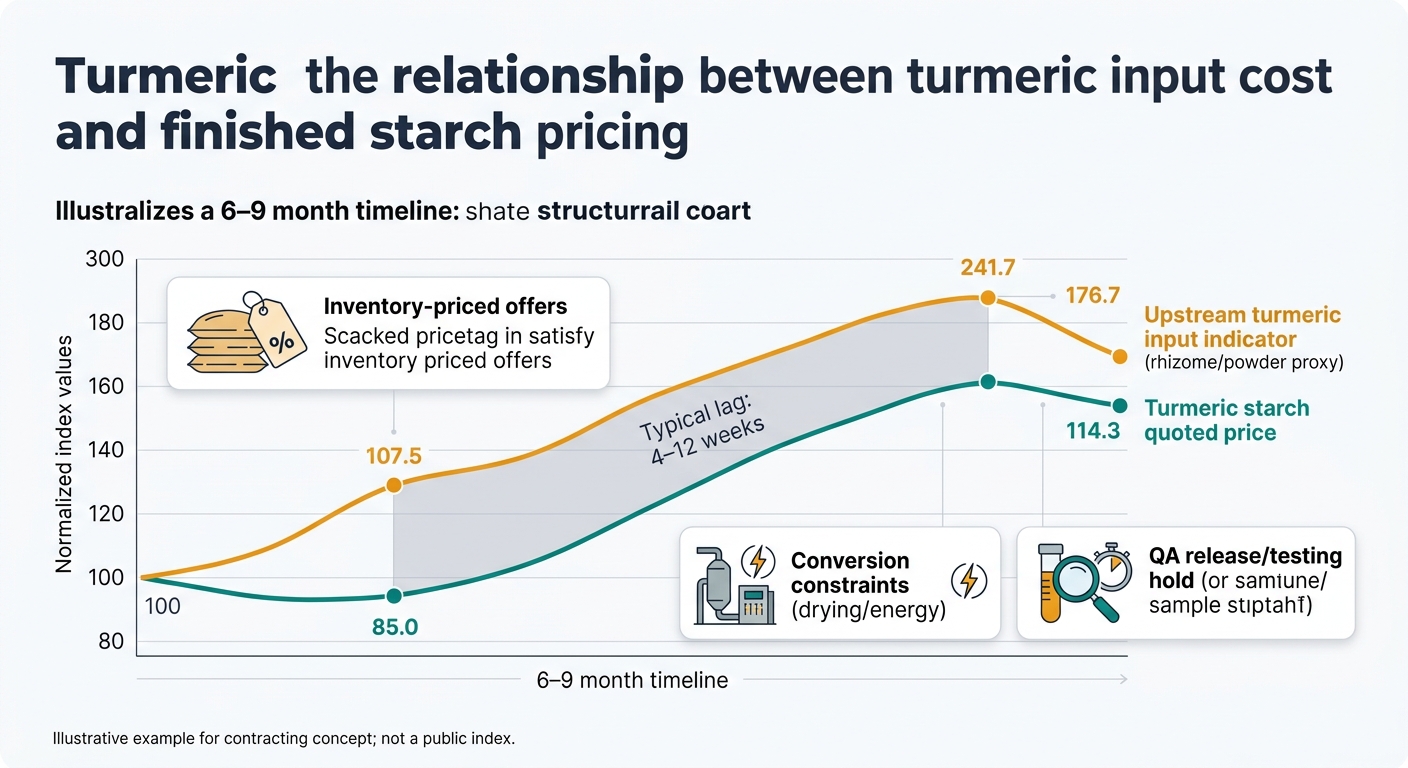
  • Insight: The most consistent “alpha” in turmeric starch comes from timing purchases around inventory lag and conversion constraints: starch quotes can stay elevated even after upstream softens, and can jump even when upstream is flat.
  • Validation note (scope/limits): There is no single public “turmeric starch index.” The lag logic is consistent with how spice and ingredient costs lock in through moisture removal, yield loss, sterilization/testing release, and inventory-based quoting—but the exact timing varies by supplier, lane, and whether product is held for release after testing. (blog.tridge.com)
  • Data (illustrative, not a market quote): Three structural drivers create predictable disconnects:
  • Inventory lag (4–12 weeks): A processor quoting starch in August may be converting inputs purchased weeks earlier. Example: upstream prices fall 10% after improved arrivals, but starch quotes only fall 2–4% for 6–10 weeks because the supplier’s input book is higher-cost and they protect margin on committed lots.
  • Yield and rejection risk: A ~5% deterioration in incoming moisture/foreign matter can reduce usable yield enough that the processor’s effective input cost rises ~3–6%, even if upstream is unchanged. In tight QA regimes, a modest rise in failed lots can push finished quotes up (order-of-magnitude) $100–$250/MT to cover rework, extra drying, and claims.
  • Capacity and energy floors: When drying/effluent constraints bind (or power reliability drops), conversion becomes the bottleneck and sets a price floor. In those windows, you’ll see offers hold even as raw indicators imply lower replacement cost.
  • Procurement Impact: If you only watch raw turmeric indicators, you’ll negotiate at the wrong moment. The exploitable window is when upstream softens first but starch quotes haven’t reset—this is when short-duration fixed pricing, indexed collars, or volume-flex bands can outperform “annual lock + quarterly reopen” by 3–7% on landed cost without increasing disruption exposure.
Illustrative 6–9 month dual-line timeline chart comparing an upstream turmeric input indicator vs turmeric starch quoted price, with a shaded band labeled “Typical lag: 4–12 weeks” and callouts for inventory-priced offers, conversion constraints (drying/energy), and QA release/testing hold; normalized index values and note that it is illustrative, not a public index.

The Less-Obvious Anomaly: “Quality Tightening” Can Raise Prices in a Soft Market

  • Insight: In turmeric starch, a “soft” crop market can still produce “tight” deliverable supply if buyer specs tighten (or enforcement tightens) on contaminants and microbiology.
  • Why this is credible: Spices are a known risk category for pathogens/filth controls and for chemical adulteration (e.g., lead chromate used to enhance color in spices, including turmeric). That reality makes “compliant + documentable” lots scarcer than “available” lots. [1]
  • Data (illustrative): A common pattern is: raw material is abundant, but the share of lots that pass buyer-specific acceptance criteria falls. Example: market prices drift down 5%, but your deliverable pool shrinks because more lots fail internal limits; suppliers respond by quoting a “compliance premium” of $80–$180/MT for tighter documentation/testing and longer release times.
  • Procurement Impact: Risk and contract teams should treat QA stringency as a price driver and contract for it explicitly—otherwise you pay the premium anyway, but in the form of delays, chargebacks disputes, and emergency buys.

Key Takeaways

  • Lag is the lever: Expect ~4–12 weeks before upstream moves show up in starch (supplier- and lane-dependent).
  • Conversion sets floors: Capacity/energy/rework can keep starch quotes elevated even in a soft crop.
  • Deliverable supply matters more than theoretical supply: Tightened acceptance criteria can create “hidden tightness” and price premiums.

2) Three Ways Teams Accidentally Write Risk Into the Deal

Mistake #1: Negotiating price before you lock the acceptance mechanics

  • What happens: Commercial terms get signed with a generic spec reference, but no shared sampling plan, test method hierarchy, or dispute timeline.
  • Why it fails: When a lot is borderline, the supplier’s COA and your inbound lab disagree; the shipment sits, production plans slip, and the argument becomes commercial instead of technical.
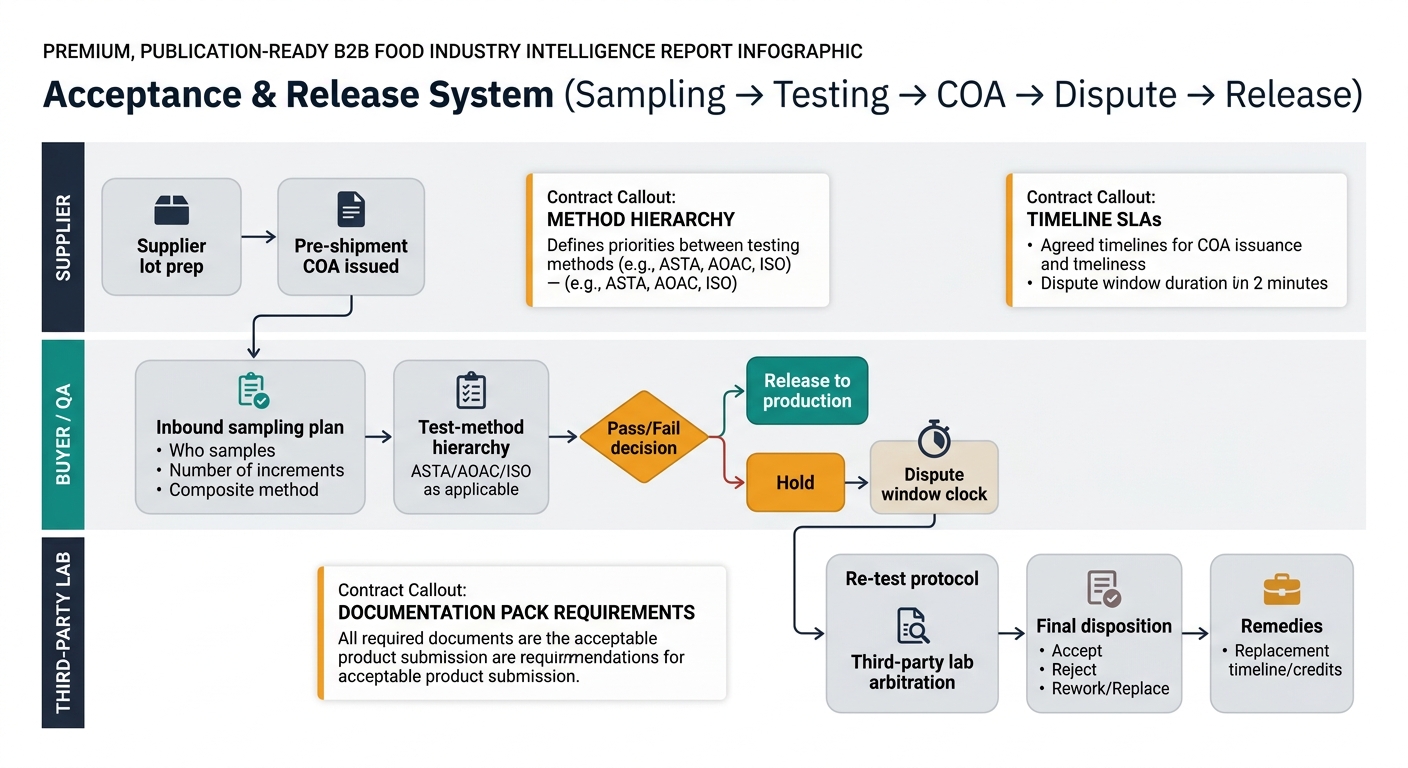
  • Make this more enforceable (industry-aligned): Borrow from established spice practice: specify recognized methods (ASTA/AOAC/ISO where applicable), a sampling approach, and a lab-arbitration pathway. ASTA maintains cleanliness specifications and analytical method references that many spice buyers use as a baseline. [2]
  • Swimlane-style process flow diagram (Supplier vs Buyer/QA vs Third-Party Lab) showing acceptance and release mechanics: supplier lot prep, pre-shipment COA, inbound sampling plan, test-method hierarchy (ASTA/AOAC/ISO), pass/fail decision, release or hold, dispute window clock, re-test protocol, third-party lab arbitration, final disposition (accept/reject/rework/replace), and remedies; includes contract callouts for method hierarchy, timeline SLAs, and documentation pack requirements.
  • The hidden cost (order-of-magnitude): A single disputed container can add 2–4 weeks of delay and trigger expedited replenishment. On a mid-size user, that can add $0.06–$0.15/kg in blended cost (retesting, demurrage, partial write-offs, and premium spot cover).

Mistake #2: Treating “backup suppliers” as names, not pre-qualified pathways

  • What happens: The contract references alternates informally (“may source elsewhere”), but there’s no pre-agreed onboarding protocol, documentation pack, or trigger to activate.
  • Why it fails: In a disruption, the alternate can quote product—but QA, compliance, and packaging approvals take longer than the shortage window.
  • The hidden cost: Teams end up buying the same origin through a trader at 5–12% higher price, with less documentation leverage and worse claim recovery.

Mistake #3: Using annual fixed-price locks in a market that behaves like a lagged index

  • What happens: You lock a 12-month price because budgeting prefers certainty.
  • Why it fails: You absorb the full downside when upstream softens (because starch resets late), but you still face renegotiation pressure when upstream spikes (because suppliers claim energy surcharges, compliance premiums, or allocation).
  • The hidden cost: You get the worst of both worlds: limited benefit from market dips and recurring exceptions. In practice, exception handling can consume 20–40 hours/quarter across procurement, QA, and legal—real governance cost that never shows up in unit price.
Unlock Full Data
Industrial Turmeric Starch Market Intelligence
Prices · Trends · Origins · Forecasts

3) What Changes When You Run Contracts Like a Risk System (Not a Price Event)

  • Insight: Intelligence-driven contracting reduces total cost of risk by turning market signals into pre-agreed actions—so you don’t renegotiate under pressure.
  • Data (directionally realistic, depends on baseline maturity): A realistic before/after for an industrial buyer running 300–800 MT/year:
Operating Model What you do Typical outcome you can measure
Before (reactive) 2–3 incumbent quotes, annual lock, ad hoc QA escalations 6–12% price variance vs. market resets; 2–3 unplanned expedites/year; dispute cycle time 15–30 days
After (intelligence-driven) Benchmark 8–15 comparable suppliers, monitor lead-time/offer spread, contract triggers for alternates + documentation 3–7% better price capture on resets; expedites reduced 50–80%; dispute cycle time 5–10 days
  • Procurement Impact: The win is not “cheaper at any cost.” It’s fewer surprises: tighter governance, faster resolution, and predictable switching when a lane/origin degrades.

4) Three Scenarios Where Better Intelligence Pays for Itself Fast

Use Case 1: Renewal in 60 Days—Choose the Right Price Structure

  • Insight: Renewal timing is where lag creates negotiation leverage.
  • Data: If upstream indicators have softened but starch quotes haven’t moved, you’re in a 4–10 week window where suppliers are protecting inventory margin.
  • Procurement Impact: Push for a 90–120 day fixed price with a defined reset mechanism (or a collar) instead of a 12-month lock; you capture the lag without betting the year on one number.

Use Case 2: A “Compliance Premium” Shows Up Mid-Contract

  • Insight: Suppliers often reframe margin recovery as documentation/testing surcharges.
  • Data: Premiums commonly appear as $80–$200/MT adders tied to extra testing, tighter release, or “new requirements.”
  • Procurement Impact: Convert the premium into enforceable obligations: specify document set, turnaround times, and remedies for late/incorrect paperwork—so you pay for compliance only if delivered.

Use Case 3: Lead Times Drift +3 Weeks on One Lane

  • Insight: Lead-time variance is an early-warning signal that often precedes price spikes or allocation.
  • Data: A sustained +2 to +4 week drift can indicate port congestion, plant downtime, or tighter deliverable supply.
  • Procurement Impact: Trigger your contingency plan: activate pre-qualified alternates for a defined share (e.g., 20–30%) and tighten notification clauses—before allocation forces you into 100% spot coverage.

5) How This Thinking Transfers to Adjacent Ingredients You Also Buy

  • Insight: Lagged pricing + deliverable-quality constraints is not unique to turmeric starch; it’s a repeatable pattern across food inputs.
  • Data: Similar dynamics show up in:
  • Cocoa powder: Bean moves don’t translate linearly to powder because grind capacity and butter/powder ratio economics set floors.
  • Garlic powder/granules: Crop abundance can coexist with tight deliverable supply when microbial or residue enforcement tightens.
  • Tapioca/cassava starch: Freight and energy can dominate conversion cost, creating price floors even when roots soften.
  • Procurement Impact: The same contract toolkit—reset logic, acceptance mechanics, and alternate activation triggers—reduces exception workload across categories, not just one SKU.

6) Why This Turmeric Starch Example Is a Practical Proof of Value

  • Insight: The hard part in procurement isn’t knowing that risk exists—it’s translating weak signals (lag, yield loss, compliance tightening, lead-time drift) into clauses and decisions that operators can execute.
  • Data: Most avoidable losses come from predictable failure modes: disputes without test-method hierarchy, alternates without onboarding paths, and annual locks in markets that reset in steps.
  • Procurement Impact: When you can quantify spreads, lags, and lane reliability, you stop debating opinions in renewal meetings and start making governed choices: when to lock, when to float, when to dual-source, and what performance evidence is required to keep a supplier “approved.”

7) The Bottom Line for Your Next Move

If upstream turmeric indicators have softened in the last 30–60 days but starch quotes are still holding, use that lag to negotiate a short fixed-price window (90–120 days) with a pre-defined reset and a contingency activation trigger tied to sustained lead-time drift. The window exists because processors are pricing off higher-cost inventory and conversion floors, not today’s raw signal—so you can capture the reset without committing your full year at a stale level. Teams that structure contracts around lag and deliverable supply typically outperform spot-driven buying by several points on cost while cutting expedite events and dispute cycle time in half. The stake is not just price—it’s whether your next disruption becomes a governed switch or an emergency buy.

Key Insights

  • Price disconnect is structural: Inventory lag, yield/rework, and conversion constraints create predictable gaps between upstream moves and starch quotes.
  • Contracting is the control surface: Acceptance mechanics, documentation obligations, and reset logic determine whether you capture market moves or absorb exceptions.
  • Alternates must be executable: A named backup without pre-agreed onboarding and triggers is not resilience.
  • Watch lead-time variance like a price index: Sustained drift is often the earliest signal you can act on.
  • Measure what matters: Track dispute cycle time, expedite frequency, lead-time variance, and spec conformance—not just unit price.

The Bottom Line for Your Next Contract

(Analyzed at: Jul, 2026)

Given the 2026 market backdrop—India-origin turmeric pricing moving on arrivals/export flows and quality segmentation, while regulators continue to spotlight spice contamination/adulteration risk—your highest-leverage contract move is to stop buying “a price” and start buying an acceptance-and-release system. Lock a 90–120 day price window only with (1) a defined test-method hierarchy and sampling plan aligned to common spice practice and (2) a pre-agreed alternate activation trigger if lead time drifts beyond tolerance. That combination is what converts lagged pricing into savings without creating a rejection/border-hold exposure that can erase the benefit; when it goes wrong, the swing is typically high single digits in total landed cost once expedites and downtime are counted. [3]

Unlock Full Data
Industrial Turmeric Starch Market Intelligence
Prices · Trends · Origins · Forecasts

References

  1. fda.gov
  2. astaspice.org
  3. in.investing.com

Related Contents

Subscribe
→
By subscribing you agree to with our Privacy Policy and provide consent to receive updates from our company.
Thank you! Your submission has been received!
Oops! Something went wrong while submitting the form.
Subscribe to receive the latest blog posts, updates, promotions, and announcements from Tridge.
