INDUSTRY TRENDS

Turmeric Extract Sourcing: Cost Build-Up, Compliance Risk, and the Procurement Leverage Points That Actually Move Outcomes

Author
Team Tridge
DATE
April 17, 2026
10 min read
turmeric-extract Cover
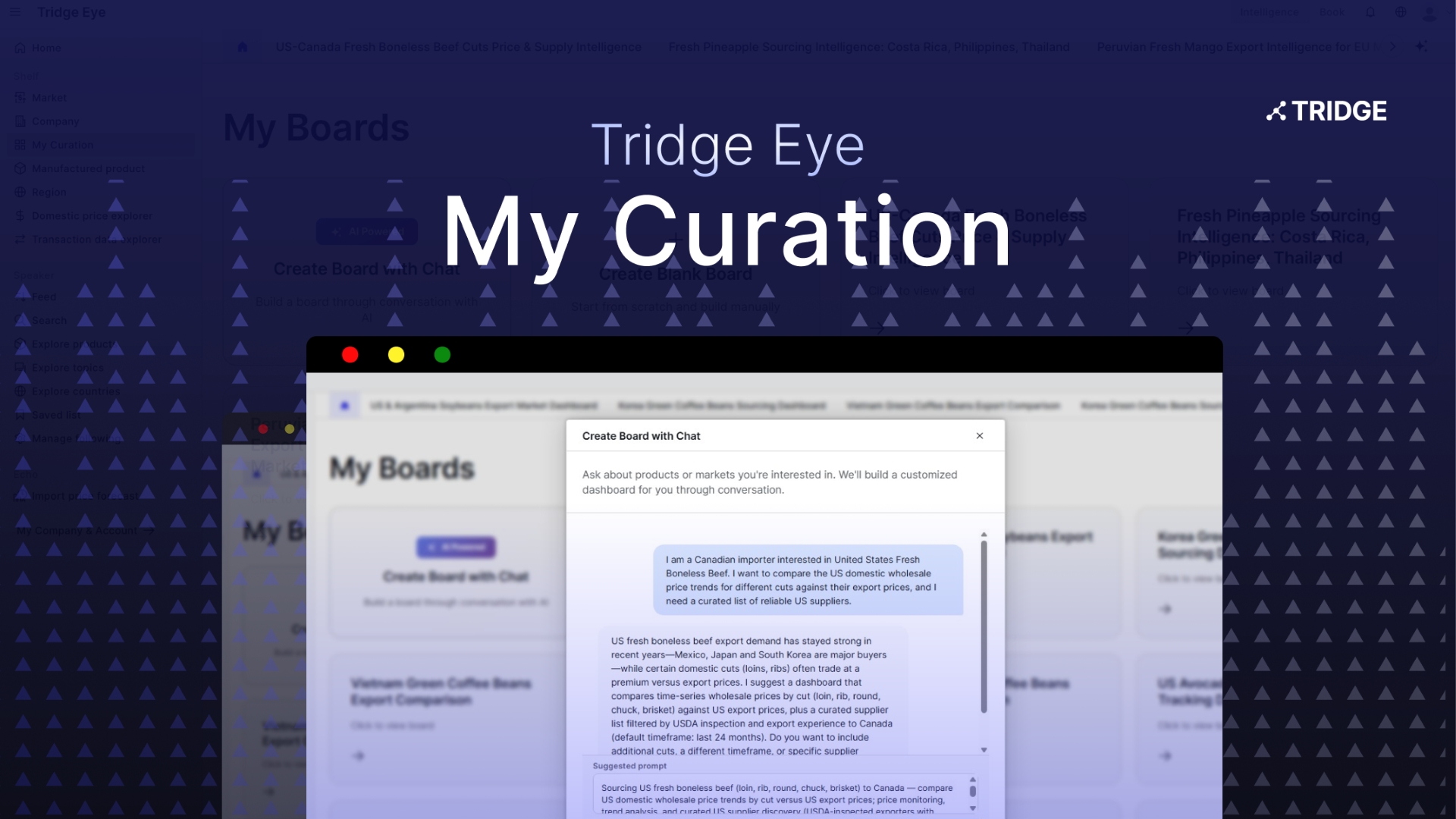
Tridge Eye Data Intelligence Solution

This report is powered by Tridge Eye Data Intelligence.

Every data point, price signal, and supply risk insight in this analysis comes from the same platform that procurement and sourcing leaders worldwide rely on daily. As you read, consider what this level of market intelligence could do for your sourcing decisions.

Explore Tridge Eye →

Turmeric extract looks like a straightforward botanical until you manage it like a procurement category: a seasonal agricultural input feeds yield-sensitive extraction, then gets filtered through strict customer QA and import controls. This guide translates that reality into the cost, risk, and leverage points procurement leaders can use to reduce variance, avoid preventable holds/rejections, and build resilience without paying an unnecessary premium.

Executive Summary

  • Turmeric extract is a “yield + compliance” category, not a simple commodity. Farmgate turmeric price is only one input; extraction yield losses, capacity tightness, and QA/documentation gates often dominate delivered cost.
  • Origin concentration is real (especially India), so many “different suppliers” still share correlated upstream risk. India is widely reported as the leading exporter; multiple sources cite India at ~two-thirds of global turmeric exports in recent years, but exact shares vary by definition and year. [1]
  • EU border risk is measurable and repeatable. CBI’s EU market-entry guidance highlights RASFF as a practical monitoring tool and reports turmeric/curcumin alerts from 2020–mid-2025 tied to dyes, pesticides, traceability/documentation issues, and microbiological/aflatoxin findings. [2]
  • U.S. import enforcement can create sudden supply disruption. FDA Import Alert 99-42 covers detention without physical examination (DWPE) for foods due to heavy metal contamination and was revised on 4/21/2025 (procedural guidance updates). [3]
  • Procurement leverage points that work: (1) lock the full spec envelope (not just “95% curcuminoids”), (2) treat documentation as a gated deliverable with SLAs, (3) use CoA trending as an early-warning dataset, (4) pre-qualify alternates before disruption.

Key Insights

(Analyzed at: Apr, 2026)

  • Strategy: Hold
  • Reliability: Medium
  • Potential Saving: 4% ~ 10%
  • Insight: In April 2026, the best near-term value is typically not “chasing the lowest quote,” but tightening governance to prevent expensive disruptions. EU RASFF patterns cited by CBI show recurring turmeric/curcumin issues tied to unauthorized dyes, pesticide residues, and documentation/traceability errors (2020–mid-2025), and U.S. DWPE mechanisms under FDA import alerts can create abrupt lead-time and cash-flow shocks. For most buyers, a “Hold” posture means: (1) keep core volumes stable with proven suppliers, (2) renegotiate using evidence-based cost drivers and service-level concessions (lead time, documentation SLAs, testing transparency) rather than only unit price, and (3) invest immediately in qualifying 1–2 alternates matched to your solvent/spec/certification constraints to unlock competitive tension without increasing compliance exposure. [2]

1) The Ground Truth: What You’re Actually Buying When You Buy Turmeric Extract

Turmeric-extract sourcing looks like a “simple botanical” category until you map the flow end-to-end. The reality is a once-a-year agricultural input (turmeric rhizome) feeding into yield-sensitive extraction capacity, then into documentation-heavy import and customer QA gates.

The supply chain flow (what moves, where value is added)

  1. Upstream / Raw material: turmeric rhizomes are grown, harvested, cured (often boiling/steaming), dried, and sometimes polished.
  2. Primary processing: cleaning, milling into powder, microbial reduction (where applied), blending lots to hit moisture/color/curcuminoids targets.
  3. Secondary processing (extraction & standardization):
  4. Oleoresin / curcuminoid extract produced via solvent extraction; some suppliers offer supercritical CO₂ routes for specific positioning, but availability and economics vary by grade/spec.
  5. Standardization to target curcuminoids % (e.g., 95% curcuminoids) via purification/crystallization and blending with carriers where applicable.
  6. Packaging & QA release: drums/bags + CoA + contaminant panels (heavy metals, residues, microbes) + traceability artifacts.
  7. Logistics & distribution: export documentation, ocean freight, customs clearance; often distributors hold stock for service-level needs.
  8. End markets: dietary supplements, functional foods/beverages, cosmetics—each drives different spec strictness and audit expectations.
A left-to-right flowchart of the turmeric extract supply chain from farm harvest and curing/drying through primary processing, extraction and standardization, packaging and QA release, export/logistics, importer/distributor stock, and end uses, with labeled risk gates for unauthorized dyes, heavy metals, pesticide residues, micro/aflatoxin, and documentation/traceability.

Why this matters for procurement

  • Your price is not just “turmeric price.” It’s turmeric price × extraction yield × compliance cost × financing/working capital × service levels.
  • Your risk is not just “late shipment.” It’s also adulteration vectors (e.g., unauthorized dyes), heavy metals, and documentation gaps that create border holds and customer release delays. [2]

Data point to anchor origin concentration (use as directional, not absolute): India is consistently a dominant player in global turmeric exports, and multiple sources cite India at roughly ~two-thirds of global turmeric exports in recent reporting (definitions and years vary). [1]

2) Where the Money Goes: Cost & Margin Build-Up by Supply Chain Node

Below is the practical cost logic procurement teams can use to understand “what’s negotiable” vs “structural.”

2.1 Upstream / Raw Material (Turmeric Rhizomes)

Key insight: Turmeric is largely a seasonal crop in key origins; supply tightness often shows up later in the season as stocks draw down. This creates a recurring pattern: post-harvest softness → mid/late-season tightening (timing varies by origin and year).

What drives cost here

  • Farmgate rhizome price (weather, acreage, yield)
  • Curing/boiling + drying fuel costs
  • Shrink from moisture loss + sorting out defects
  • Aggregation/market fees and local logistics

Procurement implication

If you only negotiate extract price without tracking raw turmeric availability + inventory position, you’ll misread supplier “cost push” vs “margin push.”

India production concentration within India (directional): India government/industry materials routinely cite large production volumes and major producing states; treat state-by-state mix as a risk lens (weather, logistics, local policy) rather than trivia. [4]

2.2 Primary Processing (Cleaning, Milling, Micro Reduction, Lot Blending)

Key insight: Primary processing is where micro load and moisture become controllable variables. If this stage is weak, secondary processors either pay to rework—or reject.

What drives cost here

  • Cleaning/sorting intensity (foreign matter removal)
  • Milling yields and loss
  • Microbial reduction steps (energy + throughput constraints)
  • QA testing frequency and lot traceability discipline

Procurement implication

“Cheap” feedstock often becomes expensive after rework, delayed QA release, or nonconformance.

2.3 Secondary Processing (Extraction, Purification, Standardization)

Key insight: Extraction economics are yield-sensitive. Small changes in incoming curcuminoids %, moisture, and contamination can materially change cost per kg of standardized extract.

What drives cost here

  • Solvent/processing route (commonly solvent extraction; CO₂ may be available for certain positioning/specs)
  • Energy/steam for evaporation and solvent recovery
  • Purification/crystallization intensity for high-purity grades
  • Waste treatment + solvent recovery compliance
  • Batch failures or downgrades due to residues/heavy metals/micro

Evidence on common solvent routes (keep practical): Commercial specification sheets for 95% curcuminoids products commonly reference solvent systems such as ethanol and/or ethyl acetate, and typically reference compliance with residual solvent limits (e.g., USP <467> / ICH Q3C frameworks). [5]

Procurement implication

Your spec decisions (e.g., 95% curcuminoids, solvent restrictions, low-residue requirements) directly shrink/expand the qualified supplier pool and change the cost curve.

2.4 Packaging & QA Release (CoA, Contaminant Panels, Traceability)

Key insight: For turmeric extracts, QA release is a cost center and a schedule driver—not an admin step.

What drives cost here

  • Routine panels: heavy metals, pesticide residues, micro, residual solvents (as applicable)
  • Identity/adulteration screening (risk-based)
  • Document control: traceability, change control, certifications

Regulatory reality to plan around

  • EU: CBI’s market-entry guidance explicitly points buyers to RASFF alert patterns and documents turmeric/curcumin alerts (2020–mid-2025) tied to dyes, pesticides, traceability/documentation errors, allergens, and microbiological/aflatoxin issues. [2]
  • U.S.: FDA uses import alerts and DWPE mechanisms; Import Alert 99-42 addresses heavy metal contamination risk categories and was revised on 4/21/2025 (process/guidance updates). [3]

Procurement implication

“Documentation lead time” can be as real as “production lead time.” Treat docs as a gated deliverable with SLAs.

2.5 Logistics & Distribution (Ocean Freight, Customs, Distributor Stocking)

Key insight: Logistics cost is often not the biggest line item, but it is a major variance driver (demurrage, holds, re-tests, re-labeling).

What drives cost here

  • Ocean freight + inland drayage volatility
  • Customs clearance quality (HS classification discipline, document accuracy)
  • Distributor margin (in exchange for shorter lead times and local inventory)

Procurement implication

If your business values continuity, distributor stocking may be a rational “insurance premium”—but it should be compared against holding cost and obsolescence risk.

2.6 End Market Margin Stack (Importer/Distributor + Brand/Manufacturer)

Key insight: Downstream margins expand when buyers demand tight specs + short lead times + strong documentation. That’s not “supplier greed” by default; it’s often the cost of risk and working capital.

Procurement implication

You can trade margin for discipline: better forecasting, earlier commitments, and clearer specs often lower the supplier’s risk premium.

A three-bar stacked chart comparing delivered cost composition for turmeric oleoresin, 95% curcuminoids extract, and a clean-label/solvent-restricted premium positioning, segmented into raw material, primary processing, secondary processing, packaging and QA release, logistics and distribution, and importer/distributor margin, using the article’s illustrative ratios and calling out the largest segment per bar.

Product-level cost breakdown (illustrative ratios by major turmeric-extract product forms)

Modeled to show where cost typically concentrates by product type. Actual ratios vary by origin, contract terms, certifications, service levels, and compliance regime.

A) Turmeric Oleoresin (food color/flavor intermediate)

Supply Chain Node Cost Ratio (% of Delivered Cost) Notes
Raw material (rhizomes/powder feedstock) 35% Bulk input dominates economics
Primary processing 10% Cleaning/milling/micro controls
Secondary processing (extraction) 25% Energy + solvent recovery + yield
Packaging & QA release 8% CoA + contaminant testing
Logistics & distribution 12% Drums, freight, customs
Importer/distributor margin 10% Service level + inventory financing

B) 95% Curcuminoids Extract (standardized nutraceutical-grade powder)

Supply Chain Node Cost Ratio (% of Delivered Cost) Notes
Raw material 25% Still material, but less dominant than purification
Primary processing 8% Tighter pre-extraction specs
Secondary processing (purification/standardization) 35% Purification intensity and yield losses matter
Packaging & QA release 12% Higher testing/documentation burden
Logistics & distribution 10% Similar lanes, higher value density
Importer/distributor margin 10% Risk premium for compliance + continuity

C) Curcumin/Curcuminoids “clean-label” positioning (e.g., solvent-restricted or premium process)

Supply Chain Node Cost Ratio (% of Delivered Cost) Notes
Raw material 22% Higher-grade feedstock selection
Primary processing 10% More stringent prep and segregation
Secondary processing 38% Process constraints reduce throughput/options
Packaging & QA release 12% More scrutiny and verification
Logistics & distribution 8% Higher value density
Importer/distributor margin 10% Premium service + risk buffer

3) The Structural Fact You Have to Build Strategy Around

Turmeric-extract is a “yield + compliance” category, not a “simple commodity” category.

That creates three structural constraints:

  1. Origin concentration (especially India) means weather, policy, and logistics shocks are correlated across many supplier options. [1]
  2. Extraction capacity is not infinitely flexible—tight periods show up as longer lead times and premiums for compliant lots.
  3. Compliance risk is asymmetric: one quality/compliance failure can cost far more than the annual “savings” from a cheaper supplier.

4) The Critical Insight: Why Raw Turmeric Prices and Extract Prices Often Disconnect

Procurement teams often expect extract prices to track farmgate turmeric linearly. In practice, the linkage is nonlinear.

The main reasons for price disconnect

  • Inventory buffering: extractors may be processing turmeric bought earlier, delaying pass-through.
  • Yield variability: lower curcuminoids % or higher moisture increases cost per kg of standardized output.
  • Compliance tightening: increased testing/rework and higher rejection rates raise effective cost.
  • Capacity constraints: when extraction lines are booked, suppliers price scarcity.

What to watch (leading indicators)

  • Shifts in lead times/MOQs (capacity signal)
  • CoA pattern changes (quality drift signal)
  • RASFF/FDA enforcement intensity signals (border risk signal) [2]

EU guidance explicitly points buyers to RASFF alert patterns for turmeric/curcumin as a practical risk lens. [2]

5) Where Procurement Teams Commonly Misstep (and Pay Later)

  1. Over-indexing on a single spec line (e.g., “95% curcuminoids”) without controlling the rest of the quality/compliance envelope (residues, heavy metals, micro, solvents).
  2. Treating CoA as a checkbox rather than a trend dataset (lot-to-lot variability, outliers, missing tests).
  3. Single-sourcing for price while underestimating qualification lead time for alternates.
  4. Running RFQs without cost-driver context, making it easy for suppliers to justify increases (or for buyers to push unsustainably low pricing that later shows up as service/quality problems).
  5. Late escalation: waiting for a border hold or customer complaint before activating alternates.

6) How Intelligence-Driven Sourcing Changes the Outcome (Decision-Led, Not Feature-Led)

Below is how procurement leaders typically use an intelligence service in practice for turmeric-extract—what it can and cannot do.

What it helps you decide better

  • Supplier selection & portfolio design (primary + pre-qualified secondary)
  • Contract timing and structure (fixed vs indexed; when to lock volume)
  • Qualification sequencing (who to audit/sample first)
  • Escalation thresholds (when to freeze volume, increase testing, or switch lanes)

What it does NOT replace

Lab testing, on-site audits, or legal/regulatory determinations (it helps you prioritize and govern them).

The “better decision loop”

  1. Supplier discovery under constraints
  2. Filter suppliers by: curcuminoids %, extraction route constraints, certifications, region, lead time.
  3. Benchmarking & comparison
  4. Build scorecards: service reliability, documentation completeness signals, commercial posture.
  5. Price intelligence & cost-driver tracking
  6. Separate market movement from supplier-specific margin expansion.
  7. Risk monitoring
  8. Track disruption signals (origin shocks, logistics, policy, quality incidents) and trigger early action.
  9. Governance support
  10. Standardize documentation checklists; track gaps and changes over time.

Why this is specifically valuable in turmeric: because enforcement and contaminant risk can trigger detentions and disruptions, and FDA import alerts explicitly support DWPE approaches for heavy metals risk categories. [3]

7) Strategic Use Cases Procurement Leaders Actually Run in Turmeric Extract

Use case A: Reduce cost volatility without increasing quality risk

  • Decision: renegotiate incumbent vs run competitive event vs lock a portion.
  • Intelligence inputs: benchmark ranges, raw material driver narrative, peer lead-time signals.
  • Action:
  • split volume into fixed + indexed tranches,
  • negotiate with evidence (market vs supplier delta),
  • set re-openers tied to driver thresholds.
  • Outcome metrics: price variance vs budget, expedite spend, rejection/hold rate.

Use case B: Pre-qualify alternates for resilience (before you need them)

  • Decision: which 2–3 alternates to qualify first.
  • Intelligence inputs: constraint-fit shortlist + risk profile + documentation readiness.
  • Action: staged qualification (docs → sample/testing → audit prioritization) based on risk.
  • Outcome metrics: time-to-switch, concentration risk (% volume in top supplier), OTIF during disruptions.

Use case C: Strengthen governance for a QA-sensitive botanical

  • Decision: set supplier review cadence and escalation triggers.
  • Intelligence inputs: documentation gap tracking + risk alerts + performance trends.
  • Action: define objective triggers (e.g., repeated CoA anomalies, late docs, lead-time stretch).
  • Outcome metrics: fewer late-stage approval delays, fewer emergency buys, audit findings closure time.

8) Why This Matters Beyond Turmeric (Adjacent Categories You Likely Also Buy)

Turmeric-extract is a strong “training ground” category because the same intelligence patterns repeat across other botanicals and spice-derived extracts:

  1. Ginger extracts / oleoresins
  2. Similar agronomy-driven seasonality and origin concentration; global production is led by India (with other major producers). [6]
  3. Ashwagandha and other high-demand botanicals
  4. Similar fraud/adulteration incentives when demand spikes; qualification lead times are long.
  5. Paprika/chili color systems
  6. Similar economically motivated adulteration risk; compliance and authenticity testing become procurement governance issues (not just QA issues).

The transferable procurement lesson: when authenticity + contaminants + documentation can stop shipments, intelligence is a governance tool, not just a sourcing tool.

9) Why This Example Works for Prospective Customers (and for Internal Alignment)

Turmeric-extract sourcing is a high-signal category because it forces clarity on the four things procurement leadership is measured on:
  • Cost control: negotiate with driver-backed benchmarks instead of last-price anchoring.
  • Risk reduction: convert “known risks” (unauthorized dyes, heavy metals, residues) into monitored signals and qualification priorities, aligned to EU RASFF patterns and FDA DWPE realities. [2]
  • Resilience: build a standing bench of alternates matched to exact constraints; reduce time-to-switch.
  • Governance: create auditable supplier review packs, documentation SLAs, and escalation triggers.

Practical next steps (what a procurement manager can do this quarter)

  1. Lock the spec envelope (curcuminoids %, solvent constraints, must-have certifications, contaminant limits) with QA/regulatory.
  2. Build a 2-tier supplier portfolio (primary + 1–2 pre-qualified alternates) tied to switching triggers.
  3. Implement a CoA trend review (not just pass/fail) and connect it to supplier scorecards.
  4. Set contracting rules (what % fixed vs indexed; when to re-open) tied to raw turmeric and capacity signals.
Tridge Eye Data Intelligence Solution

Make Faster, Data-Driven Sourcing Decisions

The insights in this report are just the starting point. Tridge Eye is the data intelligence solution that gives procurement and sourcing leaders real-time market signals, price benchmarks, and supply risk alerts — so you can act before the market moves.
Explore Tridge Eye →

References

  1. sahyadristartups.com
  2. cbi.eu
  3. accessdata.fda.gov
  4. pib.gov.in
  5. media.knowde.com
  6. wikipedia.org
Subscribe
By subscribing you agree to with our Privacy Policy and provide consent to receive updates from our company.
Thank you! Your submission has been received!
Oops! Something went wrong while submitting the form.
Subscribe to receive the latest blog posts, updates, promotions, and announcements from Tridge.