
INDUSTRY TRENDS

TSPC Sourcing Execution: Timing the Lag, Buying the Right Terms, and Protecting Allocation

Author
Team Tridge
DATE
October 7, 2026
8 min read
textured-soy-protein-concentrate Cover
Unlock Full Data
Textured Soy Protein Concentrate Market Intelligence
Prices · Trends · Origins · Forecasts

This guide is written for procurement and sourcing leaders who are strong buyers in other ingredients, but don’t live in the day-to-day mechanics of textured soy protein concentrate (TSPC). The core message is simple: you don’t “beat the market” on TSPC by predicting soybean futures—you do it by understanding where TSPC decouples (inventory + conversion capacity) and then buying the right contract terms before leverage flips to suppliers.

Executive Summary

  • Why TSPC decouples: Delivered TSPC cost is driven by feedstock + conversion (extrusion/drying) + logistics, and the conversion layer can tighten independently of soy. [1]
  • Lag is real, but don’t over-specify it: Pass-through is often asymmetric (faster up than down) because suppliers price to replacement cost, inventory positions, and utilization.
  • Best early-warning signal: Track supplier lead time vs. your days-of-cover; this often signals allocation risk earlier than price sheets.
  • Governance move that pays: Normalize RFQ offers to true landed cost (incoterms/MOQ/pack/payment) and separate index-linked feedstock from capped conversion adders.
  • 2026 compliance pressure: If you sell into the EU, EUDR due-diligence obligations begin applying 30 Dec 2026 (most large/medium operators)—make traceability and documentation readiness part of supplier selection, not a last-minute add-on. [2]

1) The Signal You’re Missing: Why TSPC Doesn’t Follow Soybeans (and When to Buy)

TSPC pricing regularly “disconnects” from the soybean complex—not because suppliers are irrational, but because your delivered TSPC cost is governed by inventory latency, capacity utilization (especially extrusion/drying), and qualification friction. The advantage comes from spotting when your supplier’s price is being set by earlier feedstock positions (inventory) versus today’s conversion constraints, and structuring buys to capture that lag.
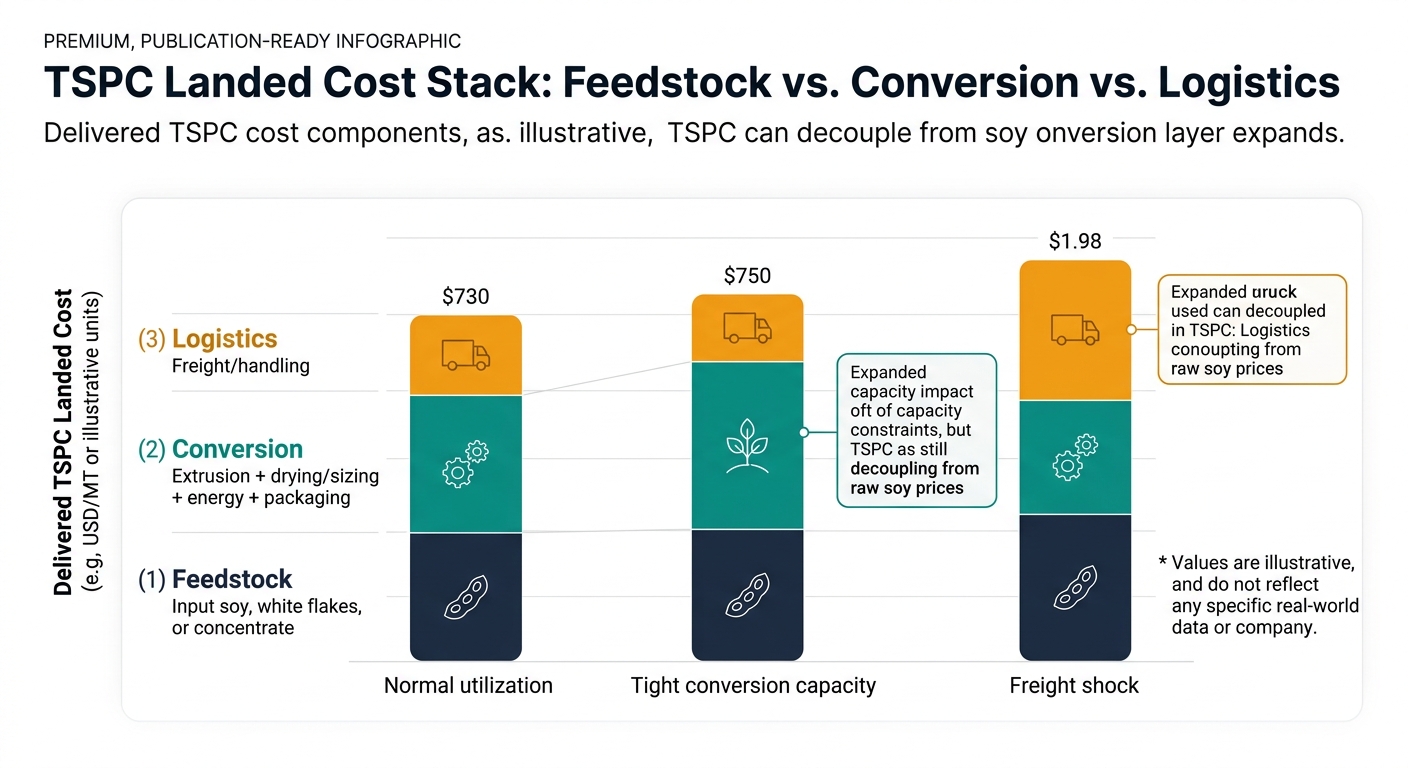
A stacked bar chart showing delivered TSPC cost components split into feedstock, conversion (extrusion + drying/sizing + energy + packaging), and logistics, with illustrative scenarios such as normal utilization, tight conversion capacity, and a freight shock to show how conversion can expand and decouple TSPC from soy.
  • Insight: A move in soybeans rarely translates 1:1 into near-term TSPC offers; the pass-through is delayed and often dampened by processors’ inventory positions and conversion constraints.
  • Data (validated conceptually): Soy proteins are typically derived from “white flakes” (defatted flakes), then processed into concentrates (often 65–70% protein, dry basis), and can be texturized by extrusion and dried/sized—each step adds conversion cost and capacity sensitivity beyond the bean itself. [1]
  • Procurement Impact: If you wait for “TSPC to follow beans,” you often miss the window; instead, negotiate a short reopener (30–60 days) or index-linked reset for the feedstock component when beans are moving down, and lock allocation terms when conversion capacity is tight even if beans are flat.

The two most common disconnect patterns (and how to exploit them)

  • Insight: Down markets create a “sticky-down” effect; up markets create an “faster pass-through” effect.
  • Data (validated as a common pricing behavior, not a hard rule): Suppliers often re-quote quickly in rising markets citing replacement cost and forward coverage; in falling markets, reductions frequently lag until inventory turns and utilization pressure forces competitive moves.
  • Procurement Impact: In rising markets, prioritize continuity: secure volume commitments and cap freight/energy adders. In falling markets, prioritize optionality: split volume into tranches (e.g., 50% fixed now, 50% priced monthly) and force transparency on what index, geography, and lag they’re using.
  • Insight: Capacity shocks can move TSPC even when soy is stable.
  • Data (validated mechanism): Texturization relies on extrusion plus drying/sizing steps; these are throughput- and energy-sensitive and can become bottlenecks during outages, maintenance, SKU changeovers, or when demand shifts toward specific forms (granules vs. chunks). [3]
  • Procurement Impact: Treat lead time and OTIF as market indicators (with your own definition). If lead times extend materially across more than one supplier, shift the negotiation from price-first to allocation-first: minimum monthly volumes, priority clauses, and agreed substitution pathways.

Quick Win (this week)

  • Insight: Your best early-warning signal is not soy futures—it’s the spread between supplier lead time and your inventory coverage.
  • Data (rule-of-thumb, not universal): If your days-of-cover is <45 days and quoted lead time is >70 days, you are already in a “seller’s leverage” regime.
A 2x2 quadrant matrix chart with X-axis as supplier quoted lead time (days) and Y-axis as inventory days-of-cover, with threshold lines at 70 days lead time and 45 days cover creating quadrants labeled Low Risk/Buyer Leverage, Watchlist, Operational Risk, and Seller Leverage/Allocation Likely, plus an example point at lead time 80 and cover 35 with a callout to trigger a contingency RFQ and bridge agreement.
  • Procurement Impact: Trigger a contingency RFQ immediately for qualified alternates and negotiate an interim bridge agreement (8–12 weeks) rather than pushing a full annual reset under time pressure.

2) Three Ways Procurement Teams Lose Money (Even When They “Win” the RFQ)

Mistake #1: Treating TSPC like a pure commodity index buy

  • What happens: Teams benchmark only soybeans/meal and push for immediate pass-through, assuming the supplier is just “marking up beans.”
  • Why it fails: TSPC price formation includes inventory lag, yield/process variability, energy, packaging, and line utilization; suppliers can be directionally right even when the index looks favorable.
  • The hidden cost: You secure a 3% unit price reduction but accept longer lead times and weaker service terms; the first late delivery forces an expedited buy or line reschedule that can erase the savings.

Mistake #2: Over-concentrating volume after a successful qualification

  • What happens: After QA/R&D approves one supplier, procurement consolidates 70–90% of volume to “simplify” and chase rebates.
  • Why it fails: In tight markets, allocation follows contracted volume clarity and strategic account priority—not goodwill. A single-site disruption creates immediate exposure because switching is slow (documentation + trials + change control).
  • The hidden cost: A 4–6 week gap in supply can trigger reformulation, downtime, or customer service penalties; the effective cost can dwarf a 1–2% rebate—especially if you must buy spot at a premium to protect production.

Mistake #3: Running an RFQ without enforcing like-for-like commercial terms

  • What happens: Quotes come back with different incoterms, pack sizes, payment terms, MOQ, and price validity windows—then the lowest number “wins.”
  • Why it fails: You’re comparing apples to oranges; differences in MOQ and lead time drive inventory carry cost and obsolescence risk, while short validity windows shift pricing power back to suppliers.
  • The hidden cost: A “low” offer with 2x MOQ can add weeks of inventory and working capital. On a mid-sized program, the carrying cost plus write-offs from slow-moving lots can neutralize apparent savings.
Sourcing Window Radar
Textured Soy Protein Concentrate — Global Harvest Calendar
CHINA SEASON ACTIVE
🇨🇳 China
JAN — DEC
🇺🇸 United St.
MAR — OCT
🇲🇽 Mexico
FEB — FEB
🇨🇴 Colombia
APR — APR
🇨🇱 Chile
APR — APR
JanFebMarAprMayJunJulAugSepOctNovDec

3) What Changes When You Run TSPC Sourcing Like an Intelligence Problem

  • Insight: The performance gap comes from timing and term design—not from finding a magical cheaper supplier.
  • Data (validated approach): Soy protein concentrates are produced from defatted flakes (“white flakes”) and processed to remove soluble carbohydrates; texturized forms add extrusion + drying/sizing steps. That means your cost stack naturally splits into (a) feedstock exposure and (b) conversion/capacity exposure. [1]
  • Procurement Impact: You can reduce realized cost variance and disruption frequency simultaneously—because you stop forcing one contract structure to solve two different sources of volatility.

Before (Traditional approach)

  • Sourcing: Incumbent + 1 backup quote, refreshed at renewal
  • Benchmarking: Soy index check + anecdotal supplier feedback
  • Risk assessment: “Supplier has always delivered”
  • Result: Overpaying during down-cycles due to sticky pricing; scrambling during capacity squeezes 1–2 times per year

After (Intelligence-driven approach)

  • Sourcing: Wider qualified longlist segmented by region/certifications; pre-negotiated alternates
  • Benchmarking: Landed-cost normalization across incoterms/MOQ/lead time; monthly spread tracking between soy and TSPC offers
  • Risk monitoring: Alerts when lead times extend, allocation language appears, or freight/energy shocks emerge
  • Result (directionally realistic): Lower average realized price vs. reactive buyers, fewer expedites and emergency buys, and faster switch time (weeks, not quarters)

4) Three Situations Where Better Intelligence Pays Back Immediately

  • Insight: The highest ROI moments are when you have a deadline, a shock, or a quality signal—and you must decide in days, not months.
  • Data: These scenarios consistently create asymmetric outcomes depending on preparation and market visibility.
  • Procurement Impact: Use the playbooks below to force leverage back into your control.

Scenario A: Renewal in 60 days while soy is falling

  • Insight: Falling beans create a negotiation window, but only if you prevent sticky-down pricing.
  • Data: Suppliers often quote against higher-cost inventory and delay reductions until inventory turns.
  • Procurement Impact: Split the contract: lock volume + service terms now, but price via a 30–60 day reset clause (or monthly average index) for the next quarter.

Scenario B: Lead times extend suddenly (allocation risk)

  • Insight: Lead-time drift is often the earliest signal of a capacity squeeze.
  • Data (validated mechanism): Extrusion and drying are throughput-limited; when lines are constrained, lead times lengthen before formal allocation notices appear. [4]
  • Procurement Impact: Trigger dual-source activation: pull forward trial/approval for your secondary supplier and negotiate allocation language (priority, minimums, escalation) before the market fully tightens.

Scenario C: Finance demands budget stability, Ops demands zero disruption

  • Insight: Fixed-price contracts solve budget variance but can increase supply risk if suppliers can’t honor volume at that price.
  • Data: Tight markets shift supplier behavior toward allocation and force majeure protections.
  • Procurement Impact: Use a collar: cap/floor around an index with clear lag rules, plus explicit volume assurance and defined escalation paths for shortages.

5) Why This Operating Model Works for Your Other Ingredients Too

  • Insight: The same “index vs. conversion capacity” split shows up across many processed-food inputs.
  • Data: Examples procurement leaders recognize: cocoa products (bean moves vs. liquor/butter processing constraints), dairy powders (milk price vs. drying capacity and seasonal milk flows), and specialty starches (corn index vs. plant outages and modified-starch changeovers).
  • Procurement Impact: Once your team standardizes (1) normalized landed-cost comparisons and (2) contract mechanisms that separate raw input from conversion, you reduce the number of “surprise” renegotiations across categories.

6) Why This TSPC Example Should Change How You Run Sourcing Governance

  • Insight: TSPC exposes a common procurement blind spot: governance focuses on unit price, while the real business outcome depends on allocation terms, qualification readiness, and timing.
  • Data (validated risk reality): Soybeans are a major allergen, and allergen cross-contact controls and correct labeling are regulated expectations—so switching suppliers is not just commercial; it’s also QA and labeling risk management. [5]
  • Procurement Impact: You get fewer escalations, fewer exception approvals, and cleaner audit trails—because decisions are tied to observable signals, not last-minute opinions.

7) The Bottom Line for Your Next Move

  • Insight: The most reliable way to “beat the index” in TSPC is to buy terms and optionality when soy is moving down, and buy allocation protection when lead times start moving up.
  • Data: The disconnect window typically appears when soybean inputs soften but supplier quotes stay firm due to inventory lag—or when quotes rise despite flat beans because conversion capacity tightens.
  • Procurement Impact: If you’re within one replenishment cycle of renewal, negotiate a split structure now (volume + service locked, price reset on a short lag) and pre-activate your backup qualification path; teams that consistently do this avoid sticky-down overpay and the emergency spot premium that hits when allocation arrives.

Key Insights

  • Insight: TSPC price “anomalies” are usually explainable by lagged inventory, capacity utilization, and qualification friction—not by random supplier behavior.
  • Data: Expect asymmetric pass-through: faster on the way up and slower on the way down (often one to two replenishment cycles), with occasional capacity-driven premiums that ignore soy direction.
  • Procurement Impact: Your leverage improves when you (1) normalize quotes to true landed cost and comparable terms, (2) separate raw-material indexing from conversion adders in contracts, and (3) use lead time vs. inventory cover as an early-warning trigger to activate dual-sourcing before allocation pressure peaks.

The Bottom Line for Your Next Contract

(Analyzed at: Oct, 2026)

If you sell into EU channels (directly or via customers), treat Q4 2026 as a documentation and traceability stress test: EUDR due-diligence obligations begin applying on 30 December 2026 for most large/medium operators, and soy is explicitly in scope. [2] The practical move is to renew TSPC with a split structure—index-linked feedstock resets plus capped conversion adders—and add a hard requirement for origin/chain-of-custody evidence that QA can audit quickly. This works because it matches how TSPC cost actually forms (feedstock vs. conversion bottlenecks) while preventing “sticky-down” pricing and last-minute compliance scrambling. Teams that wait until allocation or an audit request hits typically pay it twice: once in expedited supply and again in lost negotiating leverage—often showing up as several points of avoidable cost on annual spend.

Textured Soy Protein ConcentrateSupply Chain Intelligence
134 countries tracked
10
Exporters
10
Importers
$781M
Top Export Value
Top Exporters (2024)
🇺🇸
United States
$781M
🇳🇱
Netherlands
$316M
🇩🇪
Germany
$192M
🇬🇧
United Kingdom
$165M
🇪🇸
Spain
$107M
+129 more
Top Buyers
🇨🇦 Canada $195M🇩🇪 Germany $178M🇳🇱 Netherlands $170M🇺🇸 United States $138M🇨🇱 Chile $137M

References

  1. sciencedirect.com
  2. europarl.europa.eu
  3. sciencedirect.com
  4. cerealsgrains.org
  5. fda.gov

Related Contents

Subscribe
→
By subscribing you agree to with our Privacy Policy and provide consent to receive updates from our company.
Thank you! Your submission has been received!
Oops! Something went wrong while submitting the form.
Subscribe to receive the latest blog posts, updates, promotions, and announcements from Tridge.
