INDUSTRY TRENDS

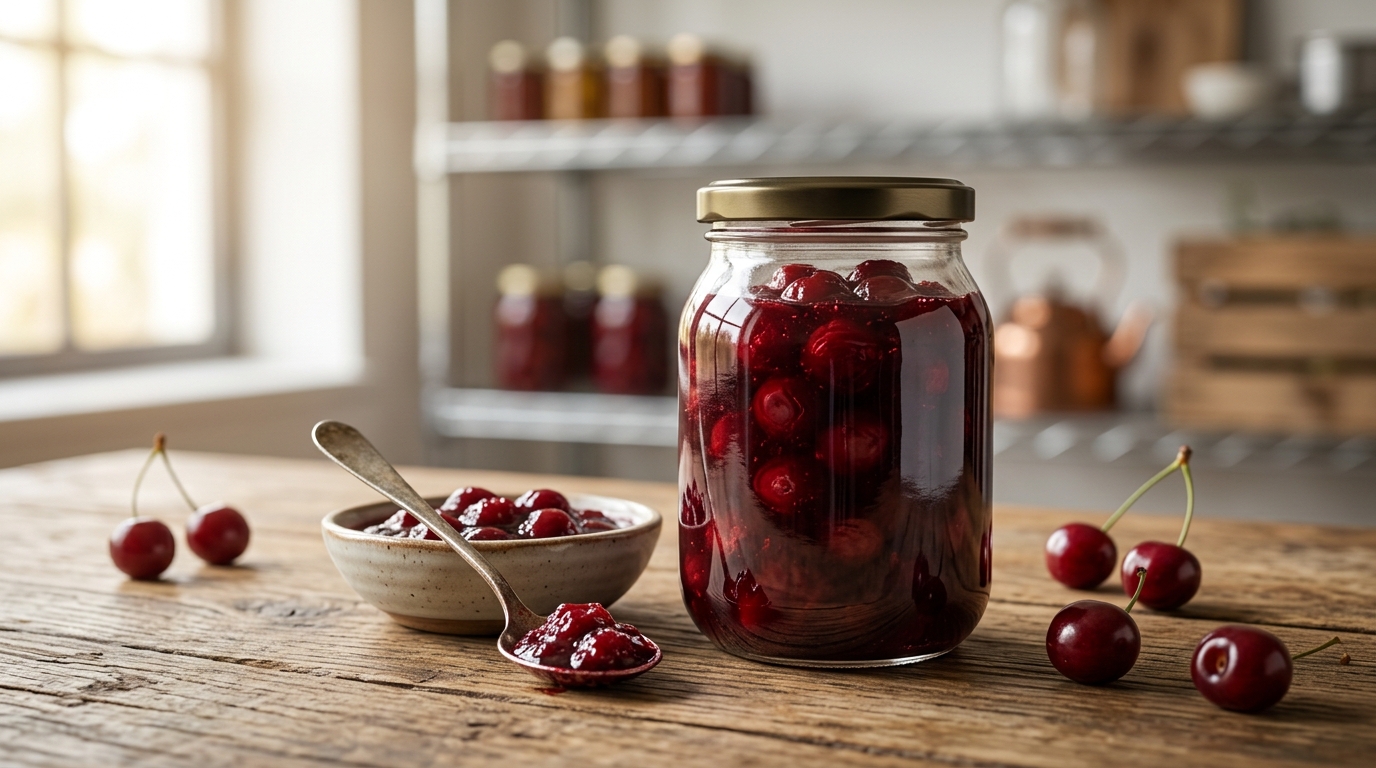
Timing Sour Cherry Jam Buys When Finished-Goods Pricing Lags Fruit: A Practical Sourcing Playbook

Author
Team Tridge
DATE
April 23, 2026
8 min read
sour-cherry-jam Cover
Tridge Eye Data Intelligence Solution

This report is powered by Tridge Eye Data Intelligence.

Every data point, price signal, and supply risk insight in this analysis comes from the same platform that procurement and sourcing leaders worldwide rely on daily. As you read, consider what this level of market intelligence could do for your sourcing decisions.

Explore Tridge Eye →

This guide is for procurement and sourcing managers who buy sour cherry jam (often private label) and keep getting surprised by quotes that don’t “move with fruit.” The goal is to make pricing discussions auditable and to time actions around the supplier’s real cost base—fruit lots, packaging POs, and conversion constraints—without breaking QA or brand specs.

Executive Summary

  • Sour cherry jam is a lagged-cost category: seasonal fruit is often carried as frozen/aseptic inventory, while packaging and conversion can reprice faster.
  • For “standard jam” labeling, many programs target ~60–65% soluble solids depending on market/regime; US standard of identity references ≥65% soluble solids [1].
  • The most actionable negotiation proof points are fruit lot month (or pack/production month for puree/concentrate) and packaging PO month tied to your SKU.
  • Better outcomes come from a two-lane plan: secure allocation/continuity ahead of harvest risk, then reopen price when the supplier’s cost base actually rolls.

Key Insights

Analyzed at: Apr, 2026

  • Strategy: Hold
  • Reliability: Medium
  • Potential Saving: 4–9%
  • Insight: In April (pre–Northern Hemisphere harvest), avoid “fruit-headline pricing.” Instead, push suppliers to separate (1) current-cost inventory runs vs (2) new-season fruit runs by quoting two price effective dates tied to fruit lot/pack month and packaging PO month. Sour cherries typically harvest in June–July in parts of Central/Eastern Europe and July–August in key US tart-cherry regions, so the cleanest leverage window is often when suppliers begin contracting/packing new-season fruit and resetting packaging POs. Use that moment to lock allocation + capped pass-through rules now, and schedule a re-cost review trigger when the fruit lot changes [2].

Access the live market signals behind this analysis.

Get the Sourcing Strategy Toolkit

Executive Summary (What signals you’re missing—and how to beat the index)

Insight → Sour cherry jam pricing often doesn’t track sour cherry input costs in the same quarter. The “alpha” comes from exploiting predictable lags: fruit is bought in a short harvest window, then carried as frozen/aseptic inventory; packaging and conversion costs can move opposite to fruit; and private label/retail repricing cycles delay pass-through.

Data → In a typical EU/US private label program, it’s common to see ~2–4 months of fruit inventory coverage at the processor/co-man level, while glass/lids can reprice in weeks and energy surcharges can hit within a month. In practical terms, a 10–20% move in fruit can translate to only ~3–8% on finished jam in the near term if packaging and conversion are rising, or ~12–18% if packaging is easing and the supplier is re-costing new-season fruit.

Procurement impact → If you negotiate only off “fruit news,” you’ll miss the real lever: where your supplier is sitting in their inventory and packaging cycle. The best buyers create a two-lane strategy: (1) lock continuity before harvest risk, and (2) use evidence of inventory re-costing + packaging indices to reopen pricing before the supplier’s standard repricing window.

Quick win: Ask every supplier for a cost-validity statement tied to fruit lot/pack month + packaging PO month (not just “valid 30 days”). That one question quickly tells you whether you’re negotiating against old-cost inventory or new-cost reality.

A horizontal 12-month multi-lane timeline chart showing fruit harvest and lot/pack month changes with inventory coverage bands, packaging PO month changes and repricing speed, and finished-goods pricing reset cadence, with annotated negotiation windows and a legend defining fruit lot/pack month and packaging PO month as auditable proof points.

1) The market timing trap: why jam prices and fruit costs disconnect

Insight → Sour cherry jam is a “lagged-cost” category: the fruit is seasonal and often carried as frozen/puree inventory, while the finished jam price is governed by contract cycles, packaging availability, and conversion constraints. That creates repeatable price disconnects you can trade.

Data → Three common disconnect patterns (with realistic numbers):

Two side-by-side waterfall charts bridging from baseline to new delivered jam cost: Scenario A shows fruit down with packaging up and conversion/energy up resulting in a small net change; Scenario B shows fruit down with packaging easing and stable conversion resulting in a larger net change. Component buckets include Fruit Input, Sugar/Ingredients, Packaging (Jar/Lid/Label), Conversion (Labor/Energy), Freight/Logistics, and Margin/Overhead, with a note that percentages are illustrative ranges emphasizing mix and timing.
  1. Fruit drops, jam holds (inventory + packaging floor)

  2. Example: Sour cherry puree/frozen input softens -15% post-harvest due to better-than-feared yields.
  3. Your co-man’s jam quote declines only -3% to -5% because:
  4. They’re still consuming fruit bought earlier at higher prices (inventory coverage ~8–12 weeks).
  5. Glass + lids rose +10% over the last quarter and now represent a larger share of delivered cost.
  6. Procurement impact: Your “right price” exists, but only after the supplier rolls to new fruit lots or if you can prove they’re already buying/using new-season fruit.
  7. Fruit rises, jam lags (contract rigidity + retailer repricing)

  8. Example: A frost event tightens supply; fruit inputs move +20% quickly.
  9. Finished jam pricing stays flat for one quarter due to:
  10. Annual/biannual private label pricing windows.
  11. Supplier buffering with carryover inventory.
  12. Procurement impact: This is the window to secure continuity: you may not get cheaper price, but you can negotiate allocation, lead-time priority, and capped surcharges before the next reset.
  13. Jam rises while fruit is flat (conversion shock)

  14. Example: Fruit is stable (±2–3%), but jam quotes jump +6–10% because:
  15. Energy/steam costs spike, or
  16. A jar/closure spec becomes constrained, forcing spot buys.
  17. Procurement impact: You can’t “argue fruit.” You must pivot to packaging alternates, freight optimization, or conversion benchmarking.

Key takeaways:

  • Your negotiation timing should follow the supplier’s inventory turn, not the harvest headline.
  • Packaging can erase fruit savings (or amplify them) inside a single quarter.
  • The most reliable leading indicator is the supplier’s fruit lot/pack month + packaging PO month tied to your SKU.

2) Three mistakes that quietly destroy savings (and how to fix them)

Mistake #1: Treating jam like a commodity quote (instead of a cost-lag product)

  • What happens: You run an RFQ, get 2–3 quotes, and award on €/kg without asking what cost base the quote reflects.
  • Why it fails: Two suppliers can quote the same price while one is on old-cost fruit and the other on new-cost fruit—meaning one is about to reprice.
  • Fix (quick win): Require a quote disclosure: fruit input form (IQF/puree/concentrate), fruit lot/pack month, packaging PO month, and cost-validity logic (e.g., “valid until fruit lot changes”).

Mistake #2: Locking a “hero jar” that turns packaging into your single point of failure

  • What happens: Brand insists on a unique jar/closure/label substrate; procurement negotiates jam but ignores packaging optionality.
  • Why it fails: When lids or specific glass formats tighten, suppliers pass through premiums fast; you lose leverage because alternates require artwork, line trials, and QA sign-off.
  • Fix (quick win): Pre-approve two packaging equivalencies (e.g., alternate lid liner or jar supplier) with a documented change-control path and a pre-priced delta.

Mistake #3: Dual-sourcing on paper, single-sourcing in reality (capacity + QA gates)

  • What happens: You “approve” a backup supplier, but they never run your SKU at scale, and you never test their peak-season lead time.
  • Why it fails: In a short crop year, the backup can’t secure fruit or jars; or your first commercial run triggers quality holds, wiping out the apparent continuity plan.
  • Fix (quick win): Fund one annual validation run (even a limited volume) and track two KPIs: time-to-confirm capacity and first-pass quality acceptance rate.

3) What changes when you run sourcing like an intelligence problem (not an annual event)

Insight → Better outcomes come from separating (a) what you can index and verify (fruit lots, packaging POs, freight), from (b) what you must govern (spec changes, QA risk, allocation rules).

Data → Typical before/after performance (realistic ranges for mature procurement teams):

Metric Traditional (quote-driven) Intelligence-driven (signal-driven)
Delivered cost variance vs. budget 6–12% 2–5%
Emergency buys (premium freight/spot packaging) 2–4 per year 0–1 per year
Time to activate alternate supplier (qualified → shipping) 8–14 weeks 3–6 weeks
OTIF in peak season 85–92% 93–97%

Procurement impact → The “win” is not just price. It’s fewer surprises: less expediting, fewer production plan changes, and a cleaner audit trail for why you changed suppliers/specs.

Quick win: Build a monthly “jam dashboard” with only 6 fields: supplier lead time drift, OTIF, quality holds, fruit lot/pack month, packaging PO month, and open CAPAs.

4) Three high-stakes scenarios where timing + signals outperform negotiation skill

Scenario A: Your annual renewal is in 60 days—and fruit headlines are noisy

Insight → Your leverage depends on whether the supplier is about to roll to new-season fruit.

Data → If fruit lot/pack month is still “old season,” price concessions are limited; if they’re already contracting/packing new fruit, you can negotiate off forward commitments.

Procurement impact (quick win): Ask for two offers: (1) price with current lots, (2) price effective upon new lot change—then choose based on your demand curve.

Scenario B: QA flags rising defects/complaints and ops wants a fast switch

Insight → Switching fast without pre-work creates hidden cost.

Data → First production runs with a new co-man commonly require 1–2 iterations for viscosity/fruit dispersion consistency.

Procurement impact (quick win): Use a “48-hour triage”: determine if the issue tracks to supplier process (line/CIP/foreign body) or origin-wide variability (crop). That decides whether you rework with incumbent or activate alternates.

Scenario C: Packaging disruption hits (jars/lids/labels)—and suppliers blame “the market”

Insight → Packaging shocks are where suppliers over-generalize and buyers under-challenge.

Data → Spot packaging premiums can be real, but they should be traceable to PO dates, MOQ breaks, and freight mode changes.

Procurement impact (quick win): Demand a pass-through rule: packaging surcharges require documented PO evidence and expire when the PO cycle normalizes.

5) Why this playbook transfers to your other categories

Insight → Sour cherry jam behaves like other “seasonal input + steady retail demand” categories where inventory and conversion costs dominate timing.

Data → Similar patterns show up in:

  • Strawberry/raspberry preserves: higher crop volatility; faster quality swings, similar lagged pass-through.
  • Tomato-based sauces: raw material cycles + packaging and energy shocks drive disconnects.
  • Fruit fillings for bakery: spec tightness (viscosity/particulates) reduces supplier pool; capacity becomes the hidden price floor.

Procurement impact: If you build the habit of verifying inventory position + packaging exposure, you’ll outperform teams who negotiate only off commodity indices.

6) The real proof: this is governance + performance, not “better haggling”

Insight → In sour cherry jam, the best buyers win by making pricing auditable and switches executable—before the market forces them.

Data → Most margin leakage comes from three places: (1) paying for supplier risk you didn’t measure, (2) paying for packaging constraints you didn’t pre-approve alternates for, and (3) paying for speed (expedites) because your alternate wasn’t truly ready.

Procurement impact (logical next step): If you can’t answer—within one meeting—which fruit lots and packaging POs your current price reflects, you’re negotiating blind. The next level of performance requires always-on external signals plus internal supplier evidence, so your team can reopen pricing (or activate alternates) based on facts, not narratives.

7) Key Strategic Insights (Market Timing & Intelligence Lens)

  • Strategy: Hold
  • Reliability: Medium
  • Potential Saving: 4–9%
  • Insight: Don’t chase fruit headlines. Time negotiations to the supplier’s re-costing moment: when they switch fruit lots (new season) or reset packaging POs. Use a two-step approach—secure allocation/continuity ahead of harvest-risk months, then reopen price once you can evidence the supplier is buying (or consuming) lower-cost fruit and/or packaging. The “alpha” is capturing the lag: you’re not predicting the crop—you’re verifying what cost base is actually in your jar today.
Tridge Eye Data Intelligence Solution

Start Making These Sourcing Decisions with Live Signals

Tridge Eye — The strategy playbook above works — but only with current data feeding it. Real-time price movements, supplier risk scores, and origin alerts turn these frameworks into daily competitive advantages.
Get My Market Intelligence →

References

  1. law.cornell.edu
  2. apps.fas.usda.gov
Subscribe
By subscribing you agree to with our Privacy Policy and provide consent to receive updates from our company.
Thank you! Your submission has been received!
Oops! Something went wrong while submitting the form.
Subscribe to receive the latest blog posts, updates, promotions, and announcements from Tridge.