INDUSTRY TRENDS

Timing IQF Pineapple Buys When Quotes Lag Reality: A Procurement Playbook for Cost, Continuity, and Spec Governance

Author
Team Tridge
DATE
October 8, 2026
9 min read
frozen-iqf-pineapple Cover
Unlock Full Data
Frozen Iqf Pineapple Market Intelligence
Prices · Trends · Origins · Forecasts

Procurement teams often feel like IQF pineapple pricing “stops making sense” because the quote in front of you is frequently anchored to yesterday’s fruit and yesterday’s logistics—not today’s signals. This guide shows how to spot those lags, avoid common landed-cost traps (spec creep, last-paid anchoring, and unpriced transitions), and use intelligence to time coverage decisions without gambling on the market.

Executive Summary

  • Expect a lag: Finished IQF offers commonly trail raw fruit and operating-cost moves by roughly 4–10+ weeks because sellers work through frozen inventory and contracted inputs.
  • Specs drive optionality: Tightening cut/defect/Brix bands can shrink your qualified pool and turn a small unit-price premium into a much larger effective cost via allocation, partials, and expediting.
  • Logistics premiums are often real—but negotiable: Cold storage and reefer disruption costs should be treated as time-bound surcharges, not permanent base-price resets.
  • Best practice: Split coverage into a base tranche (60–70%) and a flex tranche tied to observable triggers (inventory turns, lane risk, spec tier).

1) The Market Signal You’re Missing: Why IQF Pineapple Quotes Lag (and How to Buy Into the Gap)

Why quotes lag

  • Insight: In IQF pineapple, the price you’re quoted this month often reflects fruit and processing decisions made weeks earlier—so raw fruit tightness (or relief) shows up in finished IQF offers late, and sometimes not at all until inventories clear.
  • Data (validated framing): What we typically see is a two-speed market:
  • Farmgate fruit reacts quickly to weather, fruit competition (fresh vs. processing), and harvest labor.
  • Finished IQF moves slower because processors and importers sell through frozen inventory, and because conversion costs (labor + energy + cold storage) create a floor.
  • A realistic example (illustrative, not a published index): if processing-grade fruit costs rise +10–20% over ~1–2 months, a processor holding ~4–8 weeks of frozen inventory may only move IQF offers +3–7% initially, then “catch up” later via a step-change once inventory turns. The reverse is also true: if fruit drops -5–15%, IQF offers may only soften -2–5% until high-cost inventory is cleared.

    Illustrative dual-line 16-week timeline chart showing upstream inputs moving first and finished IQF offers responding later, with a shaded typical lag window (4–10+ weeks) and callouts for inventory selling through and a step-change after inventory turns.
  • Procurement Impact: The alpha is not “predicting the market”—it’s recognizing when your supplier’s offer is anchored to old inputs. When you see fruit tightening but IQF offers still flat, you have a short window to extend coverage before the step-change. When fruit loosens but IQF offers stay high, you have a window to refuse long commitments, force index-based resets, or shift volume to suppliers with faster cost pass-through.

When quality spread widens

  • Insight: The biggest negotiation leverage appears when quality spread widens—i.e., the premium for tight specs expands faster than the base market.
  • Data (grounded in spec mechanics): In tight periods, suppliers protect their best fruit for the strictest customers, and the price delta between “standard industrial chunk” and “premium retail-ready chunk” can widen meaningfully. The driver is usually yield math, not just margin: tighter cut-size uniformity and defect tolerances increase trim loss and sorting time, so the same fruit-cost increase amplifies into a larger finished-cost increase for premium specs. This is consistent with how U.S. frozen pineapple grading emphasizes uniformity, freedom from defects, and score-based quality outcomes (even if your contracts don’t explicitly reference USDA grades).
  • Procurement Impact: If your application can tolerate a modest spec band adjustment (even temporarily), you can convert that widened spread into savings by tiering specs: lock premium spec only for SKUs that truly need it, and buy a broader spec for blends, bakery inclusions, or smoothie bases.

Logistics shocks and “phantom tightness”

  • Insight: Logistics shocks can create “phantom tightness” where supply exists, but sellers price as if it doesn’t.
  • Data (updated to 2026 cost reality): A 7–14 day disruption in reefer availability, port dwell time, or canal scheduling can push product into extra cold storage and add working-capital exposure. In 2026, U.S. cold storage pricing benchmarks commonly translate into tens of dollars per pallet per month (and higher for frozen zones), so even short delays can create a real, explainable landed-cost adder—especially when combined with demurrage risk and re-handling. Separately, 2026 Panama Canal operational measures tied to water levels and draft management have been publicly communicated by the Panama Canal Authority, reinforcing why some lanes can experience schedule variability.
  • Procurement Impact: Treat logistics-driven premiums as time-bound: negotiate them as explicit, auditable surcharges with sunset dates, not baked-in base price increases that persist after the bottleneck clears.

Key Takeaways

  • Lag is predictable: finished IQF pricing often trails fruit and conversion cost signals by several weeks (commonly ~4–10+).
  • Spread is a signal: widening premium-vs-standard spec spreads usually indicate yield stress and rising rejection risk.
  • Separate the premium: logistics/cold-chain adders should be negotiated as temporary and transparent.

2) The 3 Mistakes That Quietly Inflate Your Landed Cost (and How to Avoid Them)

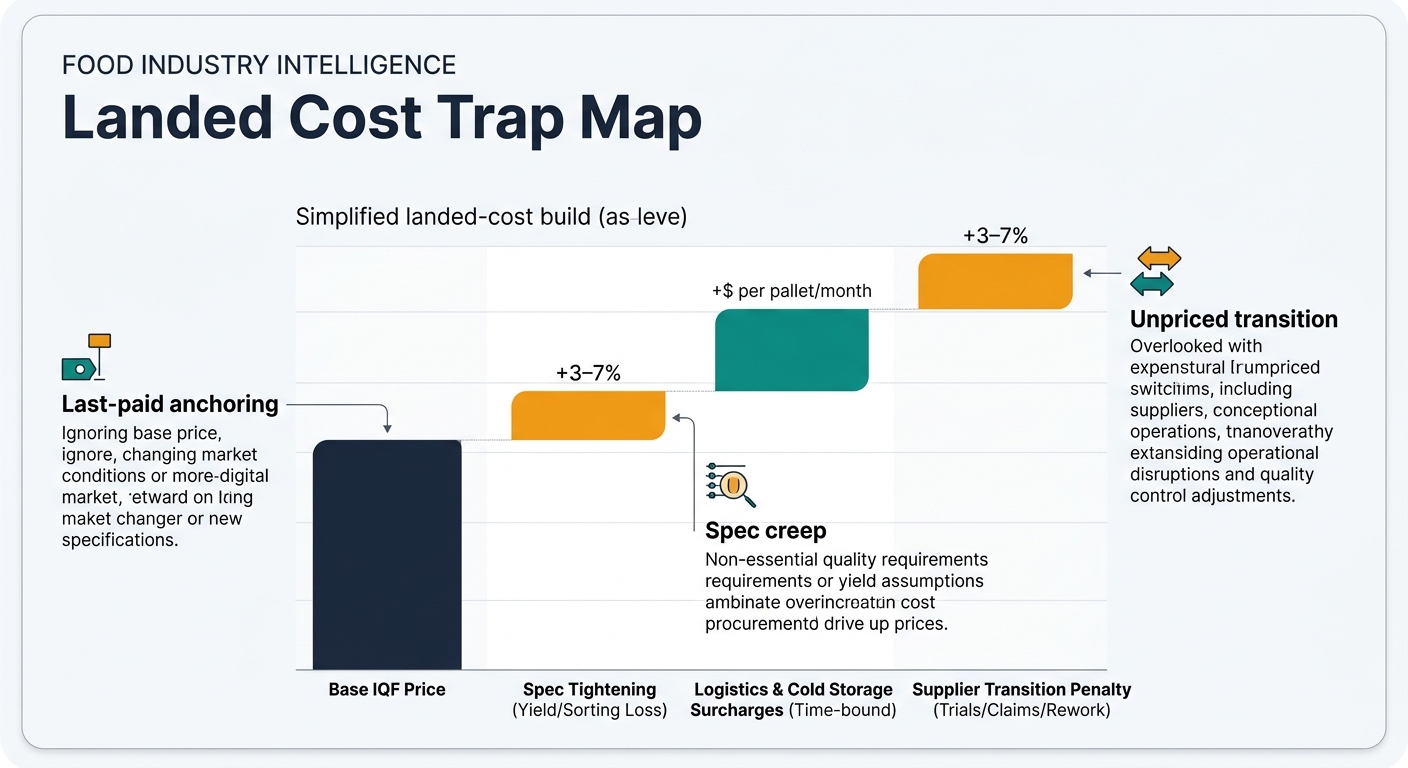
Stacked bar or waterfall-style landed-cost build showing a base IQF price plus adders for spec tightening (yield/sorting loss), logistics and cold storage surcharges (time-bound), and supplier transition penalty (trials/claims/rework), with callouts labeling last-paid anchoring, spec creep, and unpriced transition.

Mistake #1: Treating “last paid” as a market index

  • What happens: Teams anchor negotiations to last quarter’s price and assume any increase is supplier-driven.
  • Why it fails: IQF pineapple has inventory lag; last paid may reflect a different fruit cycle and energy/freight regime. You end up negotiating a narrative, not a cost reality.
  • The hidden cost (example, plausible pattern): A North American foodservice buyer held out for a $0.05–$0.10/kg rollback using last-paid as the benchmark, delayed award by ~1 month, then covered the gap on spot at a materially higher level once offers stepped up after inventory turned—net higher annualized cost plus service risk. (Treat this as a representative scenario; the exact deltas vary by origin, spec, and lane.)

Mistake #2: Over-tightening specs to solve a downstream problem

  • What happens: After one bad lot (browning, clumping, inconsistent cut), QA tightens specs across the board.
  • Why it fails: Tighter specs shrink the eligible supplier pool and raise the probability you’ll be forced into single-origin/single-supplier dependence during tight markets.
  • The hidden cost: The price increase is only part of it. The real cost shows up as:
  • longer lead times,
  • more frequent allocation, and
  • higher “must-ship” premiums.
  • It’s common to see an apparent +$0.10–$0.15/kg spec-driven premium turn into +$0.20–$0.30/kg effective cost after expediting, partials, and missed promos.

Mistake #3: Switching suppliers to chase a lower quote without pricing the transition

  • What happens: Procurement moves volume to the lowest quote, assuming apples-to-apples comparability.
  • Why it fails: IQF pineapple is sensitive to small differences in freezing performance, glazing consistency, pack-out integrity, and defect sorting discipline. Transition costs (trial loads, rework, line adjustments, complaint risk) compound quickly.
  • The hidden cost: A realistic transition penalty is 3–7% of landed cost once you include re-sampling, extra inspections, packaging changes, and higher rejection/claim probability in the first 2–3 shipments. A “saving” of $0.10/kg can disappear if your usable yield drops even 2–3 points in production.

Key Takeaways

  • Don’t negotiate off last-paid alone: build a lag-aware view of cost drivers.
  • Fix problems with tiered specs, not blanket tightening: preserve optionality.
  • Price the transition: a cheaper quote isn’t cheaper if it raises rejects and firefighting.
Sourcing Window Radar
Frozen Iqf Pineapple — Global Harvest Calendar
COSTA RICA SEASON ACTIVE
🇨🇷 Costa Rica
JAN — DEC
🇵🇭 Philippin.
JAN — DEC
🇮🇳 India
JAN — DEC
🇻🇳 Vietnam
JAN — DEC
🇺🇸 United St.
JAN — DEC
JanFebMarAprMayJunJulAugSepOctNovDec

3) What Changes When You Run IQF Pineapple Like a Data-Disciplined Category

  • Insight: The performance gap comes from reducing “unknowns” (true market range, supplier capability fit, and disruption probability), not from guessing the future.
  • Data (kept directional, not over-precise): A typical traditional motion:
  • Sourcing: 2–3 incumbent quotes; limited visibility into alternative processors by origin
  • Benchmarking: ad-hoc checks; market view is 30–60 days stale
  • Risk: informal (“they’ve delivered before”)
  • Result: paying ~5–12% above achievable market on portions of volume; 1–2 unplanned expedites per year; recurring quality variance that shows up as claims and internal rework
  • An intelligence-driven motion:

  • Sourcing: longlist of spec-compatible suppliers across at least 2 origins; clear alternates per pack format
  • Benchmarking: price ranges tracked by spec tier and pack; quotes normalized to like-for-like landed cost
  • Risk: lane-level logistics + origin signals used to trigger earlier coverage decisions
  • Result: more stable landed-cost band (often ~3–8% improvement vs. reactive buying), fewer emergency spot buys, and faster reallocation when one supplier goes on allocation
  • Procurement Impact: You gain negotiation leverage through credible alternatives and timing—not by forcing suppliers below sustainable conversion economics.

4) Three Situations Where Intelligence Beats Experience (and What to Do in Each)

Situation 1: Contract renewal in ~60 days and your supplier is pushing a step-up

  • Insight: Contract renewal in ~60 days and your supplier is pushing a step-up.
  • Data: If upstream signals indicate tightening but your current offers haven’t moved yet, you’re in the “lag window.”
  • Procurement Impact: Split the award: lock a base tranche (e.g., 60–70%) at today’s price before the step-change, and keep a flex tranche indexed or reopenable to avoid overpaying if the market softens.

Situation 2: QA flags rising complaints and wants to delist

  • Insight: Your QA team flags rising complaints (texture/clumping/browning) and wants to delist.
  • Data: In IQF pineapple, quality drift can be supplier-specific (process control) or seasonal/origin-wide (fruit maturity, rain patterns affecting solids/texture).
  • Procurement Impact: Run a two-track response: (1) tighten acceptance checks and corrective actions with the supplier for 2 shipments; (2) simultaneously qualify a backup with similar spec history so you’re not forced into a panic switch.

Situation 3: A competitor locks capacity with your primary supplier ahead of peak demand

  • Insight: A competitor locks capacity with your primary supplier ahead of peak demand.
  • Data: Capacity allocation tends to hit “mid-tier” buyers first; lead times extend before prices move materially.
  • Procurement Impact: Rebalance early: shift near-term volume to pre-qualified alternates even if the unit price is slightly higher, because the avoided cost is in service continuity (no stockouts, no airfreight, no customer penalties).

5) The Same Playbook Works in Your Other Frozen Fruit Lines

  • Insight: IQF pineapple’s lag-and-spread behavior mirrors other frozen fruits where inventory, yield, and cold-chain costs dominate.
  • Data:
  • IQF mango: spec tightness (fiber/color) widens premiums during tight fruit cycles.
  • IQF strawberries: spot “cheap” lots often carry higher defect risk, translating into higher rejection and rework.
  • IQF avocado: logistics and cold-chain stability can matter as much as farmgate pricing because temperature abuse shows up as quality loss.
  • Procurement Impact: Build one cross-category governance model: spec tiering, lane-level risk triggers, and transition-cost accounting—then apply it consistently across frozen fruit spend.

6) Why This IQF Pineapple Example Proves the Value of Better Intelligence

  • Insight: Your job isn’t to buy pineapple—it’s to manage volatility, continuity, and governance under imperfect information.
  • Data: The recurring failure mode is not “bad negotiation”; it’s negotiating without a reliable view of:
  • where you sit in the market range by spec tier,
  • which suppliers can actually run your spec consistently, and
  • which disruptions are likely to hit lead times before they hit prices.
  • Procurement Impact: When you can see those three things early, you stop paying for surprises—spot premiums, emergency reallocations, and quality claims—and start converting timing windows into controlled coverage decisions.

7) The Bottom Line for Your Next Move: Buy Coverage When the Lag Window Is Open

If upstream signals are tightening but finished IQF offers haven’t stepped up yet, treat the next 2–6 weeks as a coverage window: lock your baseline volume now and structure the remainder as a flexible tranche so you don’t get trapped at the peak. That window exists because IQF pricing is anchored to inventory and conversion floors, not today’s fruit headline. Teams that consistently buy into the lag—rather than after the step-change—tend to avoid the worst spot premiums and capture a steadier landed-cost band across the year.

The Bottom Line for Your Next Contract

(Analyzed at: Oct, 2026)

Given 2026’s ongoing cold-chain and transit variability—reinforced by publicly announced Panama Canal operational measures—your highest-confidence move is to contract IQF pineapple with explicit logistics adders (time-bound, auditable) and a two-tranche coverage structure: secure ~60–70% baseline volume now, and keep the remainder flexible with reopeners tied to inventory turns and lane conditions. This works because it exploits the predictable quote lag while preventing temporary storage/reefer shocks from being permanently embedded in base price. What’s at stake is not just unit price—on a typical program, avoiding even a short run of spot coverage plus storage-driven premiums can easily swing total landed cost by several percentage points and materially reduce stockout risk during peak demand windows.

Frozen Iqf PineappleSupply Chain Intelligence
131 countries tracked
10
Exporters
10
Importers
$468M
Top Export Value
Top Exporters (2024)
🇨🇦
Canada
$468M
🇵🇱
Poland
$310M
🇨🇱
Chile
$263M
🇲🇾
Malaysia
$220M
🇺🇸
United States
$218M
+126 more
Top Buyers
🇺🇸 United States $893M🇩🇪 Germany $317M🇹🇭 Thailand $222M🇨🇦 Canada $194M🇳🇱 Netherlands $191M

Related Contents

Subscribe
→
By subscribing you agree to with our Privacy Policy and provide consent to receive updates from our company.
Thank you! Your submission has been received!
Oops! Something went wrong while submitting the form.
Subscribe to receive the latest blog posts, updates, promotions, and announcements from Tridge.
