
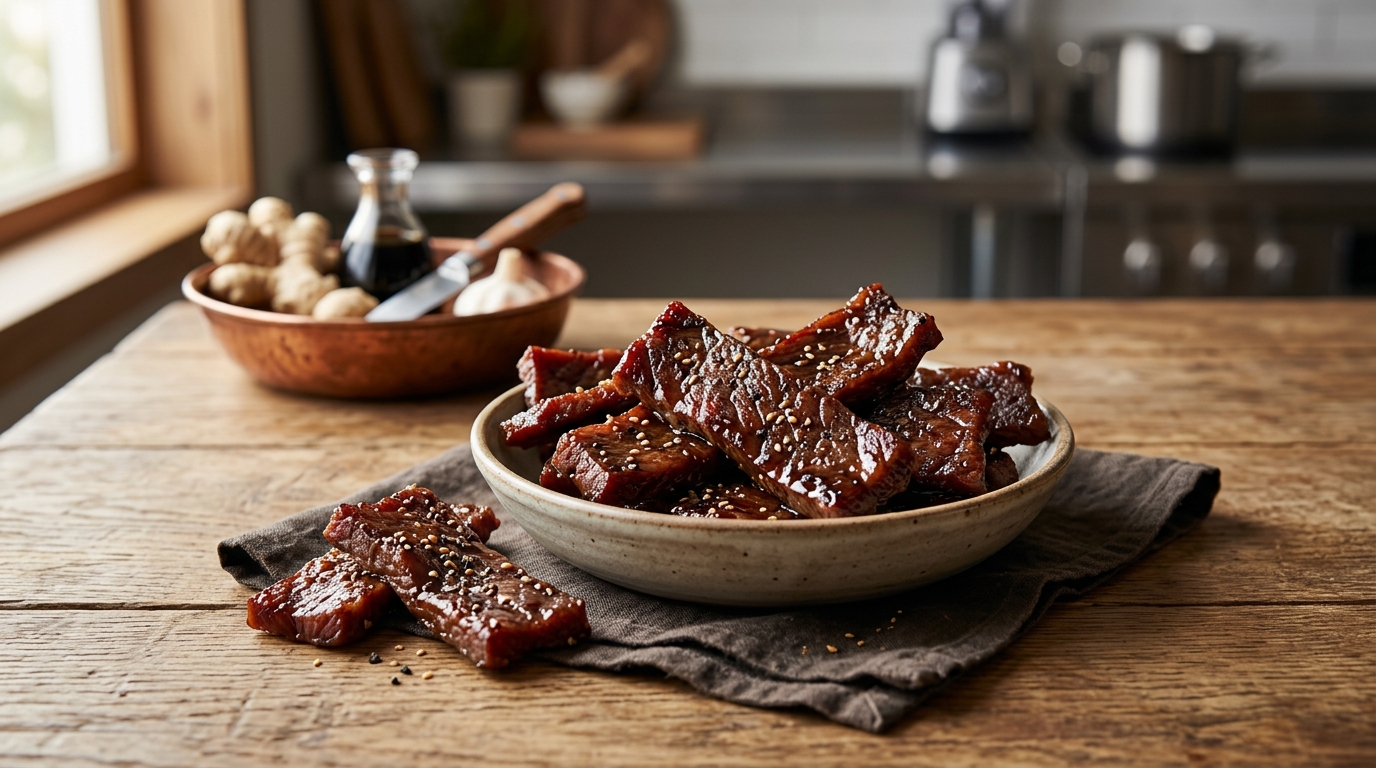
Teriyaki beef jerky “origin” conversations go sideways when they’re framed as a simple beef-price debate. In practice, you’re choosing a bundled lane that affects qualification speed, validated RTE controls, dryer throughput, packaging performance, and ultimately service reliability. This comparison is written for BD/Strategy leaders who need a credible, easy-to-explain sourcing narrative that still holds up with Procurement, QA, and Ops.
For teriyaki beef jerky, the “origin decision” is rarely just about beef price—it’s a bundled decision across export eligibility, pathogen-control validation, yield, and packaging performance that shows up as margin volatility and service failures.
Jerky is a ready-to-eat (RTE), shelf-stable dried product where FSIS guidance indicates the lethality treatment for meat jerky should achieve at least a 5.0-log reduction of Salmonella spp. (and for beef products, also references reductions for STEC), and that jerky programs need scientific support and ongoing process control—not “drying alone and hope.” (FSIS jerky compliance guideline on GovInfo; FSIS jerky guideline PDF used in FSIS training) [1]
If you compare origins only on $/lb of raw beef, you can “win” the bid but lose on (1) qualification timeline, (2) co-man throughput/yield, and (3) recall exposure—each of which can cost more than the initial price delta.
U.S. supply tends to win on speed and governance fit; Brazil can win on raw material economics but adds trade/compliance and perception friction; Australia often wins on consistency/traceability narratives but can be constrained by export allocation and freight.
USDA ERS continues to signal tight cattle/beef dynamics into 2026–2027, with elevated price expectations and forecast adjustments that keep buyers exposed to volatility even if they “change lanes.” [2]
The “best” option depends on which constraint is binding for your business this quarter: cost, continuity, audit readiness, or speed-to-scale.

| Option (Beef Origin + Typical Supply Path) | Cost | Quality | Risk | Lead Time | Availability | Bottom line |
|---|---|---|---|---|---|---|
| A) U.S. beef → U.S. jerky co-man | Medium | High | Medium-Low | Fast | Medium-High | Best for speed, governance, and retailer resets; still exposed to U.S. cattle cycle volatility. |
| B) Brazil beef → U.S. processing (or imported inputs for co-man) | Low-Medium | Medium-High | Medium-High | Medium | Medium | Can improve input economics, but adds policy/logistics variance and heavier qualification work. |
| C) Australia beef → U.S. processing (or import programs) | Medium-High | High | Medium | Slow-Medium | Medium | Strong for consistency/traceability positioning; freight and allocation can be the swing factors. |
Jerky cost is hypersensitive to yield and throughput—small shifts in target moisture/water activity, slice thickness, or lean point can swing cost per finished pound more than a modest beef price difference.
FSIS training and guidance for RTE shelf-stable products reinforces multi-hurdle thinking (lethality + stabilization + drying) and the need to control critical parameters—controls that directly influence drying time, energy use, and throughput. [3]
Put origin options into a should-cost that separates (1) beef input, (2) expected yield loss from drying, (3) energy/dryer hours, (4) packaging (barrier film + oxygen management), and (5) freight—then negotiate the line items that match your binding constraint.
Teriyaki jerky quality failures usually show up as texture (too hard/too soft), flavor drift (soy/sugar balance), or shelf-life defects (oxidation) rather than obvious “bad beef.”
FSIS notes that product dating on FSIS-regulated products is generally voluntary, but if used it must be truthful/not misleading; shelf-life outcomes depend heavily on packaging and distribution conditions—so packaging specs and lane design matter. [4]
When comparing origins, lock the spec hierarchy: what is non-negotiable (water activity target, slice style, allergen controls, flavor profile) vs what can flex (cut selection, trim blend) without consumer-visible change.
In jerky, supply risk is often “one plant / one dryer bank / one packaging converter” rather than “one country.”
FSIS jerky guidance ties a defensible program to scientific support and validated controls (including the commonly referenced 5-log Salmonella reduction expectation in the jerky guideline), which is exactly why alternate qualification often takes longer than teams expect. [1]
Origin diversification only helps if it also diversifies facilities, validated processes, and packaging sources—otherwise you’ve just added logistics complexity without reducing operational single points of failure.
For sales commitments, the dangerous number isn’t “average lead time,” it’s lead time variance during promotions and peak travel seasons.
ERS outlook commentary and forecast updates into 2026–2027 reinforce a tight supply environment that tends to drive allocation behavior and scheduling volatility across the chain (even before you add ocean freight variability for import lanes). [2]
Build contracting terms around service protection: committed run windows, packaging call-offs, and clearly defined substitution rules (e.g., equivalent film structures) to prevent last-minute expedites.
Scaling jerky isn’t just adding beef; it’s securing dryer hours, validated process windows, and QA release capacity.
FSIS training emphasizes that lethality/stabilization controls are central to RTE shelf-stable operations, which in practice means scale is gated by controlled process windows and verification cadence—not just raw material availability. [3]
When comparing options, ask suppliers/co-mans for (1) maximum weekly throughput by format, (2) changeover time for allergen-containing teriyaki lines, and (3) typical QA hold times—then translate that into your forecast risk.
Sustainability requirements can unintentionally reduce your eligible supplier pool if you treat them as binary gates rather than phased requirements.
Packaging cost/availability in 2026 continues to be influenced by resin, energy, and freight drivers, with ongoing pass-through dynamics—creating practical risk when teams try to change structures while also demanding high barrier performance. (Industry packaging market commentary; use as directional signal, not a price index.) [5]
Use a two-step approach: keep performance-critical barrier specs stable in the near term, while running parallel qualification on alternative structures/converters to avoid shelf-life regressions.
The most useful comparison is a standardized scorecard that your cross-functional team (Procurement + QA + Ops + Commercial) can agree on in one meeting.
FSIS jerky guidance emphasizes scientific support and validated controls for RTE processes; that reality makes “governance readiness” a practical differentiator between options. [1]
Use the tables below as an RFI template—force apples-to-apples answers before you ask for final pricing.
| Cost element (TCO driver) | A) U.S. beef → U.S. co-man | B) Brazil beef programs | C) Australia beef programs |
|---|---|---|---|
| Raw beef input (index) | 100 | 85–98 | 95–110 |
| Logistics + customs variance | 100 | 115–140 | 120–150 |
| Qualification / governance load | 100 | 120–160 | 115–150 |
| Total landed cost (directional) | 100 | 95–110 | 100–120 |

How to use this: If your business is promotion-heavy and service-sensitive, the variance and qualification indices can matter more than the raw beef index.
| Dimension | A) U.S. | B) Brazil | C) Australia |
|---|---|---|---|
| Food-safety governance fit (RTE validation readiness) | Low | Medium | Medium |
| Policy/trade/logistics disruption exposure | Medium | High | Medium |
| Supply concentration (depends on your co-man footprint) | Medium | Medium | Medium |
| Beef input price volatility exposure | Medium-High | Medium | Medium |
| Packaging dependency (barrier film/absorbers) | Medium | Medium | Medium |
The right option changes depending on whether you’re protecting a base business, launching a new SKU, or rescuing service levels after a disruption.
FSIS-oriented lethality/stabilization expectations and documentation needs tend to slow down alternate qualification if you haven’t pre-built a dossier (scientific support, in-plant data, verification plan). [1]
Match the option to the decision you’re making this quarter, not to a generic “best origin.”
| Your top priority | Recommended option | Why |
|---|---|---|
| Fastest time-to-cover / service recovery | A | Shorter lanes + easier governance alignment. |
| Lowest input-driven COGS (with time to qualify) | B | Potential raw material advantage, but manage variance. |
| Premium consistency + traceability narrative | C | Strong fit for premium positioning if lane planning is mature. |
The highest-leverage move is usually not a full origin switch—it’s building a pre-qualified alternate lane and a cost-driver-backed negotiation posture.
ERS outlook updates into 2026–2027 continue to support a “tight supply / high price” environment narrative for beef, while FSIS jerky guidance keeps RTE validation and scientific support as non-negotiable foundations for jerky processes. [2] [1]
You can reduce spot buys and expedite costs by pre-building alternates (beef + co-man + packaging) and contracting around variance, not averages.
Logical Next Step (analysis, not promotion): Most teams can list “alternate suppliers,” but far fewer can quantify which alternates are truly spec-safe (validated lethality approach, water activity control discipline, allergen governance, packaging equivalency) and which ones only look good on paper—closing that gap requires continuously updated cost-driver signals, facility-level risk events, and benchmarked capability data across co-mans and packaging converters.
(Analyzed at: Jul, 2026)
If you’re walking into a jerky rebid right now, don’t lead with “Brazil vs Australia vs U.S.” Lead with a two-lane plan that locks validated RTE controls + dryer capacity windows + packaging equivalency—then use origin as the lever inside that structure. With ERS still pointing to tight U.S. cattle fundamentals into 2026–2027, teams that separate the cost stack (beef input vs yield/throughput vs packaging/freight) typically find more defendable savings than a blunt origin switch, while avoiding service misses. In a promotion-heavy business, one avoided expedite cycle or short-fill can easily outweigh a 1–2% raw beef delta; the money is in variance control, not just the headline $/lb. [2]


