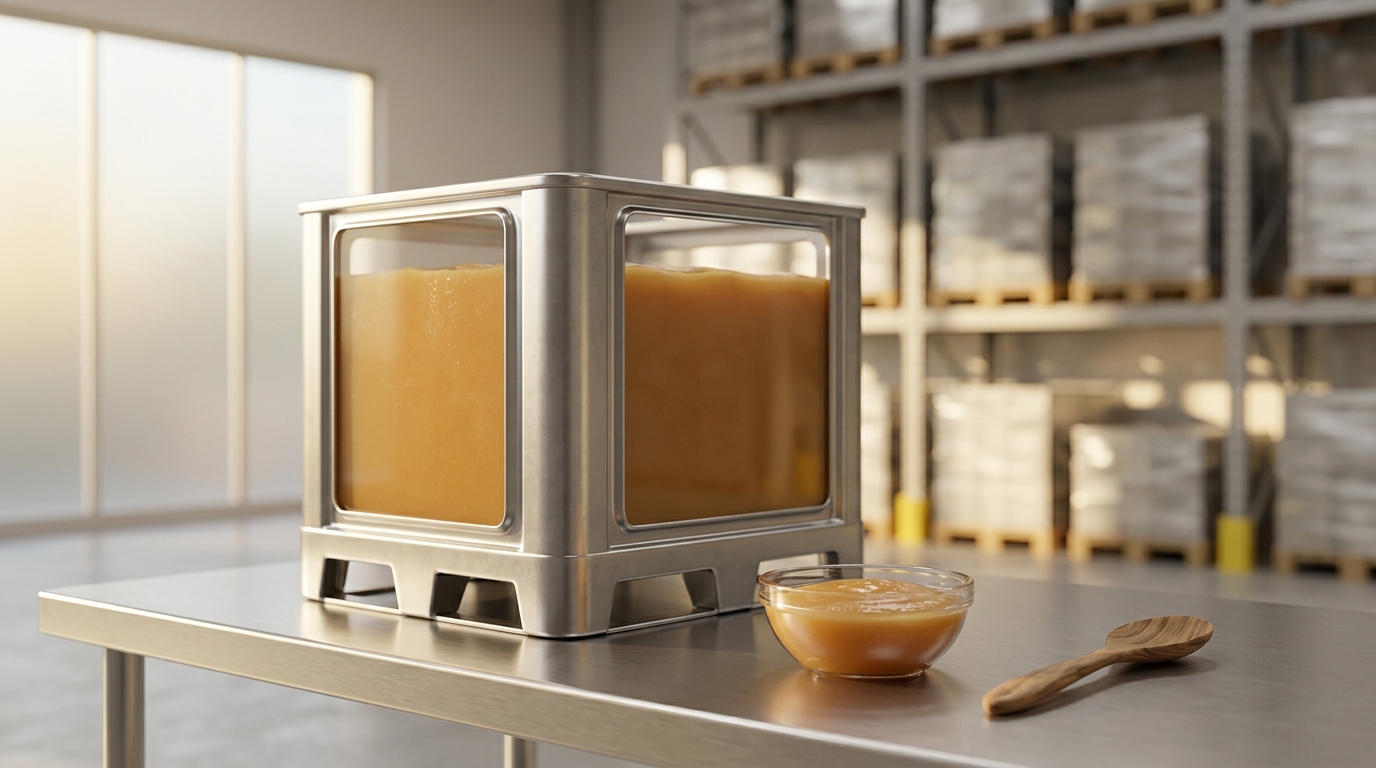
This guide maps how sweetened apple puree (aseptic bulk) is physically made and moved, and where cost and quality risk “lock in.” It’s written for Purchase—Quality, Safety, and Compliance teams who need to approve suppliers, set defensible COA rules, and avoid receiving-time holds driven by patulin, aseptic-system gaps, or packaging integrity failures.
Sweetened apple puree is a seasonal, throughput-driven processing chain: apples move quickly from orchard/packhouse into high-capacity plants where sorting losses, thermal processing, and aseptic filling determine both yield and shelf-stable performance. The biggest fixed cost-drivers are raw apple availability/quality, plant utilization during harvest peaks, and aseptic packaging integrity—once a lot is filled into sterile bulk, most downstream cost becomes logistics + QA release rather than “making it better.”
Insight: The supply chain is designed to convert variable-quality processing apples into a standardized, shelf-stable ingredient by concentrating control at the plant (standardization + aseptic validation) rather than in the field.
Data: Industrial apple purees are commonly standardized around Brix and acidity, then heat-treated and filled into aseptic drums/bag-in-box formats (often 200–220 L drum liners) to avoid cold chain. (ABMA specs show 200 and 220 L aseptic bag formats.) [1]
Procurement Impact: Your acceptance risk is structurally concentrated at two handoffs: (1) raw fruit intake (defects/mold drive mycotoxin risk) and (2) sterile zone/aseptic fill (post-process contamination + package failures).

Insight: Costs stack in a predictable order: yield loss and compliance at intake, energy + line time in thermal processing, and packaging + logistics in aseptic bulk. Margins tend to concentrate where capability is scarce (high-utilization plants and reliable aseptic packaging supply).
Data: FDA’s aseptic inspection guidance emphasizes that aseptic systems depend on validated container sterilizing, filling, and closing operations and control of sterile zones downstream of sterilization; failures create hold/scrap events rather than “easy rework.” [2]
Procurement Impact: The “expensive surprises” are structurally tied to (a) sorting losses, (b) aseptic packaging integrity, and (c) destination-market contaminant limits that can force holds even when the puree is organoleptically fine.
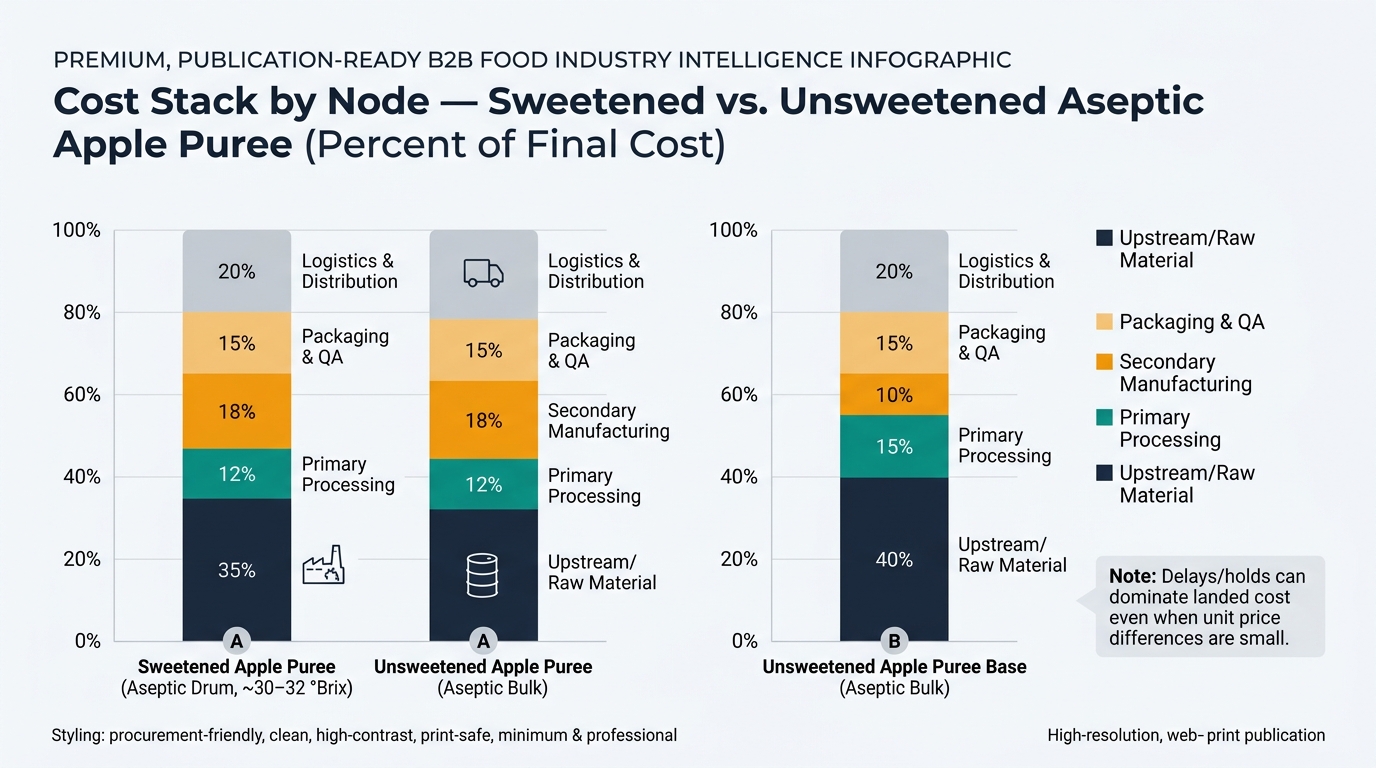
| Supply Chain Node | Cost Ratio (% of Final Cost) | Notes |
|---|---|---|
| Upstream / Raw Material | 35% | Apples + receiving losses; quality defects drive yield loss and contaminant risk (e.g., patulin exposure). |
| Primary Processing | 12% | Wash/sort, milling/finishing, enzyme, water/waste handling, deaeration; yield and throughput dominate. |
| Secondary Manufacturing | 18% | Sweetener + blending/standardization + thermal treatment; energy/steam and formulation inputs. |
| Packaging & QA | 15% | Aseptic bags/fitments, drums/IBCs, sterile handling, documentation/testing and release activities. |
| Logistics & Distribution | 20% | Inland freight + ocean/rail + warehousing; damage risk and hold time add indirect cost. |
| Supply Chain Node | Cost Ratio (% of Final Cost) | Notes |
|---|---|---|
| Upstream / Raw Material | 40% | Higher sensitivity to fruit solids and defects because there’s no sweetener “diluting” variability. |
| Primary Processing | 15% | Finishing and deaeration are critical for color/oxidation control and texture consistency. |
| Secondary Manufacturing | 10% | Less ingredient cost (no sugar), but still thermal treatment and standardization to Brix/pH targets. |
| Packaging & QA | 15% | Similar aseptic packaging burden to sweetened puree. |
| Logistics & Distribution | 20% | Similar landed-cost structure; ambient bulk still requires careful handling. |
| Supply Chain Node | Cost Ratio (% of Final Cost) | Notes |
|---|---|---|
| Upstream / Raw Material | 20% | Fruit cost matters, but packaging and retail margin dominate final cost. |
| Primary Processing | 10% | Similar conversion steps; often tuned for texture and consumer sensory. |
| Secondary Manufacturing | 10% | Sweetening/flavoring/acid adjustment; thermal processing suitable for retail format. |
| Packaging & QA | 30% | Cups/pouches/jars, case packing, coding, higher unit packaging cost. |
| Logistics & Distribution | 10% | More cube/weight inefficiency vs. bulk; retailer DC handling. |
| Retail & Wholesale Margin | 20% | Channel structure becomes a major cost layer. |
Insight: A few structural realities shape availability, quality outcomes, and cost—regardless of supplier.
Data: These realities show up repeatedly in regulatory guidance and packaging standards: patulin control expectations in apple-derived products, and the strict validation requirements of aseptic processing and packaging. [3]
Procurement Impact: These are the constraints that will keep reappearing in deviations, holds, and supplier-change events.
(Analyzed at: Sep, 2026)
Write your next sweetened-apple-puree contract so “aseptic bulk” is auditable and testable: require documented aseptic-system validation scope (sterile zones + filling/closing controls) and lock down packaging details (bag size, fitment type, compatibility, handling limits), not just Brix/pH/micro numbers.
This works because FDA’s aseptic guidance makes clear that the failure mode is almost always downstream of sterilization—at the container sterilizing/filling/closing boundary—where outcomes become binary (release vs. hold/scrap). [2] In 2026’s still-volatile logistics environment, the dollars at stake are usually in delay and disposal: one avoidable hold can quietly add storage, re-sampling, demurrage, and expedited replenishment costs that can rival the supplier’s entire margin on the shipment. [6]