INDUSTRY TRENDS

Sunflower Oil Sourcing (2026 Guide): How to Control Landed Cost, Avoid Allocation Risk, and Build Negotiation Leverage

Author
Team Tridge
DATE
March 17, 2026
10 min read
Sunflower Oil Cover
Tridge Eye Data Intelligence Solution

This report is powered by Tridge Eye Data Intelligence.

Every data point, price signal, and supply risk insight in this analysis comes from the same platform that procurement and sourcing leaders worldwide rely on daily. As you read, consider what this level of market intelligence could do for your sourcing decisions.

Explore Tridge Eye →

Sunflower oil is often treated like a “simple” edible oil line item—until a corridor disruption, a winterization miss, or a high‑oleic availability squeeze turns it into an allocation problem. This guide translates sunflower-oil supply chain realities into procurement actions: how to structure specs, lanes, contracts, and alternate suppliers so you reduce variance without increasing stockout risk.

Executive Summary

  • Sunflower oil is a “corridor + spec” commodity: availability risk spikes when Black Sea export corridors or policies tighten, and when your spec (especially winterization/clarity and high‑oleic) narrows the qualified pool.
  • Black Sea still sets tone for trade: Russia and Ukraine remain central to global sunflowerseed and sunflower oil balances, even as Argentina and EU origins matter for diversification [1].
  • Codex peroxide value reference is real: Codex Stan 210 (Named Vegetable Oils) includes a refined-oil peroxide value limit commonly referenced as ≤10 meq O2/kg (method/context still matters) [2].
  • Winterization/dewaxing is not optional for many buyers: sunflower oil waxes can crystallize and create haze; “RBD” alone does not guarantee clarity performance across temperature cycles [3].
  • Cost is a stack of spreads, not one index: seed → crude (crush), crude → refined, refined → winterized, plus origin/lane basis and packaging basis.
  • Tables are illustrative, not universal: the modeled cost ratios are directionally plausible, but should be used as a negotiation/normalization framework—not as “industry averages.”

Key Insights

Analyzed at: Mar, 2026

  • Strategy: Hold
  • Reliability: Medium
  • Potential Saving: 4% ~ 10%
  • Insight: For the next 4–8 weeks, prioritize basis control (lane/format normalization + winterization clarity governance) over trying to “time the market.” Recent reporting shows Ukraine’s 2025/26 season exports running below the prior year early in the season, reinforcing the value of pre-qualified alternates and clear trigger rules rather than aggressive spot exposure. Use an RFQ refresh to (1) re-benchmark winterized RBD spreads vs crude and (2) add at least one non–Black Sea qualified lane (e.g., Argentina/EU) to reduce allocation risk and capture basis arbitrage when Black Sea premiums widen [4].

1) What You’re Actually Buying: The Real Sunflower Oil Flow (Ground Truth)

Sunflower oil looks like a simple ingredient, but procurement outcomes are decided by where you enter the chain (seed vs crude vs refined), what spec you lock (standard vs high‑oleic; winterized/dewaxed), and how you move it (bulk vs packed).
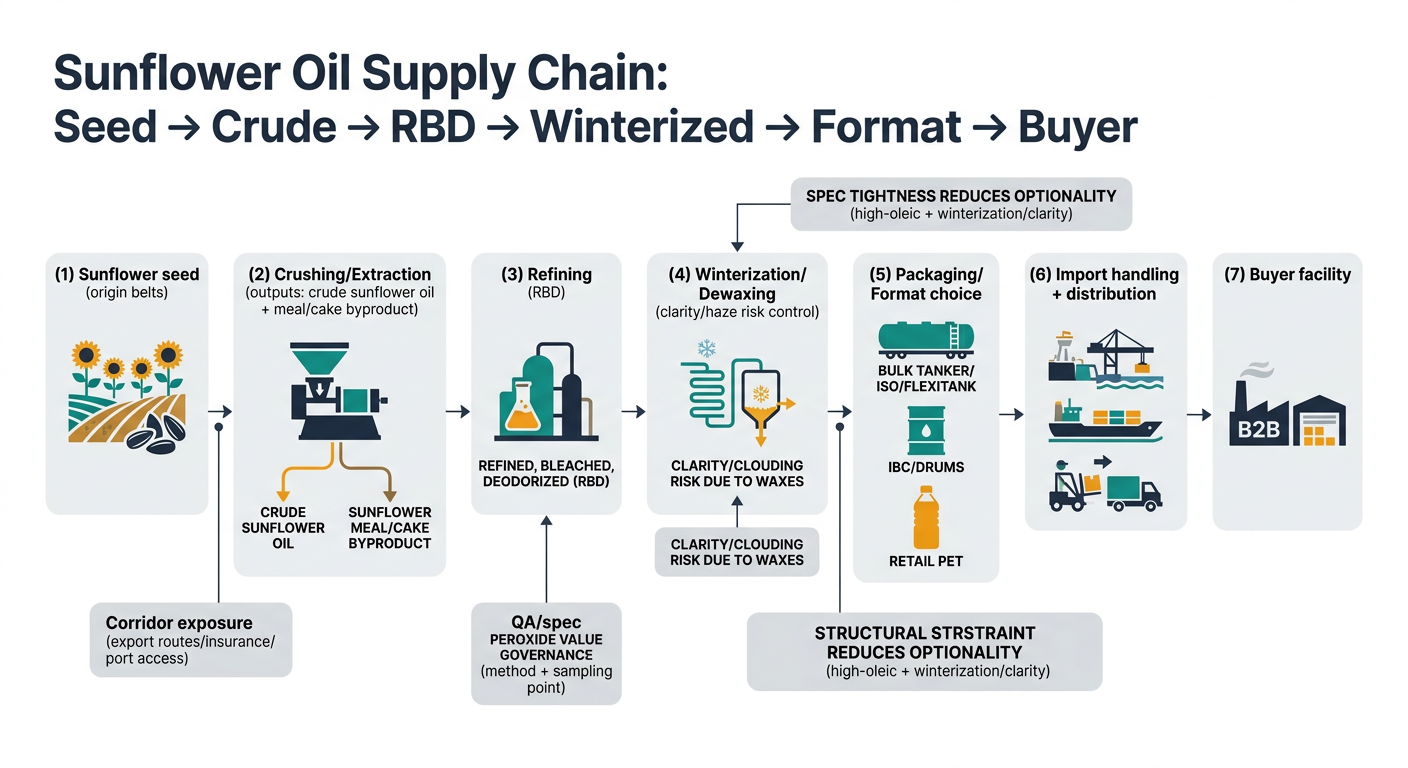
The physical flow (most common export-to-import pattern)

  1. Sunflower seed (oilseed varieties) grown in concentrated origin belts.
  2. Crushing/extraction turns seed into:
  3. Crude sunflower oil (CSFO)
  4. Sunflower meal/cake (byproduct that materially affects crush economics)
  5. Refining converts crude into RBD sunflower oil (refined/bleached/deodorized).
  6. Winterization / dewaxing (often required) to prevent clouding/haze in cooler conditions.
  7. Bulk logistics (tanker/ISO/flexitank) or packaging (IBC/drums/retail PET).
  8. Import handling + distribution into food manufacturing, foodservice, or retail.
A left-to-right process flow showing the physical and commercial nodes that determine procurement outcomes: (1) Sunflower seed (origin belts) → (2) Crushing/Extraction (outputs: crude sunflower oil + meal/cake byproduct) → (3) Refining (RBD) → (4) Winterization/Dewaxing (clarity/haze risk control) → (5) Packaging/Format choice (bulk tanker/ISO/flexitank vs IBC/drums vs retail PET) → (6) Import handling + distribution → (7) Buyer facility. Includes callouts on corridor exposure and spec tightness reducing optionality, plus QA/spec callouts on peroxide value governance and clarity/clouding risk due to waxes.

Why this matters for buyers

  • Your price is not “the sunflower oil price.” It’s the sum of seed economics + crush margin + refining yield loss + packaging + freight + finance + risk premium.
  • The category is structurally exposed to origin concentration and export corridor constraints, so procurement needs to manage availability risk alongside price.

Concentration reality (why Black Sea still sets the tone)

  • Russia and Ukraine remain central to global sunflowerseed and sunflower oil supply and exportable surplus, with exporter leadership shifting by season and policy context. Industry tables that compile USDA/Oil World data continue to show Russia and Ukraine among the dominant origin blocks for sunflowerseed and sunflower oil in recent marketing years [1].

2) Where the Money Builds Up: Cost & Margin by Node (and What Moves Fast)

Below is the procurement-relevant view: what cost drivers dominate each node, what changes quickly, and what you can influence.

2.1 Upstream: Sunflower Seed (Farm Gate → Delivered to Crusher)

Key insight: In sunflower oil, seed is the biggest cost lever—and it’s seasonal and regionally concentrated. A bad crop (yield + oil content) tightens the whole system.

What drives cost here

  • Yield & oil content (weather, heat/drought, harvest conditions)
  • Input costs (fertilizer, diesel, seed genetics)
  • Farmer selling behavior (holding vs selling, local currency expectations)
  • Local logistics to crusher (truck/rail availability)

Procurement implication

  • If you buy refined oil, you still pay seed economics—just indirectly.
  • Early signals at this node are your best lead time for contracting decisions.

2.2 Primary Processing: Crushing / Extraction (Seed → Crude Oil + Meal)

Key insight: Sunflower is a crush-margin commodity: crushers balance the value of oil + meal against seed cost. When meal demand changes, it can subsidize or penalize oil pricing.

What drives cost here

  • Plant utilization (energy reliability, labor, maintenance)
  • Extraction yield and losses
  • Working capital (seed inventory financing)
  • Byproduct economics (meal/cake demand, freight to feed markets)

Procurement implication

Supplier quotes can diverge because each crusher has different:

  • seed coverage
  • meal offtake strength
  • financing costs
  • export optionality

2.3 Secondary Processing: Refining + (Often) Winterization/Dewaxing

Key insight: Refining is not “just a service.” It adds yield loss + energy/chemicals + QA, and winterization is often the hidden constraint for clear retail specs.

What drives cost here

  • Refining chemicals (caustic, bleaching earth)
  • Energy (deodorization is energy intensive)
  • Yield loss (neutral oil loss during refining)
  • Winterization/filtration media (when wax limits/cloud point are tight)

Quality reality that creates claims and rework

  • Sunflower oil naturally contains waxes; without dewaxing, it can appear hazy at lower temperatures [5].
  • Refining can reduce oxidation markers (e.g., peroxide value), but storage/heat exposure and dwell time can still degrade quality post‑release.
  • Codex standards for named vegetable oils include peroxide value thresholds for products claiming to be “refined” (commonly referenced at ≤10 meq O2/kg). Buyers should still define test method, sampling point, and release vs end-of-shelf-life expectations in their spec and contract language [2].

Procurement implication

A “cheaper” refined offer may be cheaper because the supplier is:

  • not truly winterizing to your clarity spec
  • blending origins with different wax/quality profiles
  • taking a shorter QA/hold-time approach

2.4 Packaging & QA (Bulk vs IBC/Drums vs Retail PET)

Key insight: Packaging is where cost per ton can jump and where spec governance becomes real (COA discipline, traceability, contamination control).

What drives cost here

  • Packaging material (PET resin, caps, cartons) and line efficiency
  • QA testing frequency and release rules
  • Certification overhead (HACCP/FSSC/ISO; customer-specific audits)

Procurement implication

  • If you can accept bulk and pack locally, you may reduce unit cost—but you increase operational and QA responsibility.

2.5 Logistics & Trade (Inland → Port → Ocean → Import)

Key insight: For sunflower oil, logistics is not a rounding error. Freight, insurance, demurrage, and lane disruption can swing landed cost quickly—especially for concentrated export corridors.

What drives cost here

  • Inland bottlenecks (rail/truck, storage)
  • Port access and congestion
  • Ocean freight + insurance
  • Container availability (for flexitanks) vs bulk tanker scheduling

Procurement implication

  • Two identical specs can have materially different landed costs based on lane + format (flexitank vs ISO vs bulk).

2.6 End Market Margins (Importer/Distributor/Brand/Retail)

Key insight: Downstream margins don’t just add cost—they shape how fast price moves to you. Retail-heavy channels often lag market moves because of price-setting cadence and inventory.

Product-Level Cost Breakdown (Illustrative, Modeled % of Final Landed Cost)

Assumption: “Final landed cost” refers to delivered-to-buyer facility cost (not retail shelf price). Ratios vary by origin, season, packaging, Incoterms, and market tightness.

A 4-column 100% stacked bar chart comparing modeled cost ratios for: (A) Crude Sunflower Oil (bulk), (B) RBD Sunflower Oil (bulk), (C) High-Oleic RBD (bulk), (D) RBD packaged (IBC/drums). Stacks use consistent colors for Seed (or high-oleic seed premium), Crushing/Extraction margin, Refining + Winterization, Packaging & QA, Logistics & Trade, Supplier/Merchant margin. Includes a note badge that the breakdown is illustrative for normalization, not universal averages, and a callout showing packaged format increases Packaging & QA share.

A) Crude Sunflower Oil (CSFO), bulk

Supply Chain Node Cost Ratio (% of Final Landed Cost) Notes
Seed (farm + local delivery embedded) 62% Dominant driver; seasonal and origin-sensitive
Crushing / extraction margin 10% Includes plant utilization + working capital
Secondary processing 0% Not refined
Packaging & QA 3% Basic QA + bulk handling
Logistics & trade 18% Inland + ocean + insurance/demurrage
Supplier/merchant margin 7% Varies with tightness and counterparty risk

B) RBD Sunflower Oil (Refined), bulk

Supply Chain Node Cost Ratio (% of Final Landed Cost) Notes
Seed (embedded) 55% Still the anchor
Crushing / extraction margin 9%
Refining + (often) winterization 10% Energy/chemicals + yield loss + filtration
Packaging & QA 4% Higher QA + release discipline
Logistics & trade 16%
Supplier/merchant margin 6%

C) High‑Oleic RBD Sunflower Oil, bulk

Supply Chain Node Cost Ratio (% of Final Landed Cost) Notes
High‑oleic seed premium (embedded) 58% Premium driven by identity preservation + limited acreage
Crushing / extraction margin 9%
Refining + winterization 10% Similar process cost but tighter QA
Packaging & QA 5% Higher spec/traceability burden
Logistics & trade 14%
Supplier/merchant margin 4% Often tighter if under longer programs

D) RBD Sunflower Oil, packaged (IBC/drums)

Supply Chain Node Cost Ratio (% of Final Landed Cost) Notes
Seed (embedded) 48%
Crushing / extraction margin 8%
Refining + winterization 9%
Packaging & QA 14% Packaging materials + handling + QA
Logistics & trade 16% More handling steps
Supplier/merchant margin 5%

3) One Structural Fact You Can’t Negotiate Away: Sunflower Oil Is a “Corridor + Spec” Commodity

If you source sunflower oil globally, two structural constraints dominate outcomes:

  1. Export corridor exposure
  2. When export routes tighten, the market can move from “priced” to “allocated.”
  3. This is why contingency suppliers must be pre-qualified, not “found during a crisis.”
  4. Spec complexity reduces supplier optionality
  5. “Refined” is not enough: buyers often require winterized/dewaxed clarity, low oxidation markers, and consistent sensory.
  6. High‑oleic adds identity preservation and narrows the pool further.

Procurement takeaway: Your true risk is not just price volatility—it’s supplier optionality collapse when the market tightens.

4) The Critical Insight: Why Your Supplier’s Price Can Move Differently Than the Market

Procurement teams often expect sunflower oil to behave like a single transparent index. In practice, you’re buying a stack of spreads:

  • Seed → crude spread (crush margin): changes with meal demand and crusher utilization.
  • Crude → refined spread: changes with energy, chemicals, and refining capacity.
  • Refined → winterized spread: changes when clarity specs tighten or filtration becomes a bottleneck.
  • Origin/lane basis: changes with corridor risk, insurance, and port congestion.
  • Packaging basis: changes with PET resin, packaging line capacity, and handling costs.

Observed market signal (why substitution matters)

  • Russia’s reported export growth has been framed as improving competitiveness when the spread vs other veg oils (palm/soy) narrows, which can pull demand back toward sunflower depending on application and buyer preferences [6].

Procurement takeaway: A supplier “following the market” may still be overcharging if their basis/spreads are out of line versus peers with similar lanes and specs.

5) Where Procurement Teams Typically Misstep (and Why It Happens)

These are common failure modes when a team is strong in procurement but newer to sunflower oil specifics:

  1. Treating “refined sunflower oil” as a single spec
  2. Misses winterization/clarity requirements → claims, rework, or customer complaints.
  3. Over-indexing on one origin because it was historically reliable
  4. Concentration creeps up quietly; the risk shows up only when volumes get allocated.
  5. Running RFQs without lane/format discipline
  6. Comparing a flexitank offer vs an ISO tank offer vs drums without normalizing landed cost and risk.
  7. Confusing COA compliance with real quality stability
  8. Oxidation risk is affected by storage, temperature cycling, dwell time, and tank hygiene—not only initial test results.
  9. Waiting for disruption to qualify alternates
  10. In edible oils, qualification lead time (QA, documentation, trials) is often longer than the market shock.

6) What an Intelligence-Driven Approach Changes (Decision-First, Not Feature-First)

Below is how sourcing teams use intelligence outputs to change procurement actions—without pretending intelligence “guarantees” supply or price.

A) Decision: Lock contract vs stay spot (and how much)

Category reality: Sunflower oil volatility is driven by seed supply shocks, corridor risk, and substitution dynamics in the wider veg-oil complex.

What intelligence changes

  • Price intelligence & driver decomposition separates:
  • market move (veg-oil complex)
  • origin/lane basis
  • supplier behavior (over/under-market)

Practical sourcing actions

  • Move from “one big annual fixed price” to a governed mix:
  • base volumes on formula/index-linked structures
  • tactical top-ups with pre-approved alternates

Trade-off

More governance complexity, less variance and fewer emergency buys.

B) Decision: Reduce dependency without breaking QA

What intelligence changes

  • Supplier discovery & longlist building by spec + format (bulk/IBC/drums) + region
  • Benchmarking & qualification support to standardize approval criteria

Practical sourcing actions

  • Pre-qualify 2–3 alternates by:
  • spec match (including winterization)
  • capacity signals
  • documentation readiness (traceability, certifications)

Trade-off

Slightly higher qualification workload now, materially lower allocation risk later.

C) Decision: Adjust spec tightness (standard vs high‑oleic; clarity parameters)

What intelligence changes

  • Spec-to-supplier-pool sensitivity makes the hidden cost of tight specs visible.

Practical sourcing actions

  • Segment demand:
  • keep high‑oleic only where performance/shelf life truly needs it
  • allow standard RBD winterized for other SKUs with QA controls

Trade-off

Broader supplier pool vs tighter product uniformity.

D) Decision: Governance—prevent “silent” concentration creep

What intelligence changes

  • Category-level dashboards for:
  • supplier share
  • origin share
  • lane share
  • variance vs budget

Practical sourcing actions

  • Set thresholds (examples):
  • max % volume from any single origin
  • minimum number of qualified suppliers per format
  • escalation triggers based on corridor risk signals

7) Strategic Use Cases Sourcing Leaders Actually Run (Sunflower Oil)

  1. Contract renewal playbook (90–120 days before expiry)
  2. Inputs: price driver narrative, supplier benchmark, lane risk view
  3. Output: recommended contract mix (fixed vs formula), negotiation guardrails
  4. Alternate supplier bench-building (quarterly)
  5. Inputs: discovery longlist + qualification checklist
  6. Output: 2–3 “ready” alternates per region/format
  7. Spec rationalization with QA/R&D
  8. Inputs: spec sensitivity analysis
  9. Output: approved spec tiers (must-have vs nice-to-have)
  10. Origin and corridor risk monitoring
  11. Inputs: watchlists by origin/lane
  12. Output: triggers for early buying, safety stock review, or allocation discussions
  13. Landed cost normalization across formats
  14. Inputs: comparable Incoterms and packaging assumptions
  15. Output: apples-to-apples supplier comparison for RFQs

8) Why This Matters Beyond Sunflower Oil (Same Procurement Physics, Different Commodities)

Sunflower oil is a clean example of a broader procurement truth: price is a stack of spreads, and risk sits where optionality collapses. The same intelligence-driven approach applies to other categories many procurement teams manage:

  • Cocoa / chocolate inputs
  • Upstream crop shocks + processing capacity + certification requirements → basis volatility and supplier bottlenecks.
  • Coffee (green vs roasted vs soluble)
  • Different nodes (green supply vs roasting vs soluble processing) create different spreads and lead times.
  • Dairy fats (butter/AMF) and milk powders
  • Seasonality + processing constraints + inventory carry → contract timing and basis matter.
  • Nuts (almonds/cashews)
  • Origin concentration + quality grading + processing yield → spec decisions change supplier pool dramatically.

Procurement takeaway: once your team learns to manage sunflower oil with driver decomposition + supplier optionality + governance thresholds, you can transfer the same muscle to other volatile food inputs.

9) Why This Example Resonates with Procurement Stakeholders

Sunflower oil makes a strong internal case for intelligence-led sourcing because:

  • Cost control is measurable: variance reduces when you separate market movement from supplier basis.
  • Risk is tangible: corridor/origin shocks quickly become allocation events.
  • Governance is auditable: spec decisions, supplier qualification, and concentration thresholds can be documented.
  • Cross-functional alignment is easier: QA (spec/COA), Ops (format/lead time), Finance (variance/budget) can all see where the drivers sit.

Bottom line: Better sunflower oil procurement is less about predicting price and more about building optionality, normalized comparisons, and trigger-based decisions before the market forces your hand.

Tridge Eye Data Intelligence Solution

Make Faster, Data-Driven Sourcing Decisions

The insights in this report are just the starting point. Tridge Eye is the data intelligence solution that gives procurement and sourcing leaders real-time market signals, price benchmarks, and supply risk alerts — so you can act before the market moves.

Explore Tridge Eye →

References

  1. sunflowernsa.com
  2. fao.org
  3. rollceglobal.com
  4. fastmarkets.com
  5. en.wikipedia.org
  6. interfax.com
Subscribe
By subscribing you agree to with our Privacy Policy and provide consent to receive updates from our company.
Thank you! Your submission has been received!
Oops! Something went wrong while submitting the form.
Subscribe to receive the latest blog posts, updates, promotions, and announcements from Tridge.