
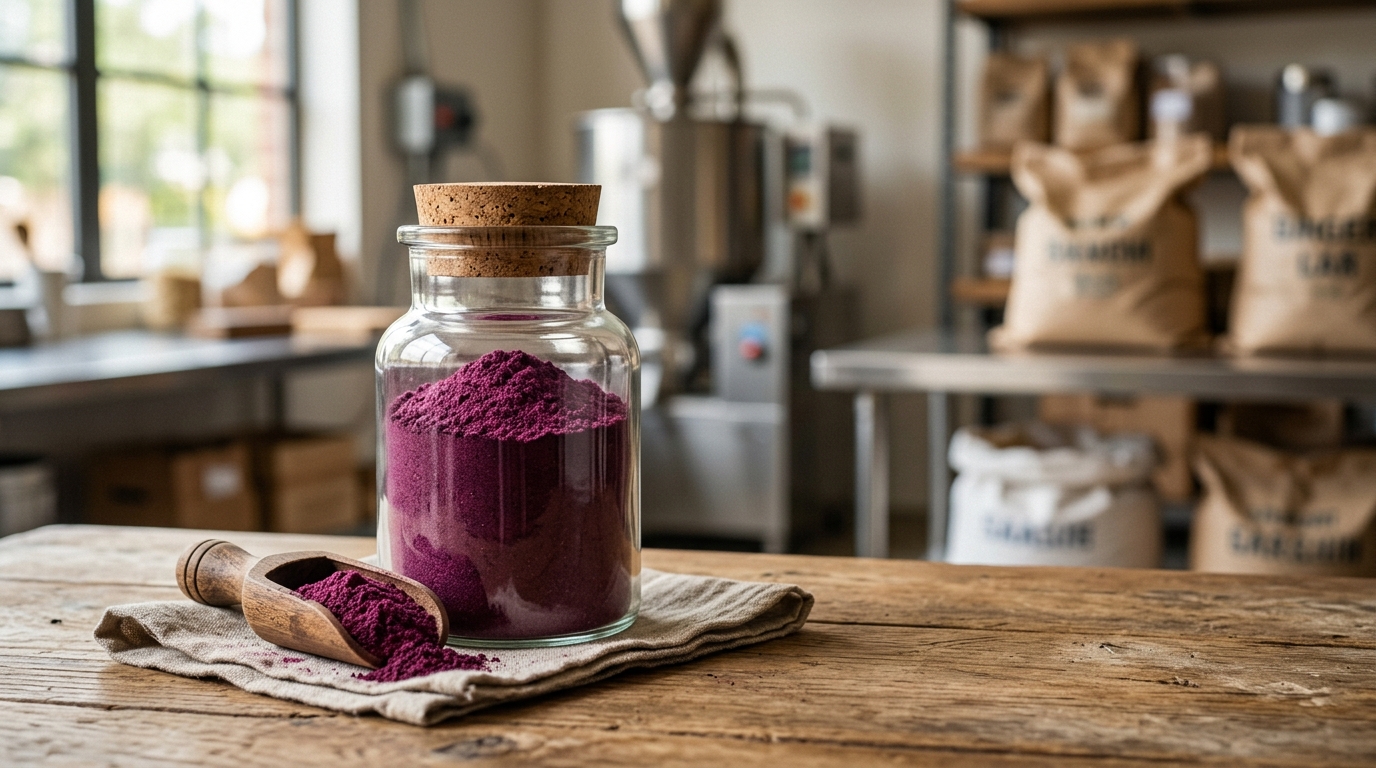
Spray-dried maqui berry powder sourcing is less about “finding a berry powder” and more about controlling a seasonal, high-variability chain where early stabilization and the spray-drying recipe determine downstream flowability, shelf stability, and claim readiness. This guide maps the physical chain, shows where cost and risk concentrate, and translates those realities into QSC-ready specification and contracting moves.
Spray-dried maqui berry powder is not a single, uniform commodity. The physical chain typically converts a seasonal berry (often wild-collected in Southern Chile) into a stabilized intermediate (frozen fruit, juice/pulp, or concentrated extract), then into a hygroscopic powder via spray drying—often requiring carriers (e.g., maltodextrin/gum systems) to make the powder manufacturable and free-flowing.
Insight: The chain’s “fixed” cost drivers are created early (collection logistics + stabilization) and again at the spray-dryer (energy + yield + carrier system), while the most common technical failures appear late (moisture pickup, caking, potency drift).
Data: Wild collection is described in some references as occurring December–March in Chile; other technical reviews describe a once-yearly harvest and cite December–February. Treat this as a practical planning range, not a precise universal calendar for every micro-region/supply program. [1]
Procurement Impact: Your downstream powder performance (flowability, solubility, color/potency stability) is structurally constrained by upstream stabilization speed and by the manufacturer’s spray-drying “recipe” (carrier choice and dosing, inlet/outlet temperatures, and powder finishing).
Ground-truth physical flow (typical):
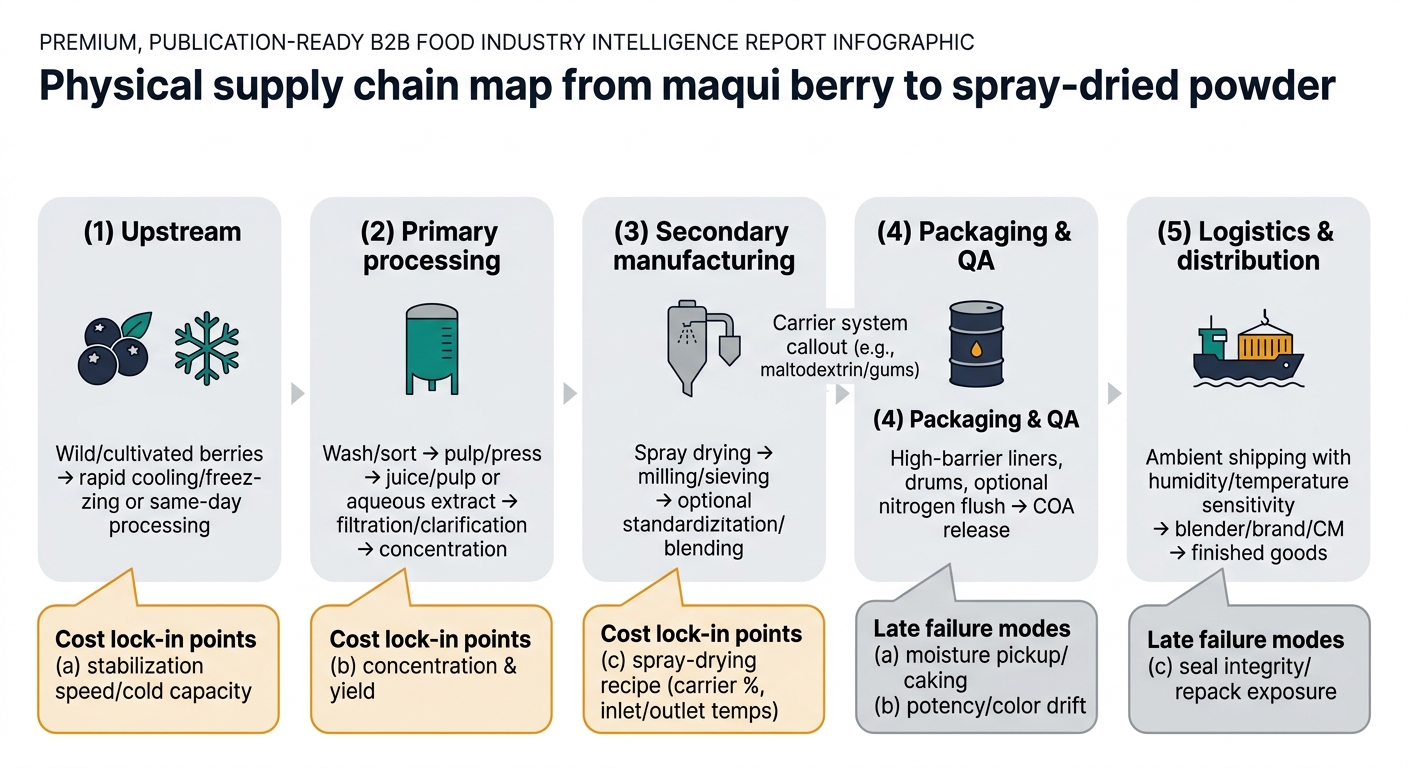
Insight: In spray-dried berry powders, “value” is created less by farming alone and more by (1) stabilization and yield management, (2) concentration + drying throughput, and (3) QA/packaging that prevents moisture/oxygen damage.
Data (validated, more defensible framing): Fruit juice/pulp feeds are challenging to spray dry because sugars/organic acids lower glass transition temperature, increasing stickiness and wall deposition (yield loss). Multiple peer-reviewed studies show that adding carriers (commonly maltodextrin, sometimes with gums/proteins) can reduce stickiness, improve powder recovery/yield, and reduce hygroscopicity—though the required carrier level is formulation- and equipment-dependent. [2]
Procurement Impact: The same “maqui powder” label can hide very different cost structures and potency-per-kg depending on whether it is whole-fruit powder vs extract powder, and whether it is carrier-free vs carrier-assisted.

| Supply Chain Node | Cost Ratio (% of Final Cost) | Notes |
|---|---|---|
| Upstream raw berries + stabilization | 25% | Harvest labor + aggregation + freezing/cooling capacity are decisive. |
| Primary processing (pulp/press + clarification) | 15% | Yield loss from sorting/filtration; water/energy use. |
| Secondary manufacturing (spray drying + carriers) | 25% | Dryer energy + yield; carrier system often needed to manage stickiness. |
| Packaging & QA release | 12% | Barrier liners + micro/heavy metals/pesticide panels + marker testing. |
| Logistics & distribution | 10% | Humidity/heat exposure drives risk; storage discipline matters. |
| Distributor/blender margin | 13% | Often repacked/blended into customer-specific formats. |
| Supply Chain Node | Cost Ratio (% of Final Cost) | Notes |
|---|---|---|
| Upstream raw berries + stabilization | 18% | Lower share because value is created downstream through concentration/standardization. |
| Primary processing (extraction + concentration) | 25% | Energy and yield; batch segregation and filtration/clarification drive cost. |
| Secondary manufacturing (spray drying + carriers/flow agents) | 22% | Dryer throughput + yield; finishing controls flowability and dusting. |
| Packaging & QA release | 15% | Higher QA burden: marker assays (e.g., anthocyanins) + contaminant panels. |
| Logistics & distribution | 8% | Higher value density reduces freight share but not humidity sensitivity. |
| Distributor/blender margin | 12% | Margin often reflects documentation burden and customer-specific specs. |
| Supply Chain Node | Cost Ratio (% of Final Cost) | Notes |
|---|---|---|
| Maqui ingredient (all upstream nodes embedded) | 30% | Maqui is a “hero” inclusion but often not the majority of formula mass. |
| Premix manufacturing (blending/agglomeration) | 20% | Flow aids, anti-caking, dust control; segregation and allergen zoning. |
| Packaging & QA release | 20% | Finished product micro + stability + label claim testing where required. |
| Logistics & distribution | 10% | Pack format drives cube and damage risk (sachets/pouches). |
| Brand/CM margin | 20% | Includes overhead, compliance, and customer program complexity. |
Insight: Three constraints shape the entire category regardless of supplier: seasonal raw supply, spray-drying physics, and moisture-driven shelf-life fragility.
Data:
Procurement Impact: These realities explain why two “equivalent” powders can diverge in performance: one may be physically stable (lower hygroscopicity + strong packaging discipline), while the other is technically compliant at ship but degrades in distribution.
Quick Win: Treat “carrier system + moisture/aw + packaging barrier” as a single integrated technical requirement, not separate line items.
Critical Risk Factors: moisture pickup (caking), potency/color drift, and upstream seasonality-driven variability.
The Bottom Line for Your Next Contract (Analyzed at: Aug, 2026): Put the “hidden factory settings” into the contract: require carrier type and % disclosure, set moisture + water activity limits, and mandate high-barrier liner specs with seal-integrity controls (plus no repack without your approval). This works because, in real fruit-powder spray drying, carriers and process settings directly drive yield and hygroscopicity—and most late-stage nonconformances are moisture-driven. [6] In 2026, with Chile cost volatility (labor/operations) and ongoing logistics/weather disruption risk, the cost of one held or reworked container can easily outweigh the incremental packaging and testing discipline by a wide margin. [3]


