INDUSTRY TRENDS

Spinach Powder Sourcing (Apr 2026): Cost Drivers, Food-Safety Reality, and Decision-Ready Buying Playbooks

Author
Team Tridge
DATE
April 8, 2026
10 min read
spinach-powder Cover
Tridge Eye Data Intelligence Solution

This report is powered by Tridge Eye Data Intelligence.

Every data point, price signal, and supply risk insight in this analysis comes from the same platform that procurement and sourcing leaders worldwide rely on daily. As you read, consider what this level of market intelligence could do for your sourcing decisions.

Explore Tridge Eye →

Spinach powder is often treated like a simple dehydrated commodity, but procurement outcomes are usually decided upstream (crop routing, yield, and dehydration capacity) and downstream (micro controls, documentation, and spec governance). This guide is written for procurement and sourcing managers who are strong in general sourcing but newer to spinach powder: it focuses on the decisions you need to make (award, dual-source, contract structure, spec trade-offs, and buffers), the realities that drive cost and risk, and what “good” looks like in governance with QA, Ops, and Finance.

Executive Summary

  • Spinach is mostly water (commonly ~92% moisture fresh), so dehydration creates high shrink and makes yield + plant throughput disproportionately important to supply and price.
  • Low-moisture ≠ low-risk: pathogens like Salmonella can survive for long periods in low-moisture foods, which increases the importance of validated process controls and environmental monitoring (even when growth is prevented by low water activity). [1]
  • Your spec is your market: drying method + particle size + moisture/water activity + micro targets often determine the viable supplier pool more than origin alone.
  • Cost is often dominated by conversion (drying energy + capacity) rather than only farm input costs; this is why farm shocks don’t map 1:1 to powder pricing.
  • Nitrate sensitivity is real for EU-facing supply chains (maximum levels are regulated for certain leafy vegetables including spinach), so “same powder, different market” can become a compliance issue. [2]
  • The biggest predictable failure mode: running an RFP without locking equivalence (drying method, mesh, micro posture, documentation set) and then awarding on price.

Key Insights

(Analyzed at: Apr, 2026)

  • Strategy: Hold
  • Reliability: Medium
  • Potential Saving: 6% ~ 12%
  • Insight: Use the current window to “hold” pricing risk while expanding optionality: (1) lock a primary supplier under a 6–12 month agreement with energy/freight re-openers and allocation language, and (2) qualify at least one backup supplier with a near-equivalent spec (agreed Tier-2 tolerances on color/mesh) to reduce emergency-buys and expedite costs. This typically yields savings through avoided spot premiums, fewer air-freight events, and better leverage in renewals—without forcing a risky spec change.

Spinach Powder Sourcing: Costs, Risks, and Smarter Buying Decisions

1) The Ground Truth: What You’re Actually Buying When You Buy Spinach Powder

Spinach powder looks like a simple commodity, but procurement outcomes are usually determined upstream—by how fresh spinach is routed (fresh market vs. processing), how the plant manages microbial risk, and which drying method is used.

The real supply chain flow (typical)

  1. Upstream / Raw material: fresh spinach grown for processing (often contracted acreage)
  2. Primary processing: receiving → sorting/trim → intensive washing/sanitizing → dewatering → (sometimes) blanching
  3. Secondary processing: drying (air/drum/spray/freeze) → milling → sieving/standardizing
  4. Packaging & QA: COA creation; micro/residue/heavy metals; metal detection; high‑barrier liners optional
  5. Logistics & distribution: ambient shipping but humidity control matters; long lead times for imports
  6. End markets: supplements/greens blends, bakery/pasta, soups/sauces, snacks, natural color systems
A left-to-right flowchart showing the typical spinach powder supply chain with clear stage labels and simple icons: (1) Processing spinach sourcing (contracted acreage / processing-grade leaf) → (2) Receiving + sorting/trim → (3) Intensive washing/sanitizing → (4) Dewatering → (5) Optional blanching (callout: impacts color/sensory + micro posture) → (6) Drying (branch into air/hot-air, drum, spray, freeze with brief cost/quality notes under each) → (7) Milling + sieving/standardization (callout: mesh/particle size as a spec gate) → (8) Packaging + QA/COA (callout: micro testing, heavy metals, residues, metal detection; optional high-barrier liners) → (9) Ambient logistics with humidity-control warning → (10) End markets (supplements/greens blends, bakery/pasta, soups/sauces, snacks/natural colors). Include two small risk callouts: 'Leafy greens upstream risk' near washing and 'Low-moisture pathogen survival risk' near post-dry handling/packaging.

Why this category behaves differently than “normal” ag ingredients

  • Extreme shrink: spinach is typically ~92% water when fresh, so drying converts a bulky, perishable crop into a concentrated powder. A commonly used rule-of-thumb yield range is roughly 12–20 kg fresh spinach to produce ~1 kg powder (varies by solids, process, blanching, and target moisture/water activity). This is why farm yield swings and dehydration capacity utilization can punch above their weight in pricing.
  • Two risk profiles at once:
  • Leafy greens risk upstream (field contamination, wash efficacy)
  • Low‑moisture risk downstream (pathogens can survive for long periods in powders even if they don’t grow). This is a well-recognized issue across low-moisture foods and ingredients and drives emphasis on hygienic design, environmental monitoring, and validated process controls where applicable. [1]
  • Specs are the market: color (chlorophyll retention), particle size, moisture/water activity, and micro targets often determine the viable supplier pool more than country-of-origin does.

2) Where the Money Is Made (and Lost): Cost & Margin by Supply Chain Node

Below is an analyst view of where cost concentrates and where suppliers typically protect margin. This is the section procurement managers use to decide: spot vs contract, dual‑source strategy, and which specs to tighten/relax.

2.1 Upstream / Raw Material (Fresh Spinach for Processing)

Key insight: Fresh spinach economics are dominated by yield volatility + rejection risk + competition with fresh-market demand.

  • Cost drivers
  • Yield swings (heat, excess rain, disease pressure) and harvest timing
  • Labor/mechanization and irrigation constraints
  • Rejection risk (soil, foreign material, cosmetic/quality thresholds)
  • Margin reality
  • Grower margins are often thin; volatility shows up as availability risk and spot premiums during short crops.

2.2 Primary Processing (Wash / Dewater / Optional Blanch)

Key insight: This is where spinach powder suppliers either build trust—or create hidden risk. Washing, dewatering, and sanitation are cost-heavy and quality-critical.

  • Cost drivers
  • Water, chemicals/sanitizers, and wastewater treatment
  • Labor for sorting/trim and food-safety controls
  • Yield loss from trim and sorting
  • Procurement implication
  • If you buy through a trader, you may lose visibility into who owns this step, which is often where variability and incident risk originate.

2.3 Secondary Processing (Drying + Milling + Standardization)

Key insight: Drying is often the dominant industrial cost bucket because it is energy-intensive and can be capacity-constrained at peak season.

Drying method drives both cost and supplier pool

  • Air/hot-air dried flakes → milled: typically broader capacity base; can be cost-effective but color and micro performance vary by plant controls.
  • Drum-dried: efficient throughput; can change flavor notes and color depending on thermal load.
  • Spray-dried (from puree/juice): can produce fine, uniform powders; requires upstream conversion to slurry and strong process control.
  • Freeze-dried: premium; narrow capacity; higher capex/opex; often chosen for high color and sensory retention.

Cost drivers

  • Energy (gas/electric/steam), maintenance, depreciation
  • Milling/sieving losses (fines), rework, and standardization blending
  • Validation/testing burden for micro targets

2.4 Packaging & QA (Where Claims Become Defensible)

Key insight: For many buyers, the “price” is not the problem—the documentation and defensibility is.

Cost drivers

  • COA generation and lab testing (micro, heavy metals, pesticide residues)
  • Packaging choice: standard lined kraft vs high‑barrier/foil; nitrogen flush for premium stability
  • Foreign matter controls (metal detection/X‑ray)

Quality reality

  • Commercial specs for dried vegetable powders often include water activity limits to manage stability and caking risk. The exact threshold varies widely by supplier and process (it is not universal to see <0.3 for spinach powder—values like ≤0.5 to ≤0.55 are also common in market spec sheets).

2.5 Logistics & Distribution (Where “Ambient” Still Fails)

Key insight: Spinach powder ships ambient, but humidity exposure can cause caking, color degradation, and claims.

Cost drivers

  • Ocean freight + inland drayage + warehousing
  • Inventory carrying cost (long lead times + QA release time)
  • Claims/credits from moisture ingress or odor/taint events

2.6 End Markets (Where the Specification Becomes Non-Negotiable)

Key insight: The downstream application determines which spec parameters are truly “must-have.”
  • Supplements/greens blends: tighter micro expectations; consistency in taste/odor; sometimes tighter heavy metals expectations
  • Bakery/pasta: particle size, color stability, and process tolerance
  • Soups/sauces: dispersion/rehydration behavior; flavor profile
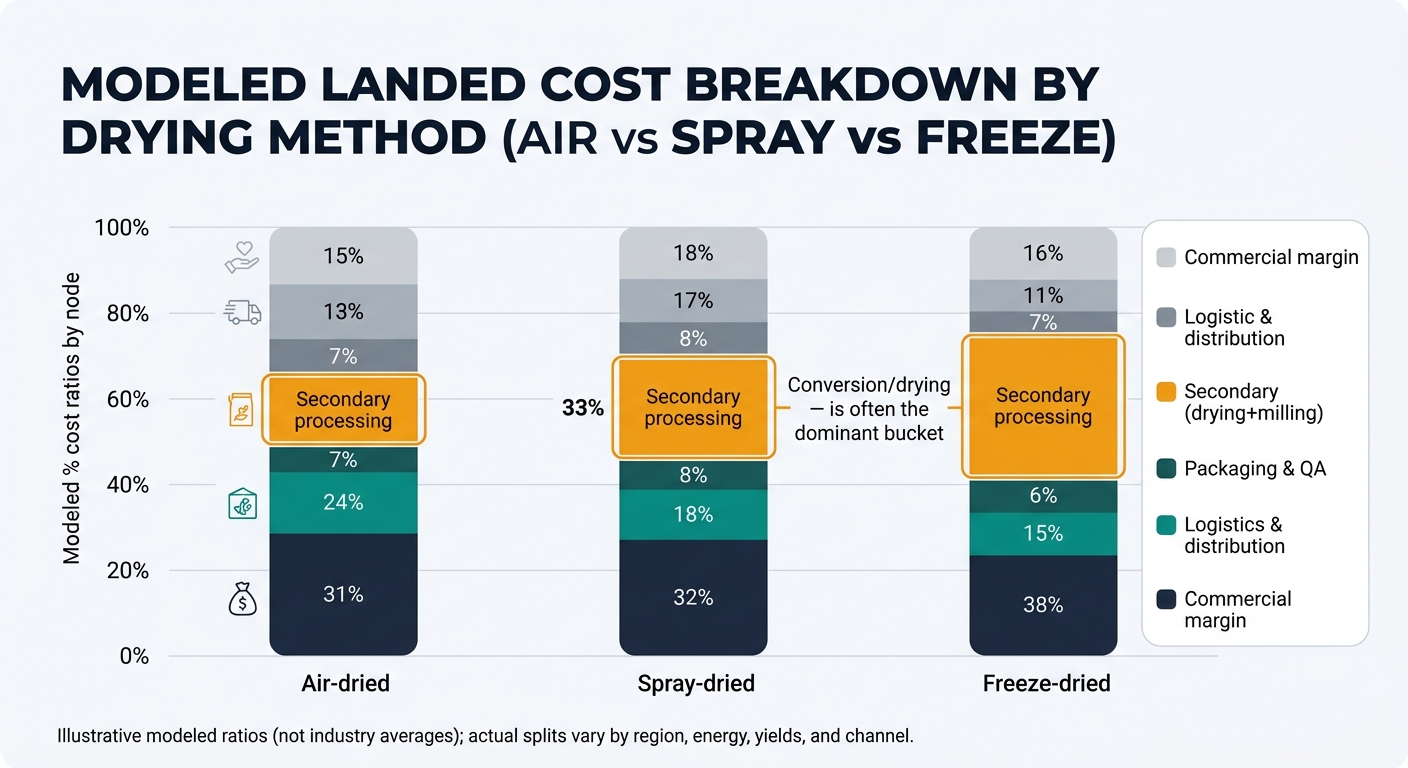
Three stacked bars (Air-dried, Spray-dried, Freeze-dried) showing the modeled % cost ratios by node: Raw material, Primary processing, Secondary processing (drying+milling), Packaging & QA, Logistics & distribution, Commercial margin. Use consistent color legend across bars. Add a visual emphasis (outline or annotation) around 'Secondary processing' to highlight that conversion/drying is often the dominant bucket, especially for freeze-dried. Include a footnote line inside the graphic: 'Illustrative modeled ratios (not industry averages); actual splits vary by region, energy, yields, and channel.'

Product-level cost breakdown (illustrative models)

Values below are modeled ratios of final delivered cost (not quotes). They help procurement teams identify where negotiation leverage exists (and where it doesn’t).

Important validation note: These ratios are plausible for decision-making discussion, but they are not “industry averages.” Actual splits swing materially by region, energy prices, plant technology, yields, and whether you are buying manufacturer-direct vs trader. Use them as a framework to ask better questions, not as a benchmark to enforce pricing.

A) Conventional air-dried spinach powder (milled flakes)

Supply Chain Node Cost Ratio (% of Final Cost) Notes
Raw material (fresh spinach) 28% Yield/rejection risk drives volatility
Primary processing 14% Wash/dewater, wastewater, labor
Secondary processing 30% Drying energy + milling/sieving
Packaging & QA 10% Testing + COA + packaging
Logistics & distribution 8% Freight + warehousing
Commercial margin (processor/trader) 10% Higher if trader-heavy chain

B) Spray-dried spinach powder (from puree/juice)

Supply Chain Node Cost Ratio (% of Final Cost) Notes
Raw material (fresh spinach) 24% Still sensitive to farm supply
Primary processing 16% More emphasis on slurry prep and control
Secondary processing 34% Spray drying energy + tighter controls
Packaging & QA 11% Often tighter spec governance
Logistics & distribution 7% Similar, but higher claims sensitivity
Commercial margin (processor/trader) 8% Lower if manufacturer-direct

C) Freeze-dried spinach powder (premium)

Supply Chain Node Cost Ratio (% of Final Cost) Notes
Raw material (fresh spinach) 18% Premium is mostly processing
Primary processing 14% Higher sorting/selectivity common
Secondary processing 44% Freeze-drying capex/opex dominates
Packaging & QA 12% High-barrier packaging more common
Logistics & distribution 6% Similar lanes, higher insurance/handling
Commercial margin (processor/trader) 6% Often manufacturer-direct for premium

3) Structural Fact You Need in the Room: “Spinach Powder” Is Multiple Categories

Procurement teams often treat spinach powder as a single spec item. In reality, it’s a family of products with different economics and risk.

The four “hidden” segmentation axes

  1. Drying method (air/drum/spray/freeze) → cost, color, and microbial control options
  2. Particle size / mesh → beverage dispersion vs bakery performance; milling yield losses
  3. Quality/regulatory posture → pesticide MRL compliance, heavy metals expectations, organic integrity (if applicable), and (for EU-facing supply) nitrate sensitivity [2]
  4. Supply chain type → manufacturer-direct vs trader/aggregator (traceability and margin leakage)

Practical takeaway: Before negotiating price, lock the segmentation: “Which drying method + which mesh + which micro/residue limits + what documentation set?” Otherwise you’ll compare non-equivalents.

4) The Critical Insight: Why Farm Shocks Don’t Map Linearly to Powder Prices

Spinach powder pricing often surprises procurement teams because the biggest cost lever is not always spinach itself.

Why the linkage breaks

  • Energy dominates the conversion step: drying is energy-intensive, so power/gas volatility can move powder pricing even when farm prices are stable.
  • Capacity is the real bottleneck: dehydration and milling lines have finite throughput; when utilization is high, suppliers protect margin via allocations and longer lead times.
  • Inventory + QA release time create time lags: powder pricing can reflect farm conditions from weeks/months earlier depending on contracted raw material, WIP, and testing holds.

Food safety economics: low-moisture ≠ low-risk

Even though powders don’t support pathogen growth, Salmonella can survive for long periods in low-moisture foods and is a recognized industry challenge. This drives: [1]

  • More testing
  • More emphasis on hygienic zoning and environmental monitoring
  • More supplier qualification friction (especially when your end market expects preventive controls and validated programs)

5) Where Procurement Teams Commonly Misstep (and Why It’s Predictable)

These are the recurring failure modes when experienced procurement managers enter spinach powder without category-specific context.

  1. Running an RFP that compares non-comparable powders
  2. Mixing air-dried milled flakes with spray-dried powders
  3. Not controlling for mesh/particle size and color metrics
  4. Over-optimizing on unit price while under-buying risk controls
  5. Treating COA as sufficient without understanding process validation and facility controls
  6. Assuming leafy-greens controls upstream automatically protect a low-moisture powder downstream
  7. The risk profile changes after drying; survival dynamics and environmental controls become central. [1]
  8. Ignoring nitrate/regulatory sensitivity for certain end uses
  9. Nitrate is naturally higher in leafy vegetables like spinach, and EU frameworks set maximum levels for nitrates in spinach/leafy vegetables (relevant for EU-bound products and for customers with strict internal limits). [2]
  10. Letting QA become the critical path during disruption
  11. Backups are identified only after a supply event, when qualification lead times collide with production needs.

6) What an Intelligence-Driven Approach Changes (Decision-by-Decision)

This is not about “more data.” It’s about changing which decisions you can safely make earlier.

A) Award decision (single vs dual source)

  • Without intelligence: award to the lowest quote that “meets spec on paper.”
  • With intelligence signals:
  • Segment suppliers by true comparability (drying method, mesh, micro posture, documentation completeness)
  • Benchmark lead-time reliability and incident signals
  • Decide a dual-source split that matches your risk budget (e.g., 70/30 with pre-approved alternates)

B) Contract structure (spot vs fixed vs indexed)

Better contracting posture comes from separating cost drivers:

  • Raw spinach availability (seasonality/weather)
  • Energy for drying (structural driver)
  • Freight/FX (landed cost volatility)

Practical contract moves

  • Fixed price with re-opener clauses tied to observable energy/freight indices
  • Volume bands with allocation language during peak utilization

C) Spec governance (tighten what matters, relax what doesn’t)

  • Use intelligence to identify which spec parameters collapse the supplier pool:
  • Example: tightening color threshold may eliminate a large portion of viable suppliers; tightening mesh may eliminate another set.
  • Align stakeholders on a two-tier spec:
  • Tier 1 (non-negotiable): micro limits, allergen controls, traceability, key compliance
  • Tier 2 (managed variability): color band, particle distribution, sensory notes—controlled via incoming QC and blending rules

D) Risk monitoring → triggers that start mitigation early

Start qualification when risk signals appear (not after a missed shipment):

  • Weather anomalies in key growing regions
  • Port congestion on main lanes
  • Recall/regulatory attention clusters for low-moisture foods

What this can and cannot do: intelligence helps you prioritize and time decisions; it does not replace audits, validated lethality steps, or lab testing.

7) Strategic Use Cases Procurement Leaders Actually Fund

These are the use cases that map to measurable outcomes (budget stability, continuity, governance).

  1. Reduce cost volatility without increasing stockout risk
  2. Outcome: lower quarter-to-quarter landed cost variance through better contract design and supplier optionality
  3. Pre-qualify alternatives before disruption
  4. Outcome: shorter time-to-switch; reduced downtime exposure
  5. Supplier benchmarking for governance
  6. Outcome: audit-ready award rationale; reduced exception approvals
  7. Spec trade-off modeling with QA/R&D
  8. Outcome: broader supplier pool without compromising critical safety/compliance thresholds
  9. Traceability and chain-of-custody clarity (manufacturer vs trader)
  10. Outcome: fewer surprises on documentation, origin claims, and responsibility for upstream controls

8) Why This Matters Beyond Spinach Powder (Adjacent Categories You Likely Buy)

If you source spinach powder, you likely also touch categories where the same intelligence patterns apply:

  • Kale / mixed greens powders: similar shrink economics, color/sensory variability, and low-moisture pathogen survival risk profile.
  • Dehydrated herbs & spices: widely recognized as low-moisture foods where Salmonella control and validated treatments are central to compliance expectations.
  • Paprika/chili powders (natural color systems): color specs narrow the supplier pool; contamination controls and treatment validation are often decisive.
  • Onion/garlic powders: capacity constraints and quality variability (granulation, moisture, caking) frequently drive supplier performance issues.

The transferable lesson: specs + process controls + capacity constraints usually explain more procurement outcomes than “country price averages.”

9) Why This Example Works as a Procurement Intelligence Story

Spinach powder is a strong example because it forces cross-functional decision-making under uncertainty:

  • Procurement must balance cost vs continuity
  • QA/Food Safety must manage a dual risk profile (leafy greens upstream; low-moisture downstream)
  • R&D/Ops must live with dispersion, color, and flavor variability
  • Finance needs predictability despite energy/freight volatility

When teams apply intelligence correctly, the measurable shift is not “cheaper powder.” It’s:

  • fewer emergency buys,
  • fewer spec-related rejections and claims,
  • faster supplier switching during disruption,
  • and more defensible governance when something goes wrong.
Tridge Eye Data Intelligence Solution

Make Faster, Data-Driven Sourcing Decisions

The insights in this report are just the starting point. Tridge Eye is the data intelligence solution that gives procurement and sourcing leaders real-time market signals, price benchmarks, and supply risk alerts — so you can act before the market moves.

Explore Tridge Eye →

References

  1. pubmed.ncbi.nlm.nih.gov
  2. apps.fas.usda.gov
Subscribe
By subscribing you agree to with our Privacy Policy and provide consent to receive updates from our company.
Thank you! Your submission has been received!
Oops! Something went wrong while submitting the form.
Subscribe to receive the latest blog posts, updates, promotions, and announcements from Tridge.