INDUSTRY TRENDS

Spicy Mustard Greens Kimchi Sourcing: A Decision Tree Ops Teams Can Run (Continuity, Quality, and Landed Cost)

Author
Team Tridge
DATE
September 8, 2026
11 min read
spicy-mustard-greens-kimchi Cover
Unlock Full Data
Spicy Mustard Greens Kimchi Market Intelligence
Prices · Trends · Origins · Forecasts

This decision-tree briefing is written for supply chain and operations leaders who already know how to run S&OP—but may not have deep domain context on fermented leafy vegetables. The goal is to connect mustard-greens realities (seasonality, perishability, fermentation time-lag, cold-chain sensitivity) to sourcing choices you can execute this week and defend in governance reviews.

Executive Summary

  • Mustard greens are a cool-season crop and are prone to bolting/quality issues under hot conditions; plan contracts around seasonal stress, not fiscal quarters. [1]
  • Treat mustard-greens kimchi as refrigerated RTE: Listeria control and sanitation governance are non-negotiable, and cold-chain discipline directly affects claims and shelf-life outcomes. [2]
  • Use the decision tree to isolate the dominant loss driver (late/short vs. QA holds vs. leakers/temperature excursions vs. cost variance) before changing suppliers or inventory.
  • Thresholds (OTIF, downtime hours, hold rate, shrink/claims) are practical starting points; calibrate them to your penalties, shelf-life, and plant constraints.
  • (Market lens, Sep 2026) Reefer capacity tightness and heat-driven field stress make dual-region plans + pre-qualified alternates more valuable than “cheapest/kg” sourcing. [3]

1) What This Framework Helps You Decide (So You Don’t Break the Line)

Insight: Spicy mustard greens kimchi procurement is not “buying vegetables + spices”—it’s buying throughput stability across a perishable raw input, a yield-sensitive brining step, and a time-lagged fermentation WIP pipeline.

Data (validated): Mustard greens are a cool-season crop and are susceptible to bolting under hot conditions; quality and yield are meaningfully influenced by temperature stress. [1]

Procurement Impact: Your sourcing strategy should be chosen based on which constraint is most expensive for you right now—(1) line downtime, (2) QA holds/rework, (3) shrink/leakers in distribution, or (4) landed-cost volatility—because each constraint points to a different supplier/origin/contracting design.

  • Decision this framework supports: Origin and supplier-tier selection (farm/packer/processor), contract type (spot vs. seasonal vs. indexed), and volume commitment design (base + flex + contingency).
  • Why structure matters here: Fermentation creates inventory-in-process (WIP) and a delayed feedback loop—by the time you detect a raw-material issue, you may already have multiple lots fermenting that will later fail sensory/pH targets.
  • Who should use it (and when): Supply Chain & Operations leaders and procurement partners when (a) service level is at risk, (b) you’re considering adding/ switching an origin, (c) you’re entering a new retail program with penalties/chargebacks, or (d) your QA hold rate is creeping up.

Quick Win: Treat mustard greens kimchi as a refrigerated RTE workflow with agricultural variability—not as a shelf-stable condiment category. That single mindset shift changes how you set safety stock, supplier redundancy, and spec-flex.

2) Fast Orientation: Triggers, Inputs, and What “Good” Looks Like

Insight: The right sourcing path depends on whether your pain is availability, consistency, or cold-chain/pack integrity—and you can diagnose that with a small set of internal metrics.

Data (validated): FDA guidance for controlling Listeria monocytogenes in ready-to-eat (RTE) foods is explicitly aimed at manufacturers/processors/packers/holders of RTE foods under FSMA preventive controls expectations—this is directly relevant to refrigerated kimchi operations and supplier governance. [2]

Procurement Impact: If you don’t separate “ag supply risk” from “process control risk,” you’ll overpay for the wrong lever (e.g., buying more greens when your real issue is brine yield loss or leakers from CO2).
When to use this framework (trigger conditions)

  • Service risk trigger: OTIF to DC/retail < 95% for 4 consecutive weeks.
  • Continuity trigger: Unplanned line downtime from raw-material issues > 4 hours/week.
  • Quality trigger: QA holds/rework affecting > 2% of lots (by count) or > 1% of volume (by kg).
  • Cost trigger: Landed cost variance > ±8% vs. plan over a quarter.
  • Governance trigger: More than 2 emergency supplier switches in a quarter without complete documentation (spec exception, approval, and disposition).
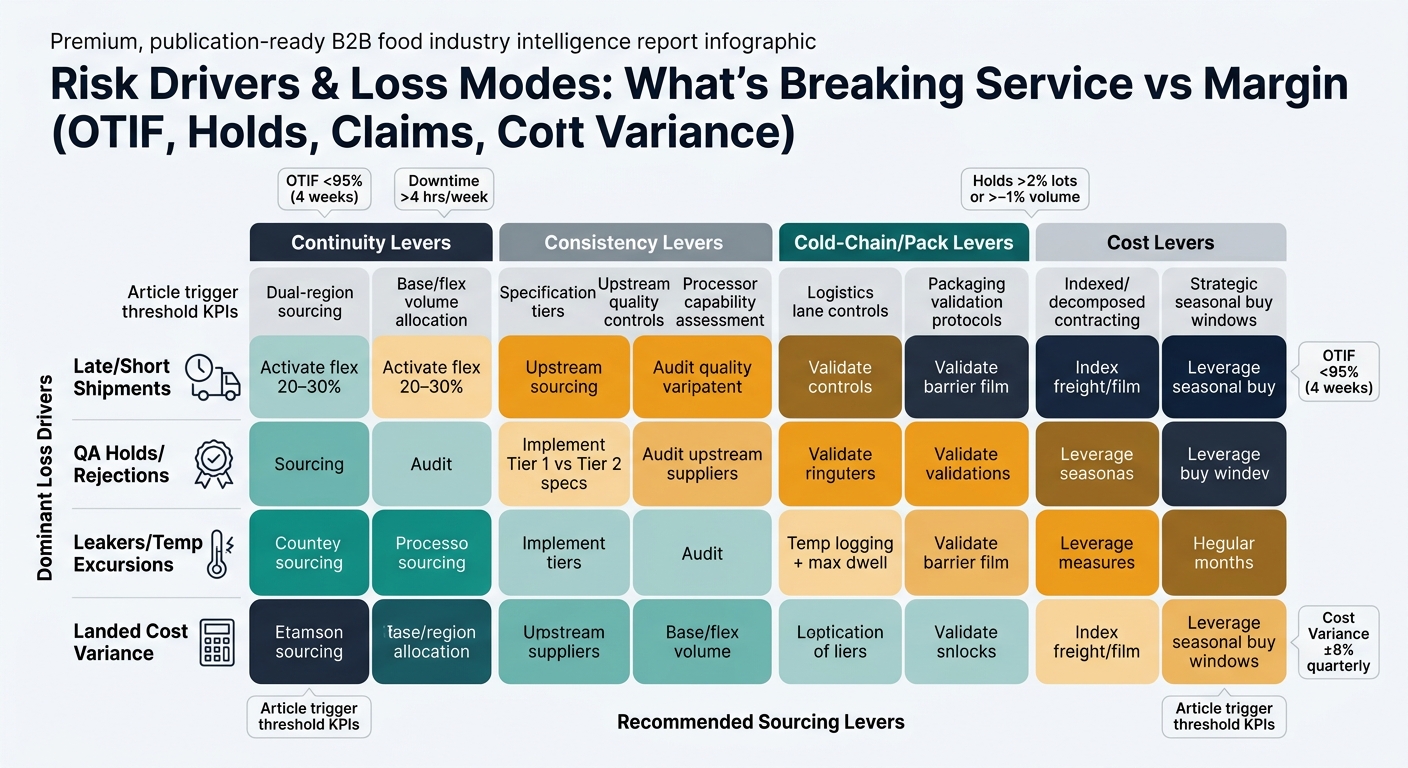
A 2D matrix/heatmap mapping dominant loss drivers (Late/Short Shipments, QA Holds/Rejections, Leakers/Temp Excursions, Landed Cost Variance) to sourcing levers (continuity, consistency, cold-chain/pack, and cost), with KPI threshold callouts for OTIF, downtime, holds, and cost variance.

Inputs you’ll need (minimum viable dataset)

  • Demand & service: Weekly forecast, customer fill-rate targets, penalty/chargeback terms.
  • Operations: Line rate (kg/hr), fermentation capacity (vats/totes), WIP days, changeover constraints.
  • Quality: Incoming defects by reason (bolting, decay, pesticide residue flags, foreign matter), finished pH band, leaker/ swollen pack claims.
  • Supply: Current supplier tier map (farm → packer → processor), lead times, minimum order quantities.
  • Cold chain: Lane temperatures, dwell times at DC, returns reasons.

Overview of decision paths (outcomes)

  • Outcome 1 (Continuity-first): Dual-region supply + pre-qualified alternates + base/flex contracting.
  • Outcome 2 (Consistency-first): Tightened supplier process controls + spec tiers + QA-linked scorecards.
  • Outcome 3 (Cost-first without service loss): Seasonal buying windows + indexed components (greens vs. packaging vs. freight proxies).
  • Outcome 4 (Urgency/shortage): Spec-flex + substitution guardrails + temporary lane/pack changes.

Quick Win: If you can’t answer “What % of our disruptions are late/short vs. rejected/held?” you’re not ready to negotiate—start with that split.

3) The Decision Tree You Can Actually Run in a Weekly S&OP Meeting

A clean weekly S&OP decision-tree flowchart mirroring Section 3: Decision Point 1 branching to Path A vs Path B; Path A branches by late/short vs QA holds, then buffer feasibility to A1 vs A2, and QA root-cause to A3 vs A4; Path B branches by cost volatility tolerance to B1 then channel sensitivity to B2 vs B3; with overlays/end-nodes for urgency and spec strictness plus KPI threshold callouts (OTIF, downtime, holds, shrink/claims).

Insight: A usable decision tree must force trade-offs: freshness vs. continuity, spec rigidity vs. availability, and spot price vs. total landed cost (including shrink and expedites).

Data (validated): Mustard is a cool-season crop and can bolt under stress; temperature-driven field variability is predictable enough to plan around using seasonal playbooks. [1]

Procurement Impact: Your contracting and redundancy strategy should align to the harvest stress calendar (when quality and yields are most volatile) rather than to your fiscal quarter.

Decision Point 1: How exposed are you to a single point of failure?

  • If your top supplier (or top origin) covers >60% of volume OR you have <2 approved alternates → follow Path A (Continuity-first design)
  • If no supplier covers >60% and you have ≥2 alternates → follow Path B (Optimize cost + consistency)

Path A (Continuity-first design)

Decision Point 2A: What is the dominant failure mode?

  • If disruptions are mostly late/short shipments (not rejections) → go to Decision Point 3A-1
  • If disruptions are mostly QA holds/rejections (incoming or finished) → go to Decision Point 3A-2

Decision Point 3A-1 (Late/short): Can you buffer with WIP and finished inventory without blowing shrink?

  • If you can hold ≥14 days of total coverage (WIP + finished) with shrink/claims staying ≤1.5% → Recommendation A1: Base + Flex volume contracting
  • Base: Contract 70–80% of forecast with primary supplier(s) aligned to cool-season windows.
  • Flex: Add 20–30% optionality via secondary region/packer with pre-set lead time and spec tier.
  • Lane controls: Require temperature logging for chilled moves; define max dwell time at DC.
  • If you cannot hold ≥14 days without shrink/claims rising → Recommendation A2: Dual-region split + shorter lead times
  • Split: Target 45–55% / 45–55% across two regions (or two packers) to reduce correlated weather risk.
  • Shorten: Prioritize suppliers closer to plant/DC to reduce transit time and temperature excursions.

Decision Point 3A-2 (QA holds/rejections): Is the issue upstream variability or in-plant control?

  • If incoming greens show high variability (bolting, leaf integrity, decay, foreign matter) → Recommendation A3: Spec-tiering + upstream controls
  • Spec tiers: Define Tier 1 (premium texture) vs. Tier 2 (acceptable for cooked/processed variants) with QA sign-off.
  • Supplier requirements: Pre-cool compliance, field pack hygiene, and defect-rate reporting by lot.
  • If incoming is stable but finished lots drift (pH/sensory, gas/leakers) → Recommendation A4: Process-anchored supplier selection (processor capability)
  • Prioritize processors with documented pH monitoring cadence and fermentation temperature control.
  • Packaging fit: Validate venting/film specs to manage CO2 and reduce swollen/leaking packs.

Path B (Optimize cost + consistency)

Decision Point 2B: What is your cost volatility tolerance?

  • If you must keep landed cost variance within ±5% quarterly → Recommendation B1: Indexed/Decomposed contracting
  • Separate components: Greens (seasonal), packaging resin/film, freight/cold storage.
  • Index where possible: Tie variable components to transparent benchmarks; keep conversion margin fixed.
  • If you can tolerate ±10% variance but must protect service → go to Decision Point 3B

Decision Point 3B: Are you buying for retail (high claims risk) or foodservice/industrial (more tolerant)?

  • If retail with high returns sensitivity (leakers, over-souring) → Recommendation B2: Cold-chain-first lanes + tighter pack specs
  • Temperature discipline: Design lanes around ≤41°F / ≤5°C cold-holding expectations and define excursion guardrails (max time above spec) from plant to DC. [4]
  • If foodservice/industrial with more tolerance → Recommendation B3: Seasonal spot + contingency clauses
  • Buy windows: Heavier buys in cool-season periods when quality/yield are more stable.
  • Contingency: Pre-approved spec-flex and substitute-origin rules to avoid emergency buys.

Decision Point 4 (All paths): How urgent is the need?

  • If you need supply within ≤21 days → Recommendation U1: Use approved alternates + temporary spec-flex
  • If you have >60 days runway → Recommendation U2: Qualify a second tier (packer/processor) and lock a seasonal program

Decision Point 5 (All paths): How strict is your quality spec and compliance requirement?

  • If you require third-party certifications and strict incoming specs with low tolerance for variation → Recommendation Q1: Fewer suppliers, deeper audits, higher redundancy inventory
  • If you can allow controlled variation (tiered specs) → Recommendation Q2: More suppliers, spec-flex governance, lower inventory

Quick Win: Put “spec tiers” into the contract, not into an email thread during a shortage. That’s the difference between controlled flexibility and uncontrolled brand risk.

4) Three Walkthroughs (How Different Teams Land on Different Answers)

Insight: The same market conditions can justify opposite sourcing strategies depending on whether your constraint is fermentation capacity, cold chain, or QA hold risk.

Data (validated): Best-practice references for traditionally fermented vegetables advocate a critical control point of sustained pH decline to <4.6; this is a practical safety/quality control anchor for governance and supplier capability discussions. [5]

Procurement Impact: Your supplier choice should be evaluated not only on price/kg, but on how reliably they keep you inside your pH/sensory window without creating leakers or rework.

Scenario A: Retail program launch, high penalties, limited alternates

  • Profile: New national retail placement; OTIF target 98%; one incumbent supplier covers 75%.
  • Path through tree:
  • Decision 1: >60% concentration → Path A
  • Decision 2A: Failures are late/short (seasonal gaps) → Decision 3A-1
  • Decision 3A-1: Cannot hold 14 days (claims rise after day 10) → Recommendation A2
  • Decision 4: Need within 30–45 days → U2 (qualify second region/packer fast)
  • Why this is the right answer: Retail penalties make expedites and missed fills more expensive than a modest unit-cost increase from dual-region sourcing.
  • Expected operational outcome: Fewer line stops, improved OTIF, reduced expedite spend.

Scenario B: Stable supply, rising costs, finance demands predictability

  • Profile: Two approved suppliers; service stable; landed cost variance is hurting margin planning.
  • Path through tree:
  • Decision 1: Not concentrated → Path B
  • Decision 2B: Must keep variance within ±5% → Recommendation B1
  • Decision 5: Specs strict (brand premium) → Q1 (deeper audits, redundancy inventory)
  • Why this is the right answer: Decomposed contracting prevents overreacting to a single driver (e.g., packaging resin vs. greens) and stabilizes forecasting.
  • Expected operational outcome: Lower landed-cost variance without increasing shrink.

Scenario C (Common edge case): Plenty of greens available, but QA holds spike and leakers increase

  • Profile: No shortage; incoming looks “fine,” but finished product shows more swollen packs and inconsistent acidity.
  • Path through tree:
  • Decision 1: Either path; choose based on failure mode → QA holds dominate → Path A
  • Decision 2A: QA holds/rejections → Decision 3A-2
  • Decision 3A-2: Incoming stable, finished drifts → Recommendation A4
  • Why this is the right answer: This is a processor capability and packaging gas-management problem, not a farm availability problem.
  • Expected operational outcome: Higher schedule attainment, fewer claims/returns, less rework.

Quick Win: When leakers rise, don’t immediately blame “bad batches of greens.” First test whether fermentation temperature control and packaging venting specs changed (even subtly).

5) Action Matrix (Match Your Situation to a Sourcing Strategy)

Insight: Procurement actions should be scenario-specific and measurable—each strategy needs a defined KPI and a review trigger.

Data (validated): FDA continues to emphasize that Listeria can survive/grow at refrigeration temperatures; for refrigerated RTE products, sanitation and environmental controls are governance requirements, not optional “quality initiatives.” [6]

Procurement Impact: Align supplier selection and contract terms with the KPI that protects your P&L most (downtime, shrink, chargebacks, or audit exposure).

Buyer Profile Key Factors Recommended Strategy Expected Outcome
Single-source exposure >60% volume with one supplier; limited alternates Dual-region split (45–55/45–55) + pre-qualified backup Reduced correlated disruption risk; higher OTIF
Cost predictability mandate Finance requires ±5% variance Decomposed/indexed contracting (greens vs. packaging vs. freight) Lower landed cost variance; fewer surprises
QA holds rising Holds >2% lots; rework increasing Spec-tiering + supplier process audits + pH/temperature controls Fewer holds; higher schedule attainment
Retail returns/leakers Swollen/leaking packs; temperature excursions Cold-chain-first lanes + packaging spec validation Lower claims; improved shelf-life performance
Urgent shortage Need supply ≤21 days Approved alternates + temporary spec-flex governance Avoid line stoppage; controlled brand risk

Quick Win: Put one KPI next to each supplier: either “lead time consistency,” “incoming defect rate,” or “finished claims rate.” If you track all three but act on none, you’ll still be reactive.

6) Risk Mitigation Playbook (Early Warnings, Contingencies, and Review Triggers)

Insight: In mustard greens kimchi, the biggest preventable losses come from late detection—by the time finished goods fail, you’ve already consumed capacity and created WIP you can’t un-make.

Data (validated): Fermented-vegetable best-practice references emphasize controlling fermentation variables (temperature, pH, salt) and using pH decline to <4.6 as a critical control point; this supports using pH drift as an early-warning metric. [5]

Procurement Impact: Your mitigation plan should define automatic triggers for switching suppliers, activating spec-flex, or adding inventory—without waiting for a crisis meeting.

For Recommendation A1/A2 (Continuity-first: base/flex or dual-region)

  • What to watch for:
  • Early warning sign: Lead time variability increases by >2 days vs. 8-week average.
  • Early warning sign: Incoming defect rate (bolting/decay/foreign matter) rises >1.5x baseline.
  • Contingency actions:
  • Inventory action: Shift from finished-goods buffer to WIP buffer if shelf-life/claims are sensitive.
  • Supply action: Activate secondary region at pre-agreed volumes within 7–14 days.
  • Monitoring metrics & triggers:
  • Trigger: OTIF <95% for 2 weeks → activate flex volumes.
  • Trigger: Expedite spend >1% of COGS monthly → rebalance origin split.
  • Common mistakes:
  • Mistake: “Backup supplier” exists on paper but lacks packaging compatibility or cold-chain capacity.

For Recommendation A3/A4 (Quality-first: spec tiers or processor capability)

  • What to watch for:
  • Early warning sign: pH drift outside target band in >1% of lots.
  • Early warning sign: Claims/returns for swollen packs increase >30% month-over-month.
  • Contingency actions:
  • Process action: Tighten fermentation temperature controls; increase pH monitoring frequency during seasonal transitions.
  • Commercial action: Switch affected lots to Tier 2 channels (foodservice/industrial) if allowed.
  • Monitoring metrics & triggers:
  • Trigger: QA holds >2% lots → pause supplier expansion; focus on process capability audit.
  • Common mistakes:
  • Mistake: Solving variability by rejecting more loads—causes shortages and emergency buys.

For Recommendation B1/B2/B3 (Cost-first with guardrails)

  • What to watch for:
  • Early warning sign: Packaging availability/lead time extends (resin/film constraints) while greens are available.
  • Early warning sign: Refrigerated lane performance worsens (temperature excursions, dwell time).
  • Contingency actions:
  • Commercial action: Add a packaging contingency clause (approved alternates, pre-tested films/lids).
  • Logistics action: Shift lanes or add cross-dock controls to reduce time above spec.
  • Monitoring metrics & triggers:
  • Trigger: Landed cost variance >±8% quarterly → re-open component indices.
  • Common mistakes:
  • Mistake: Optimizing price/kg while ignoring shrink and chargebacks—total landed cost rises.

Quick Win: Build a “two-key” rule: no emergency supplier switch without (1) QA spec tier decision and (2) cold-chain lane confirmation. That prevents hidden downstream failures.

7) One Actionable Sourcing Call (With Confidence Level)

Insight: The most consistently high-ROI move in this category is not chasing the cheapest greens—it’s reducing line downtime and claims by designing redundancy + spec-flex before seasonal stress hits.

Data (validated): Mustard greens are vulnerable to heat-driven quality issues, and fermented-vegetable manufacturing best practices anchor control around pH decline to <4.6; both support pre-defined spec tiers and capability-based processor selection. [7]

Procurement Impact: Pre-qualifying alternates and codifying spec tiers can save money through fewer expedites, fewer holds, and fewer retail claims—even if unit price is slightly higher.

  • Strategy: Buy
  • Reliability: Medium
  • Potential Saving (reframed for credibility): Category teams most often see savings show up as avoided downtime/expedites and fewer claims; quantify it internally as “hours avoided” and “claims % avoided” rather than promising a universal %.
  • Insight: Lock a base/flex program timed to cool-season supply (base 70–80%, flex 20–30%) and formalize QA-approved spec tiers so you can switch origins or suppliers without triggering uncontrolled holds or retail claims.

Logical Next Step (analysis, not promotion): If you can’t quantify how much of your cost variance comes from (a) raw greens yield loss in trimming/brining, (b) fermentation WIP time and capacity, and (c) cold-chain/pack failures, you will keep negotiating the wrong lever. The highest-leverage capability gap is a single “control tower” view that ties supplier/origin events to downstream KPIs (OTIF, downtime hours, hold rate, claims rate, and landed cost variance) fast enough to intervene before WIP becomes finished-goods loss.

The Bottom Line for Your Next Contract

(Analyzed at: Sep, 2026)
If you’re negotiating mustard-greens kimchi supply for the next 1–2 quarters, treat heat exposure and reefer variability as the two compounding risks: hot spells increase field defects/bolting risk, and tight reefer capacity raises the odds of temperature excursions and late arrivals. [8] The move that holds up operationally is a dual-region or base/flex design with pre-qualified alternates plus contract language that ties spec tiers and cold-chain lane controls to clear triggers—so you can shift 20–30% of volume without a QA “stop-the-line” event. The stake is usually not pennies per pound; it’s avoiding a week of expediting and service penalties that can easily erase the margin you thought you negotiated.

Spicy Mustard Greens KimchiSupply Chain Intelligence
132 countries tracked
10
Exporters
10
Importers
$365M
Top Export Value
Top Exporters (2024)
🇳🇱
Netherlands
$365M
🇮🇹
Italy
$278M
🇪🇸
Spain
$232M
🇰🇷
South Korea
$178M
🇹🇷
Turkey
$156M
+127 more
Top Buyers
🇺🇸 United States $753M🇩🇪 Germany $471M🇯🇵 Japan $358M🇰🇷 South Korea $304M🇬🇧 United Kingdom $228M

References

  1. extension.uga.edu
  2. fda.gov
  3. dat.com
  4. fda.gov (Food Code PDF)
  5. ars.usda.gov
  6. fda.gov (CPG Sec. 555.320)
  7. ask.ifas.ufl.edu
  8. gov.ca.gov

Related Contents

Subscribe
→
By subscribing you agree to with our Privacy Policy and provide consent to receive updates from our company.
Thank you! Your submission has been received!
Oops! Something went wrong while submitting the form.
Subscribe to receive the latest blog posts, updates, promotions, and announcements from Tridge.
