
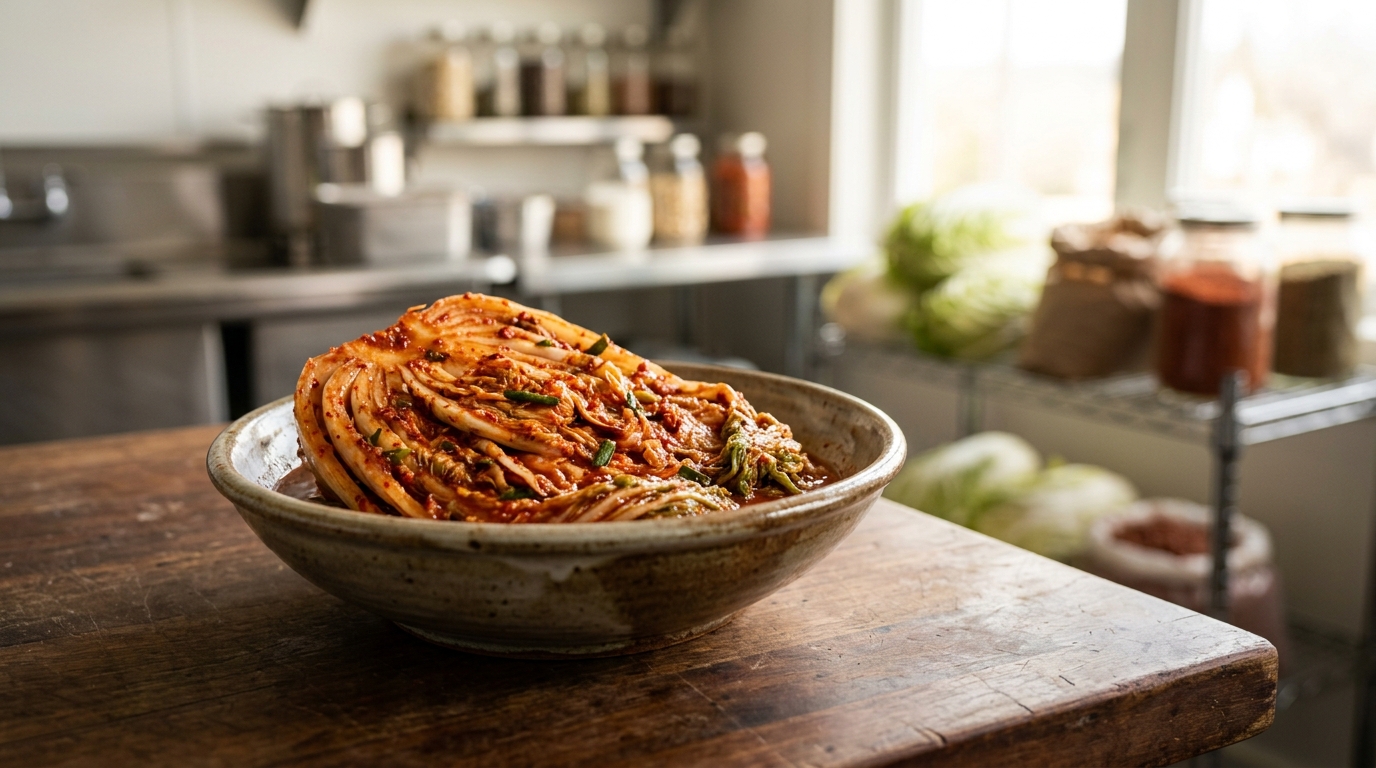
Spicy cabbage kimchi isn’t a simple “cabbage + seasoning” buy—it’s a controlled biological process with structural yield loss, time/temperature constraints, and packaging/cold-chain dependencies that directly shape total landed cost and service levels. This guide maps where cost gets locked in and what procurement teams should ask for (and govern) to avoid surprises.
Spicy cabbage kimchi is not a single “ingredient buy”—it’s a chained system where cost and risk get locked in by (1) cabbage agronomy and defect rates, (2) water- and labor-heavy brining/washing yield loss, (3) fermentation time/temperature control, and (4) packaging + cold-chain performance under ongoing CO2 generation. The physical flow is typically: napa cabbage + aromatics + chili inputs → trimming/splitting → salting/brining → rinsing/draining → seasoning (yangnyeom) mixing → packing → controlled fermentation/hold → refrigerated distribution.

Insight: Kimchi cost builds through three “irreversible” steps: (1) raw cabbage quality/defect rate, (2) brining/washing labor + water + wastewater, and (3) packaging/cold-chain that must tolerate gas and odor.
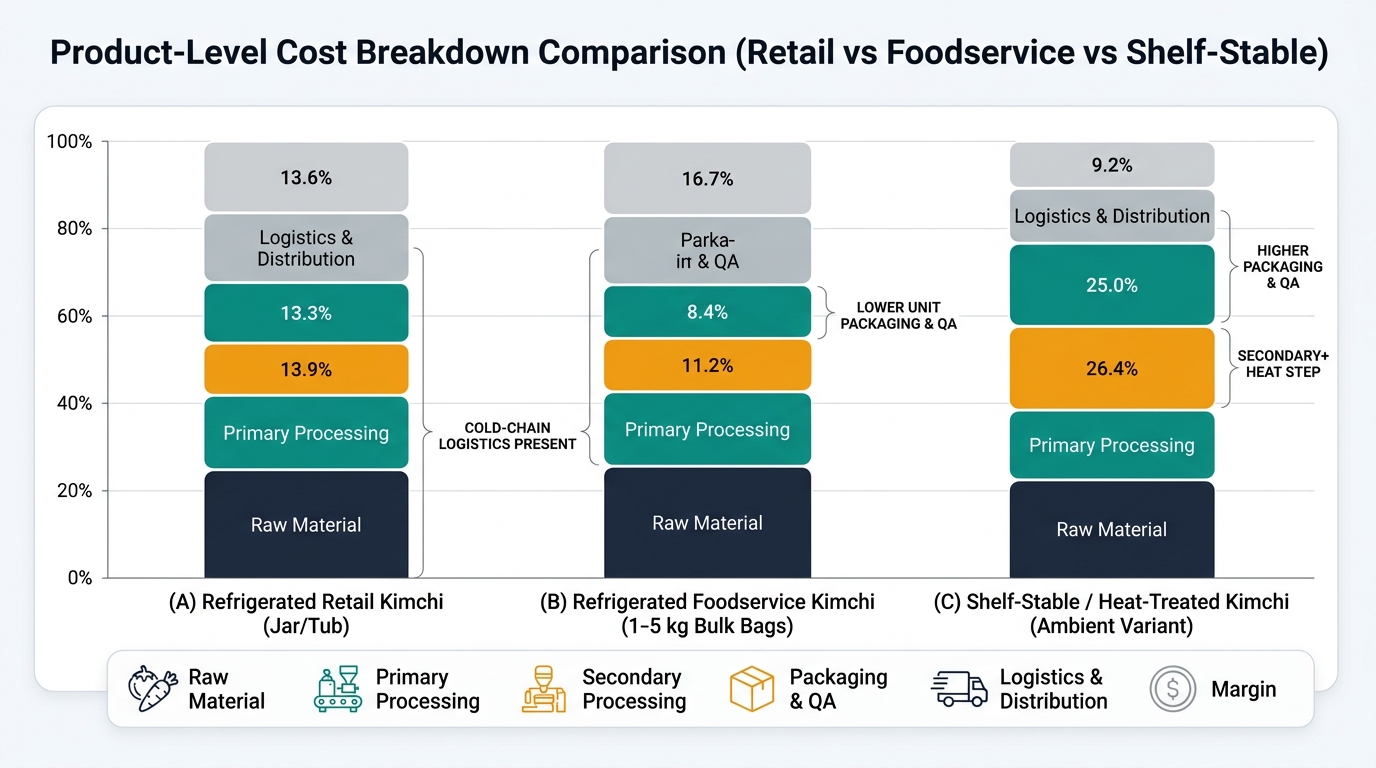
| Supply Chain Node | Cost Ratio (% of Final Cost) | Notes |
|---|---|---|
| Raw Material (cabbage + aromatics + chili) | 30% | Cabbage dominates mass; gochugaru grade can swing seasoning cost. |
| Primary Processing (brine/wash/drain) | 20% | Labor + water + wastewater + yield loss are structural. |
| Secondary Processing (mix + ferment control) | 15% | Fermentation space/time + energy + batch QA. |
| Packaging & QA | 15% | Functional packaging to manage CO2/leak/odor + compliance testing. |
| Logistics & Distribution (cold chain) | 10% | Reefer transport + chilled storage + shrink/claims. |
| Retail & Wholesale Margin | 10% | Category margins + slotting/promo mechanics vary by channel. |
| Supply Chain Node | Cost Ratio (% of Final Cost) | Notes |
|---|---|---|
| Raw Material | 35% | Higher cabbage share per kg; seasoning intensity may be lower than premium retail. |
| Primary Processing | 22% | Throughput and labor minutes per kg matter; bulk runs can be more efficient. |
| Secondary Processing | 13% | Fermentation control still required; less packaging-driven complexity. |
| Packaging & QA | 8% | Lower unit packaging cost, but seal integrity still critical. |
| Logistics & Distribution | 12% | Heavier cases; cold-chain remains mandatory. |
| Foodservice Distributor Margin | 10% | Distributor handling and delivery economics. |
| Supply Chain Node | Cost Ratio (% of Final Cost) | Notes |
|---|---|---|
| Raw Material | 28% | Inputs similar, but recipe may be adjusted for heat process stability. |
| Primary Processing | 18% | Same trim/brine/wash fundamentals. |
| Secondary Processing (incl. heat step) | 20% | Thermal processing, validation, and potential texture trade-offs. |
| Packaging & QA | 18% | Retort-capable or hot-fill packaging + process authority/validation. |
| Logistics & Distribution | 6% | Ambient freight reduces cold-chain cost, increases warehousing flexibility. |
| Retail & Wholesale Margin | 10% | Different set dynamics; often positioned as pantry item. |
(Analyzed at: Jul, 2026)
Write your next kimchi contract around control points, not just a price-per-kg: require (a) a defined pH-at-ship window and hold/fermentation conditions tied to your shelf-life promise, (b) packaging performance criteria explicitly designed for CO2 pressure and seal integrity, and (c) lane-level cold-chain requirements with temperature logging and clear claims rules.
This works because swelling/leaks and “off-spec souring” are usually time–temperature–packaging interactions, not a single ingredient event—and 2026 refrigerated freight remains volatile enough that transit variability is a real quality variable, not an operational rounding error. [2]
If you don’t codify these controls, you typically pay later in the form of retailer chargebacks, emergency rework, and expedited freight—often a mid-single-digit hit to landed cost stability over a year even when raw cabbage pricing looks “normal.”


