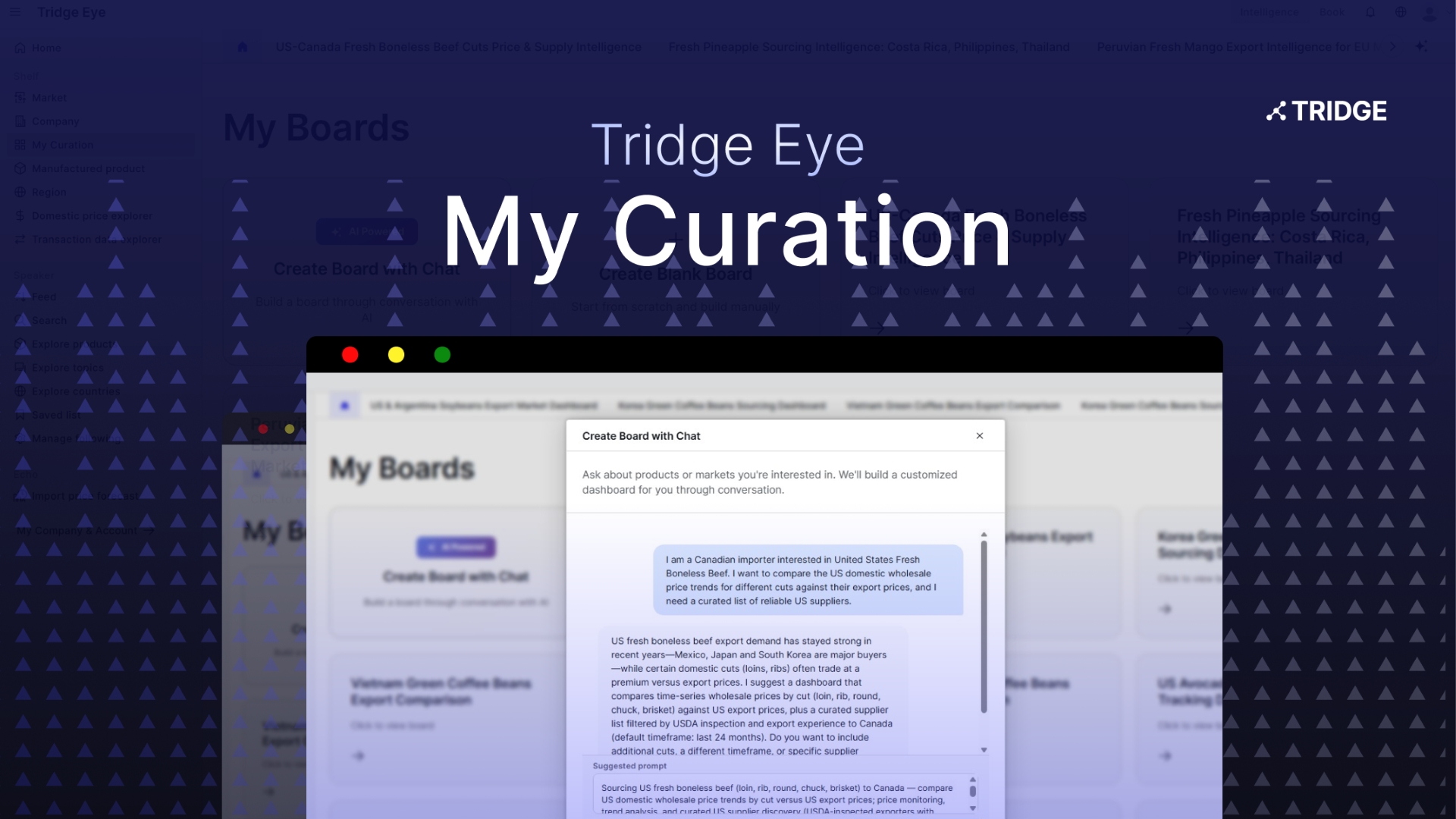
This report is powered by Tridge Eye Data Intelligence.
Every data point, price signal, and supply risk insight in this analysis comes from the same platform that procurement and sourcing leaders worldwide rely on daily. As you read, consider what this level of market intelligence could do for your sourcing decisions.
Soybeans behave like a “simple” commodity only until you have to (1) lock supply across hemispheres, (2) manage specs like non-GMO/IP, and (3) explain price outcomes to finance and governance stakeholders. This guide translates soybean market structure (CBOT + basis + freight + timing) into practical procurement decisions: how to benchmark, how to diversify corridors, what to monitor, and how to document defensible sourcing rationale.
(Analyzed at: Mar, 2026)

Soybeans look like a simple bulk commodity until you try to lock supply, manage specs, and defend a price. The reality is a bi-hemispheric, corridor-constrained, basis-driven supply chain where the “same CBOT price” can translate into very different delivered costs and disruption risks.
The practical flow (what procurement teams touch):

Why this matters for procurement:
Below is an intelligence-style breakdown of how cost and margin accumulate across the soybean chain. The goal is not academic accuracy to the decimal; it’s to show where negotiation leverage exists and where risk can overwhelm price.
Key insight: Farm-level economics set the floor, but what you feel as a buyer is basis and availability, not the farmer’s input bill.
Procurement implication: If you don’t separate CBOT vs. basis vs. freight, you’ll misdiagnose where “supplier price increases” are actually coming from.
Key insight: Crush economics can flip the market’s behavior. When oil value surges (biofuels pull), crushers bid more aggressively for beans and basis can move even without a futures rally.
Procurement implication: If you buy beans directly (or buy meal/oil indexed to beans), you need to monitor meal/oil spreads and understand when crushers will become “price insensitive” to secure throughput.
Key insight: The more you move from commodity to ingredient (RBD oil, lecithin, proteins), the more cost becomes QA, process yield, and compliance, and the more the supplier universe narrows.
Procurement implication: “More suppliers” on paper is not the same as “more qualified suppliers.” Qualification intelligence is often the gating factor.
Key insight: For EU-bound flows, traceability is moving from a preference to a gating requirement. The EU’s deforestation regulation (EUDR) has been subject to timeline adjustments; official EU communications have referenced postponement/simplification steps and updated timelines in late 2025 communications [3].
Procurement implication: Compliance costs don’t stay “in sustainability.” They show up as premiums, reduced eligible supply, longer lead times, and higher rejection risk.
Key insight: In soybeans, logistics disruptions frequently express themselves first as basis blowouts (local cash vs futures), not as CBOT moves.
Procurement implication: Two suppliers offering the “same FOB” can still produce very different delivered outcomes if one corridor is prone to draft/strike/congestion risk.
These ratios are illustrative to show where cost concentrates by product form. Actual splits vary by origin, contract structure, timing, and whether you buy bulk or specialty.
| Supply Chain Node | Cost Ratio (% of final delivered cost) | What usually moves this line item |
|---|---|---|
| Upstream raw beans (farm + aggregation) | 70–85% | CBOT + local basis, FX, crop size |
| Primary processing | 0% | N/A (whole bean) |
| Secondary processing | 0% | N/A |
| QA / compliance | 1–3% | Inspection, documentation |
| Logistics & distribution | 10–20% | Inland freight, elevation, ocean freight, demurrage |
| Trading / supplier margin | 2–6% | Counterparty risk, financing, optionality |
| Supply Chain Node | Cost Ratio (% of final delivered cost) | What usually moves this line item |
|---|---|---|
| Upstream beans embedded in meal value | 55–75% | Bean price + crush economics |
| Primary processing (crush) | 8–15% | Energy, plant utilization, crush margin |
| Secondary processing | 0–5% | Dehulling/standardization, additives |
| QA / compliance | 2–5% | Protein/moisture, contaminants, certifications |
| Logistics & distribution | 10–20% | Bulk freight, port handling |
| Trading / supplier margin | 3–8% | Coverage, credit, performance risk |
| Supply Chain Node | Cost Ratio (% of final delivered cost) | What usually moves this line item |
|---|---|---|
| Upstream beans embedded in oil value | 45–70% | Bean price + oil share of crush value |
| Primary processing (crush) | 6–12% | Extraction yield, crush margin |
| Secondary processing (refining) | 8–18% | Energy, refining losses, QA |
| QA / compliance | 3–7% | Food safety, traceability |
| Logistics & distribution | 8–18% | Tank logistics, heating, port handling |
| Trading / supplier margin | 3–8% | Coverage, credit, allocation risk |
| Supply Chain Node | Cost Ratio (% of final delivered cost) | What usually moves this line item |
|---|---|---|
| Upstream raw beans + specialty premium | 65–80% | Premium for segregation + rejection risk |
| Primary processing | 0% | N/A |
| Secondary processing | 0% | N/A |
| QA / compliance | 4–10% | Identity preservation controls, testing |
| Logistics & distribution | 10–20% | Containers, handling, longer lead times |
| Trading / supplier margin | 4–10% | Liability, documentation burden |
Most procurement teams understand futures. Fewer operationalize what matters in physical execution:
A CBOT-linked contract without a clear basis mechanism is often a governance problem: you can’t tell if you paid for market movement or supplier behavior.

Procurement teams get surprised when their delivered price rises even though “the market is flat.” In soybeans, that disconnect typically comes from four mechanics:
For experienced procurement leaders coming from other categories, soybeans introduce traps that look like “supplier issues” but are actually market structure issues.
Common mistakes:
This section describes how procurement teams use structured intelligence to make defensible decisions—without assuming soybean-domain expertise.
Operational output (what procurement leaders can run with):
Soybeans are a clean example because basis, corridors, and coproduct economics are visible—but the same intelligence logic applies across other categories procurement teams commonly manage:
The transferable lesson: procurement advantage comes from separating market structure from supplier behavior and building a portfolio that is resilient by design.
Soybeans compress several hard procurement problems into one category:
For procurement leaders, the value of intelligence is not “more information.” It’s decision-ready comparability: you can defend supplier selection, negotiate with a clear basis logic, and reduce disruption exposure without overpaying for unnecessary resilience.

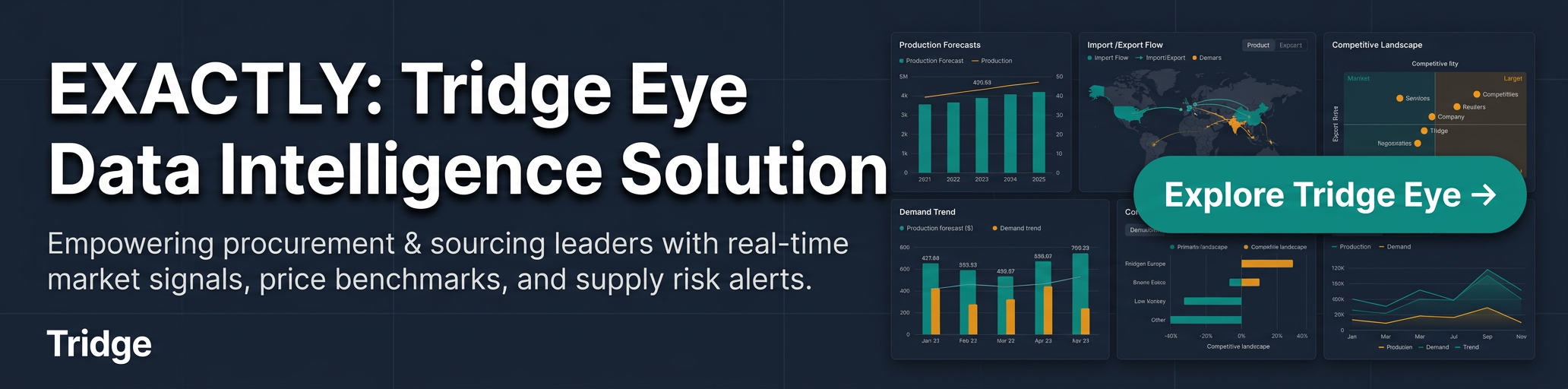
Make Faster, Data-Driven Sourcing Decisions
The insights in this report are just the starting point. Tridge Eye is the data intelligence solution that gives procurement and sourcing leaders real-time market signals, price benchmarks, and supply risk alerts — so you can act before the market moves.