
This report is powered by Tridge Eye Data Intelligence.
Every data point, price signal, and supply risk insight in this analysis comes from the same platform that procurement and sourcing leaders worldwide rely on daily. As you read, consider what this level of market intelligence could do for your sourcing decisions.
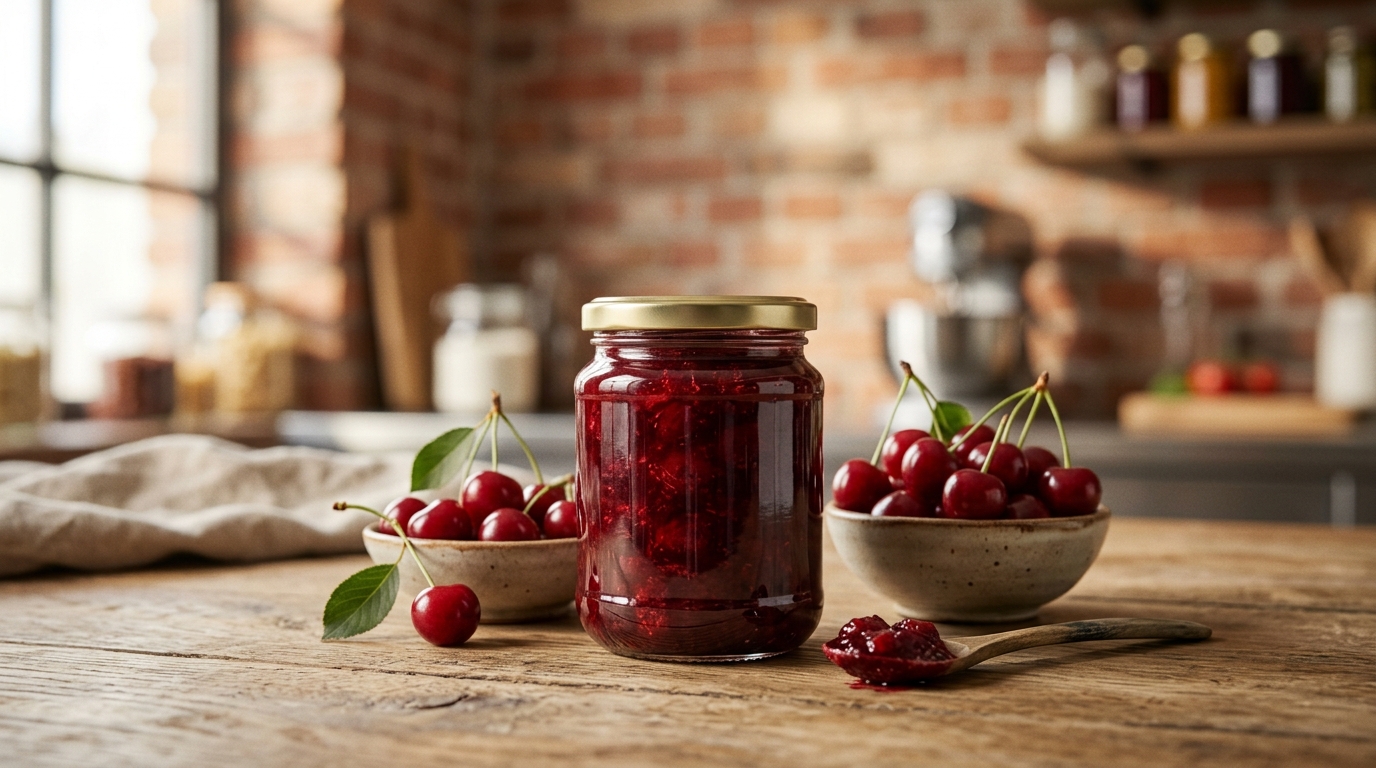
This guide maps the sour-cherry-jam supply chain the way procurement teams actually experience it: a short, capacity-constrained fruit season upstream, then year-round manufacturing that is often limited by packaging and line capability. Use it to align sourcing, QA, and operations on what is truly interchangeable (and what is not) before you run an RFP or renegotiate contracts.
(Analyzed at: Apr, 2026)
Download real-time cost tracking for every node in this supply chain.
Sour cherry jam looks like a simple shelf-stable SKU, but its cost base is structurally “front-loaded” into (1) a short, high-throughput harvest and primary processing window, and (2) retail packaging—especially glass jars and closures.
Sour cherries are typically harvested over a short early-summer window in temperate climates, then stabilized as IQF fruit, puree/pulp, or concentrate to feed year-round jam manufacturing. Jam itself is commonly formulated to high soluble solids (often around ~65 °Brix in many standards/definitions) and low pH for preservation, with hot-fill/pasteurization and closure integrity as the core safety controls. In the EU, jam definitions are regulated and minimum fruit content is being raised (e.g., jam to 450 g fruit/kg and “extra jam” to 500 g fruit/kg in the revised framework), structurally shifting formulations toward more fruit and less sugar.
Your “fixed cost drivers” are not evenly distributed: fruit stabilization capacity (pitting/IQF/aseptic), packaging line capability (hot-fill + cap torque/vacuum control), and glass/closure supply are the nodes that most often constrain throughput and drive unavoidable cost-to-serve.
Sour cherry jam is a two-step supply chain: seasonal fruit is converted into storable intermediates, then re-converted into finished jam close to demand.
The dominant physical flow is:
The “real supply base” is often upstream of the jam brand: if you only map finished-jam suppliers, you miss the choke points in pitting/IQF and in jars/closures that can cap output regardless of fruit availability.

Farmgate economics are dominated by yield and harvest execution; quality losses happen fast.
Sour cherries are highly perishable; bruising and delays raise defect rates and reduce usable yield. Key physical specs at intake include maturity (soluble solids), firmness, color, and defect/foreign matter limits. Harvest is concentrated into a short window, so labor/mechanization availability and transport time to the processor directly determine delivered quality.
The orchard node sets the “fruit solids” reality downstream: lower-quality fruit increases sorting loss and can force more puree/concentrate usage (changing texture and piece identity).
This is the first major bottleneck: throughput equipment and stabilization infrastructure convert seasonality into year-round supply.
Physical operations include:
Primary processing cost drivers are labor, water/wastewater, energy (freezing/thermal), yield loss, and QA (foreign matter controls).
If you need “whole fruit pieces” in jam, your dependency shifts toward IQF/pitted fruit capacity; if puree/concentrate is acceptable, you trade piece identity for easier logistics and often more stable manufacturing.
Jam manufacturing is a controlled water-removal and gelation process; the “spec” is mostly physics and chemistry.
Typical technical targets and controls:
Core cost drivers: fruit ingredient solids, sweeteners, pectin/acidulants, energy for evaporation, line efficiency (changeovers), and rework/scrap from off-spec gel/viscosity.
Small formulation changes (fruit form, pectin type, cook endpoint) can shift both yield and sensory outcomes—so “equivalent” suppliers must be compared on process capability, not just ingredient lists.
For retail sour cherry jam, packaging is often a first-order cost and a hard operational constraint.
Physical requirements are non-negotiable:
Glass is widely used for chemical inertness and barrier performance, but it increases freight weight and breakage exposure.
Cost drivers: jars, lids, labels, cases, palletization, packaging scrap/breakage, QA testing (micro, pH/°Brix, vacuum/torque), and compliance documentation.
Packaging availability can cap finished-goods output even when fruit and co-packer time are available; jar/lid lead times and line changeover constraints often determine feasible SKU proliferation.
Jam ships ambient, but it is “dense and fragile”: logistics is about damage prevention and cube/weight economics.
Key physical cost drivers:
The same formula can have meaningfully different delivered cost depending on jar weight, case pack, and palletization—logistics engineering is a structural lever, not a market variable.

Percentages below are illustrative shares of final delivered cost (ex-works manufacturer → delivered to DC). Actuals vary by fruit %, jar size/weight, private label vs branded, and whether fruit is IQF vs puree/concentrate.
| Supply Chain Node | Typical Cost Share Range | What structurally drives it |
|---|---|---|
| Orchard (fresh fruit) | 10–25% | Yield, harvest method, delivered quality, local labor |
| Primary processing + stabilization | 10–25% | Sorting/pitting yield loss, freezing/thermal energy, QA |
| Jam manufacturing (cook/formulate) | 15–30% | Fruit solids + sweetener + pectin, evaporation energy, line efficiency |
| Packaging + QA release | 20–40% | Glass + closure + label, breakage/scrap, hot-fill controls |
| Logistics & distribution | 8–18% | Weight/cube, breakage, warehousing, pallet compliance |
| Product form feeding jam | Primary processing cost intensity | Manufacturing complexity | Typical use-case |
|---|---|---|---|
| IQF pitted sour cherries | High (pitting + freezing) | Medium–High (piece handling, dispersion) | Premium “fruit pieces” identity |
| Sour cherry puree/pulp | Medium (thermal/aseptic) | Medium (texture control via pectin/cook) | Consistent texture, fewer piece claims |
| Juice concentrate | Medium–High (evaporation energy) | Medium (color/flavor balancing) | Flavor + solids adjustment; often blended |
| Control | Why it matters physically | Common measurement |
|---|---|---|
| Soluble solids (°Brix) | Preservation + texture; sets gel system behavior | Refractometer °Brix |
| pH / titratable acidity | Microbial hurdle + pectin set + color stability | pH meter; titration |
| Fruit content (% or g/kg) | Identity, regulatory compliance, sensory | Mass balance; label/legal |
| Piece integrity / defect limits | Consumer perception; foreign matter risk | Sieve/visual; QA sampling |
| Closure integrity (vacuum/torque) | Shelf stability; leak prevention | Vacuum gauge; torque meter |
Year-round jam supply depends on pitting/IQF/freezer or aseptic capacity concentrated into a few peak weeks.
The harvest window is short; the system’s ability to stabilize fruit (IQF, aseptic puree, concentrate) determines how much usable fruit is carried into the rest of the year.
When stabilization capacity is tight, you can see constraints even if orchards have fruit—because the fruit cannot wait.
Glass jars and twist-off lids behave like engineered components, not commodities.
Hot-fill compatibility, finish dimensions, closure compound performance, and jar weight/strength all affect line performance and breakage. Glass is favored for barrier/inertness and shelf presentation, but it raises freight and damage risk.
A “jam shortage” can be a jar/lid shortage in disguise; packaging specs can be the hardest constraint to swap quickly.
In regulated markets, “jam” is a legal definition; compliance changes can force higher fruit usage.
The EU has updated rules on jams/jellies, including higher minimum fruit content (e.g., standard jam moving from 350 g/kg to 450 g/kg; extra jam to 500 g/kg in the revised framework).
Higher mandated fruit content increases dependency on fruit solids and stabilization capacity, and can reduce formulation flexibility (especially for price-sensitive SKUs).
Strategy: Hold
Reliability: High
Potential Saving: 3–8%
Insight: Standardize jar finish + lid system across sour-cherry (and adjacent) SKUs to reduce changeovers, scrap, and emergency substitutions driven by packaging availability.
Strategy: Buy
Reliability: Medium
Potential Saving: 2–6%
Insight: Where brand/spec allows, qualify puree/pulp as an alternate input to IQF fruit to reduce dependence on peak-week freezing throughput and improve manufacturing consistency.
Strategy: Strong Buy
Reliability: Medium
Potential Saving: 1–4%
Insight: Build a single “spec spine” (°Brix, pH, fruit content definition, piece/defect limits, vacuum/torque) used across plants and co-packers to reduce rework, QA holds, and subjective sensory disputes.
The hardest operational question is rarely “Can someone make sour cherry jam?”; it’s “Which upstream fruit form and which packaging system are truly interchangeable without breaking line performance or sensory identity?” Answering that consistently requires disciplined, comparable data on fruit intermediates (IQF vs puree vs concentrate), packaging component compatibility, and process capability at each manufacturing site.
See These Cost Structures Shift in Real Time
Tridge Eye — The supply chain breakdown you just read is a snapshot. Costs, margins, and risk profiles change daily — and the teams that track them in real time consistently out-source their competitors.