
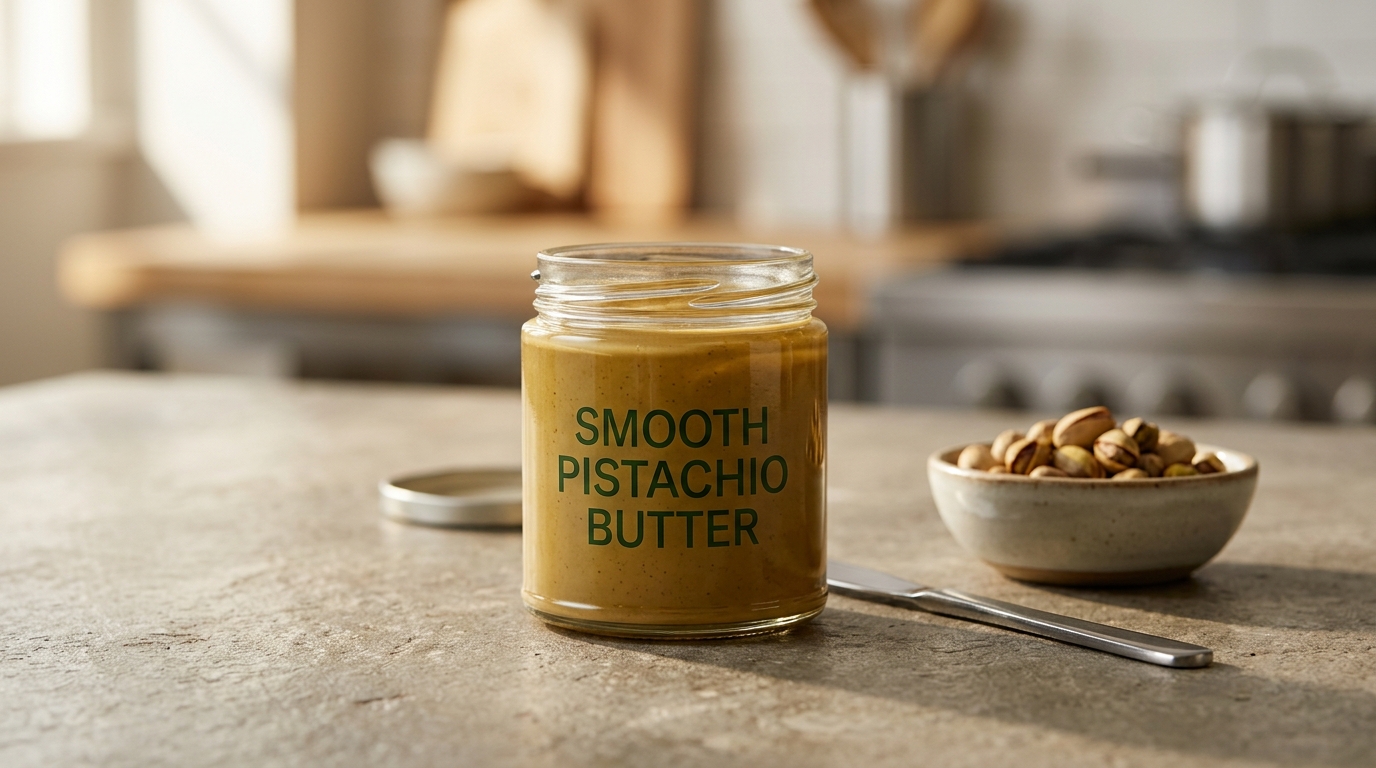
Smooth pistachio butter looks like a simple “nuts in, butter out” ingredient, but for procurement teams the real story is where cost and risk become irreversible: harvest timing, kernel sorting/testing, and the hold-and-release mechanics that sit between a lot and a shippable COA. This guide maps the chain in the order it really operates and highlights the few control points that consistently reduce surprises.
Smooth pistachio butter is a short supply chain on paper—kernels get processed into paste/butter and packed—but the cost structure is “front-loaded.” Most of the final cost is determined before grinding ever starts: orchard yield, kernel grade/defect rate, and the amount of sorting/testing needed to release compliant lots.
The chain is built around one seasonal harvest and year-round demand, so inventory carry and QA hold-and-release are structural (not optional) cost drivers.
In the U.S., pistachio production/marketing cycles run September 1 through August 31, and growers typically begin harvest in September; demand for butter is continuous, so kernels/paste are stored for months and lots may be held pending aflatoxin and quality clearance.
When you see a price or availability issue downstream, it usually traces to upstream yield/grade and the time-and-cash tied up in tested, released inventory—not “extra margin” added at the grinder.

Pistachio butter cost is dominated by kernel input value and the “conversion economics” of turning variable-grade kernels into a consistent, compliant, smooth spread.
In most nut spreads, raw material is the largest cost line; pistachio is further shaped by (1) grade spreads (green premium vs industrial), (2) testing/hold time, and (3) packaging intensity for retail.
Understanding which node is absorbing variability (sorting/testing vs blending/processing vs packaging) clarifies where specifications and QA requirements are actually being paid for.
| Supply Chain Node | Cost Ratio (% of Final Cost) | Notes |
|---|---|---|
| Raw Material (kernels/pieces) | 65% | Kernel grade/defect rate dominates; industrial grades may be used with blending. |
| Primary Processing | 12% | Sorting + aflatoxin testing/hold-and-release is a gating cost. |
| Secondary Manufacturing | 10% | Grinding/refining + yield loss; roast step if specified. |
| Packaging & QA | 5% | Pails/drums + COA; lower packaging intensity than retail. |
| Logistics & Distribution | 8% | Ambient freight; heat exposure risk on long lanes. |
| Supply Chain Node | Cost Ratio (% of Final Cost) | Notes |
|---|---|---|
| Raw Material (kernels) | 50% | Color/flavor targets can force higher-grade kernel usage or tighter blending rules. |
| Primary Processing | 10% | Sorting + food safety release; tighter documentation increases overhead. |
| Secondary Manufacturing | 12% | Texture/viscosity control + formulation (salt/sugar/oil/emulsifier if used). |
| Packaging & QA | 18% | Jar, closure, label, carton; oxygen/light management for shelf-life stability. |
| Logistics & Distribution | 10% | Higher cube/weight and retailer distribution complexity vs bulk. |
| Supply Chain Node | Cost Ratio (% of Final Cost) | Notes |
|---|---|---|
| Raw Material (kernels + sugar/fats) | 45% | Pistachio share may be lower; added ingredients become meaningful. |
| Primary Processing | 10% | Sorting/testing still required; roast profile impacts flavor. |
| Secondary Manufacturing | 18% | Cooking/blending steps, emulsification, tighter rheology targets for fillings. |
| Packaging & QA | 12% | Often both bulk and foodservice packs; label/claims still apply. |
| Logistics & Distribution | 15% | Distribution often multi-channel; heat sensitivity remains. |

A few non-obvious constraints shape availability, consistency, and cost more than day-to-day market noise.
These constraints are rooted in biology (annual harvest), physics (oxidation/heat), and compliance mechanics (testing and traceability).
If you build specs and QA expectations that ignore these constraints, you’ll see chronic exceptions: late COAs, inconsistent sensory, and limited supplier optionality.
Smooth pistachio butter is a kernel-driven product where quality and compliance are manufactured through sorting, testing, blending, and packaging—not just grinding.
Across product forms, raw kernels are typically the majority of cost; packaging becomes the largest non-kernel cost in retail; and heat/oxygen exposure is the main quality degradation pathway in storage and transit.
The fastest way to reduce surprises is to align specifications to the physical constraints: define measurable texture targets (particle size/viscosity), explicit oxidation/shelf-life expectations (pack and storage conditions), and lot-level documentation requirements that match the realities of testing and release.
(Analyzed at: Jul, 2026)
Write one enforceable “lot release + temperature exposure” clause and treat it as a continuity control, not a quality nice-to-have. In 2026, USDA is already flagging an off-year dynamic for California pistachios, which is exactly when suppliers get tempted to stretch specs and ship faster; your best defense is to require (a) lot-level COA release aligned to aflatoxin governance and (b) documented maximum temperature exposure during storage/transit, because oxidation and sensory drift are the predictable downstream failure modes once kernels are converted. Teams that formalize this typically avoid the quiet 2–5% landed-cost leakage from claims, rework, expedited replacements, and write-offs that spikes during tight or volatile supply years.


