INDUSTRY TRENDS

Smoked Vienna Sausage Sourcing Decision Tree (Risk & Contract Management): Governance-First Paths for Stability, Compliance, and Volatility Control

Author
Team Tridge
DATE
July 28, 2026
11 min read
smoked-vienna-sausage Cover
Smoked Vienna Sausage
Powered by Tridge Eye
🇺🇦 Ukraine↑ 9.1%
$4.27/kg
Wholesale reference prices across 10 markets

Executive Summary

  • Most failures are interface failures: price is tier-1; disruptions often originate in cook/cool validation, packaging components, or cold-chain lanes.
  • FSIS Appendix A/B are still the common validation anchors for lethality and stabilization/cooling support in HACCP systems—write evidence SLAs to match. [1]
  • Use measurable triggers (OTIF, lead-time bands, CAPA aging, dispute frequency) to activate alternates before a minor miss becomes a multi-week event.
  • Indexation with documentary gates typically reduces amendment churn when meat/energy/packaging costs swing.
  • 2026 reality check: commodity and energy volatility remains a meaningful input into processed-meat total landed cost; plan contract reopeners and index baskets accordingly. [2]

1) What this framework helps you decide (and why it’s harder than it looks)

Insight

Smoked Vienna sausage sourcing decisions fail most often at the interfaces—raw-meat volatility, post-lethality food safety controls, and packaging format constraints—so a decision tree that forces explicit trade-offs is more reliable than “lowest bid wins.”

Data

In many processed-meat programs, the largest controllable risk drivers sit outside tier-1 pricing: (1) validated cook/cool (lethality + stabilization) controls used to manage pathogens in cooked meats, (2) dependency on casings/spice blends/packaging components, and (3) cold-chain lane fragility. FSIS provides widely used compliance guidelines (Appendix A for lethality; Appendix B for stabilization/cooling) that establishments commonly use as scientific support within HACCP validation packages. [1]

Procurement Impact

Use this framework when you need a sourcing strategy you can defend to leadership and auditors: it links your volume/quality requirements to contract terms (audit rights, evidence SLAs, indexation, contingency triggers) that reduce disruption impact and dispute frequency.

  • Who should use it: Risk & contract management (primary), with procurement, QA/food safety, operations, and finance as mandatory reviewers.
  • When to use it: New award, renewal, co-man exit planning, packaging format change (vac-pack ↔ can/jar), or any time you’ve had repeat OTIF/quality disputes.
  • Quick Win: Before you negotiate price, classify your product configuration as RTE with post-lethality exposure vs fully sealed with minimal post-lethality exposure—it changes the dominant risk controls, evidence you must demand, and the cost of switching suppliers.

2) Executive view you can run in 15 minutes

Insight

You can usually narrow to 2–3 viable sourcing strategies by answering five questions: volume, shelf-life/logistics, spec rigidity, risk tolerance, and price volatility posture.

Data

FSIS recall communications and annual recall summaries are updated on an ongoing basis, reinforcing that recall/enforcement exposure is a practical governance risk (not a theoretical one). [3]

Procurement Impact

Treat the framework as a pre-negotiation alignment tool—if internal stakeholders disagree on “must-haves,” your contract will end up with vague clauses that are hard to enforce during an incident.
Trigger conditions (use the tree if any apply)

  • Single-site dependency: >70% of your volume from one plant or one co-man line.
  • Tight service requirement: Customer penalties or lost sales if OOS lasts >7 days.
  • Format constraint: Your brand requires a specific can/lid, jar, or film spec with long lead times.
  • Compliance exposure: You sell into channels requiring audited schemes (e.g., GFSI-aligned) and documented HACCP validation evidence.
  • Volatility pressure: Frequent price disputes tied to pork, energy, packaging, or freight.

Inputs you’ll need (minimum)

  • Demand profile: Annual volume (MT), weekly peak, promo uplift (%), and acceptable allocation rules.
  • Product configuration: Chilled vs frozen vs shelf-stable; pack format; target shelf-life; distribution radius.
  • Specification criticality: Texture/smoke profile tolerances, casing type, allergen profile, label claims.
  • Risk posture: Maximum tolerable outage (days), and acceptable “cost of resilience” (% premium).
  • Cost drivers: Meat inputs, packaging (metal or film), energy, and freight lanes; use a recognized commodity dataset for baseline tracking where possible (e.g., World Bank commodity datasets). [4]

Decision paths (outcomes)

  • Outcome 1: Single-source with hard governance + pre-qualified backup (most common)
  • Outcome 2: True dual-source split award (resilient, higher complexity)
  • Outcome 3: Regionalized sourcing (reduces correlated logistics risk)
  • Outcome 4: Format change (e.g., chilled→frozen or alternate pack) to buy resilience
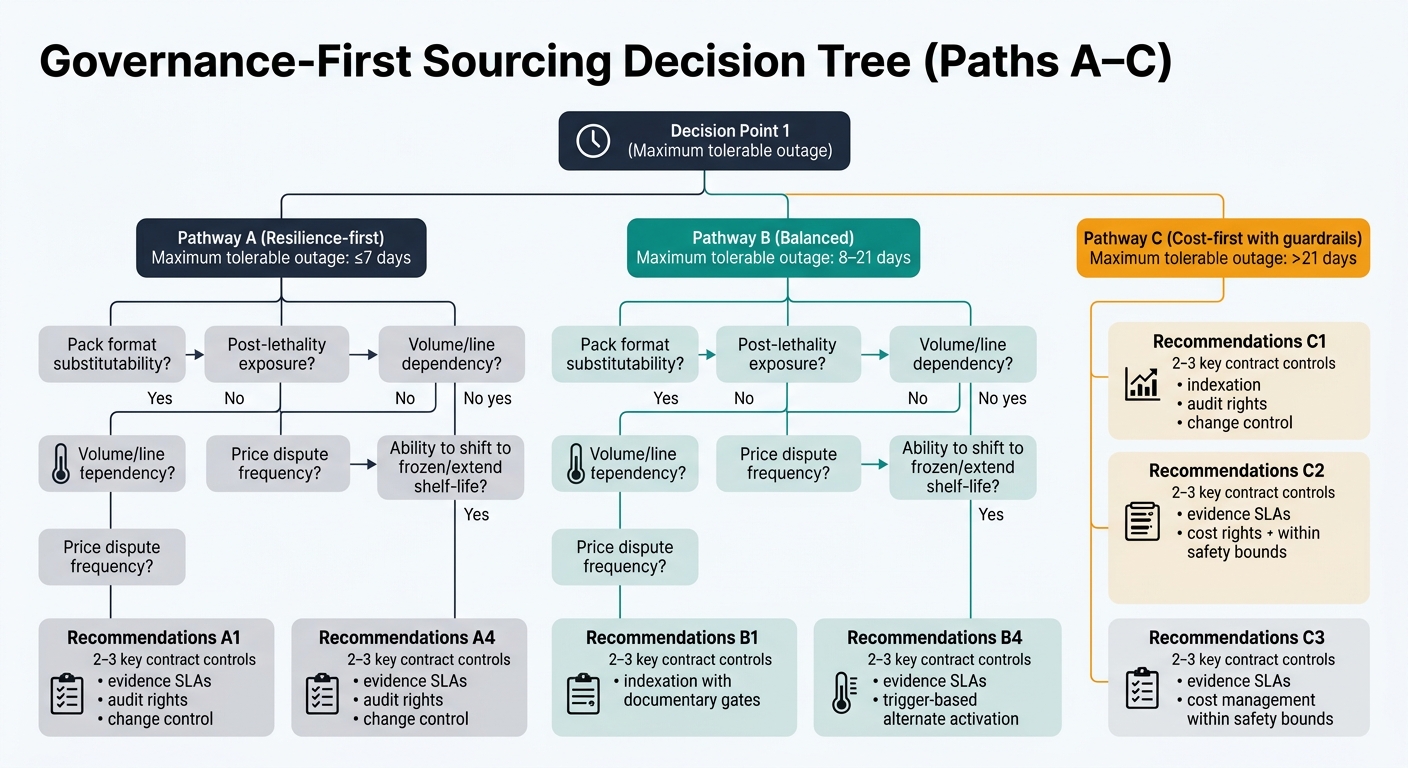
A clean decision tree visualizing Decision Point 1 (maximum tolerable outage) branching into Path A (Resilience-first), Path B (Balanced), and Path C (Cost-first with guardrails), with subsequent decision points (pack format substitutability, post-lethality exposure, volume/line dependency, price dispute frequency, ability to shift to frozen/extend shelf-life) and ending recommendations (A1–A4, B1–B4, C1–C2) plus key contract controls such as evidence SLAs, audit rights, change control, indexation with documentary gates, and trigger-based alternate activation.

3) The decision tree: choose a sourcing strategy you can actually govern

Insight

The right strategy depends less on “country of origin” and more on whether your constraints are capacity, food-safety validation, or packaging/lanes—each requires different contract controls.

Data

For cooked meat and poultry products, validated lethality and stabilization processes are a core expectation under HACCP scientific support; FSIS Appendix A/B are widely referenced guidelines for this validation approach. [1]

Procurement Impact

This tree translates operational realities (cook/cool, casing integrity, cold chain, can supply) into enforceable terms: documentation SLAs, audit rights, change control, allocation rules, and price adjustment logic.

Decision Point 1: How fast does an outage become a business event?

  • If your maximum tolerable outage is ≤ 7 days → follow Path A (Resilience-first)
  • If your maximum tolerable outage is 8–21 days → follow Path B (Balanced)
  • If your maximum tolerable outage is > 21 days → follow Path C (Cost-first with guardrails)

Path A (Resilience-first): you cannot afford a plant stoppage

Decision Point 2A: Is your pack format hard to substitute?

  • If you require shelf-stable cans/jars OR a proprietary film/lid/label system with lead time ≥ 8 weeks → Recommendation A1: Dual-source packaging + pre-qualify a second pack line
  • Audit rights: Include right to audit tier-2 packaging suppliers (or require supplier-provided audit summaries + CAPA evidence).
  • Change control: No packaging material changes without written approval + validation evidence (seal integrity, shelf-life).
  • Allocation clause: Defined allocation logic during shortages (e.g., “customer-ranked service levels”).
  • If your format is substitutable within 2–4 weeks (e.g., standard vac-pack sizes) → Recommendation A2: True dual-source split award (60/40 or 70/30)
  • Interchangeability clause: Explicit equivalency bands for smoke profile/texture/color and test methods.
  • Surge capacity: Pre-priced surge volumes + expedited freight rules.

Decision Point 3A: Is your product post-lethality exposed (higher environmental monitoring + Listeria governance burden)?

  • If slicing/peeling/handling occurs after lethality OR product is reworked/handled before final pack → Recommendation A3: Governance-heavy RTE controls + higher audit cadence
  • Evidence SLA: Time-bound delivery of HACCP validation support, environmental monitoring summaries, and corrective actions.
  • Right to witness: Right to witness key verification (e.g., cook/cool verification, sanitation verification) during audits.
  • If fully sealed immediately after lethality with minimal post-lethality exposure → Recommendation A4: Standard audit cadence + focused stabilization/cooling evidence

Path B (Balanced): you can absorb some disruption but not repeated misses

Decision Point 2B: What is your annual volume and line dependency?

  • If annual volume ≥ 500 MT OR you need weekly deliveries with tight OTIF (≥ 95%) → Recommendation B1: Single-source primary + pre-qualified alternate (cold standby)
  • Standby commitment: Alternate supplier keeps packaging/tooling/spec readiness; you fund via a small retainer or volume option.
  • Trigger-based switch: Define triggers (2 consecutive OTIF misses, regulatory action, or force majeure > X days) that activate alternate volumes.
  • If annual volume < 500 MT AND specs are flexible → Recommendation B2: Multi-supplier bench without split award
  • Most-favored governance: Standardized QA and documentation requirements across bench suppliers to reduce onboarding time.

Decision Point 3B: Are you seeing frequent price disputes?

  • If >2 price disputes/quarter OR repeated “extraordinary cost” claims → Recommendation B3: Indexed pricing with documentary gates
  • Index basket: Meat input + packaging + freight/energy components (weights agreed upfront).
  • Documentation requirement: Pass-through allowed only with verifiable input invoices or index references.
  • Review cadence: Monthly/quarterly true-up; cap-and-collar to limit budget shocks.
  • If disputes are rare → Recommendation B4: Fixed price with reopener triggers
  • Reopener: If agreed indices move beyond ±X% for Y consecutive weeks.

Path C (Cost-first with guardrails): you can plan inventory and accept longer recovery

Decision Point 2C: Can you shift configuration to reduce logistics risk?

  • If you can move some volume to frozen (or extend shelf-life materially) → Recommendation C1: Optimize landed cost + inventory buffer
  • Inventory policy: Supplier-held or 3PL-held safety stock with ownership/insurance defined.
  • Shelf-life warranty: Clear acceptance windows and claims process.
  • If you must stay chilled with short shelf-life → Recommendation C2: Lowest-cost award + strict performance remedies
  • Service credits: Pre-agreed credits for OTIF misses and temperature excursions.
  • Expedite rules: Who pays for reefer expedite under defined fault conditions.

4) Scenario walkthroughs (follow the tree end-to-end)

Insight

Walking real buyer profiles through the same decision points exposes where governance (not price) is the binding constraint.

Data

ASF is a systemic pork-industry risk. Even without direct outbreaks in your sourcing country, trade restrictions and supply rebalancing can influence pork input pricing and availability; WOAH and FAO continue to publish situation updates. [5]

Procurement Impact

Use the scenarios to pressure-test your current contract: if your current terms don’t support the recommended controls for your path, you’re relying on goodwill during the next disruption.

Scenario A: National retail program with promo spikes and <7-day outage tolerance

  • Buyer profile: 1,200 MT/year; chilled vac-pack; penalties for OOS; strict label and sensory profile.
  • Path through the tree:
  • Decision Point 1: Outage tolerance ≤ 7 days → Path A
  • Decision Point 2A: Format substitutable within 2–4 weeks → Recommendation A2 (true dual-source split award)
  • Decision Point 3A: Post-lethality handling exists (common in small-diameter sausage finishing/packing) → Recommendation A3 (governance-heavy RTE controls)
  • Why this outcome fits: Dual-source reduces single-plant downtime impact; governance-heavy controls reduce the probability that a quality hold becomes a multi-week supply event.
  • Quick Win: Set a contractual “surge playbook” (pre-priced expedite + allocation rules) before the first promo.

Scenario B: Foodservice buyer, moderate tolerance, recurring price disputes

  • Buyer profile: 350 MT/year; mixed chilled/frozen; can tolerate 14-day disruption; frequent raw material pass-through requests.
  • Path through the tree:
  • Decision Point 1: 8–21 days → Path B
  • Decision Point 2B: < 500 MT → Recommendation B2 (bench of alternates)
  • Decision Point 3B: >2 disputes/quarter → Recommendation B3 (indexed pricing + documentary gates)
  • Why this outcome fits: You don’t need the operational complexity of split awards, but you do need a repeatable pricing governance model to reduce amendment churn.
  • Quick Win: Add a “no documentation, no adjustment” rule with a short SLA for supporting evidence.

Scenario C (edge case): Shelf-stable cans with long packaging lead times

  • Buyer profile: 600 MT/year; shelf-stable canned Vienna sausages; packaging is single-source; outage tolerance 7–10 days.
  • Path through the tree:
  • Decision Point 1: ≤ 7 days (or near) → Path A
  • Decision Point 2A: Hard-to-substitute cans/lids → Recommendation A1 (dual-source packaging + second pack line readiness)
  • Why this outcome fits: Your biggest single point of failure may be the can/lid supply and seaming validation, not the meat.
  • Quick Win: Contractually require advance notice (e.g., 90 days) of any packaging supplier changes or resin/metal spec changes.

5) Action matrix (pick your strategy by profile)

Insight

Most organizations over-invest in negotiating unit price and under-invest in defining triggers, evidence SLAs, and allocation rules—which are what you need when things go wrong.

Data

World Bank commodity datasets and forecast updates provide a structured way to track macro commodity movements (useful as a neutral reference point when building indexation logic). [2]

Procurement Impact

Use the matrix to align stakeholders quickly and document why the chosen strategy is appropriate for your risk posture.

Buyer Profile Key Factors Recommended Strategy Expected Outcome
National retail, high service penalties Outage ≤7 days; promo spikes; tight sensory spec Dual-source split (60/40 or 70/30) + surge clauses + enhanced audit cadence Lower disruption impact; fewer emergency expedites; clearer governance during allocation
Foodservice, moderate volatility Outage 8–21 days; lower volume Single-source + pre-qualified bench + periodic audits Reduced onboarding time during disruption; controlled governance overhead
Shelf-stable can program Packaging lead time ≥8 weeks; can/lid dependency Dual-source packaging + second pack line readiness + strict change control Lower risk of packaging-driven line stoppage; improved continuity
Private label, cost-first Outage >21 days; flexible spec Fixed price with reopener triggers + inventory buffer options Lower admin burden; predictable budgeting with defined exceptions
Regulated channel / high audit burden Post-lethality exposure; strict documentation Governance-heavy contract: evidence SLAs + right to witness + CAPA timelines Faster corrective action closure; fewer repeat incidents; stronger defensibility

6) Risk mitigation playbook by decision path (what to watch, what to trigger)

Insight

Risk mitigation is most effective when it’s written as “if-then” governance: early warning signals → contractual triggers → pre-approved actions.

Data

FSIS expectations for lethality and stabilization are anchored in documented scientific support and process control; aligning contract evidence requirements to these expectations reduces the risk of “we can’t produce the records” during an investigation or customer audit. [1]

Procurement Impact

You reduce disruption duration (MTTR) and dispute frequency by pre-defining what constitutes a breach, what evidence is due, and what remedies activate.
Path A controls (Resilience-first)

What to watch for (early warnings)

  • Capacity signal: Lead times extend by >20% for 2 consecutive cycles.
  • Quality drift: Increased casing splits/fat-out/color nonconformance; rising hold rates.
  • Compliance strain: Slower CAPA closure; audit findings repeat.

Contingency actions

  • Volume shift: Activate split-award flex bands (e.g., move +10–20% volume to alternate within 2 weeks).
  • Spec flexibility: Pre-approved temporary spec relaxation (e.g., minor smoke profile band) with QA sign-off.

Monitoring metrics + review triggers

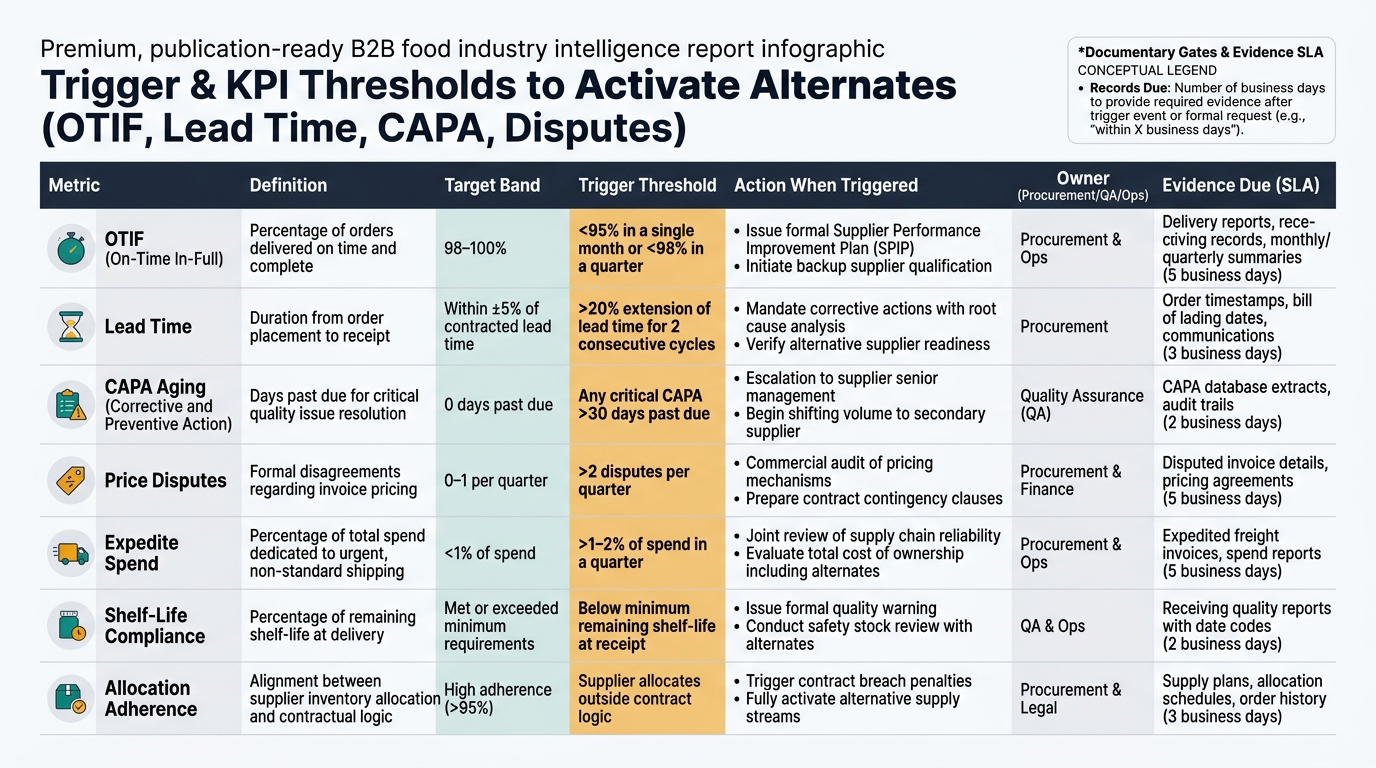
  • OTIF: Trigger escalation if OTIF <95% in a month or <98% in a quarter.
  • Corrective actions: Trigger if any critical CAPA exceeds 30 days past due.
  • Allocation adherence: Trigger if supplier allocates without following contract logic.
An infographic table summarizing monitoring metrics and trigger thresholds to activate alternates, including OTIF, lead time, CAPA aging, price disputes, expedite spend, shelf-life compliance, and allocation adherence, with columns for definition, target band, trigger threshold, action, owner (Procurement/QA/Ops), and evidence due (SLA), plus a small legend defining documentary gates and evidence SLA.

Common mistakes

  • Mistake: Dual-source “on paper” without validated interchangeability.
  • Fix: Require side-by-side lot qualification, agreed test methods, and documented equivalency bands.

Path B controls (Balanced)

What to watch for

  • Price claim pattern: Frequent “exceptional” surcharges.
  • Lane fragility: Reefer tender rejections; warehouse appointment failures.

Contingency actions

  • Indexation switch: Convert to indexed basket at renewal if disputes exceed threshold.
  • Bench activation: Run a quarterly “readiness drill” with alternates (documentation refresh + sample run).

Monitoring + triggers

  • Dispute frequency: Trigger governance review if >2 disputes/quarter.
  • Lead time: Trigger if lead time exceeds agreed band for 2 cycles.

Common mistakes

  • Mistake: Maintaining a bench without keeping certifications and specs current.
  • Fix: Contract a minimal annual activity (audit refresh + small qualification run).

Path C controls (Cost-first with guardrails)

What to watch for

  • Inventory aging: Shrinking remaining shelf-life at receipt.
  • Hidden cost creep: Expedites becoming routine.

Contingency actions

  • Buffer redesign: Shift from “just in time” to defined safety stock with ownership terms.
  • Format pivot: Evaluate partial frozen conversion to stabilize lanes.

Monitoring + triggers

  • Expedite spend: Trigger if expedite cost exceeds 1–2% of spend in a quarter.
  • Shelf-life compliance: Trigger chargebacks if product arrives below minimum remaining shelf-life.

Common mistakes

  • Mistake: Over-reliance on fixed price while ignoring supplier viability under commodity swings.
  • Fix: Add reopeners tied to neutral indices and require documentation for exceptions.

7) Key insight you can act on this quarter

Insight

If your smoked Vienna sausage program is RTE and service-critical, the most reliable savings come from reducing “incident cost” (holds, recalls, expediting, dispute time) rather than squeezing base price.

Data

ASF remains a high-impact systemic risk to pork supply globally, and FSIS cooking/stabilization validation guidance is well-defined; both factors argue for contracts that explicitly manage volatility and verification evidence rather than relying on informal practices. [5] [1]

Procurement Impact

A practical next step is to quantify your risk-adjusted landed cost: base price + expected expedite/hold/dispute cost under a defined disruption scenario, then align contract triggers and alternate readiness to the scenario that would hurt you most.

  • Strategy: Buy
  • Reliability: Medium
  • Potential Saving: 3%–8% (context-dependent; driven more by avoided expedites/holds than by unit price)
  • Insight: Put indexation + documentary gates and a trigger-based alternate activation clause into your next renewal; it typically reduces amendment churn and the high-cost tail of disruptions (expedites, write-offs, and service penalties) more than negotiating another 1–2% off unit price.

Logical Next Step (analysis, not promotion)

The hardest procurement question to answer without consistent intelligence is whether your biggest single point of failure is (a) the co-man site/line, (b) tier-2 packaging, or (c) cold-chain lanes—and how that risk is changing month to month. Until you can monitor those dependency signals and performance trends consistently, you’ll tend to overpay for resilience in some areas while remaining under-protected in the one that actually breaks your supply.

The Bottom Line for Your Next Contract

(Analyzed at: Jul, 2026)

If you do one thing this renewal cycle, make your “alternate activation” and “price adjustment” clauses operational: tie them to objective triggers (e.g., two consecutive OTIF failures, CAPA aging beyond 30 days, or an agreed commodity basket moving beyond a defined band) and require time-bound evidence packages aligned to FSIS Appendix A/B validation support expectations. [1] In 2026, volatility signals remain noisy across energy and broader commodities, and that uncertainty is exactly when vague reopeners and undocumented surcharges turn into disputes and service misses. [2] The teams that pre-agree documentary gates and switch mechanics typically avoid the expensive tail—expedites, write-offs, and customer penalties—which can easily outweigh a 1–3% unit-price win over a year.

Unlock Full Data
Smoked Vienna Sausage Market Intelligence
Prices · Trends · Origins · Forecasts

References

  1. fsistraining.fsis.usda.gov
  2. worldbank.org
  3. fsis.usda.gov
  4. thedocs.worldbank.org
  5. woah.org

Related Contents

Subscribe
→
By subscribing you agree to with our Privacy Policy and provide consent to receive updates from our company.
Thank you! Your submission has been received!
Oops! Something went wrong while submitting the form.
Subscribe to receive the latest blog posts, updates, promotions, and announcements from Tridge.
