
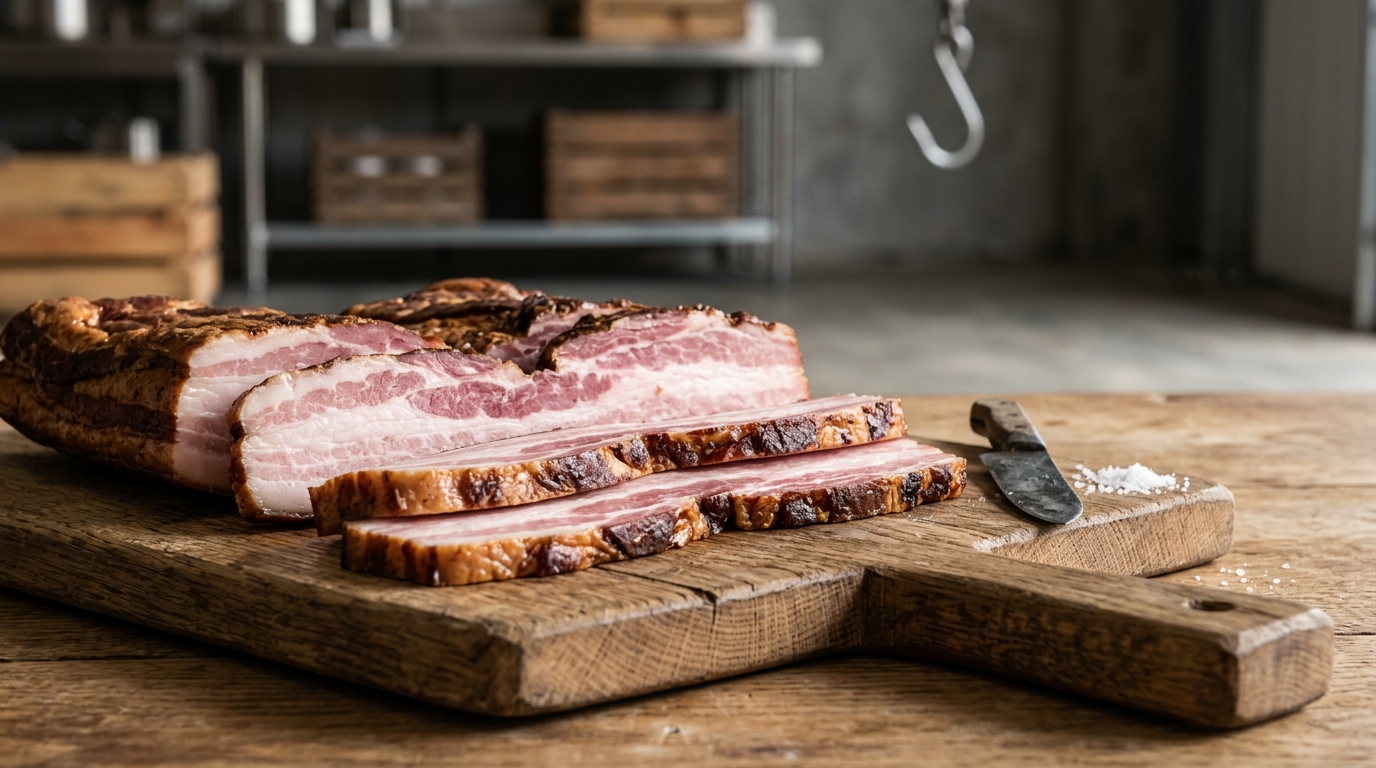
Smoked bacon is often treated like a “simple” pork item, but procurement outcomes (cost, service, and complaints) are usually determined by a few physical choke points: belly availability, yield/shrink through curing and cooking, and the packaging + cold-chain system that protects shelf-life. This guide maps the real flow and translates it into what category teams can actually govern in specs and contracts.
Smoked bacon is not a single commodity—it’s a cut-driven, yield-sensitive chain where value is created (or lost) at a few physical choke points: belly availability at primary processing, yield control during curing/smoking, and cold-chain packaging/distribution. Unlike many shelf-stable foods, most cost is “baked in” by biology (hog growth cycle), carcass breakdown math (how much belly you get), and irreversible process losses (trim + shrink).

Insight: The smoked-bacon supply chain is built around turning a variable raw input (bellies/loins) into a highly spec’d finished good under cold-chain and food-safety constraints.
Data (validated): In USDA’s mandatory price reporting / cutout framework, belly is a distinct primal with its own daily value print, alongside loin/ham/butt/picnic/rib. [5]
Procurement Impact: Your finished bacon cost base is physically determined upstream (belly/loin yield) and then amplified downstream by spec-driven yield (pump %, trim, shrink), packaging barrier performance, and refrigerated distribution intensity.
Insight: Bacon cost accumulates in layers: raw material sets the floor, processing yield sets the multiplier, and packaging/cold-chain sets the carrying cost.
Data (validated, corrected framing): For post-lethality exposed RTE products (e.g., fully cooked bacon that is exposed to the environment after the lethality step), FSIS’ Listeria Rule (9 CFR 430) drives ongoing control programs and verification expectations that behave like “fixed” operating cost in practice. [3]
Procurement Impact: Even before commercial terms, the physical node you buy from (primal vs slab vs sliced retail pack) determines which cost buckets you are “owning” vs “outsourcing.”
| Supply Chain Node | Cost Ratio (% of Final Cost) | Notes |
|---|---|---|
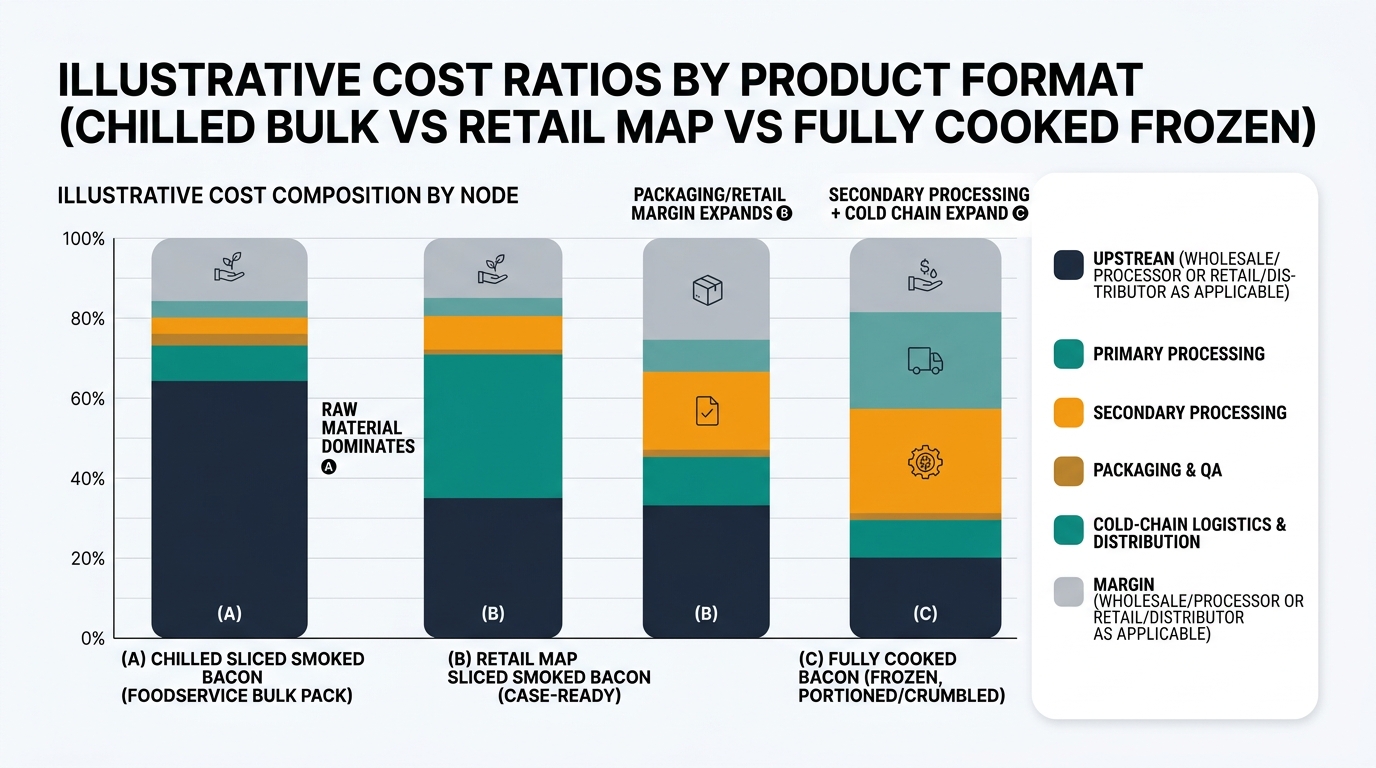
| Upstream Raw Material (bellies/loins) | 55% | Dominant driver; belly/loin quality and trim needs set the floor. |
| Primary Processing | 8% | Slaughter/breakdown, chilling/freezing decisions, primal sorting. |
| Secondary Processing | 18% | Cure pickup control, smoke/thermal energy, slicing labor/automation, yield loss/shrink. |
| Packaging & QA | 7% | Vacuum bags/labels, metal detection, micro testing, rework from leakers. |
| Cold-Chain Logistics & Distribution | 7% | Refrigerated transport + storage + handling. |
| Wholesale/Processor Margin | 5% | Margin for capacity, risk, and service complexity. |
| Supply Chain Node | Cost Ratio (% of Final Cost) | Notes |
|---|---|---|
| Upstream Raw Material | 45% | Still largest, but downstream packaging/retail margin expands total. |
| Primary Processing | 7% | Similar functions; more emphasis on consistent belly sizing for slice presentation. |
| Secondary Processing | 16% | Tighter slice count/length specs increase trim and downtime. |
| Packaging & QA | 12% | MAP trays/films, seal integrity, graphics, higher QC touchpoints. |
| Cold-Chain Logistics & Distribution | 8% | DC handling + store distribution adds touches. |
| Retail/Distributor Margin | 12% | Shelf placement, shrink risk, and merchandising costs. |
| Supply Chain Node | Cost Ratio (% of Final Cost) | Notes |
|---|---|---|
| Upstream Raw Material | 35% | Lower share because cooking shrink + labor/energy expand downstream costs. |
| Primary Processing | 6% | Primal preparation and freezing discipline matter for cook performance. |
| Secondary Processing | 30% | Cooking shrink expectations are structurally high; energy + labor + yield control dominate. [2] |
| Packaging & QA | 10% | High barrier films, portion control, foreign material controls. |
| Cold-Chain Logistics & Distribution | 12% | Frozen storage and distribution intensity increases cost. |
| Wholesale/Processor Margin | 7% | Margin reflects higher process complexity and compliance burden. |
Insight: Smoked bacon is governed by a few “physics and compliance” constants that shape availability, quality, and cost—independent of short-term market moves.
Data (validated, corrected): The “compliance constant” is most acute when you are buying RTE, post-lethality exposed bacon products, which fall under FSIS’ Listeria Rule alternatives and verification regime. [3]
Procurement Impact: These constants explain why two suppliers can quote similar raw material inputs yet deliver very different shelf-life, complaint rates, and service stability.
Insight: Smoked bacon cost is a function of (1) primal availability/quality, (2) yield control in curing/smoking/cooking, and (3) packaging/cold-chain integrity.
Data (validated): USDA IMPS addresses shrink/yield expectations for bacon items, and FSIS’ Listeria framework defines auditable control expectations for post-lethality exposed RTE products. [2] [3]
Procurement Impact: When you change format (slab → sliced → cooked/crumbled) or claims (e.g., “natural/uncured,” sodium targets), you are not just changing ingredients—you are reallocating cost into yield loss, line speed, QA burden, and packaging performance requirements.
Key Takeaways: Belly form sets the floor; processing yield sets the multiplier; packaging/cold-chain sets the shelf-life and complaint risk envelope.
(Analyzed at: Jul, 2026)
With 2026 commentary pointing to soft belly and ham demand weighing on pork values, you have a real window to negotiate—but only if you don’t “buy cheap and lose service.” [4] The highest-conviction move is to contract with a belly-indexed mechanism (using USDA primal belly/cutout references) paired with hard OTIF/service commitments and a pre-approved spec-flex ladder (e.g., allowable belly weight band, slice count tolerance, chilled/frozen switch rules). [5] That structure works because it aligns price to the physical cost engine (belly) while protecting you from the expensive failure modes—expedites, short ships, and rework—that can quietly swing delivered cost by low-to-mid single digits over a year.


