INDUSTRY TRENDS

Sliced Young Radish (Yeolmu) Kimchi: Supply Chain Map, Structural Cost Drivers, and Contract Levers for Procurement

Author
Team Tridge
DATE
July 9, 2026
8 min read
sliced-young-radish-kimchi Cover
Unlock Full Data
Sliced Young Radish Kimchi Market Intelligence
Prices · Trends · Origins · Forecasts

Sliced young radish kimchi (yeolmu-kimchi style) is a refrigerated fermented produce item where quality, shrink, and claims are mostly determined before shipment—by raw radish condition, wash/slice/salt execution, fermentation stage at pack-out, and packaging/cold-chain discipline. This guide maps the physical flow and highlights where costs “lock in,” so procurement can benchmark suppliers on the right structural drivers (not just ingredient price + freight).

Executive Summary

  • Fermentation state is a spec, not a preference: reputable guidance expects kimchi-style ferments to reach pH ≤ 4.6 on a temperature-dependent timeline; excursions accelerate acidification and gas generation [1].
  • Packaging is a functional control: CO2 accumulation can drive swelling/leakage, making venting/headspace/seal design a direct cost-and-claims lever [2].
  • RTE chilled plants carry structural QA overhead: environmental monitoring and Listeria controls are a real operating cost, not “optional QA” [3].
  • Cost differences are often structural: wash throughput, wastewater capacity, cold storage footprint, and packaging spec explain a lot of the price spread.
  • 2026 context: reefer capacity tightness and higher year-over-year contract rates make temperature-controlled freight a larger share of landed cost risk than many teams budgeted [4].

1) How This Category Is Physically Built (and Where Costs “Lock In”)

Insight

Sliced young radish kimchi (yeolmu-kimchi style) is a refrigerated, actively fermenting produce product where the physical state at ship (salt level, cut geometry, fermentation stage, package headspace/venting) determines what arrives at DC and what survives shelf life.

Data

Food-safety guidance for kimchi-style fermentation commonly uses pH ≤ 4.6 as a key safety threshold, with time-to-target strongly temperature-dependent (faster warm, slower refrigerated). Updated guidance examples specify achieving final pH ≤ 4.6 in ~2 days at room temperature and ~4 days at ≤10°C (process- and product-dependent) [1]. CO2 generation during fermentation is a known packaging stressor that can cause swelling/leakage; studies evaluate one-way valves and headspace approaches to manage this [2].

Procurement Impact

Most “cost” is structurally embedded before the product ever ships: raw radish tenderness/yield, wash/sanitation throughput, water/wastewater capacity, fermentation temperature control, and packaging performance under CO2 pressure. Your supply chain map should therefore start at (1) radish agronomy and harvest window, (2) hygienic washing/slicing, (3) fermentation control, (4) packaging engineered for gas/brine, and (5) uninterrupted cold chain.

A left-to-right flowchart showing the end-to-end physical process for sliced young radish (yeolmu) kimchi from farm harvest through receiving/sorting, intensive washing/trimming, slicing, salting/draining, seasoning/mixing, controlled fermentation, packing with headspace/venting, chilled storage, and refrigerated distribution/export, with callouts marking where costs lock in (raw yield, wash/wastewater throughput, fermentation stage/pH window, packaging for CO2/brine, and cold-chain discipline).

Ground-truth flow (typical)

Farm harvest (young radish + greens) → receiving/sorting → intensive washing + trimming → slicing + salting/draining → seasoning/mixing → controlled fermentation (fresh/partial/ripe) → packing (tub/pouch; often designed to tolerate or vent gas) → chilled storage → refrigerated distribution (domestic) or chilled export lane.

2) Where Money Accumulates: Node-by-Node Cost and Margin Structure

Insight

Unlike shelf-stable pickles, the economics here are dominated by labor + water + yield loss + cold chain + packaging engineered for fermentation gas.

Data

FDA materials emphasize that failures to implement effective environmental monitoring can drive inspectional concern and sampling; Listeria control expectations are particularly relevant for refrigerated ready-to-eat (RTE) foods [3]. Independent RTE guidance similarly frames environmental monitoring for L. monocytogenes as a core program element [5]. Kimchi packaging research highlights CO2-driven swelling/leakage as a core technical challenge [2].

Procurement Impact

The “why” behind supplier price differences is usually structural (plant layout, wash capacity, wastewater treatment, packaging spec, cold storage footprint), not discretionary margin. When you compare suppliers, map them to the same physical nodes and ask where they carry (or externalize) these costs.
1. Upstream / Raw Material (Young Radish Farming & Harvest)

  • Insight: Raw radish quality is the first irreversible constraint: tenderness (low fiber), cleanliness (soil load), and size uniformity determine trimming loss and texture after salting.
  • Data: Yeolmu is a “young summer radish” used largely for its greens/stems with a small root; the product form inherently includes higher leaf/stem mass versus mature root-only radish, raising perishability and handling sensitivity [6].
  • Procurement Impact: Expect cost sensitivity to harvest labor, field heat removal speed, and rejection rates for fibrous/dirty lots. Variability here cascades into higher wash time, higher trim loss, and inconsistent crunch (sensory claims downstream).

2. Primary Processing (Receiving, Washing, Trimming, Slicing, Salting/Draining)

  • Insight: This is the highest “hidden cost” node because it combines labor-heavy handling with water-intensive sanitation and meaningful yield loss.
  • Data: Typical fermented vegetable SOPs emphasize frequent pH monitoring during early fermentation and hygienic handling/packaging for RTE fermented vegetables; those controls sit on top of intensive washing, trimming, slicing, salting, and draining steps that drive yield loss and sanitation load [7].
  • Procurement Impact: Plants with limited wash lines or wastewater treatment capacity bottleneck quickly, especially in peak harvest windows. Slicing geometry (thickness/length) also changes salt uptake rate and brine release, affecting net weight vs. drained weight performance in pack.

3. Secondary Processing (Seasoning/Mixing + Fermentation Control)

  • Insight: Fermentation is a controlled biochemical process; temperature and time determine acidity trajectory, gas production, and the “fresh vs ripe” eating profile.
  • Data: Kimchi guidance commonly uses pH as a control/verification metric and notes strong temperature dependence; example guidance targets pH ≤ 4.6 with faster achievement at room temperature than under refrigeration [1].
  • Procurement Impact: Suppliers with tight temperature control (fermentation rooms, chilled staging) can ship to a defined acidity window more consistently, reducing downstream swelling/leakage and sensory drift. This node also locks in working capital: controlled aging requires space, energy, and inventory discipline.

4. Packaging & QA (Gas/Brine Management + Food Safety Systems)

  • Insight: Packaging is not just a container; it is an engineered control for CO2, brine migration, odor containment, and shelf-life stability.
  • Data: Published kimchi packaging research notes CO2 accumulation can cause swelling/leaking and evaluates one-way valves and headspace gas approaches [2]. FDA communications and inspectional references reinforce that environmental monitoring effectiveness matters in RTE refrigerated contexts, which translates into routine sampling, corrective actions, and documentation overhead [3].
  • Procurement Impact: Packaging spec (film barrier, seal integrity, headspace, vent/valve design, tub rigidity) is a direct cost driver and a returns/shrink driver. QA costs are structurally higher for suppliers operating mature environmental monitoring and traceability systems.

5. Cold Chain Logistics & Distribution (Chilled Storage + Refrigerated Transport)

  • Insight: Temperature excursions don’t just “reduce shelf life”—they accelerate fermentation, increasing acidity, CO2, swelling, and leakage risk.
  • Data: Fermentation kinetics are temperature-dependent; guidance specifies different time-to-pH targets at room vs. refrigerated temperatures [1]. Packaging studies explicitly flag swelling/leakage as a failure mode when gas accumulates [2].
  • Procurement Impact: Landed cost is structurally tied to refrigerated freight, cold storage dwell time, and damage/returns handling. Export lanes add time-at-temperature risk; domestic production reduces transit time but may face higher labor/overhead costs.

Product-Level Cost Breakdown

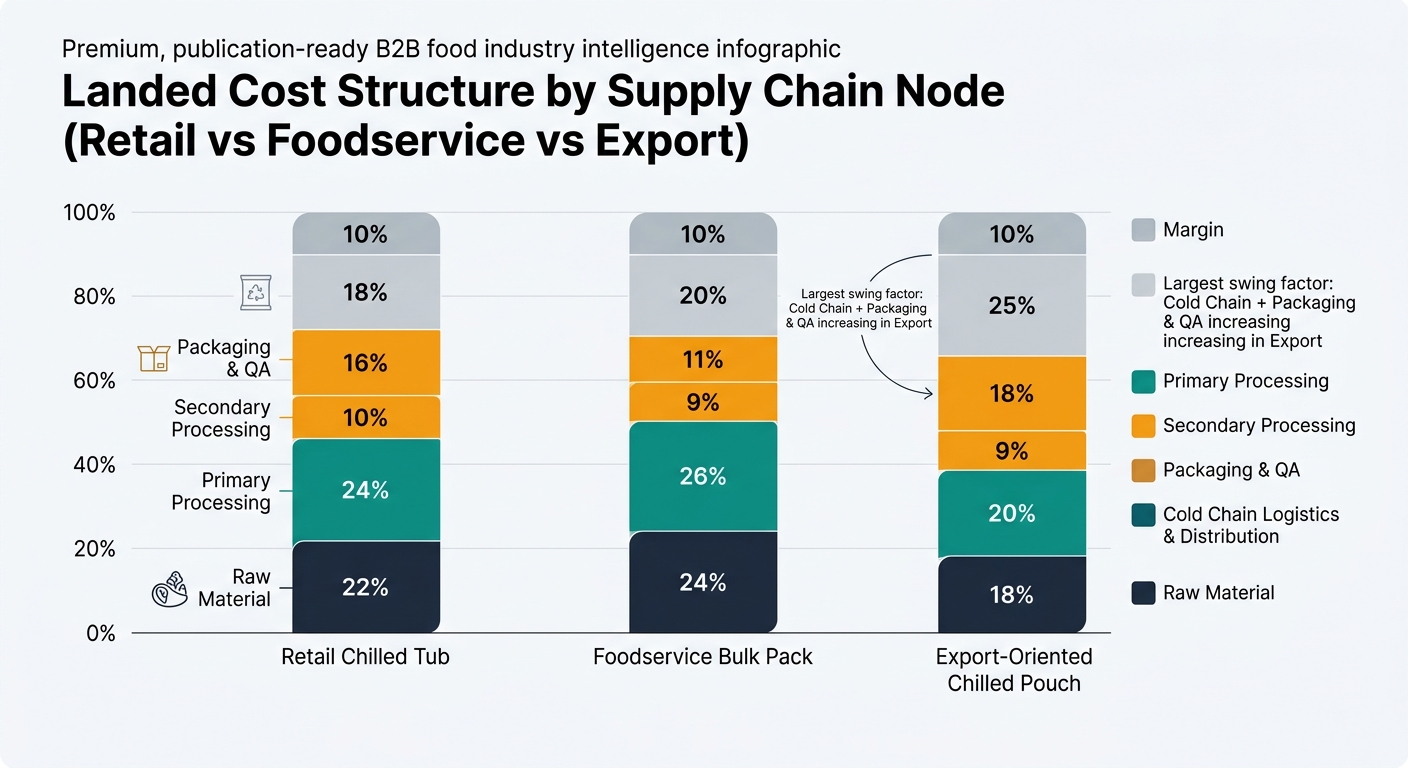
A 100% stacked comparison chart with three bars (Retail Chilled Tub, Foodservice Bulk Pack, Export-Oriented Chilled Pouch) segmented by supply chain node—Raw Material, Primary Processing, Secondary Processing, Packaging & QA, Cold Chain Logistics & Distribution, and Margin—using the article’s percentages and annotating that Cold Chain plus Packaging & QA increase in Export.

A) Retail Chilled Sliced Young Radish Kimchi (Tub, “Fresh/Partial Ferment”)

Supply Chain Node Cost Ratio (% of Final Cost) Notes
Raw Material (young radish + key ingredients) 22% Radish quality affects yield and texture; ingredients add baseline cost.
Primary Processing (wash/trim/slice/salt/drain) 24% Labor + high water use + wastewater + yield loss concentrate here.
Secondary Processing (mix + fermentation control) 10% Temperature control, staging space, and batch management.
Packaging & QA 16% Gas/brine management packaging + testing/monitoring overhead.
Cold Chain Logistics & Distribution 18% Refrigerated freight + chilled storage + returns handling risk.
Wholesale/Retail Margin 10% Channel margin; varies by brand/private label and retailer.

B) Foodservice Bulk Pack Sliced Young Radish Kimchi (Bag-in-box or Large Pouch)

Supply Chain Node Cost Ratio (% of Final Cost) Notes
Raw Material (young radish + key ingredients) 24% Higher throughput often means tighter raw spec to avoid line disruption.
Primary Processing 26% Scale lowers unit overhead, but labor and yield loss remain dominant.
Secondary Processing 9% Often shipped at a defined fermentation stage for kitchen consistency.
Packaging & QA 11% Lower per-kg packaging cost, but seal integrity is critical under CO2.
Cold Chain Logistics & Distribution 20% Heavier cases; refrigerated freight and handling drive cost.
Wholesale/Foodservice Margin 10% Distributor margin and service requirements.

C) Export-Oriented Chilled Sliced Young Radish Kimchi (Pouch with Venting Features)

Supply Chain Node Cost Ratio (% of Final Cost) Notes
Raw Material (young radish + key ingredients) 18% Often offset by larger-scale sourcing near export hubs.
Primary Processing 20% High sanitation and throughput requirements for export programs.
Secondary Processing 9% Fermentation stage selection is critical due to transit time.
Packaging & QA 18% More robust packaging and compliance documentation burden.
Cold Chain Logistics & Distribution 25% Longer lanes amplify refrigeration, dwell time, and risk of excursions.
Importer/Distributor/Retail Margin 10% Multi-tier channel structure adds margin layers.
Unlock Full Data
Sliced Young Radish Kimchi Market Intelligence
Prices · Trends · Origins · Forecasts

3) Structural Facts That Don’t Change (Even When Markets Do)

Insight

The category’s risk and cost profile is shaped by physical constraints—biology (fermentation), water-intensive sanitation, and cold-chain dependence—more than by “commodity-like” sourcing dynamics.

Data

(1) Kimchi fermentation progresses with time/temperature and guidance uses pH ≤ 4.6 as a key threshold with timelines that vary sharply by temperature [1]. (2) CO2 generation creates package swelling/leakage pressure, which packaging technology explicitly targets (e.g., valves/headspace strategies) [2]. (3) FDA highlights environmental sampling and Listeria control expectations in RTE contexts, reinforcing the structural QA burden for chilled RTE foods [3].

Procurement Impact

Three “constants” to build into any supply map and spec set:

  • Cold chain is a product attribute, not a logistics add-on: Temperature control determines fermentation state at receipt and therefore shrink/returns risk.
  • Wash capacity and wastewater treatment are hard bottlenecks: Plants can’t “overtime” their way past limited wash lines or water permits without quality drift.
  • Packaging is a functional control system: Venting/headspace/seal design directly affects leakage claims, odor containment, and shelf-life stability.

Quick Win

When comparing suppliers, ask for their wash-line throughput (kg/hr), wastewater handling approach, fermentation temperature controls, and packaging venting/seal specs—these are structural capability indicators, not marketing claims.

Key Insights (What to Remember When You Look at Any Supplier)

Insight

Sliced young radish kimchi cost and performance are “built” at three irreversible points: raw radish quality/yield, hygienic wash-slice-salt execution, and packaging + cold chain that can tolerate ongoing fermentation.

Data

Fermentation progression is temperature-dependent and commonly tracked via pH; guidance references reaching pH ≤ 4.6 with colder temperatures slowing the drop [1]. Packaging swelling/leakage is driven by CO2 production, addressed via venting/valves/headspace features [2].

Procurement Impact

If you only map “ingredient cost + freight,” you will miss the dominant fixed drivers: yield loss, water/wastewater, sanitation verification, packaging performance under CO2, and the cost of keeping the product cold enough to arrive in the intended fermentation window.

4) The Bottom Line for Your Next Contract

The Bottom Line for Your Next Contract

(Analyzed at: Jul, 2026)

Standardize a ship/receive fermentation-and-temperature spec bundle: require a defined pH window at ship, a minimum remaining shelf life at receipt, and explicit time/temperature limits (plus data-logger evidence on higher-risk lanes). This works because pH trajectory is temperature-driven and directly linked to CO2 generation—the mechanism behind swelling/leakage and many “mystery” credits [1]. In 2026, with reefer capacity tight and contract rates running higher year-over-year, freight variability is more likely to create excursions you end up paying for through shrink and claims, not line-item freight [4]. I can outline decision frameworks and the intelligence to gather, but final supplier selection, food safety validation, and contract terms should be confirmed by your QA, legal, and operations teams.

Unlock Full Data
Sliced Young Radish Kimchi Market Intelligence
Prices · Trends · Origins · Forecasts

References

  1. bccdc.ca
  2. pmc.ncbi.nlm.nih.gov
  3. fda.gov
  4. actresearch.net
  5. fsai.ie
  6. en.wikipedia.org
  7. ars.usda.gov

Related Contents

Subscribe
→
By subscribing you agree to with our Privacy Policy and provide consent to receive updates from our company.
Thank you! Your submission has been received!
Oops! Something went wrong while submitting the form.
Subscribe to receive the latest blog posts, updates, promotions, and announcements from Tridge.
