
This report is powered by Tridge Eye Data Intelligence.
Every data point, price signal, and supply risk insight in this analysis comes from the same platform that procurement and sourcing leaders worldwide rely on daily. As you read, consider what this level of market intelligence could do for your sourcing decisions.
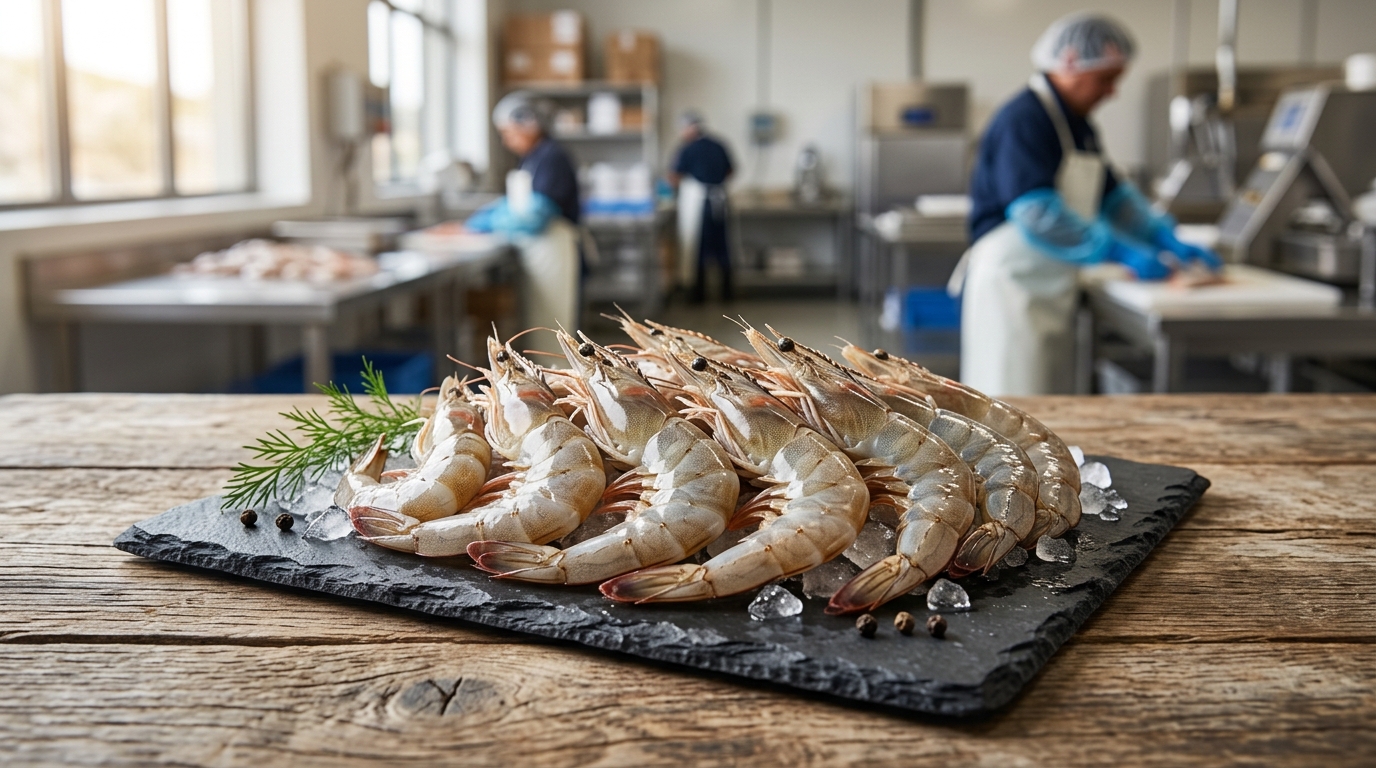
Shrimp looks like a commodity on a price sheet, but it behaves like a biologically volatile, cold-chain-dependent, compliance-sensitive supply chain. For procurement leaders who are strong buyers in other categories, the practical unlock is to translate “shrimp market talk” (count sizes, formats, origins) into total landed cost (TLC) and continuity risk drivers you can govern: yield, glaze/moisture controls, lane reliability, and border/inspection exposure. This guide walks through the real flow of product, where cost actually accumulates, where disruptions typically start, and how to structure decisions so they’re auditable and resilient.
(Analyzed at: Mar, 2026)
This typically yields mid-single-digit savings through fewer claims/short-weights/expedites and reduces stockout probability during lane or compliance disruptions.
Most procurement teams approach shrimp like a single commodity. In practice, you are buying a cold-chain-dependent, biology-driven protein whose price and availability are shaped by pond survival rates, size distribution, processing yield, and import clearance behavior.
Hatchery & farming (aquaculture ponds)
Primary processing (near origin)
Secondary processing (labor + QA intensive)
Export logistics (reefer container lanes)
Import clearance & compliance (destination market gate)
Importer/distributor cold storage → customer DC → end market
Buyer takeaway: shrimp is “commodity-like” only at the headline price level. Your real variance comes from yield + compliance + lane reliability, not just the invoice.

Shrimp’s “unit price” is often a poor proxy for total landed cost (TLC) because small deviations in glaze %, moisture, peel yield, or clearance delays can swing true cost per usable pound more than a 3–7% price negotiation.
Below is a practical walk-through of cost drivers at each node, followed by product-level cost breakdown tables.
Assumptions (so you can adjust): frozen, ocean freight, mainstream specs; ratios vary by origin, season, customer QA, and lane.

| Supply Chain Node | Cost Ratio (% of Final Cost) | Notes |
|---|---|---|
| Farm (raw material) | 55% | Feed + survival rate dominate; size count drives farmgate price. |
| Primary processing | 15% | De-heading yield + freezing + glazing control. |
| Secondary processing | 0% | N/A for raw HLSO. |
| Packaging & QA | 6% | Cartons, labeling, basic testing. |
| Logistics & distribution | 14% | Reefer + cold store + inland. |
| Importer/wholesale margin | 10% | Financing + service + shrink. |
| Supply Chain Node | Cost Ratio (% of Final Cost) | Notes |
|---|---|---|
| Farm (raw material) | 45% | Smaller counts often more available but volatile in spread vs large counts. |
| Primary processing | 10% | Freezing and grading. |
| Secondary processing | 22% | Labor and yield loss from peeling/deveining. |
| Packaging & QA | 7% | More spec controls; more testing and documentation. |
| Logistics & distribution | 10% | Often similar lanes; higher value density reduces freight % slightly. |
| Importer/wholesale margin | 6% | Competitive category; margin pressure. |
| Supply Chain Node | Cost Ratio (% of Final Cost) | Notes |
|---|---|---|
| Farm (raw material) | 35% | Raw input cost diluted by processing adders. |
| Primary processing | 8% | Initial freezing/handling. |
| Secondary processing | 30% | Cooking losses + labor + tighter process control. |
| Packaging & QA | 10% | Labeling + allergens + tighter micro specs. |
| Logistics & distribution | 9% | Cold chain still critical. |
| Importer/wholesale margin | 8% | Higher service expectations + claims handling. |
| Supply Chain Node | Cost Ratio (% of Final Cost) | Notes |
|---|---|---|
| Farm (raw material) | 25% | Shrimp becomes one component in a finished SKU. |
| Primary processing | 5% | Initial grading/freezing. |
| Secondary processing | 38% | Breading lines, pickup control, labor, rework, yield variance. |
| Packaging & QA | 12% | Retail packaging + label compliance + allergen controls. |
| Logistics & distribution | 8% | Similar cold chain; higher cube inefficiency can matter. |
| Importer/wholesale margin | 12% | Branding, promo programs, higher complexity. |
If you are “dual-sourcing” but both sources are exposed to the same correlated risks (similar disease pressure windows, similar reefer lanes, similar U.S. trade actions), your portfolio is less resilient than it looks.
Shrimp price discussions often fail because buyer and supplier talk past each other:
Market price is quoted by count size + format, but your P&L is driven by net yield
Origin-level shocks transmit unevenly
Compliance and clearance risk is not priced consistently
Trade actions can dominate the delivered-cost equation
Procurement translation: the “best” supplier is often the one with the most stable delivered, usable yield and lowest disruption probability—not the lowest quote.
Treating spec as static
Single-metric supplier selection (unit price) instead of TLC + risk
Late-stage contingency planning
Not separating market-driven price moves from supplier-driven moves
Assuming origin diversification equals risk diversification
This is not about “more data.” It’s about making shrimp buying decisions auditable, comparable, and earlier.
Boundaries (important): this does not replace audits, lab testing, or legal review; it improves prioritization and timing.
Reduce cost volatility without increasing stockout risk
Design dual-sourcing by correlated-risk logic (not just “two suppliers”)
Lower hidden cost from yield/spec drift
Pre-qualify contingency capacity for value-added SKUs
Trade-policy readiness (scenario planning)
Shrimp is a clear example because yield + compliance + cold chain are so unforgiving—but the procurement logic generalizes.
Coffee (green vs roasted)
Cocoa/chocolate ingredients
Frozen berries
Palm oil derivatives / oleochemicals
Common thread: when the product is globally traded and specification-sensitive, intelligence reduces decision latency (how fast you can act) and improves auditability.
Shrimp makes the value of intelligence obvious because it combines:
Success looks like: fewer emergency buys, tighter variance in landed usable cost, faster supplier switches during shocks, and sourcing decisions that are easy to defend internally.

Make Faster, Data-Driven Sourcing Decisions
The insights in this report are just the starting point. Tridge Eye is the data intelligence solution that gives procurement and sourcing leaders real-time market signals, price benchmarks, and supply risk alerts — so you can act before the market moves.