INDUSTRY TRENDS

Sesame Seed Sourcing (2026): A Procurement Guide to Landed Cost, Release Risk, and Real Negotiation Leverage

Author
Team Tridge
DATE
March 19, 2026
9 min read
sesame-seed Cover
Tridge Eye Data Intelligence Solution

This report is powered by Tridge Eye Data Intelligence.

Every data point, price signal, and supply risk insight in this analysis comes from the same platform that procurement and sourcing leaders worldwide rely on daily. As you read, consider what this level of market intelligence could do for your sourcing decisions.

Explore Tridge Eye →

Sesame is often treated as a “simple seed,” but procurement outcomes are usually decided elsewhere: conversion yield (cleaning/dehulling/roasting losses), release-to-use friction (micro + residues + documentation), and logistics variability. This guide translates the sesame supply chain into procurement levers—where costs build, where risks hide, and how to negotiate on the right anchors (delivered, released, usable product), not just raw-seed direction.

Executive Summary

  • Procurement reality: You are buying “delivered, released, usable sesame at spec,” not just raw seed. Release risk and conversion loss can outweigh a 5–10% unit-price swing.
  • Regulatory baseline (U.S.): Sesame is the 9th major food allergen under the FASTER Act, effective January 1, 2023—raising change-control and labeling governance expectations across suppliers and co-manufacturers. [1]
  • Compliance shock example (EU): The ethylene oxide incident in sesame (notably from India) triggered reinforced controls and recalls; it is a clear template for how compliance can remove supply faster than weather. [2]
  • Food safety consequence is real: Sesame/tahini continues to see Salmonella risk management and recalls; downstream costs include holds, claims, and brand exposure. [3]
  • Foreign matter is a procurement lever: FDA’s Compliance Policy Guide for sesame adulteration illustrates why cleaning/sorting discipline and lot integrity matter commercially. [4]
  • Cost tables in this guide are illustrative models: Use them as a diagnostic framework; calibrate with your own supplier quotes, yields, and freight lanes.

Key Insights

(Analyzed at: Mar, 2026)

  • Strategy: Hold
  • Reliability: Medium
  • Potential Saving: 4% ~ 9%
  • Insight: Treat 2026 sesame sourcing as a “release-risk and conversion-yield” optimization problem more than a pure unit-price play. The best near-term savings typically come from (1) tightening supplier KPIs on cleaning/dehulling yield and defect rates (reducing effective $/kg usable), and (2) reducing “compliance friction” (fewer holds/retests) by standardizing COA fields, residue/micro test cadence, and lot-traceability expectations across your top suppliers. This is a Hold (not Strong Buy) signal because without a verified, current origin-specific price dislocation, over-committing volume can reduce flexibility; instead, lock in governance and yield improvements that pay back regardless of price direction.

1) The supply chain reality you’re actually buying into (not just “sesame”)

Sesame looks like a simple agricultural input, but the commercial reality is a multi-node, quality-sensitive, compliance-exposed supply chain where value and risk accumulate at different points.

Ground-truth flow (typical for industrial food buyers)

  1. Farm & aggregation (smallholder-heavy)
  2. Seed is harvested, dried, threshed, bagged.
  3. Early decisions (drying discipline, admixture control, pesticide practices) heavily shape later rejection risk.
  4. Primary processing (cleaning / de-stoning / sorting / lot formation)
  5. Exportable “cleaned sesame” is created here.
  6. Optical sorting, magnets, gravity tables, and re-bagging reduce foreign matter and standardize lots.
  7. Secondary processing (dehulling, roasting, grinding to paste/tahini)
  8. This is where yield loss and food safety controls become cost-critical.
  9. Many buyers underestimate how much the processing step, not the farm, determines usable supply.
  10. QA & compliance release (testing + documentation)
  11. Micro (notably Salmonella), residues, heavy metals, aflatoxins (market/spec dependent), allergen controls, traceability.
  12. Export logistics + import clearance
  13. Containers, port handling, route risk, insurance, demurrage, and document accuracy.
  14. Importer / distributor / end-user manufacturing
  15. Often includes re-cleaning, re-testing, heat treatment validation (where applicable), and claim management.

Why this matters for procurement leaders

  • You are not buying a commodity only; you’re buying a probability distribution of: yields, cleanability, microbial risk, documentation completeness, and logistics reliability.
  • The “same” sesame spec can behave very differently depending on origin corridor, processor discipline, and lot integrity.
A left-to-right process flow showing the industrial sesame supply chain with six labeled nodes (Farm & Aggregation; Primary Processing; Secondary Processing; QA & Compliance Release; Export Logistics + Import Clearance; Importer/Distributor/End-user Manufacturing) and callouts for Conversion Yield Loss, Release-to-Use Friction, and Landed-Cost Variability, using neutral icons and arrows.

2) Where cost and margin really accumulate (by node and by product form)

Below is the practical cost-and-margin logic procurement teams can use to diagnose why offers diverge—and where negotiation leverage exists.

2.1 Upstream farming & aggregation (raw seed)

Key insight: Raw seed price is the headline driver, but farm-gate liquidity + harvest-time weather often drive selling pace and quality variability, which then show up downstream as higher cleaning loss, longer lead times, or higher rejection risk.

What actually drives cost here

  • Farm-gate price dynamics (local currency vs USD export parity)
  • Moisture management and drying discipline (quality degradation risk)
  • Aggregation margins and working-capital cost (traders pre-finance buying)

Procurement implication

  • A “cheap” origin in USD can become expensive if it triggers higher cleaning loss or higher rejection/claims later.

2.2 Primary processing (cleaned seed for export)

Key insight: Primary processors monetize yield loss + throughput + QA credibility. When quality is inconsistent upstream, processors either:

  • pass through risk (cheaper offer, weaker guarantees), or
  • price in more re-cleaning, re-sorting, and tighter lot controls.

Typical cost drivers

  • Cleaning/sorting yield loss (foreign matter removal, off-color removal)
  • Electricity, labor, spares for sorting lines
  • Lot formation discipline + basic testing

Risk signal you can use

FDA’s Compliance Policy Guide (CPG) on sesame adulteration provides a concrete regulatory lens on foreign matter and filth concerns—use it as a procurement talking point when you negotiate cleaning standards, defect tolerances, and re-clean responsibility. [4]

2.3 Secondary processing (hulled, toasted, paste/tahini)

Key insight:Hulled and paste/tahini economics are yield-sensitive—small changes in input quality (seed size, moisture, defects) change dehulling yield, color, and microbial control burden.

Cost drivers by process

  • Dehulling: yield loss + water/chemicals (depending on method) + drying energy
  • Roasting: energy + shrink + flavor consistency controls
  • Grinding to paste/tahini: equipment, temperature control, particle size targets, stability, and rework

Food safety cost reality

Sesame-derived products (including tahini) continue to face Salmonella risk management; recalls are a high-consequence cost event (holds, claims, customer disruption). Example: FDA’s recall notice for a tahini product distributed from September 2023 through January 2024 due to potential Salmonella contamination. [3]

2.4 QA, compliance, and documentation

Key insight: Compliance is not a paperwork tax—it is a market access gate that can abruptly remove supply.

Two structural compliance drivers procurement must price in

  • EU enforcement shocks: The European Commission documents the ethylene oxide incident in sesame seeds (notably from India) starting October 2020; it drove reinforced controls and broad downstream disruption. [2]
  • U.S. labeling governance: Sesame is the 9th major allergen under the FASTER Act effective January 1, 2023, which elevates labeling, change control, and cross-contact governance expectations. [1]

Procurement implication

  • A supplier with “cheap” pricing but weak compliance systems can create hidden total cost: holds, retesting, rework, and customer complaints.

2.5 Logistics & landed cost build

Key insight: Landed cost volatility is often driven more by port routing, container availability, and document accuracy than by the seed itself.

Cost drivers

  • Inland trucking from producing regions to export hubs
  • Container freight + insurance + demurrage/detention
  • Import inspections, sampling delays, and clearance friction
A multi-series stacked bar chart with four vertical bars labeled Cleaned Unhulled Seed, Hulled Seed, Toasted Seed, and Sesame Paste/Tahini. Each bar is segmented by six consistently colored cost nodes: Farming & Aggregation, Primary Processing, Secondary Processing, QA & Compliance, Logistics & Import, and Importer/Processor Margin, using the illustrative percentage splits provided in the article and a subtitle note stating it is an illustrative model to calibrate with lanes, yields, and specs.

Product-level cost breakdown (illustrative, procurement-model view)

Modeled as % of final delivered cost to your plant/DC. Ranges vary by origin, spec tightness (purity/color), and compliance requirements.

A) Cleaned unhulled sesame seed (industrial, bagged)

Supply chain node Cost ratio (% of final) What moves it most
Farming & aggregation 55% farm-gate price, FX, selling pace
Primary processing 12% cleaning loss, sorting intensity
Secondary processing 0% N/A
QA & compliance 6% testing frequency, documentation rigor
Logistics & import 15% freight, port delays, clearance
Importer/wholesale margin 12% inventory risk, service level

B) Hulled sesame seed

Supply chain node Cost ratio (% of final) What moves it most
Farming & aggregation 45% raw seed parity
Primary processing 10% pre-clean quality
Secondary processing 18% dehulling yield, drying energy
QA & compliance 8% micro/residue controls, lot integrity
Logistics & import 12% freight + holds
Importer/wholesale margin 7% working capital, shrink

C) Toasted sesame seed

Supply chain node Cost ratio (% of final) What moves it most
Farming & aggregation 42% raw seed parity
Primary processing 9% sorting intensity
Secondary processing 22% roasting energy, shrink, flavor rejects
QA & compliance 9% micro controls, sensory release
Logistics & import 11% freight + packaging protection
Importer/wholesale margin 7% service level, shelf-life risk

D) Sesame paste / tahini input (B2B)

Supply chain node Cost ratio (% of final) What moves it most
Farming & aggregation 35% seed parity
Primary processing 8% pre-clean quality
Secondary processing 28% grinding throughput, rework, heat control
QA & compliance 12% Salmonella controls, release testing
Logistics & import 9% drums/pails, handling
Importer/processor margin 8% liability + inventory risk

3) The structural facts that shape every sourcing strategy (even when prices look calm)

Structural fact #1: Supply is geographically broad, but exportable “food-grade + compliant” supply is narrower

  • Many countries produce sesame, but consistent export-grade, spec-compliant lots concentrate around established corridors and processors.
  • Production leadership commonly cited includes Sudan, India, Myanmar among top producers (shares vary by year/source). [5]

Structural fact #2: Compliance events can remove supply faster than weather

  • The EU ethylene oxide incident is a clear example of a regulatory shock that forced recalls and tighter border checks. [2]

Structural fact #3: In the U.S., sesame is now an allergen-governance category

  • Since January 1, 2023, sesame labeling is mandatory; this elevates change-control expectations across suppliers and co-manufacturers. [1]

4) The critical insight: why “raw sesame price” and your delivered cost often disconnect

Procurement teams often anchor negotiations on raw seed market direction, but delivered cost is frequently driven by conversion loss + compliance friction + logistics variance.

The three biggest disconnect mechanisms

  1. Yield loss amplification
  2. When upstream quality deteriorates (moisture, admixture, off-color), cleaning and dehulling losses rise.
  3. The supplier’s offer may track raw price, but your usable yield drops—raising effective cost/kg.
  4. Compliance gating
  5. A single residue or microbiological issue can create holds, retesting, or rejection—costing more than a 5–10% unit price swing.
  6. Salmonella-linked recalls in sesame-derived products demonstrate the high consequence of micro failures. [3]
  7. Landed-cost volatility
  8. Freight, port congestion, and documentation errors can extend lead times and increase demurrage.

Management takeaway: The correct negotiation anchor is not “seed is down,” it’s “delivered, released, usable sesame at spec is the market.”

5) How procurement teams typically get sesame wrong (and why it’s predictable)

  1. They treat sesame like a simple commodity
  2. Over-index on unit price, underweight rejection probability and lot variability.
  3. They dual-source on paper, not in reality
  4. Alternates aren’t qualified for the same micro/residue regime, roasting profile, or hulling yield.
  5. They don’t separate supplier margin from market movement
  6. Without benchmarks by origin/spec, every negotiation becomes anecdotal.
  7. They let QA/compliance be a late-stage blocker
  8. Compliance surprises (residue enforcement, allergen governance) then force emergency buys.

6) What an intelligence-driven approach changes (practically, in your weekly workflow)

This is not about “predicting” sesame perfectly. It’s about making decisions with faster, defensible signals and reducing avoidable surprises.

A. Price intelligence → better negotiation posture

Outputs you use

  • Benchmark ranges by product form (cleaned vs hulled vs toasted vs paste), spec tightness, and origin corridor
  • Driver narrative: what is moving (farm-gate, FX, freight, compliance)

Decision impact

  • You can challenge supplier increases with:
  • “Is this raw parity, conversion loss, or compliance cost?”
  • “Which part is temporary vs structural?”

B. Supplier benchmarking → fewer “unknown unknowns”

Outputs you use

  • Scorecards comparing suppliers on:
  • lot consistency proxies (shipment regularity where observable)
  • certifications and documentation maturity
  • claims/incident patterns (where available)

Decision impact

  • You stop awarding volume to the lowest quote that later fails release testing.

C. Risk monitoring → earlier triggers, fewer emergency buys

Outputs you use

  • Alerts tied to:
  • policy/export friction, port disruptions, route risk
  • compliance enforcement themes (e.g., residue crackdowns)

Decision impact

  • You pull forward actions: increase coverage, allocate trial volumes, or activate alternates.

D. Governance analytics → auditable decisions

Outputs you use

  • Documented decision memos: price vs risk vs service trade-offs
  • KPI tracking: OTIF, claims rate, lead-time adherence, cost variance

What this does NOT replace

  • On-site audits, lab testing, legal/compliance review, and supplier qualification remain mandatory.

7) Strategic use cases procurement leaders actually run (with trade-offs made explicit)

Use case 1: Reduce volatility without sacrificing continuity

  • Action this week: build a market-referenced benchmark for your current form/spec; separate raw parity vs conversion vs freight.
  • Action this month: rebalance coverage (contract vs spot) based on lead times and risk signals.
  • Quarter outcome metrics: cost variance vs budget, emergency buys avoided, service level.

Trade-off: tighter coverage reduces volatility but can limit flexibility if the market drops.

Use case 2: Build true origin redundancy (not “backup supplier” theater)

  • Action this week: longlist alternates by origin + processing capability (cleaning, dehulling, roasting).
  • Action this month: run qualification plan with QA (micro plan, residue plan, traceability docs).
  • Quarter outcome metrics: time-to-switch, approved alternates per spec tier, share of volume outside primary origin.

Trade-off: redundancy costs money (qualification, trials, sometimes a higher unit price) but buys resilience.

Use case 3: Tighten compliance governance for a high-liability ingredient

  • Action this week: map your allergen and label change-control requirements (U.S. sesame allergen rule effective Jan 1, 2023). [1]
  • Action this month: implement supplier documentation standards (COA fields, lot traceability, test cadence).
  • Quarter outcome metrics: holds/rejections, recall exposure reduction, audit findings.

Trade-off: higher front-end QA cost, lower downstream disruption cost.

8) Why this matters beyond sesame (what it teaches you for the rest of your pantry)

Sesame is a clean example of a broader procurement truth: the most dangerous costs are the ones not visible in the unit price.

Examples from adjacent categories many sesame buyers also source:

  • Spices (cumin, paprika, pepper): contamination/adulteration risk means supplier discipline and testing matter as much as origin price.
  • Tree nuts & peanuts: aflatoxin and allergen governance create similar “release-to-use” gating economics.
  • Cocoa: farm-gate price is only part of the story; conversion yields, quality grading, and logistics constraints drive delivered cost.
  • Dried fruits: moisture and mold controls can swing rejection rates and rework costs.

The transferable lesson: build sourcing strategy around delivered, released, usable input cost—not just “market price.”

9) Why this sesame example is persuasive for leadership alignment

Sesame is a category where procurement can clearly show that intelligence-driven decisions:

  • Protect margin (by reducing effective cost/kg through fewer rejects and better yield outcomes)
  • Improve service levels (fewer line-stopping shortages)
  • Reduce governance risk (documented decisions in an allergen-regulated, recall-sensitive ingredient)

The leadership-ready narrative (one slide’s worth)

  • What changed: supply and compliance shocks can remove usable sesame quickly (e.g., EU ethylene oxide enforcement; Salmonella recall exposure). [2] [3]
  • Why it matters: unit price is not the full cost; release risk and yield loss drive total cost.
  • What we do differently: benchmark by form/spec/origin, pre-qualify alternates, and set triggers for coverage changes.
  • What we measure next: cost variance, claims rate, OTIF, time-to-switch, and % volume with qualified redundancy.
Tridge Eye Data Intelligence Solution

Make Faster, Data-Driven Sourcing Decisions

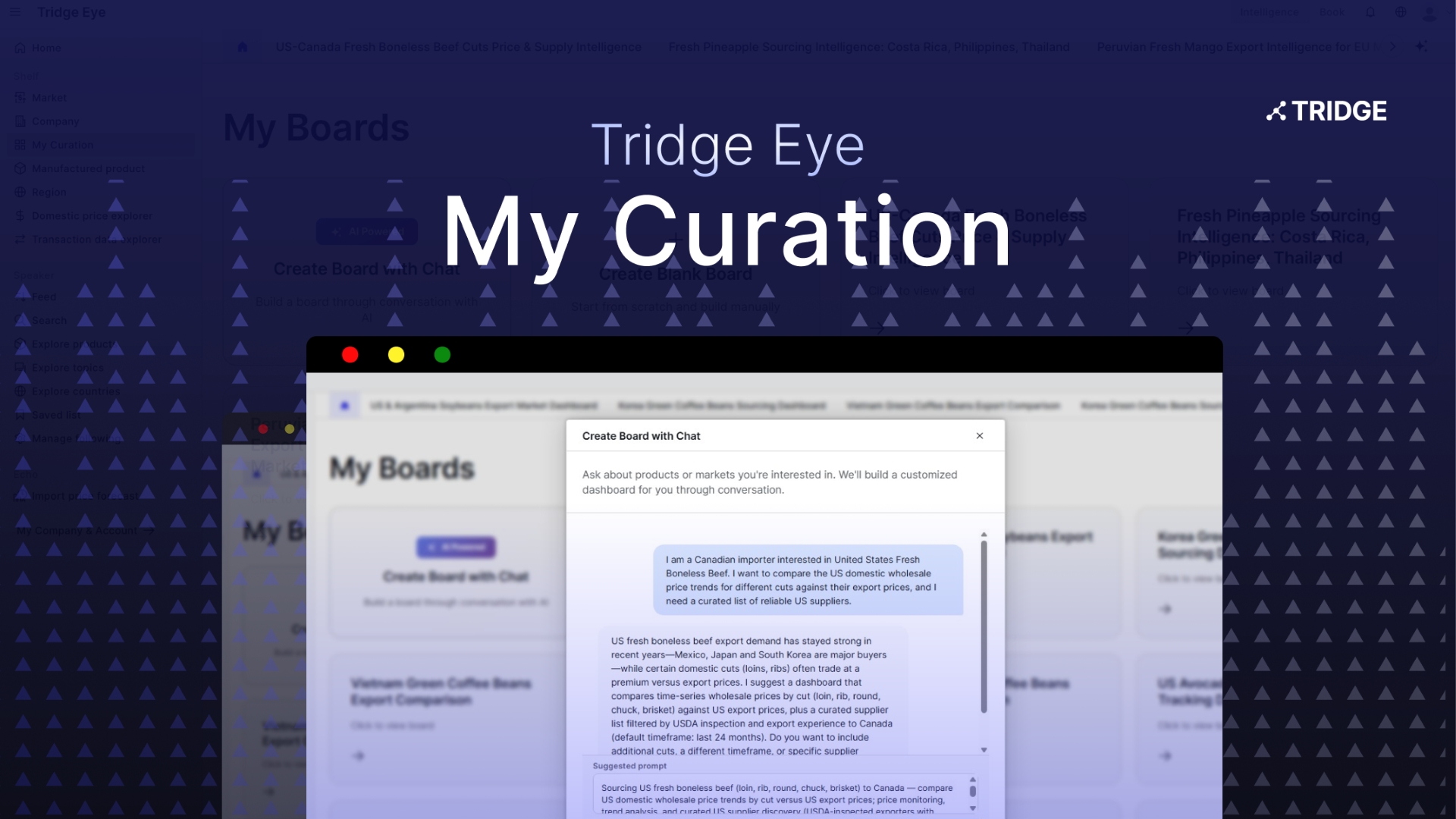
The insights in this report are just the starting point. Tridge Eye is the data intelligence solution that gives procurement and sourcing leaders real-time market signals, price benchmarks, and supply risk alerts — so you can act before the market moves.
Explore Tridge Eye →

References

  1. fda.gov
  2. food.ec.europa.eu
  3. fda.gov
  4. fda.gov
  5. cropj.com
Subscribe
By subscribing you agree to with our Privacy Policy and provide consent to receive updates from our company.
Thank you! Your submission has been received!
Oops! Something went wrong while submitting the form.
Subscribe to receive the latest blog posts, updates, promotions, and announcements from Tridge.