INDUSTRY TRENDS

Seed-Potato Sourcing Intelligence: Managing Landed Cost, Compliance Risk, and Planting-Window Reliability

Author
Team Tridge
DATE
March 25, 2026
9 min read
seed-potato Cover
Tridge Eye Data Intelligence Solution

This report is powered by Tridge Eye Data Intelligence.

Every data point, price signal, and supply risk insight in this analysis comes from the same platform that procurement and sourcing leaders worldwide rely on daily. As you read, consider what this level of market intelligence could do for your sourcing decisions.

Explore Tridge Eye →

Seed potatoes look like “just another ag input” until you try to switch suppliers late, move lots across borders, or plant into a tight window. This guide translates seed-potato category realities (certification, lot identity, storage biology, and timing) into procurement decisions you can govern: how to compare suppliers like-for-like, how to avoid spec drift disguised as “market pricing,” and how to build optionality before allocation or disruption hits.

Executive Summary

  • Seed potatoes are regulated planting stock, not a true commodity: supply is constrained by multi-season multiplication and certification/testing cycles, so “spot buying” is structurally limited.
  • Certification categories matter: the EU marketing categories include pre-basic, basic, and certified, and quality criteria differ by category. [1]
  • Lot identity and documentation are supply levers: lot/variety/class integrity plus correct paperwork can determine whether a shipment moves on time (or at all).
  • Storage biology is a cost-and-risk node: seed tubers are commonly stored around 2–4°C to limit sprouting for long-term holding, with implications for vigor, dormancy break, and shipping readiness. [2]
  • Unit price is a weak KPI: the more decision-relevant metric is landed cost-to-planting-window (price + freight + shrink + claims + delay risk).
  • Operational takeaway for 2026 planning: build a ready-to-activate alternate bench for critical varieties and lock logistics capacity earlier on “no-fail” acres; use spec templates to prevent grade/size substitutions.

Key Insights

Analyzed at: Mar, 2026

  • Strategy: Buy
  • Reliability: Medium
  • Potential Saving: 6% ~ 14%
  • Insight: Treat 2026 seed as a “time-critical, compliance-gated” buy: lock no-fail varieties and planting-week delivery windows earlier than you would for commodity inputs, and simultaneously pre-qualify 2–3 alternates per critical variety (even at small volumes). The savings come less from headline unit price and more from avoiding (a) emergency freight, (b) late-plant yield penalties, and (c) spec drift (size/class changes) that shows up as higher claims and stand variability.

1) The ground truth: what you’re actually buying when you buy seed potatoes

Seed potato is not a commodity input in the way fertilizer or packaging is. It is regulated planting stock with:

  • A multi-year multiplication chain (clean starting material → early generations → certified lots) that constrains “instant” supply.
  • Certification categories/classes that function like a quality + phytosanitary risk ladder. In the EU, the marketing/certification categories explicitly include pre-basic, basic, and certified. [1]
  • Lot identity (variety, class/category, crop year, grower/shipper) that must remain intact through grading, storage, and shipment; in the U.S., certified seed is commonly identified via official certification documentation and tags (often referenced in practice as “blue tags” for certified seed lots in many state programs and export contexts). [3]
  • Time sensitivity: late delivery isn’t a service miss—it can be a yield miss.
  • Biological performance variability driven by physiological age/dormancy, storage regime, virus pressure, and handling.

Procurement reality: your decision is rarely “who is cheapest?” It is:

  1. Which supplier portfolio can hit planting windows with compliant lots, at acceptable agronomic risk?
  2. Where do we pay for optionality (backup lots / alternates) vs. where do we lock volume and price?
A left-to-right flowchart showing the regulated, time-critical seed-potato supply chain from clean starting material through early multiplication, certified field multiplication, post-harvest curing and grading, storage and sprout management at 2–4°C, packaging/labeling and documentation, temperature-managed logistics and border/inspection timing, to delivery aligned to planting week, with compliance gates and a time-sensitivity ribbon plus a legend defining lot identity.

2) Where cost and margin build up (and why unit price misleads)

Key insight: seed-potato cost accumulates at control points (health status, certification, storage, grading, documentation, cold chain). The “seed price” is often a proxy for risk and constraints, not just production cost.

Below is a practical, procurement-friendly breakdown by supply-chain node.
2.1 Upstream: clean starting material & early multiplication (nuclear stock → minitubers)

What happens here

  • Pathogen-tested starting material is maintained and multiplied under controlled conditions.
  • This is where varietal IP/licensing and health-status discipline begin.

Cost drivers that show up later in your invoice

  • Controlled-environment production (greenhouse/aeroponic)
  • Testing regimes and discard rates
  • Limited multiplication ratios (supply is structurally “slow” to expand)

Margin reality

  • Value is embedded as “availability” of early-generation material and access to popular varieties.

2.2 Field multiplication under certification (pre-basic/basic/certified lots)

What happens here

  • Field production under certification rules (inspections, roguing, isolation, pest/disease management).
  • Lots can be downgraded or rejected if tolerances aren’t met.

Cost drivers

  • High agronomy input intensity and inspection compliance
  • Virus management and yield loss from roguing
  • Weather risk that changes size profile (a major driver of “usable seed outturn”)

Margin reality

  • Tight years show up first as allocation language and “no availability” for specific varieties/classes.

2.3 Post-harvest: curing, grading, and defect removal (the outturn bottleneck)

What happens here

  • Curing + grading into planting size bands (e.g., 28–35, 35–45, 45–55 mm—varies by program) and removal of defects.

Cost drivers

  • Shrink and rejects (bruising, rot, scab/defects)
  • Labor and line throughput constraints during peak season

Margin reality

  • A supplier can keep price “stable” by quietly shifting you to a less favorable size profile or class unless specs are tightly governed.

2.4 Storage & sprout management (where biology meets energy cost)

What happens here

  • Seed is held to align with destination planting windows; dormancy and vigor are managed.
  • Seed tubers (as planting stock) can be stored for long periods at ~2–4°C to limit sprouting; this is commonly referenced in technical literature and extension/production guidance for seed storage ranges (often expressed as ~38–40°F / 3.3–4.4°C as a practical target band). [2]

Cost drivers

  • Electricity/ventilation/refrigeration
  • Weight loss (dehydration) and rot risk
  • Sprout suppression strategy (temperature management and, where used/allowed, sprout suppression tools)

Margin reality

  • Storage performance affects claims, stand establishment, and “hidden” landed cost.

2.5 Packaging, labeling, and documentation (compliance cost, not admin overhead)

What happens here

  • Lot labeling, traceability, certificates, phytosanitary documents.
  • In North America, many programs use a North American Seed Potato Health Certificate (often requested through certification services) as a foundational lot-history document supporting movement and buyer assurance. [4]

Cost drivers

  • Documentation QA, testing, chain-of-custody controls
  • Rework and delays when papers don’t match lot reality

2.6 Logistics & border/inspection timing (the “missed window” risk)

What happens here

  • Temperature-managed transport and timed release.
  • Inspections and phytosanitary constraints can block or delay movement.

Cost drivers

  • Reefer premiums, demurrage risk
  • Border inspections, additional declarations
  • Route constraints and seasonal capacity

Margin reality

  • Emergency freight is often the single biggest avoidable cost in disrupted seasons.
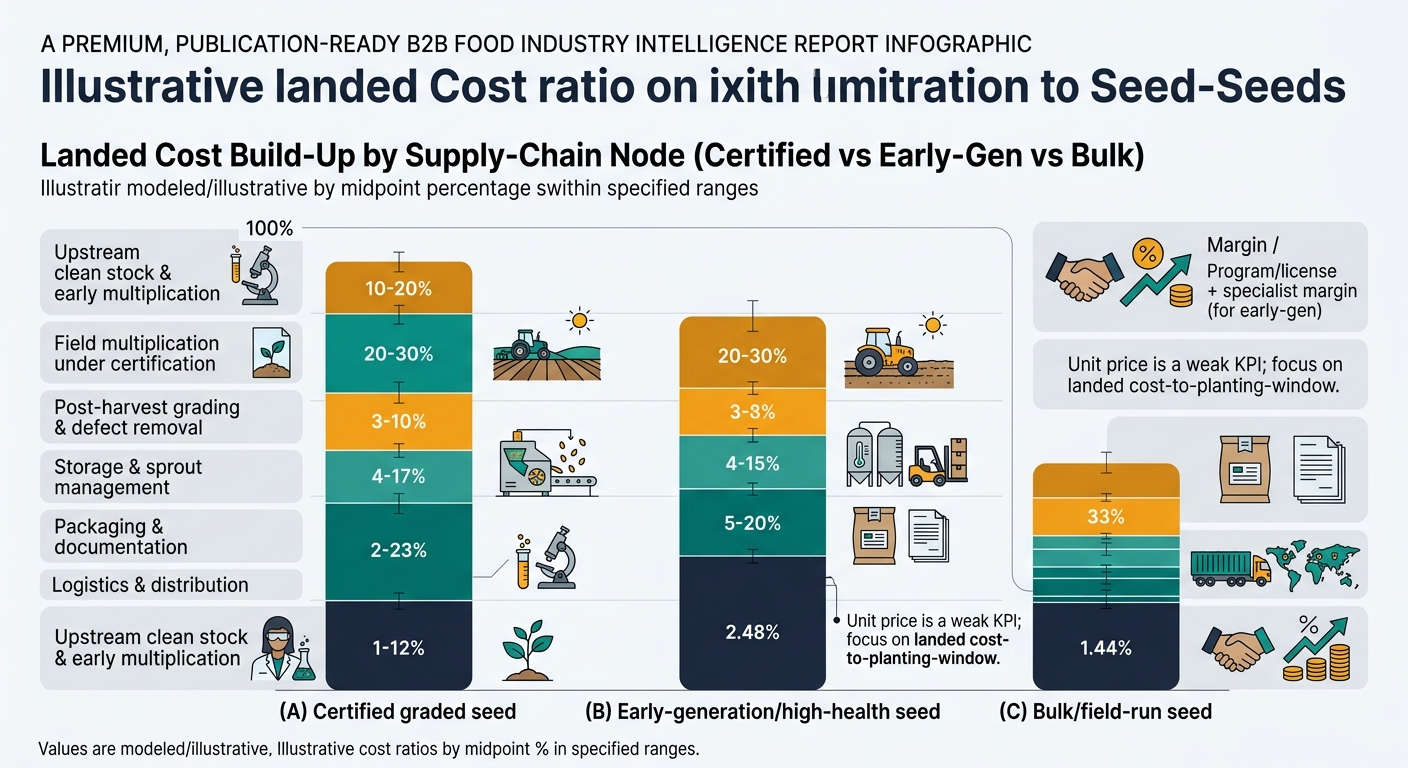
A three-column stacked bar chart comparing illustrative landed cost build-up ratios for (A) Certified graded seed, (B) Early-generation/high-health seed, and (C) Bulk/field-run seed, stacking the same supply-chain nodes with consistent colors and labeled as modeled/illustrative, with a callout that unit price is a weak KPI and focus should be on landed cost-to-planting-window.

Product-level cost breakdown (illustrative ratios)

These are modeled ranges to show where cost concentrates by product form; actual ratios vary by origin, variety, class, season tightness, and lane. The tables below are internally consistent (each sums to 100%) and intended for procurement scenario modeling—not as industry “averages.”

A) Certified graded seed (bagged / big bag)

Supply chain node Cost ratio (% of final delivered cost) What moves it most
Upstream clean stock & early multiplication 8–15% Variety access, early-gen scarcity
Field multiplication under certification 30–45% Crop outturn, downgrades, inspections
Post-harvest grading & defect removal 10–18% Size profile, rejects, throughput
Storage & sprout management 10–18% Energy, storage losses, dormancy control
Packaging & documentation 4–8% Labeling, testing, traceability
Logistics & distribution 10–20% Reefer need, distance, border timing
Packer/exporter/importer margin 8–15% Allocation power, service reliability

B) Early-generation / high-health seed (pre-basic/basic programs)

Supply chain node Cost ratio (% of final delivered cost) What moves it most
Upstream clean stock & early multiplication 15–30% Lab/greenhouse intensity, discard rates
Field multiplication under certification 25–40% Tight tolerances, inspection outcomes
Post-harvest grading & defect removal 8–15% Outturn + defect pressure
Storage & sprout management 8–15% Longer holding periods, vigor risk
Packaging & documentation 5–10% Higher documentation burden
Logistics & distribution 8–18% Lane complexity, inspection timing
Program/variety license + specialist margin 10–20% IP, scarcity, program reputation

C) Bulk / field-run seed (where permitted)

Supply chain node Cost ratio (% of final delivered cost) What moves it most
Upstream clean stock & early multiplication 5–10% Less embedded early-gen value
Field multiplication under certification 35–55% Yield + health status
Post-harvest grading & defect removal 3–8% Minimal grading intensity
Storage & sprout management 8–15% Storage losses dominate
Packaging & documentation 2–5% Lower packaging cost
Logistics & distribution 12–25% Bulk handling, lane distance
Margin 5–12% Service level lower, risk higher

3) Structural fact that drives procurement outcomes: supply is “slow,” but demand shocks are “fast”

Key insight: seed-potato supply tightness is often locked in seasons ahead because:

  • Multiplication is multi-season; you can’t simply add capacity next month.
  • Certification and post-harvest testing cycles create time-to-qualify constraints.
  • Popular processing varieties concentrate demand; in short years, allocation favors established programs.

Procurement implication: optional capacity must be built before the shock, not after.

4) The critical insight: why seed-potato prices can rise even when table/processing potato markets don’t

Key insight: seed and ware potatoes share biology, but their economics diverge because seed price is driven by:

  • Usable seed outturn (right sizes + low defects) rather than total tonnage.
  • Certification downgrades and virus pressure (a lot can exist but be unmarketable as seed).
  • Storage + dormancy management costs (and risk) that are less relevant to potatoes sold immediately.
  • Phytosanitary restrictions that can instantly remove an origin corridor (e.g., potato cyst nematode controls and declarations can govern movement/export conditions).

Failure mode: procurement benchmarks against “potato market price” and then treats seed quotes as inflated—missing that the seed market is pricing risk, compliance, and timing.

5) Where procurement teams typically get it wrong (especially if they’re new to seed)

  1. They negotiate unit price instead of landed cost-to-planting-window
  2. A 3–5% unit saving is irrelevant if it triggers late delivery or higher field failure/claims.
  3. They accept “equivalent” substitutions without spec normalization
  4. Variety, class/category, size profile, physiological age, and documentation are not interchangeable.
  5. They underwrite compliance risk by treating paperwork as back-office
  6. Missing/incorrect phytosanitary or health documents can create border delays or rejections.
  7. They discover alternates only after allocation hits
  8. By then, the market is out of compliant lots, or alternates can’t pass internal QA/agronomy gates in time.
  9. They don’t govern “spec drift”
  10. Suppliers can meet a broad contract but shift class/size/lot characteristics that degrade performance.

6) How an intelligence-driven service changes the outcome (without pretending to replace agronomy)

Key insight: the service changes decisions when it makes spec-comparable, risk-ranked options visible early enough to act.

Capability 1: Specification-aware supplier benchmarking (to stop spec drift and false equivalence)

What procurement can do differently:

  • Standardize a seed spec template that forces like-for-like comparison:
  • Variety + allowed substitutes (if any)
  • Certification category/class (EU: pre-basic/basic/certified; local equivalents)
  • Crop year, generation where relevant
  • Size bands + tolerance (and tuber count expectations)
  • Defect tolerances and virus testing expectations (program-dependent)
  • Delivery window aligned to planting plan
  • Benchmark suppliers on:
  • Availability by variety/class/size (not just “we have the variety”)
  • Historical OTIF and claims
  • Documentation completeness and turnaround

Decision impact: management gets a defensible rationale for paying a premium when the premium buys lower probability of a missed planting window.

Capability 2: Supply chain risk monitoring (signals & alerts) (to decide when to activate alternates)

What procurement can do differently:

  • Monitor disruption signals that matter specifically to seed potatoes:
  • Weather anomalies in seed regions (proxy for outturn/rot risk)
  • Logistics capacity constraints during export windows
  • Regulatory and phytosanitary developments (movement constraints can change rapidly)
  • Storage/sprout-management constraints (storage temperature and sprout-suppression approaches materially affect viability and shipping readiness). [2]
  • Use triggers tied to time-to-react:
  • If risk is 8–12 weeks out: pre-book reefer capacity, lock alternate lots
  • If risk is 2–4 weeks out: activate contingency lanes, prioritize critical varieties

Decision impact: fewer “panic buys,” fewer emergency freight premiums, and fewer internal escalations.

7) Strategic use cases procurement leaders can operationalize this season

Use case A: Balance price vs planting-window reliability (critical varieties first)

  • Segment SKUs/varieties into:
  • No-fail (highest margin acres / contracted processor acres)
  • Flexible (some substitution possible)
  • Apply benchmarking to define when a premium is rational:
  • Premium is acceptable if it reduces probability of late delivery or non-compliance beyond a threshold.

KPIs to track

  • OTIF to planting-week
  • Claims rate by supplier and by variety
  • % of volume in “no-fail” category covered by at least 2 qualified sources

Use case B: Build a “ready-to-activate” backup bench (before allocation notices)

  • Pre-qualify 2–3 alternates per critical variety:
  • Certification compatibility
  • Documentation readiness
  • Lane feasibility and lead time

KPIs to track

  • Time-to-switch (weeks) by variety
  • % of alternates with completed QA/agronomy gate

Use case C: Governance and auditability for seed programs (make decisions repeatable)

  • Create a supplier scorecard that combines:
  • Spec compliance (lot-level)
  • Documentation quality
  • OTIF and issue responsiveness
  • Cost variance vs. benchmarked like-for-like specs

KPIs to track

  • Spec variance incidents per 100 lots
  • Documentation defect rate
  • Concentration risk (top-2 suppliers share)

8) Why this matters beyond seed potatoes (examples procurement teams will recognize)

Key insight: seed potatoes are an extreme example of a broader procurement pattern— biological/regulated inputs where “equivalence” is hard and timing is everything.

Comparable categories where intelligence-based sourcing prevents expensive mistakes:

  • Coffee (specialty vs commercial blends): quality grading and origin risk can break “same SKU” assumptions.
  • Cocoa: supply shocks propagate via quality differentials and certification constraints.
  • Natural rubber / latex: performance specs and regional disruption risks dominate unit-price logic.
  • Pharma excipients / regulated food ingredients: documentation, audits, and change control matter as much as price.

The transferable lesson: when the input is spec-sensitive + time-sensitive + compliance-sensitive, procurement needs a system that makes comparisons defensible and risks visible early.

9) Why seed potatoes are a powerful proof case for procurement intelligence

Seed potatoes force clarity on what “good procurement” means:

  • Cost: landed cost includes storage losses, rejects, and emergency logistics—unit price is insufficient.
  • Risk: phytosanitary and certification failures can remove supply overnight; compliance is a supply lever.
  • Resilience: multi-season multiplication means optionality must be designed, not improvised.
  • Governance: lot identity, documentation, and spec adherence create an auditable trail—if you can govern seed, you can govern almost anything.

In other words: seed-potato sourcing rewards teams that manage specs, time, and risk as first-class procurement variables—not afterthoughts.

Clarifying questions (to tailor this into a portfolio and KPI plan)

  1. Which destination region(s) and planting windows are you sourcing for (months/weeks)?
  2. Are you sourcing for table, processing (fries/chips), or starch programs—and which varieties are “no-fail”?
  3. What certification scheme and documentation set are mandatory in your lanes (EU categories vs North American certificates, etc.)?
Tridge Eye Data Intelligence Solution

Make Faster, Data-Driven Sourcing Decisions

The insights in this report are just the starting point. Tridge Eye is the data intelligence solution that gives procurement and sourcing leaders real-time market signals, price benchmarks, and supply risk alerts — so you can act before the market moves.
Explore Tridge Eye →

References

  1. food.ec.europa.eu
  2. pmc.ncbi.nlm.nih.gov
  3. aphis.usda.gov
  4. potatoslvrc.com
Subscribe
By subscribing you agree to with our Privacy Policy and provide consent to receive updates from our company.
Thank you! Your submission has been received!
Oops! Something went wrong while submitting the form.
Subscribe to receive the latest blog posts, updates, promotions, and announcements from Tridge.