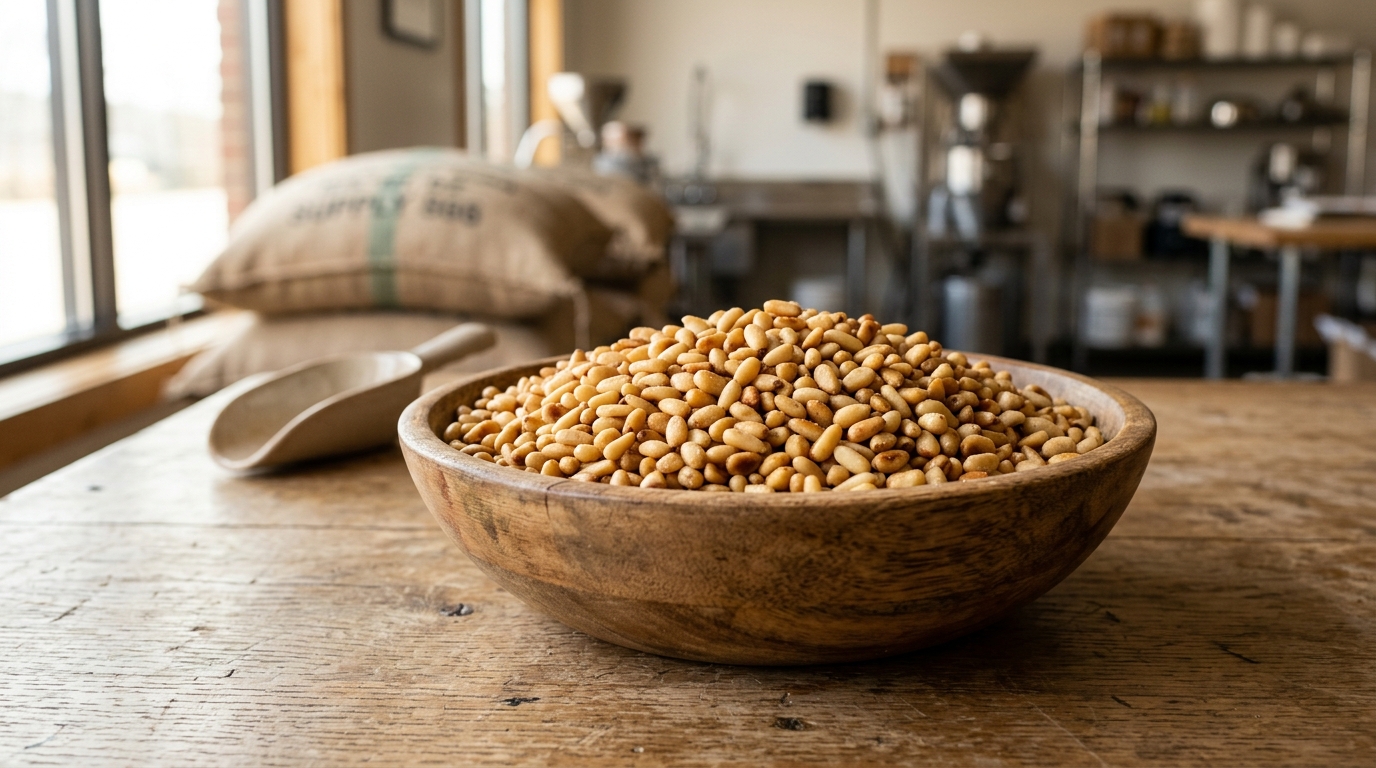
Roasted pine nuts look like a “simple” ingredient, but procurement outcomes are mostly determined upstream: species/origin, shelling & sorting yield, and how well oxidation is controlled after roasting through packaging and transit. This guide maps the physical flow and highlights the cost lock-in points so procurement teams can negotiate and govern the right levers (not just price per kg).
Roasted pine nuts are a high-value, oxidation-sensitive ingredient whose cost structure is largely fixed by biology (species + cone yields), mechanical yield loss (shelling/breakage), and post-roast shelf-life control (oxygen + temperature management)—not by downstream handling alone. The physical chain is short, but each node compounds cost because losses are hard to recover once they occur.
Insight: The supply chain is best understood as a yield-and-stability problem: every step either preserves edible kernel yield or accelerates rancidity risk.
Data: FAO’s State of Mediterranean Forests 2013 reports estimated worldwide pine nut production on a shelled kernel basis of ~30,000–40,000 tonnes, with wide uncertainty and significant year-to-year variability in some origins. It also breaks out indicative ranges by origin/species: Mediterranean countries (Pinus pinea) 6,000–9,000 t, Russia 8,000–17,000 t, China 5,000–12,000 t, Korea 1,500–2,000 t, Pakistan/Afghanistan (P. gerardiana) 2,000–10,000 t. [1]
Procurement Impact: Your “physical map” should start with species/origin → shelling yield → oxidation control after roasting. If you don’t map those three, you’ll misread why two suppliers with the same Incoterm can deliver very different defect/claim rates and shelf-life outcomes.

Insight: Pine nuts behave like a “loss-amplifying” supply chain—breakage, defects, and oxidation don’t just create waste; they force extra sorting, rework, and higher packaging standards downstream.
Data: Commercial pine nut specifications commonly operationalize quality with moisture limits (often around ≤5%), defect ceilings (broken/damaged/discolored), foreign matter limits, and oxidative stability indicators (commonly peroxide value (PV); many nut programs treat PV <10 meq O2/kg oil as a “high quality” threshold, though buyer limits vary by method/product). [3]
EU aflatoxin limits depend on product and intended use; for many foods intended for direct human consumption, historic EU tables commonly cite Aflatoxin B1 2 µg/kg and Total aflatoxins 4 µg/kg as reference maximum levels (confirm against the current EU contaminant regulation and your exact product category). [4]
Procurement Impact: These numbers are not “QA paperwork.” They imply physical cost drivers: drying discipline, storage conditions, sorting intensity, and packaging barrier performance—each of which has a predictable cost footprint.

| Supply Chain Node | Cost Ratio (% of Final Cost) | Notes |
|---|---|---|
| Upstream / Harvest & Aggregation | 20% | Manual harvest + drying discipline; lot fragmentation adds handling overhead. |
| Primary Processing (Shelling/Sorting) | 35% | Yield loss + sorting intensity + foreign matter control are dominant fixed drivers. |
| Secondary Processing (Roasting) | 10% | Energy + roast-loss + re-sorting to meet color/flavor targets. |
| Packaging & QA Release | 12% | Vacuum/N2, barrier films, lab testing (PV/FFA/micro/mycotoxins), traceability. |
| Logistics & Distribution | 8% | Transit time + excursion risk; protective packaging reduces claims. |
| Importer/Distributor Margin | 15% | Working capital + shrink/claims reserve + service level obligations. |
| Supply Chain Node | Cost Ratio (% of Final Cost) | Notes |
|---|---|---|
| Upstream / Harvest & Aggregation | 25% | Quality “locks in” via moisture control and storage hygiene at origin. |
| Primary Processing (Shelling/Sorting) | 45% | Highest value-add and loss point; defect ceilings drive labor and rework. |
| Packaging & QA Release | 10% | COA, mycotoxin alignment, foreign matter controls; barrier packaging to protect oils. |
| Logistics & Distribution | 8% | Longer lanes increase oxidation risk without strong barrier packaging. |
| Importer/Distributor Margin | 12% | Consolidation, documentation, and inventory carry for year-round supply. |
| Supply Chain Node | Cost Ratio (% of Final Cost) | Notes |
|---|---|---|
| Upstream / Harvest & Aggregation | 12% | Kernel cost still matters, but packaging/retail margins dominate. |
| Primary Processing (Shelling/Sorting) | 25% | Higher cosmetic standards (uniform color/shape) increase sorting burden. |
| Secondary Processing (Roasting) | 8% | Tight roast profile for consistent sensory experience. |
| Packaging & QA Release | 20% | High-barrier films/jars, nitrogen flush, label controls, higher QA sampling. |
| Logistics & Distribution | 10% | More touchpoints; higher exposure to warm retail DC conditions. |
| Retail & Wholesale Margin | 25% | Category margins + promo funding + shrink reserves. |
Insight: Pine nuts are not one commodity; they are a family of species with different physical behaviors, and the supply chain is built around that reality.
Data: FAO describes multiple species streams (Mediterranean stone pine; Northeast Asian/Russian; chilgoza) with approximate production ranges and significant data uncertainty. [1]
Procurement Impact: Treat “pine nuts” as a spec-defined ingredient, not a generic nut line. The following constants shape availability, quality, and downstream cost-to-serve.
(Analyzed at: Apr 2026) Industry supply signals for 2025/26 point to a tight market and elevated allocation risk—so the highest-ROI contract move is to separate “price” from “grade availability + shelf-life performance.”
Lock a primary supplier on a defined grade with a release gate that combines PV + moisture + defect/foreign matter limits and ties those results to the actual packaging shipped (vacuum/N2 + barrier spec) and maximum transit temperature exposure language.
This works because the avoidable cost in roasted pine nuts is rarely roasting itself; it’s the claims, emergency re-sorts, and write-offs created when oxidation control breaks during pack-out and transit. In tight years, teams that formalize this gate and enforce it consistently can often protect ~1–3% of landed cost through fewer rejections/claims and less expedited replacement buying—while avoiding the bigger downside of stockouts when only sub-grade material is available. [8]