
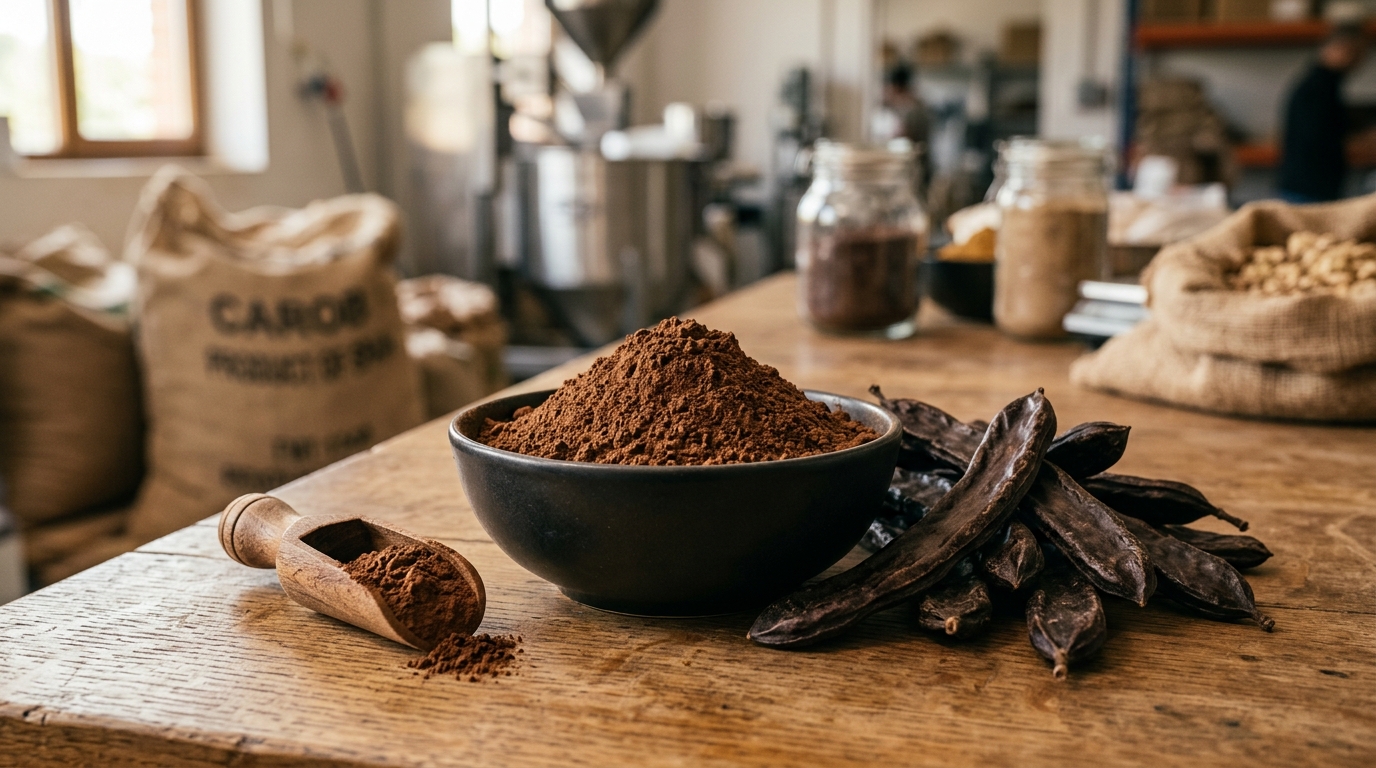
Raw carob powder looks like a simple dried botanical ingredient, but procurement outcomes (nonconformances, audit readiness, continuity) are mostly determined upstream—by harvest timing, moisture stabilization, and how the processor runs deseeding and milling. This guide maps the real physical flow and highlights the few controls that reliably reduce uncertainty for Purchase—Quality, Safety, and Compliance.
Raw carob powder is structurally a Mediterranean dried-botanical powder chain: seasonal pods are harvested, stabilized through drying/cleaning, mechanically deseeded (because the seed stream feeds locust bean gum economics), then milled/sieved into a spec’d powder that is highly sensitive to moisture and foreign material control. Harvest timing and post-harvest dehydration discipline are the first fixed cost drivers; milling/sieving accuracy and QA verification are the second.
Insight: The chain is not “powder-first”—it is pod-first with a seed co-product, so processing decisions are shaped by seed recovery value and the physical realities of drying, cleaning, and separation. [1]
Data: Mediterranean sources commonly describe harvest in late summer into autumn (often August–September, with some regions extending into October), followed by mechanical breaking (“kibbling”) and separation steps. [2]
Procurement Impact: Even before you discuss suppliers, you’re dealing with a chain where moisture stabilization + mechanical separation + milling control determine whether the powder can reliably meet micro/foreign matter expectations and deliver consistent color/flavor.

Insight: Costs accumulate in predictable “physics-driven” places: drying capacity and losses, cleaning/separation yield, milling wear + sieving throughput, and QA/testing + packaging barrier performance.
Data: Published processing descriptions repeatedly emphasize harvest seasonality plus early mechanical steps (kibbling/separation). Separately, carob pod composition is commonly described as ~90% pulp and ~10% seeds (by weight), reinforcing why seed recovery strongly influences processor economics. [3]
Procurement Impact: Your landed cost is structurally shaped by yield and compliance costs, not just freight: every percentage point of moisture/foreign matter control and every yield loss in deseeding/milling is a real cost node.
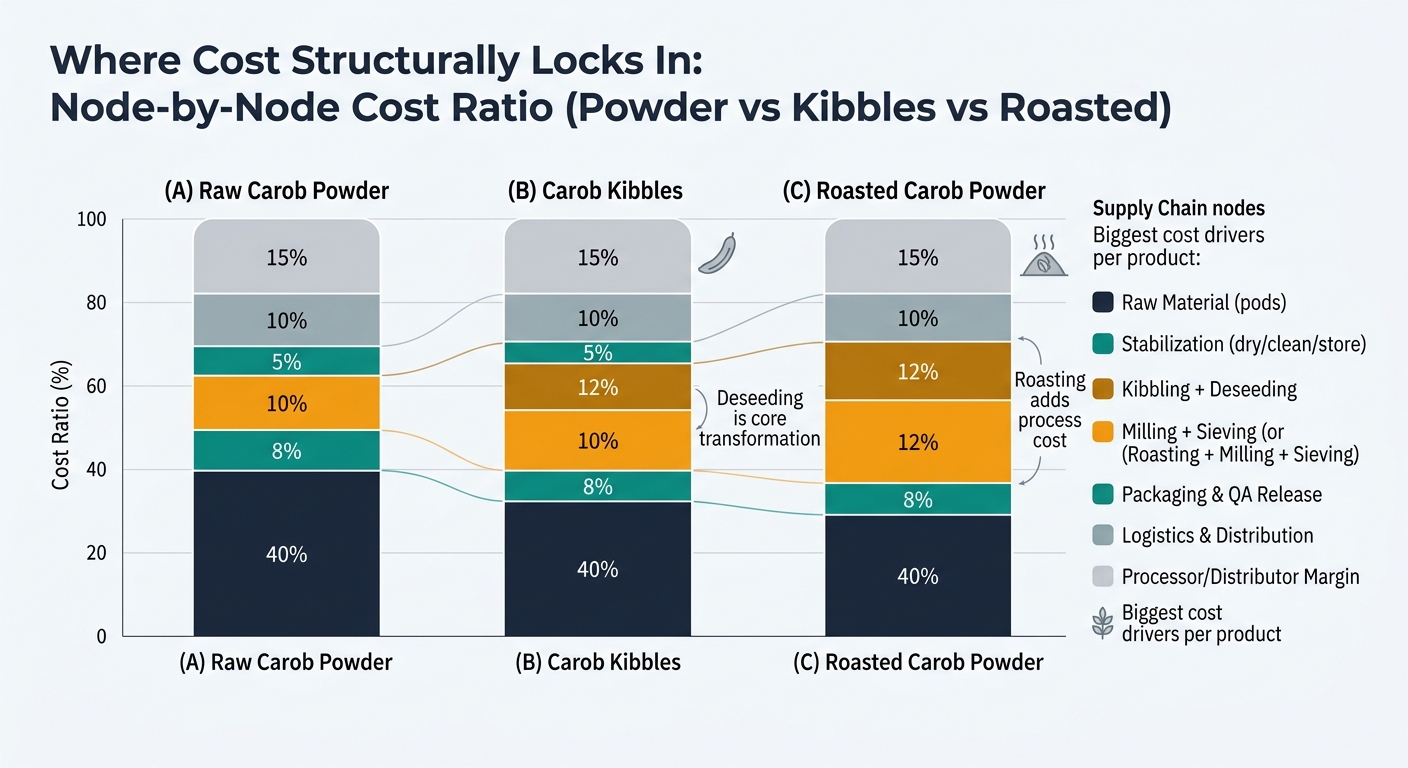
| Supply Chain Node | Cost Ratio (% of Final Cost) | Notes |
|---|---|---|
| Raw Material (pods) | 30% | Harvest labor + sorting losses drive variability-cost. |
| Stabilization (dry/clean/store) | 12% | Drying capacity and cleaning effectiveness prevent downstream rejects. |
| Kibbling + Deseeding | 10% | Separation yield + maintenance; influenced by seed recovery focus. |
| Milling + Sieving (+ safety controls) | 18% | Particle size control, magnets/metal detection, dust control. |
| Packaging & QA Release | 10% | Barrier liners + testing + lot release costs. |
| Logistics & Distribution | 10% | Ambient dry freight; moisture/odor protection in transit. |
| Processor/Distributor Margin | 10% | Value-add for consistent spec and documentation readiness. |
| Supply Chain Node | Cost Ratio (% of Final Cost) | Notes |
|---|---|---|
| Raw Material (pods) | 35% | Higher share because downstream value-add is reduced. |
| Stabilization (dry/clean/store) | 15% | Must still manage moisture and infestation risk. |
| Kibbling + Deseeding | 20% | This is the core transformation step for kibbles. |
| Packaging & QA Release | 10% | Larger particle size reduces dust but still needs hygiene controls. |
| Logistics & Distribution | 10% | Lower density fines-loss risk than powder; still moisture sensitive. |
| Processor/Distributor Margin | 10% | Margin reflects intermediate spec and lower finishing complexity. |
| Supply Chain Node | Cost Ratio (% of Final Cost) | Notes |
|---|---|---|
| Raw Material (pods) | 28% | Similar upstream, but roasting can mask some variability while creating its own spec needs. |
| Stabilization (dry/clean/store) | 10% | Some moisture reduction achieved later via roasting. |
| Kibbling + Deseeding | 10% | Same mechanical separation requirement. |
| Roasting + Milling + Sieving | 25% | Added thermal step, energy, process control, and sensory QA. |
| Packaging & QA Release | 10% | Aroma retention and moisture barrier become more critical. |
| Logistics & Distribution | 7% | Similar lanes; slightly higher sensitivity to odor taint. |
| Processor/Distributor Margin | 10% | Added process value for sensory consistency. |
Insight: The carob powder chain has a few “hard constraints” that persist across suppliers and years: harvest seasonality, co-product economics, and moisture-driven stability.
Data: Harvest timing is repeatedly described as late summer to autumn in Mediterranean sources; processing commonly includes kibbling/separation of seeds; and the pod is commonly described as ~90% pulp and ~10% seed, which explains why the seed stream materially shapes processor incentives. [2]
Procurement Impact: Your spec and supplier qualification must tolerate the realities of agricultural variability while being strict on the controls that prevent safety/quality failures.
(Analyzed at: Aug, 2026)
Write the contract so you’re buying controls, not just a powder description: require a declared drying/stabilization approach, a lot-by-lot moisture (or water activity) limit, and named metal control points (magnet + metal detection) with packaging barrier minimums. This works because the chain is structurally pod-first with seed co-product economics, so your best leverage is to lock in the few process controls that prevent moisture pickup and foreign-material escapes—not to over-tighten sensory descriptors you can’t enforce. With carob powder demand still supported by cocoa-substitution and “natural” positioning, late-season variability and periodic tightness are realistic; teams that standardize these controls typically avoid the quiet 1–3% ingredient-spend bleed from rework, holds, and rejections that never shows up as a headline recall but hits OEE every month. [4]


