

Procurement leaders buying pure-pressed (NFC) apple juice rarely lose money because they “picked the wrong supplier.” They lose money because cost drivers move on different clocks (apples/juice vs. packaging vs. refrigerated freight) and contracts don’t reflect that reality. This guide translates those market mechanics into contracting, qualification, and governance moves a sourcing manager can execute.
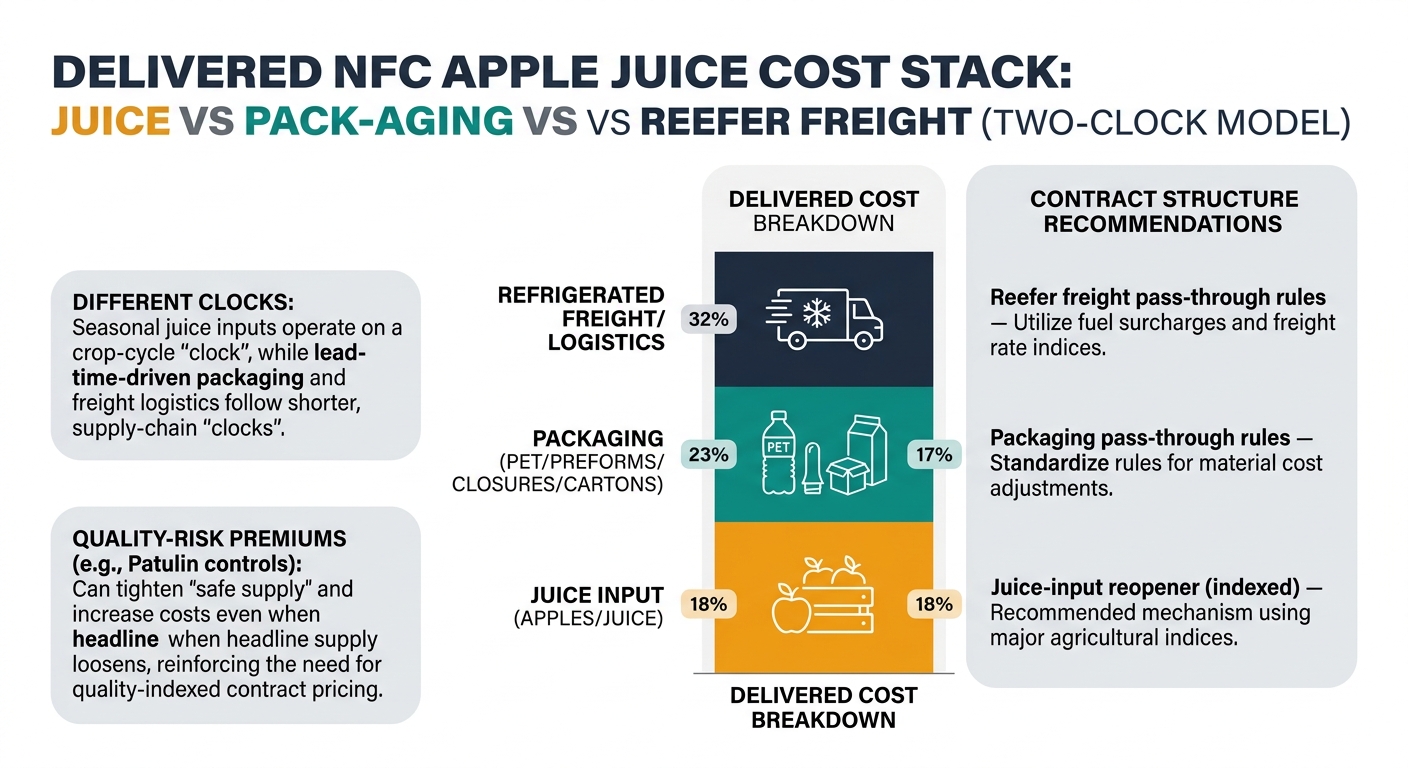
Split your negotiation into two clocks: (1) juice input (seasonal, inventory-lagged), (2) packaging + logistics (lead-time driven). Ask for separate line-item reopeners and you’ll stop paying last quarter’s risk premium for this quarter’s reality.
Audit your “dual source” claim: can you place a PO today for 25–30% of volume with the alternate, in your packaging format, to your delivery points, within your lead-time tolerance? If not, you’re single-sourced.
| Dimension | Before (Traditional) | After (Intelligence-driven) |
|---|---|---|
| Supplier set | 1–2 incumbents | 1–2 incumbents + 2 qualified alternates (switch-ready) |
| Contracting | Fixed all-in price | Juice-input reopener + packaging/freight pass-through rules |
| Coverage | 4–8 weeks visibility | 12–20 weeks visibility with trigger points (inventory, lead time, risk signals) |
| Quality risk | Reactive holds/claims | Pre-agreed escalation: extra testing, lot segregation, substitute origin rules |
| Outcome (typical) | More frequent expedite events; higher cost variance in easing markets | Lower landed-cost variance; faster switch time (weeks → days) |
Add one metric to your SRM: “switch-ready volume (%) within 30 days.” It’s the single best leading indicator of resilience you can govern.

Pre-negotiate “format substitution rules” (e.g., alternate cap/label spec, secondary carton supplier) so you can keep shipping during packaging squeezes without a full commercial reset.
Use the current lag between juice-input moves and delivered NFC pricing to renegotiate contract mechanics—not just price. Ask for a short bridge term (90–120 days) with a juice-input reopener and explicitly separated packaging/freight pass-through rules, because that’s where the disconnect lives and where suppliers typically preserve margin during easing cycles. The stake isn’t theoretical: teams that capture the lag window typically reduce landed-cost variance by a few points and avoid paying last quarter’s risk premium for this quarter’s supply reality. If you can’t quantify that lag (and trigger the reopener on time), your negotiation will keep anchoring to stories instead of signals.
(Analyzed at: Oct, 2026)
Given 2026’s mixed apple-supply signals (weather-driven regional impacts showing up in U.S. production outlooks) and the fact that refrigerated freight and packaging inputs have their own inflation cycles, the highest-confidence move is to stop buying NFC on a single blended price. Put a 90–120 day bridge in place now and hardwire two mechanisms: a juice-input reopener (tied to an agreed benchmark) and separate packaging + reefer freight pass-through rules. This works because it targets the exact place where price transmission lags, and it prevents you from paying a “quality + logistics premium” after the market has already eased. On a typical multi-million-dollar program, even a couple points of avoided lag is real money—often the difference between holding margin and funding the next promotion.


