
This report is powered by Tridge Eye Data Intelligence.
Every data point, price signal, and supply risk insight in this analysis comes from the same platform that procurement and sourcing leaders worldwide rely on daily. As you read, consider what this level of market intelligence could do for your sourcing decisions.
Procurement leaders usually get pulled into cocoa powder decisions only when budgets blow out or supply tightens. This guide is designed to prevent that. It explains (in plain procurement language) what cocoa powder really is in the value chain, why cocoa futures headlines often don’t match your delivered price, and how to govern contracts and supplier strategy so you can control variance without increasing stockout risk.
(Analyzed at: Mar, 2026)
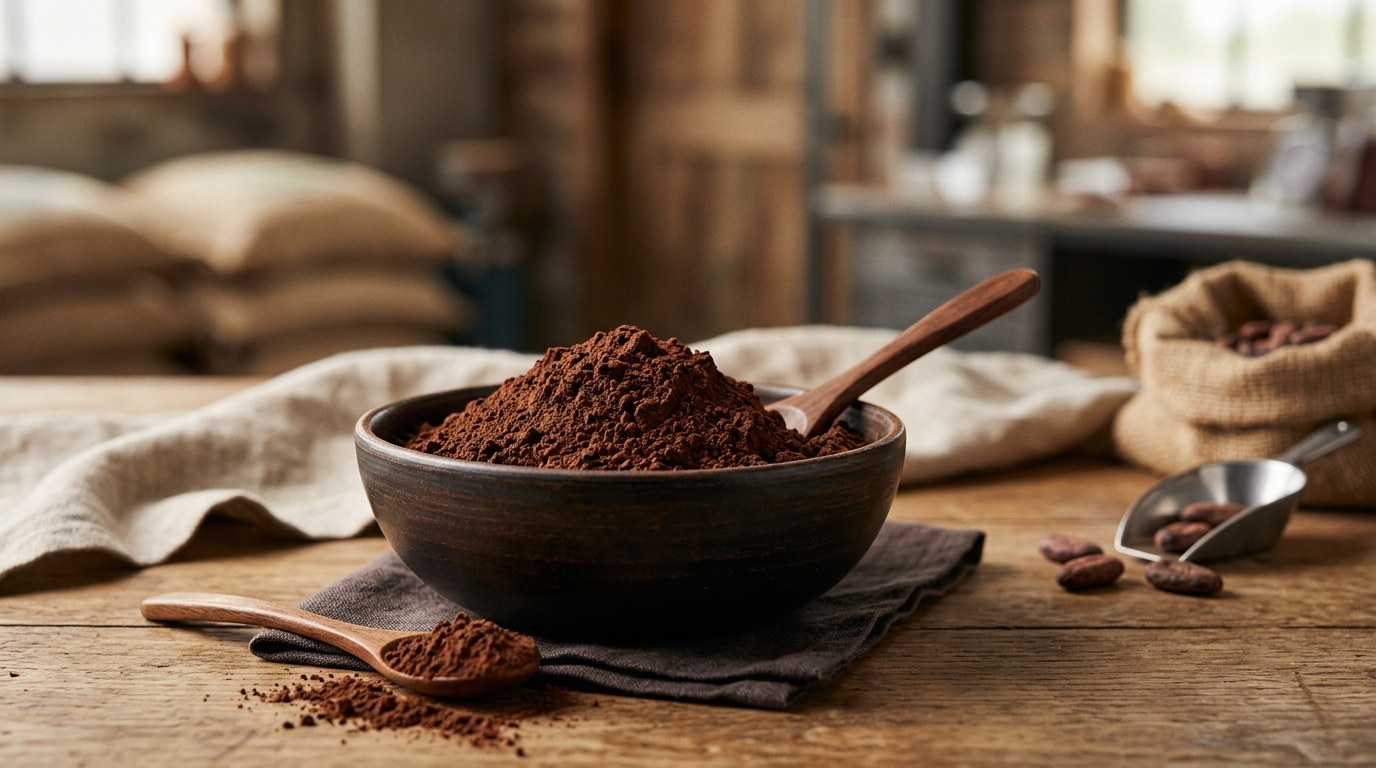
Pure cocoa powder is not “made from beans” in a straight line. It is the powdered form of press cake, which is a co-product of cocoa butter production. That co-product reality is why cocoa powder availability and pricing can tighten even when your demand hasn’t changed—because grinders optimize output based on the butter vs. powder value equation. [4]

In cocoa powder, raw material (beans) dominates total cost, but the variance you see on invoices is often driven by a mix of:
Below is a practical decomposition by node, written for contracting and negotiation prep.
What happens: Smallholders harvest pods, ferment and dry beans; quality defects and moisture are set here.
Why it matters commercially:
Main cost drivers:
What happens: Aggregation, warehousing, financing, export contracts.
Procurement-relevant dynamics:
Main cost drivers:
What happens: Beans are cleaned/roasted/winnowed → liquor → pressed into butter + cake.
Procurement reality:
Main cost drivers:
What happens: Press cake is milled; suppliers may alkalize (Dutch) and/or apply validated kill steps (e.g., steam treatment), then blend lots to hit consistent color/flavor.
Specs that drive cost and supplier pool:
Main cost drivers:
What happens: Bagging into multiwall bags + liners, palletization, lot coding, COA issuance.
Main cost drivers:
What happens: Containerized ocean freight + inland delivery; cocoa powder is moisture/odor sensitive.
Main cost drivers:

These are modeled ratios to explain where cost concentrates. Actuals vary by origin, hub, spec tightness, contract terms, and market tightness.
| Supply Chain Node | Cost Ratio (% of Delivered Cost) | What typically moves it |
|---|---|---|
| Beans & origin export | 55% | bean market + origin differentials |
| Grinding/pressing | 15% | energy + grinding margins |
| Powder milling/blending | 8% | fineness/color standardization |
| Packaging & QA | 7% | micro/heavy metals testing intensity |
| International + domestic logistics | 8% | freight basis + warehousing |
| Supplier margin & commercial terms | 7% | contract structure, volume commitment |
| Supply Chain Node | Cost Ratio (% of Delivered Cost) | What typically moves it |
|---|---|---|
| Beans & origin export | 52% | bean market + quality availability |
| Grinding/pressing | 14% | energy + plant utilization |
| Alkalization + blending/standardization | 12% | pH/color tightness, rework |
| Packaging & QA | 8% | additional QA + documentation |
| International + domestic logistics | 8% | lanes/ports variability |
| Supplier margin & commercial terms | 6% | service level, allocation in tightness |
| Supply Chain Node | Cost Ratio (% of Delivered Cost) | What typically moves it |
|---|---|---|
| Beans & origin export | 50% | bean market + butter/powder economics |
| Grinding/pressing | 16% | butter extraction strategy |
| Powder milling/blending | 10% | fat target consistency |
| Packaging & QA | 8% | tighter QC on fat/moisture |
| International + domestic logistics | 8% | freight + inventory holding |
| Supplier margin & commercial terms | 8% | scarcity premium, allocation |
Cocoa powder is structurally tied to cocoa butter through pressing decisions.
This is why procurement teams sometimes see:
Procurement leaders often try to explain powder price changes purely with cocoa futures. That’s necessary—but insufficient.
Procurement takeaway:
You’re deciding how much volume to place under fixed vs indexed vs hybrid terms, and what governance you need to avoid budget blowouts and stockouts.
Practical clauses procurement leadership can govern:
Examples of triggers:
The core lesson is co-product + spec-driven supply risk + compliance externalities. Similar patterns show up in categories cocoa buyers often also manage:
Procurement teams that build repeatable intelligence-to-decision governance in cocoa can reuse the same operating system elsewhere.
Pure cocoa powder is a “stress test” category:
For procurement management, it forces discipline in:

Make Faster, Data-Driven Sourcing Decisions
The insights in this report are just the starting point. Tridge Eye is the data intelligence solution that gives procurement and sourcing leaders real-time market signals, price benchmarks, and supply risk alerts — so you can act before the market moves.