

Premium calamansi concentrate is not a “commodity juice” buy: most of your cost and quality risk is physically baked in before you ever negotiate—through fruit maturity/yield, concentration energy intensity, and how well the supplier protects aroma and controls oxygen and hygiene through bulk handling. This guide maps the real chain and the cost stack so procurement teams can compare offers on like-for-like capability, not just price per kg.
Premium calamansi concentrate is a short, yield-sensitive chain: fruit quality at harvest determines how much usable juice you can extract, and processing choices determine whether you keep the aroma that makes “premium” worth paying for. The physical flow is typically Southeast Asia–centric, with the Philippines being a major production base (and tracked in official PSA crop statistics), then shipped in bulk (aseptic or frozen) to industrial users. [1]
Insight: The chain’s “hard costs” are locked in early (fruit maturity + extraction yield) and again at concentration/packaging (energy + aseptic controls).
Data: In many industrial juice concentrate systems, concentrates are commonly produced at >60 °Brix, which implies substantial water removal; vacuum evaporation is widely used and can strip aroma volatiles unless aroma recovery and/or cut-back is applied. [5]
Procurement Impact: Even before any commercial discussion, your landed economics will be structurally shaped by (1) fruit-to-juice yield, (2) evaporation energy intensity, and (3) whether the supplier can hold premium sensory through hygienic, low-oxygen handling.
Supply chain flow (physical map): Orchard/collection → extraction/screening → clarification/standardization → concentration (vacuum and/or membrane steps) + optional aroma recovery/cut-back → pasteurization/aseptic fill (or freezing) → export in drums/totes → destination storage → re-pack or direct dosing into manufacturing.

Insight: Calamansi concentrate cost is not “one conversion step”—it is a stack of yield losses, utilities, packaging, and compliance controls that compound at each node.
Data: Concentration by vacuum evaporation is a dominant industrial method in juice processing; without volatile recovery, aroma compound losses reduce flavor, and citrus systems commonly use aroma recovery and/or cut-back to restore sensory. [2]
Procurement Impact: When you compare offers, you’re implicitly comparing different physical cost structures (yield, energy, aseptic capability, and logistics model), not just different supplier margins.
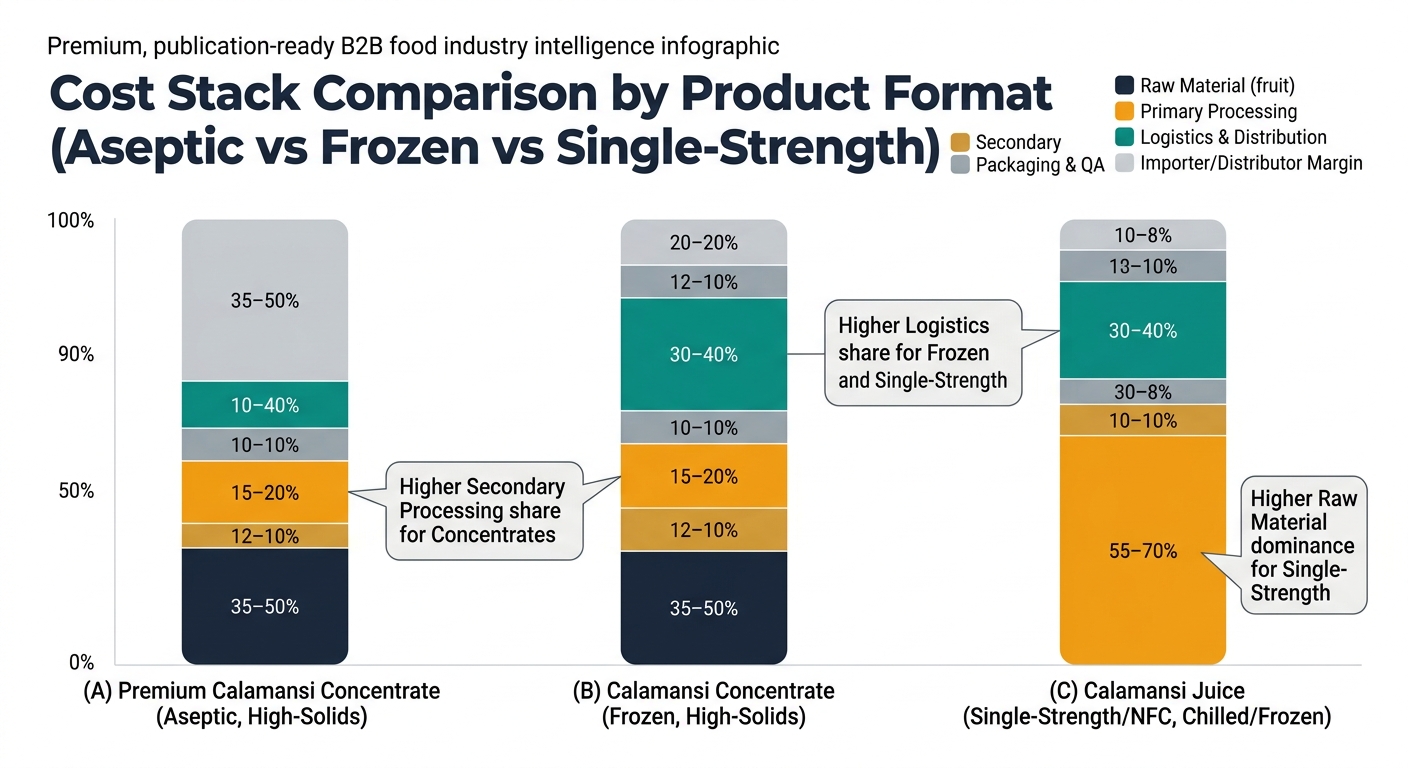
| Supply Chain Node | Cost Ratio (% of Final Cost) | Notes |
|---|---|---|
| Raw Material Cost (fruit) | 35–50% | Dominant driver; maturity and shrink strongly affect effective yield. |
| Primary Processing | 8–12% | Extraction yield, enzymes/processing aids, wastewater, labor. |
| Secondary Processing | 15–25% | Energy-intensive concentration + aroma management/standardization losses. |
| Packaging & QA | 8–12% | Aseptic bags/liners, drums/totes, micro + residues testing, traceability. |
| Logistics & Distribution | 10–18% | Ocean freight + inland moves; ambient is cheaper than frozen but still handling-sensitive. |
| Importer/Distributor Margin | 5–12% | Varies by service level (inventory, re-pack, QA release). |
| Supply Chain Node | Cost Ratio (% of Final Cost) | Notes |
|---|---|---|
| Raw Material Cost (fruit) | 32–45% | Similar fruit economics; quality often preserved better post-pack. |
| Primary Processing | 8–12% | Same yield mechanics; additional cold handling may start earlier. |
| Secondary Processing | 14–22% | Concentration still energy-driven; less reliance on aseptic validation. |
| Packaging & QA | 6–10% | Frozen drums/totes; cold-chain QA and temperature logging add overhead. |
| Logistics & Distribution | 18–30% | Reefer ocean + cold storage + higher handling cost are structural. |
| Importer/Distributor Margin | 5–10% | Often lower “value-add” than aseptic re-pack programs, but depends. |
| Supply Chain Node | Cost Ratio (% of Final Cost) | Notes |
|---|---|---|
| Raw Material Cost (fruit) | 40–55% | More water shipped; fruit cost dominates and yield penalties are less “diluted.” |
| Primary Processing | 12–18% | Higher volume to handle per kg-solids; filtration/clarification decisions matter. |
| Packaging & QA | 10–15% | Often smaller pack or stronger cold-chain controls; micro risk higher. |
| Logistics & Distribution | 20–30% | Shipping water is expensive; cold-chain frequently required. |
| Distributor/Channel Margin | 5–12% | Depends on whether it’s industrial bulk or foodservice/retail. |
Insight: Premium calamansi concentrate behaves like a “quality-at-risk” ingredient: oxidation, aroma stripping, and lot variability are structural, not occasional.
Data: Concentration by evaporation is known to remove volatile aroma compounds; industry practice uses aroma recovery/cut-back to restore sensory. Bulk transport guidance emphasizes sanitary design and cleaning because contamination risk is inherent in bulk systems. [6]
Procurement Impact: Premium programs should treat aroma retention and hygienic design as core manufacturing capabilities, not optional QA add-ons.
Quick Win: When internal stakeholders ask “Why does this supplier cost more?”, anchor the discussion in the fixed physics: (1) juice recovery, (2) concentration energy and aroma retention, and (3) aseptic/frozen handling model.
(Analyzed at: Jul, 2026)
Lock your next premium calamansi concentrate award around process evidence, not just COA lines: require (i) lot-to-run traceability, (ii) documented aroma management approach (recovery/add-back or cut-back), and (iii) bulk-transport hygiene controls aligned to FDA’s bulk concentrate guidance (liner/container type, sanitation and loading/unloading controls). [6]
This works because the biggest structural failure modes—aroma stripping during concentration and oxidation/contamination during bulk handling—are process- and handling-driven and can pass a basic COA. If you don’t contract for these controls, the cost shows up later as avoidable quality holds, higher dosing to hit flavor, and claim/write-off exposure that can easily erode a meaningful share of landed cost over a season.


