INDUSTRY TRENDS

Palm Oil Procurement Intelligence Guide (Mar 2026): Managing Cost, Continuity, NDPE Traceability, and EUDR-Driven Compliance Risk

Author
Team Tridge
DATE
March 7, 2026
8 min read
Palm Oil Cover
Tridge — Trusted Global Food Sourcing

This report is powered by Tridge market intelligence.

Every data point, price signal, and supply chain insight in this analysis is drawn from the same engine that procurement teams worldwide rely on daily. As you read, consider what this level of visibility could do for your category.

See how Tridge Eye works →

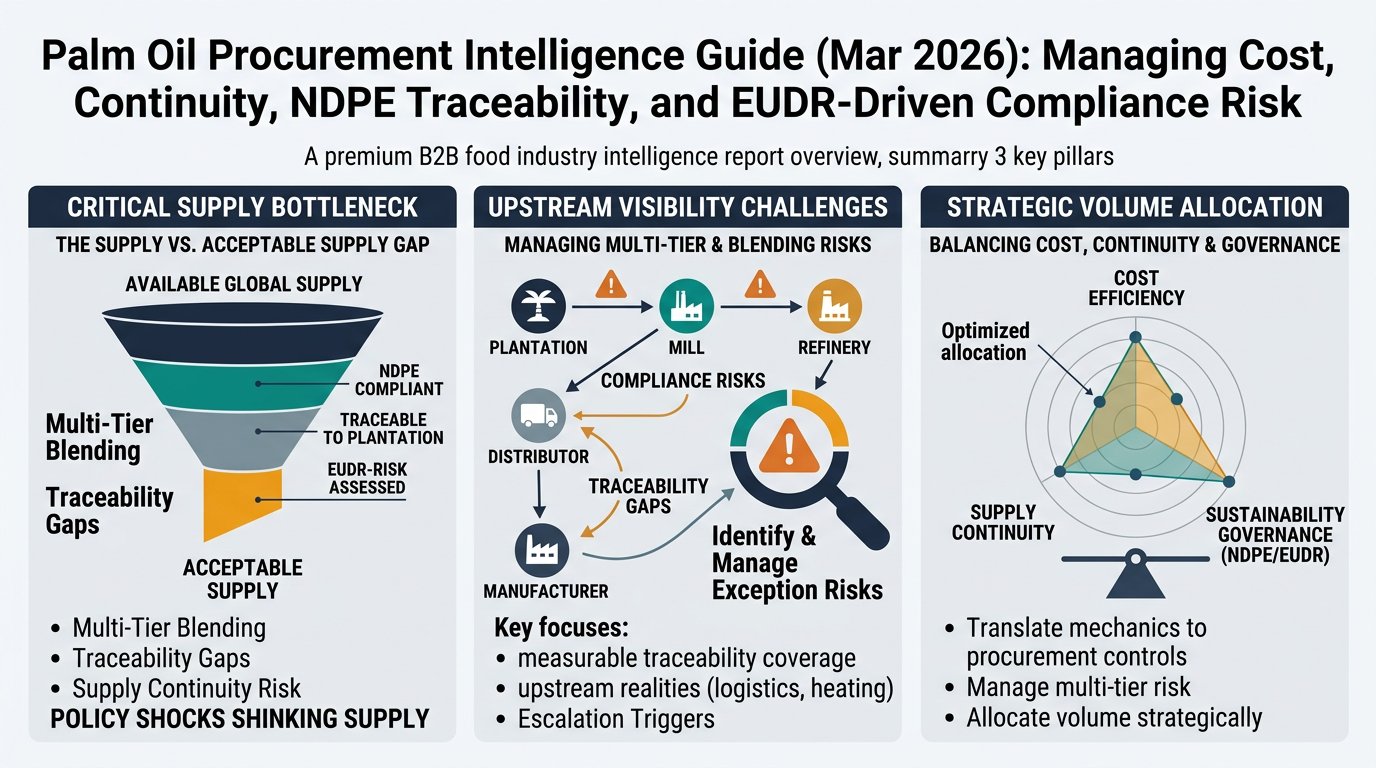
Palm oil procurement rarely fails because a buyer can’t negotiate—it fails because upstream realities (multi-tier blending, heated logistics, policy shocks, and traceability gaps) make “acceptable supply” smaller than “available supply.” This guide translates palm’s supply chain mechanics into procurement controls you can actually run: measurable traceability coverage, exception management, escalation triggers, and volume allocation that balances cost with continuity and sustainability governance.

Executive Summary

  • Multi-tier risk is structural: A single parcel can represent exposure to dozens/hundreds of mills unless you buy segregation; treat mill-level traceability coverage as a KPI, not a checkbox.
  • FFB time sensitivity is real: Fresh Fruit Bunches (FFB) should reach the mill quickly (often cited as within ~24 hours) to protect quality/yield—making local logistics and labor availability upstream cost/risk drivers [1].
  • EUDR timeline changed again (key procurement implication): EU institutions amended the implementation timeline; the European Commission implementation page states Large/medium operators: 30 Dec 2026; Micro/small: 30 Jun 2027 (with a special case for some micro/small already under EUTR) [2].
  • Availability under your governance threshold can tighten even when benchmarks soften: policy + biofuel demand + due diligence friction can widen premiums for traceable/segregated routes.
  • Cost breakdown tables here are illustrative—not market-true: use them as a thinking tool for where leverage sits (upstream vs logistics vs margin), not as a pricing model.

Key Insights

Analyzed at: Mar, 2026

  • Strategy: Hold
  • Reliability: Medium
  • Potential Saving: 4% ~ 10%

Insight: Treat 2026 as a governance-and-optionality year, not a “wait-and-see” year. With EUDR application dates now pushed to 30 Dec 2026 (large/medium) and 30 Jun 2027 (micro/small), the near-term advantage is not speculative price timing—it’s avoiding future “compliance premium” shocks by locking in (a) mill-list cadence + exception thresholds in contracts, and (b) a pre-qualified alternate supplier bench for segregated or higher-traceability flows. Companies that use the extra runway to reduce “unknown mill share” and formalize escalation volume levers typically avoid the most expensive outcome: emergency switches into a tight pool of compliant supply [2].

1) The Palm Oil Supply Chain Reality You’re Actually Buying Into

Palm oil procurement looks simple at the invoice level (RBD palm oil, olein, stearin, PFAD), but the risk and cost drivers sit upstream—often outside the buyer’s direct contractual relationship.

Ground truth flow (typical)

  1. Plantation / Smallholders grow oil palm and harvest Fresh Fruit Bunches (FFB).
  2. Mills must process FFB quickly (commonly cited as within ~24 hours) to protect yield/quality; mills produce Crude Palm Oil (CPO) + kernels [1].
  3. Kernel crushers convert kernels into Palm Kernel Oil (PKO) and Palm Kernel Expeller/Cake (PKE/PKC).
  4. Refineries convert CPO into RBD palm oil.
  5. Fractionators split RBD into palm olein (liquid) and palm stearin (solid). Refineries also generate PFAD (a fatty acid distillate used in oleochemicals and other markets; in some regions it can be indirectly influenced by biofuel-linked demand).
  6. Traders / aggregators may sit between each step (especially between mills and refiners), which is where traceability and governance can blur.
  7. Logistics often requires heated handling (bulk tanks, ISO tanks, flexitanks; drums/IBCs for specialty flows).
  8. End markets: food (frying, bakery, snacks, instant noodles), oleochemicals (surfactants, personal care), and in some regions biofuel-linked demand.
A clean, procurement-oriented flowchart showing the typical palm oil chain: Plantation/Smallholders (FFB) → Mills (CPO + kernels) → Kernel Crushers (PKO + PKC) → Refineries (RBD) → Fractionators (olein/stearin + PFAD) → Traders/Aggregators (blending points highlighted) → Heated Logistics (bulk tanks/ISO/flexitanks; drums/IBCs for specialty) → End Markets (food, oleochemicals, biofuel-linked). Visually emphasize (with callouts/icons) the two key risk mechanics: (1) time sensitivity of FFB to mill (quality/yield impact) and (2) traceability choke point at the mill plus blending risk at trader/refinery nodes. Keep it brand-neutral and avoid any 'dashboard' UI styling.

Structural concentration that matters for resilience (keep the claim precise)

  • Indonesia and Malaysia are consistently the two dominant producers; many industry references describe them as accounting for ~80%+ of global production in typical years, though the exact share varies by year and methodology. (Use this as a risk framing, not a single-point statistic.) [3]

Why this matters for a Risk & Sustainability buyer

  • Your “supplier” is often a refiner or trader, but your exposure is frequently tied to mills and plantation landscapes (deforestation, labor allegations, land tenure disputes) and to origin-country policy (export controls, domestic market rules, biodiesel mandates).

2) Where Cost and Margin Accumulate (and Why Your Negotiation Levers Shift by Node)

2.1 Upstream: Plantations & Smallholders (FFB)

Key insight: FFB is time-sensitive and labor-driven. Harvesting cadence and transport to mills drive oil extraction rate (OER) and free fatty acid (FFA) outcomes—small changes upstream can widen downstream basis and quality claims.

Cost drivers (what actually moves the number)

  • Harvest labor availability and wage policy
  • Fertilizer regimes (under-application can reduce yields in later quarters)
  • Weather variability (flooding/drought) and biological yield cycles
  • Road access to mills (especially in remote producing regions)

Margin reality

  • Many smallholders are price takers; margin is volatile and often squeezed when input costs rise.

2.2 Primary Processing: Mills (FFB → CPO + kernels)

Key insight: Mills are the traceability choke point. If you can’t map to mill, you usually can’t credibly manage deforestation and grievance risk at scale.

Cost drivers

  • Yield/OER performance and losses from delayed fruit delivery
  • Energy/steam (often biomass-backed) and maintenance
  • Effluent management (POME handling) and compliance costs

Margin reality

  • Mill margins are heavily linked to CPO price and by-product economics (kernels, biomass energy offsets).

2.3 Secondary Processing: Refining & Fractionation (CPO → RBD → olein/stearin + PFAD)

Key insight: This is where specification and contaminant risk becomes commercial. Refining/fractionation decisions influence:

  • Color, odor, melting profile/iodine value
  • Formation/mitigation of process contaminants (e.g., 3-MCPD esters/glycidyl esters risk management is a recurring buyer concern in refined oils)

Cost drivers

  • Energy intensity (deodorization)
  • Bleaching earth/chemicals, catalysts (in some downstream conversions)
  • QA and testing, segregation/certification handling

Margin reality

  • Refiners can defend margin via spec complexity, segregation premiums, and logistics capability (heated storage, tank availability).

2.4 Packaging & QA (bulk vs drums/IBCs)

Key insight: Packaging choice is not just cost—it’s risk control.

Cost drivers

  • Drums/IBCs add material + handling + contamination control
  • Sampling/testing cadence (COA integrity, hold/release discipline)
  • Labeling and chain-of-custody documentation

2.5 Logistics & Trade Finance

Key insight: Palm is a “heated logistics commodity.” Basis volatility often comes from port congestion, tank availability, heating constraints, and freight—not only from CPO futures direction.

Cost drivers

  • Inland haulage to port, storage, heating
  • Ocean freight and demurrage
  • FX exposure (IDR/MYR vs USD)
  • Working capital for inventory and shipment cycles

2.6 Wholesale/Distribution & End-Market Margin

Key insight: Your final delivered cost often embeds risk premiums (segregated supply, shorter lead times, alternative origins, or governance “cleaner” routes).

Product-level cost breakdown (illustrative, delivered-to-buyer)

Modeled percentages to show where cost concentrates by product form. Actual ratios vary by origin, contract terms (spot vs indexed), packaging, certification/segregation, and freight. Use these tables to structure negotiations (where leverage sits), not as a “should-cost.”

A) RBD Palm Olein (bulk, food-grade)

Supply Chain Node Cost Ratio (% of final) Notes
Upstream (FFB economics embedded in CPO) 55% Dominant driver; yield/weather/policy transmit here first
Milling (CPO conversion) 8% OER, energy, compliance
Refining & fractionation 12% Energy + chemicals + yield losses
Packaging & QA 3% Bulk sampling/testing
Logistics & trade finance 12% Heated storage, freight, FX, demurrage
Trader/Distributor margin 10% Service level + credit + optional segregation

B) RBD Palm Stearin (bulk, industrial/food)

Supply Chain Node Cost Ratio (% of final) Notes
Upstream (FFB/CPO) 52% Shared upstream exposure
Milling 8% Similar to olein
Refining & fractionation 15% Fractionation yield/value split matters more
Packaging & QA 3% Bulk
Logistics & trade finance 12% Heated handling
Trader/Distributor margin 10% Often sold on formula/index

C) PFAD (bulk, oleochemical/biofuel-linked)

Supply Chain Node Cost Ratio (% of final) Notes
Upstream (CPO) 45% Still linked, but can behave differently vs edible fractions
Milling 6% Embedded
Refining (distillation) 10% PFAD is a refining by-product
Packaging & QA 2% Bulk
Logistics & trade finance 15% Can be basis-heavy
Trader/Distributor margin 22% Market is thinner; policy/biofuel demand can widen spreads
A stacked bar chart with three bars (RBD Palm Olein, RBD Palm Stearin, PFAD). Each bar is segmented by the same nodes used in the tables: Upstream (FFB/CPO), Milling, Refining & Fractionation (or Refining for PFAD), Packaging & QA, Logistics & Trade Finance, Trader/Distributor Margin. Use the exact illustrative percentages from the article tables and add a footnote label 'Illustrative ratios (not market-true)'. Ensure the visual clearly shows PFAD’s higher trader/distributor margin share relative to olein/stearin. No pricing numbers, only percentages.

3) The Structural Fact Most Non-Palm Buyers Miss: “Your Tier-1 Isn’t Your Risk Boundary”

In palm, risk is multi-tier by design:

  • FFB is produced by many actors (including smallholders), aggregated into mills.
  • Traders can blend across multiple mills/refineries.
  • A single delivered parcel can represent exposure to dozens to hundreds of mills unless strict segregation is purchased.

So your core governance challenge becomes:

  • How much of your volume is traceable to mill?
  • What is the “unknown” share—and is it shrinking quarter over quarter?
  • Do suppliers have NDPE policies and functioning grievance/remediation workflows (not just PDFs)?

4) The Critical Insight: Why Palm Prices and “Sustainable Availability” Can Diverge

Procurement teams often assume “higher price = tighter supply” and “lower price = easier buying.” In palm, availability under your sustainability/compliance threshold can tighten even when headline prices soften.

Three mechanisms drive the disconnect:

  1. Policy-driven domestic pull in Indonesia can restrict exportable supply or change flows.
  2. Biofuel mandates change the marginal barrel (domestic blending requirements can tighten export availability even without a weather shock).
  3. Regulatory due diligence increases segregation friction.
  4. EUDR implementation timing has been amended; the European Commission’s implementation page lists 30 Dec 2026 (large/medium) and 30 Jun 2027 (micro/small) [2].

Net effect: You can see stable or falling benchmarks while your “acceptable supply pool” shrinks, premiums widen, and lead times extend.

5) How Procurement Teams Typically Get This Wrong (Even When They’re Good at Procurement)

  1. Over-indexing on certification as audit-grade proof
  2. RSPO is valuable, but it’s a system and chain-of-custody framework, not a guarantee that every risk is eliminated.
  3. Treating traceability as a yes/no checkbox
  4. The practical metric is coverage + exception rate (unknown mills, late submissions, inconsistent mill lists).
  5. Waiting for a crisis to qualify alternates
  6. In palm, qualification is slowed by spec approvals (melting profile, frying performance), logistics heating constraints, and governance documentation.
  7. Not separating “price negotiation” from “risk capacity allocation”
  8. The cheapest supplier may be cheap because they can blend broadly; your governance threshold may require tighter segregation and thus different economics.

6) What an Intelligence-Driven Approach Changes (Decision-Led, Not Feature-Led)

Buyer decision focus: Renew/award volumes while tightening sustainability and continuity controls.

An intelligence-driven service changes outcomes by making risk governable in procurement language:

A) Convert upstream complexity into procurement controls

  • Build supplier and group-entity maps (refiner/trader ownership, upstream link claims)
  • Track traceability coverage to mill as a KPI (and the “unknown share” as an exception metric)
  • Maintain a grievance register linkage: allegations → supplier response → corrective action status (signal, not legal proof)

B) Turn monitoring into pre-defined volume actions

Instead of ad hoc reactions:

Define escalation triggers (examples)

  1. Unknown mill share rises above X% for Y consecutive months
  2. Supplier misses response SLA on grievance/traceability submissions
  3. New policy shock increases export friction (domestic pull, levy, mandate changes)

Define volume levers

  • Shift 10–30% to pre-qualified alternates
  • Temporarily restrict to segregated routes for sensitive SKUs

C) Make it defensible across stakeholders

  • Sustainability: exception trendlines, remediation progress
  • Legal/compliance: documented due diligence steps and decision rationale
  • Operations/quality: spec stability and contingency options
  • Finance: explain premium vs avoided disruption/recall/rework risk

Boundary clarity (important): Intelligence provides risk indicators and governance evidence, not audit-grade proof or legal determinations.

7) Strategic Use Cases (Practical Plays for a Risk & Sustainability Buyer)

Use case 1: “Supply stability under sustainability constraints” (RBD palm olein)

  • Objective: keep plants running while reducing deforestation/regulatory exposure
  • Workflow: benchmark incumbents on traceability + governance maturity → set thresholds → dual-source critical SKUs
  • Outcome metric: emergency spot buys reduced; unknown share down QoQ

Use case 2: Traceability & governance scorecards for QBRs

Standardize definitions:

  • % volume traceable to mill
  • # of mills in scope
  • unknown/exception share
  • response SLA adherence
  • corrective action aging (days open)

Outcome metric: fewer “data-chasing” cycles; faster escalation decisions

Use case 3: Alternative supplier readiness before disruption (stearin/PFAD)

Pre-qualify alternates by:

  • spec capability (melting profile/iodine value)
  • logistics capability (heated bulk, tank access)
  • governance posture (NDPE, transparency cadence)

Outcome metric: time-to-switch reduced from months to weeks

8) Why This Matters Beyond Palm (Examples You’ll Recognize)

Palm is the clearest example of a broader procurement pattern: the invoice is downstream; the risk is upstream and multi-tier.

Comparable categories where intelligence-led sourcing changes outcomes:

  • Cocoa: deforestation and smallholder traceability; compliance-driven segregation premiums
  • Coffee: origin concentration + climate volatility; due diligence documentation burden
  • Soy (and derivatives): land-use change exposure; trader aggregation masks farm-level risk
  • Natural rubber: smallholder-heavy supply + land-use risk; compliance and reputational sensitivity

The transferable lesson: treat sustainability and continuity as measurable operating controls, not annual questionnaires.

9) Why This Palm Oil Example Is So Persuasive for Procurement Leaders

Because it forces clarity on a hard truth:

  • You cannot “buy” lower deforestation risk with a clause alone.
  • You can, however, manage it like a procurement system: thresholds, exceptions, remediation, and volume allocation.

Measurable outcomes (what to report internally)

  • Traceability coverage to mill (% of volume)
  • Unknown/exception share (% and trend)
  • Supplier response SLA (% on-time)
  • Corrective action closure rate (% closed within X days)
  • Continuity outcomes: # of emergency buys, lead-time variance, and disruption-related premium spend
Tridge — Trusted Global Food Sourcing

Take Your Sourcing Intelligence to the Next Level

The insights in this report are just the starting point. Tridge Eye gives you real-time market signals, origin risk alerts, and price benchmarks — so you can act before the market moves.
Explore Tridge Eye →

References

  1. mjmpom.com
  2. green-forum.ec.europa.eu
  3. en.wikipedia.org
Subscribe
By subscribing you agree to with our Privacy Policy and provide consent to receive updates from our company.
Thank you! Your submission has been received!
Oops! Something went wrong while submitting the form.
Subscribe to receive the latest blog posts, updates, promotions, and announcements from Tridge.