

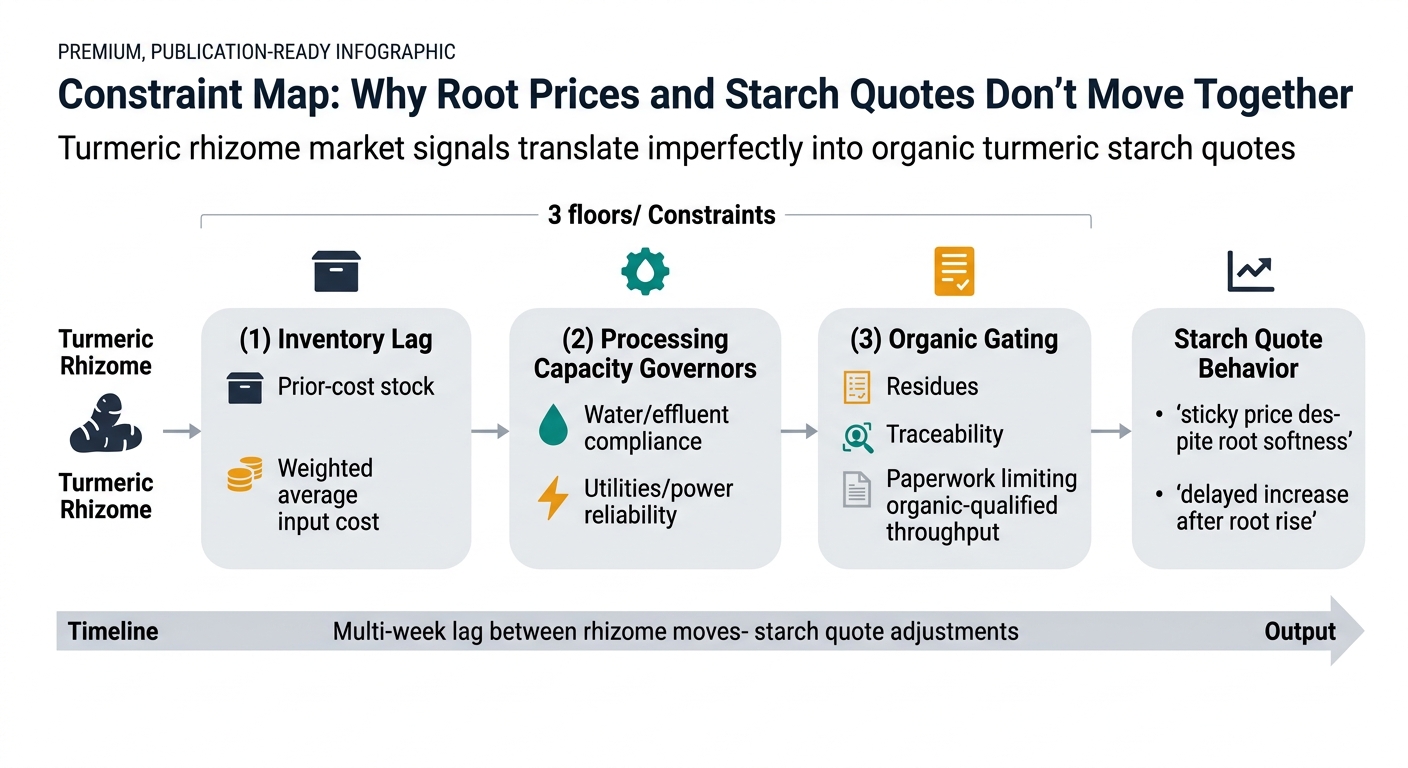
Procurement teams tend to treat organic turmeric starch like a simple derivative of turmeric root pricing. In practice, price and availability are often set by processing capacity, wastewater/utility constraints, and organic documentation throughput—so the best results come from contracting around those constraints, not arguing for perfect raw-cost pass-through.
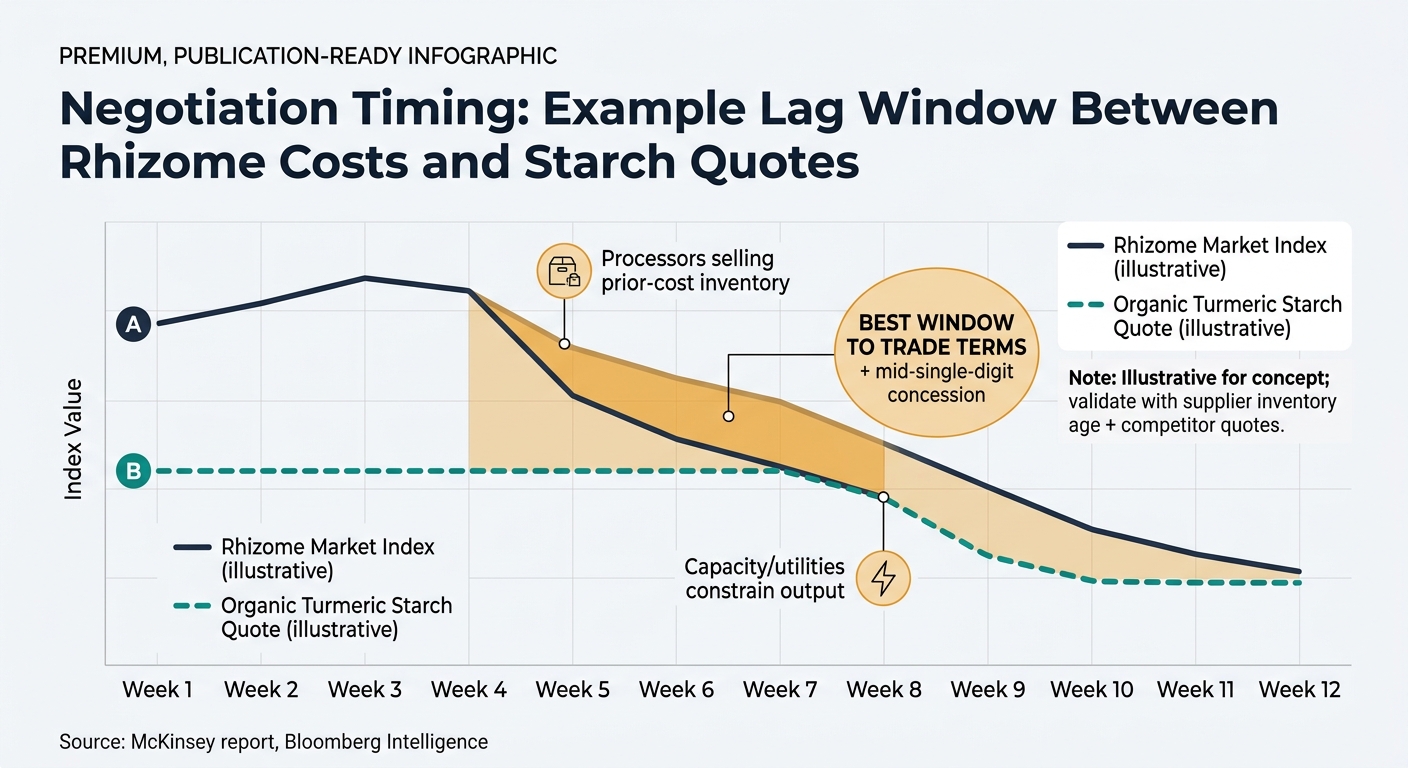
You can do everything “right” on supplier management and still overpay (or get squeezed on availability) because organic turmeric starch pricing is not a clean pass-through of turmeric rhizome costs. The market regularly shows directional disconnects (root down, starch flat/up) and timing disconnects (root up now, starch up later). That’s not noise—it’s how the category clears.
Quick Win (Section 1): In your next negotiation, ask for the supplier’s last 8–10 weeks of rhizome purchase timing and current starch inventory age. If they can’t answer cleanly, treat their price narrative as weak and increase competitive tension.
Quick Win (Section 2): Add two line items to every award decision: (1) expected internal qualification hours (QA + regulatory + operations) and (2) expected documentation cycle time (days from ship to complete TC/COA set). Make suppliers compete on both—not just $/kg.
| Dimension | Before (Traditional) | After (Intelligence-driven) |
|---|---|---|
| Supplier set | 1 incumbent + 1 “backup on paper” | 2 qualified processors + 1 warm alternate |
| Contracting | Annual reset, weak indexing | Split: 60–90 day reset for a tranche + term for base volume |
| Market read | Supplier narratives + occasional broker talk | Track root signals, capacity constraints, and lane lead times weekly |
| Risk posture | Reactive (switch when failure occurs) | Trigger-based (shift volume when indicators breach thresholds) |
| Typical result | Overpay on part of volume; unplanned expedites/holds | Lower paid-price variance; fewer expedites; fewer documentation holds |
Procurement Impact: Leadership gets a defensible strategy: not “we found a cheaper supplier,” but “we reduced disruption probability and stabilized landed cost.” That’s easier to approve, easier to audit, and harder for stakeholders to override.
Quick Win (Section 3): Track three KPIs monthly: (1) % volume under documented contract coverage, (2) lead-time standard deviation (days), (3) documentation completeness on first submission (% lots). These predict firefighting before it happens.
Quick Win (Section 4): Pre-negotiate a “surge clause” with your secondary supplier (pre-agreed incremental volume + lead time) so switching is operationally feasible, not theoretical.
Quick Win (Section 5): For any organic derivative, write a one-page “constraint map” (what can tighten first: raw, processing, documentation, lanes). Use it to choose contract length and award splits.
Quick Win (Section 6): In your next QBR, review not just price and OTIF, but also: average days to complete documentation set per lot, and % lots requiring rework. Those two metrics are early warnings for future disruption.
Use the raw-to-starch timing disconnect to negotiate a two-layer deal: secure your base volume now with tighter service and documentation SLAs, and keep a smaller tranche on a 60–90 day reset to capture the delayed pass-through when suppliers cycle into lower-cost inventory. The window exists because starch quotes typically adjust weeks after upstream cost moves, and suppliers defend headline price while quietly trading on terms. Teams that structure awards around that lag—rather than arguing for instant full pass-through—tend to capture mid-single-digit savings while materially reducing expedite and hold risk over the next two quarters.
(Analyzed at: Oct, 2026)
If you’re importing organic turmeric starch into the U.S., treat documentation as a first-class supply constraint and contract it explicitly: require the supplier to support on-time electronic NOP Import Certificate issuance (plus complete COA/traceability packs) as a measured SLA, not a “best effort.” Since every organic shipment must be tied to an NOP Import Certificate (mandatory since March 19, 2024), the operational cost of one preventable hold can easily outweigh a mid-single-digit $/kg concession [1]. Structure awards so you still have leverage on price (a smaller 60–90 day reset tranche), but you stop paying hidden costs for paperwork latency.


