INDUSTRY TRENDS

Organic Pistachio Butter Supply Chain Map (Quality/Safety/Compliance Lens): Flow, Cost Lock-In Points, and Spec Governance

Author
Team Tridge
DATE
August 14, 2026
8 min read
organic-pistachio-butter Cover
Unlock Full Data
Organic Pistachio Butter Market Intelligence
Prices · Trends · Origins · Forecasts

This guide maps the organic pistachio butter supply chain the way a Quality/Safety/Compliance buyer needs to see it: where risk is created, where cost becomes irreversible, and where specifications and documentation determine whether lots release smoothly or get held. The goal is not “more data,” but faster, more defensible supplier approvals and fewer nonconformances.

Executive Summary

  • Cost locks in upstream: The biggest swings are driven by kernel yield + defect removal (especially sorting/grading tied to aflatoxin and defects).
  • Aflatoxin is a market-design constraint: U.S. enforcement commonly references 20 ppb total aflatoxins for pistachios, while EU maximum levels are commonly lower (often cited around 8 µg/kg B1 and 10 µg/kg total for pistachios), forcing more sorting/testing for EU-bound supply. [1]
  • Pathogen control is structural: FDA preventive-controls guidance explicitly includes nut butters as a category where Salmonella is a key hazard consideration—validated controls and strong prerequisite programs are not optional. [2]
  • Organic integrity is lot-linked: Missing or mismatched lot/volume linkage in organic transaction documentation can create “paperwork holds” even when quality is acceptable. [3]
  • 2026 reality check: U.S. pistachio bearing acreage is large and still expanding, but crop cyclicality (“off years”) and tighter border scrutiny for aflatoxin in some destinations keep supply risk and governance workload elevated. [4]

1) How the Physical Supply Chain Is Built (and Where Cost “Locks In”)

Organic pistachio butter is structurally a kernel-driven product: most downstream cost, quality, and compliance exposure is already determined by what happens between orchard → hulling/drying → sorting/grading before a grinder ever turns. The chain is short in “number of steps,” but dense in yield loss (defect removal), validated food-safety controls (tree-nut / nut-butter Salmonella hazard expectations), and documentation (organic chain-of-custody).

Insight: The supply chain is best understood as two conversions—(1) fruit-to-kernel (ag + primary processing) and (2) kernel-to-butter (roast/thermal control + milling + packing)—with cost accumulating fastest where defects are removed and where QA/traceability is created.

Data: FDA’s preventive-controls hazard identification materials explicitly call out nut butters within the nuts category where Salmonella is a relevant hazard to consider—driving emphasis on validated controls and strong prerequisite programs. [2]

Procurement Impact: Your “fixed” cost drivers are not negotiable levers; they are physical realities: orchard yield variability, sorting intensity, lethality/thermal control capability (where applicable), and packaging/QA overhead (especially for retail jars).

Supply chain flow (physical): Organic pistachio orchards → harvest/hulling/drying → storage → shelling + optical sorting + grading → roasting and/or validated lethality step (where applicable) → grinding/refining (particle size + heat management) → optional formulation (salt/oil/stabilizer if used and organic-compliant) → packaging (bulk drums/pails or retail jars) → distribution.

A left-to-right flowchart showing the physical chain with QA/compliance callouts at each node: Organic orchards → harvest → hulling/drying → storage → shelling → optical sorting/grading → aflatoxin sampling/testing decision gate (pass/hold/rework) → roasting and/or validated lethality control (Salmonella hazard consideration) → grinding/refining (temperature + particle size control) → optional formulation (salt/oil/stabilizer if used; organic-compliant) → packaging (bulk drums/pails vs retail jars) → QA release (COA + lot traceability) → distribution (heat exposure risk + organic paperwork). Visually mark 'Cost Lock-In' points (sorting/yield loss; packaging format selection) and 'Spec Governance' points (aflatoxin limits by destination; organic lot/volume linkage; COA release). Use simple icons (orchard, dryer, sorter, lab vial, roaster, grinder, drum/jar, document, truck) and avoid any dashboard/UI visuals.

2) Where Cost and Margin Accumulate by Node (Quality-Critical Cost Drivers)

Insight: In pistachio butter, the biggest cost swings come from kernel yield and defect removal, while the biggest “non-negotiable” cost adders come from food-safety validation, allergen segregation, and packaging weight/complexity.

Data (validated and tightened): In the U.S., FDA references 20 ppb (µg/kg) total aflatoxins for pistachios in its action level / compliance policy context. [1] EU maximum levels are set under EU contaminants legislation and are commonly cited in technical and regulatory summaries for pistachios around 8 µg/kg aflatoxin B1 and 10 µg/kg total (depending on category/use). [5]

Procurement Impact: The same physical lot can be “economically usable” for one destination and rejected for another; that reality forces more sorting, more testing, or more conservative sourcing upstream.
1. Upstream / Raw Material (Organic Orchards + Harvest)

  • Insight: Orchard biology and water/heat exposure drive kernel size, split rate, and defect propensity—these set the baseline yield and quality ceiling.
  • Data (clarified): Pistachios, like many tree crops, show meaningful year-to-year yield variability; USDA’s 2026 outlook discussion explicitly frames pistachio production expectations using on/off-year yield ranges as a planning lens. [4]
  • Procurement Impact: Upstream variability expresses downstream as higher sorting loss, more sensory variance (color/roast response), and shorter practical shelf-life if quality is marginal.

2. Primary Processing (Hulling/Drying, Storage, Shelling, Sorting & Grading)

  • Insight: This is the yield-loss node: removing insect damage, moldy kernels, foreign material, and aflatoxin-risk fractions is where cost “locks in” because rejects cannot be milled back into compliance.
  • Data (strengthened): U.S. pistachio lots are subject to defined aflatoxin sampling/testing and pass/fail logic in federal regulations for domestic programs (e.g., failure when test results exceed 20 ppb). [6]
  • Procurement Impact: More aggressive sorting improves compliance probability but increases effective raw-material cost per usable kg; this is the core physical reason why “same origin” kernels can produce very different butter economics.

3. Secondary Processing (Roast / Lethality Controls + Grinding to Butter)

  • Insight: Nut-butter plants convert kernels into a ready-to-pack paste, but they also convert process control into value: roast profile, heat history, and particle size determine texture, oil separation, and oxidation rate.
  • Data (tightened to primary guidance): FDA’s hazard-identification materials for preventive controls include nut butters within the nuts category and flag Salmonella as a key hazard consideration—supporting the procurement expectation for validated controls and robust sanitation/prerequisite programs. [2]
  • Procurement Impact: If the plant cannot demonstrate consistent thermal/process control (and validation where applicable) and tight particle-size/temperature control, you should expect higher variance in viscosity, separation, and sensory—creating more downstream rework (even when COAs “pass”).

4. Packaging & QA Release (Bulk Drums/Pails vs Retail Jars)

  • Insight: Packaging is not just a container; it is a shelf-life system. Oxygen/light exposure and headspace management materially affect rancidity and color stability in an oil-rich paste.
  • Data (reframed as practical QA reality): For oil-rich nut products, oxidation management is commonly tracked via indicators such as peroxide value (PV) and free fatty acids (FFA); the procurement implication is to specify methods, limits, and sampling frequency rather than relying on generic “fresh” claims.
  • Procurement Impact: Retail packs (containers, labels, coding, case packs) add fixed cost and QA touchpoints; bulk packs reduce unit packaging cost but can increase handling and segregation requirements at the receiving plant.

5. Logistics & Distribution (Heat Exposure + Documentation Friction)

  • Insight: Organic pistachio butter is physically stable at ambient temperatures, but heat spikes accelerate oxidation and oil separation; documentation flow (organic certificates, lot traceability) can be as schedule-critical as freight.
  • Data (more authoritative for organic paperwork): USDA NOP import integrity guidance explicitly references maintaining records (including lot/volume traceability) and recognizes use of transaction certificates completed by USDA-accredited certifiers as part of the documentation set. [3]
  • Procurement Impact: The physical risk is not only spoilage; it’s “paperwork holds” at receiving—product can be on-site but not releasable if lot-linked organic documentation is incomplete.
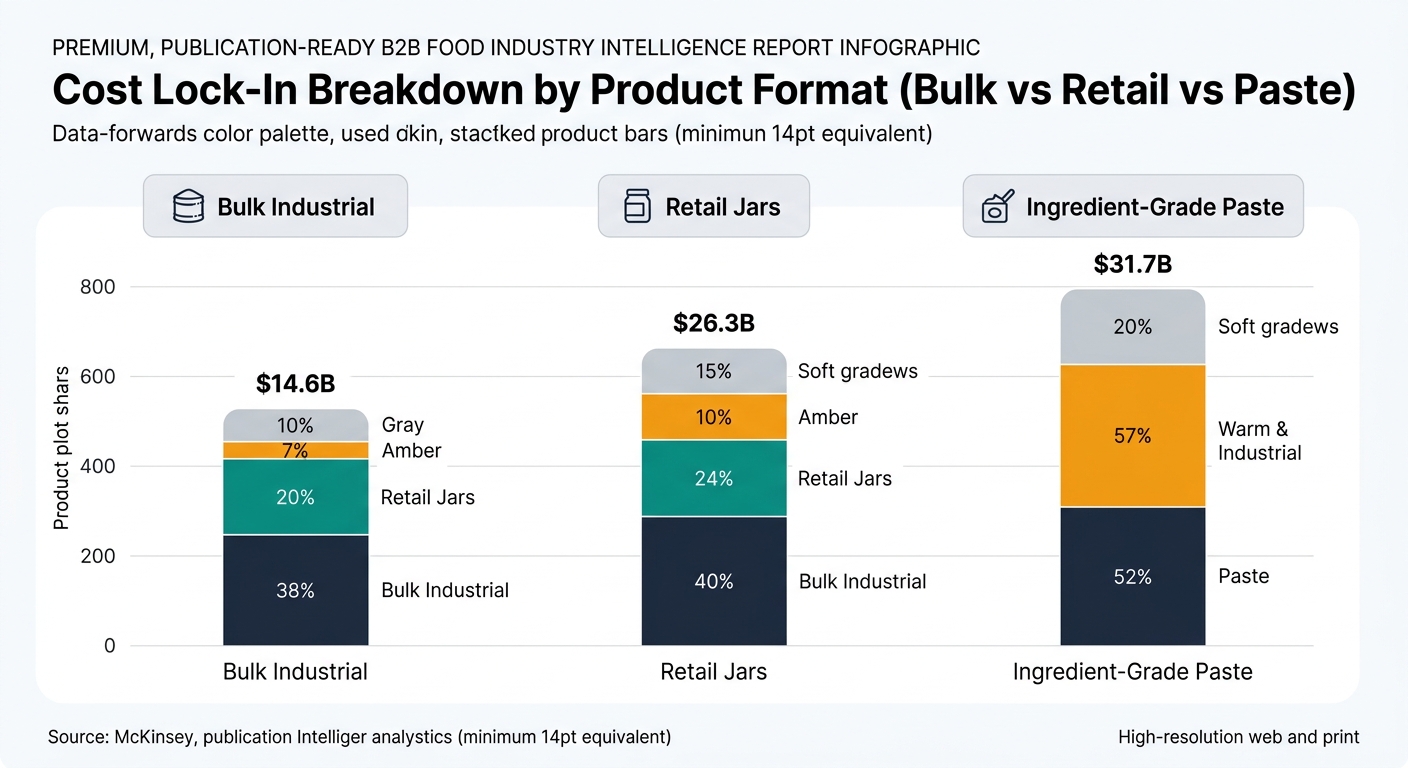
Three stacked bars (Bulk Industrial, Retail Jars, Ingredient-Grade Paste) using the article’s cost ratios. Segments: Raw Material; Primary Processing (sorting/grading/aflatoxin controls); Secondary Processing (roast/lethality + grinding/refining); Packaging & QA; Logistics & Distribution; Margin/Overhead (or Wholesale/Retail Margin for retail). Add annotations highlighting the biggest drivers: (1) Raw material dominance across all formats, (2) Packaging & QA step-change in retail jars, (3) Higher primary + refining sensitivity for paste. Include a small legend and keep it data-forward (no UI mockups).

Product-Level Cost Breakdown

A) Organic Pistachio Butter (Bulk Industrial: drums/pails)

Supply Chain Node Cost Ratio (% of Final Cost) Notes
Raw Material (organic pistachio kernels equivalent) 55% Kernel quality/yield dominates; defect removal increases effective cost/kg.
Primary Processing (shelling, sorting, grading, aflatoxin controls) 12% Optical sorting, yield loss, sampling/testing overhead.
Secondary Processing (roast/kill-step controls + grinding) 10% Energy + throughput + sanitation downtime; process validation overhead.
Packaging & QA 8% Drums/pails, liners, coding; COA/test release.
Logistics & Distribution 7% Inbound kernels + outbound bulk; heat exposure management.
Manufacturer Margin/Overhead 8% Plant overhead, compliance systems, working capital.

B) Organic Pistachio Butter (Retail jars)

Supply Chain Node Cost Ratio (% of Final Cost) Notes
Raw Material (organic pistachio kernels equivalent) 40% Still dominant, but diluted by packaging and channel margin.
Primary Processing (shelling, sorting, grading, aflatoxin controls) 10% Same physics as bulk; often tighter cosmetic/sensory expectations.
Secondary Processing (roast/kill-step controls + grinding) 8% Texture consistency and heat management matter for consumer experience.
Packaging & QA 17% Glass/plastic, lids, labels, case packs; more QC checks and coding.
Logistics & Distribution 10% Heavier freight per edible kg; more touchpoints.
Wholesale/Retail Margin 15% Channel structure adds a large fixed layer beyond manufacturing.

C) Organic Pistachio Paste (Ingredient-grade, often finer grind for confectionery/bakery)

Supply Chain Node Cost Ratio (% of Final Cost) Notes
Raw Material (organic kernels) 58% Color/greenness and flavor intensity can tighten kernel acceptance.
Primary Processing (sorting/grading) 14% Higher reject sensitivity if color/defects are tightly controlled.
Secondary Processing (refining/fine particle size) 12% More energy/time; tighter temperature control to protect color/aroma.
Packaging & QA 7% Typically bulk; still requires robust lot testing and traceability.
Logistics & Distribution 5% Lower packaging weight than retail; still heat-sensitive quality.
Manufacturer Margin/Overhead 4% Often lower channel complexity than retail jars.
Unlock Full Data
Organic Pistachio Butter Market Intelligence
Prices · Trends · Origins · Forecasts

3) Structural Facts You Can’t “Engineer Out” (Plan Specs Around Them)

Insight: Three structural constraints shape organic pistachio butter availability and conformance: (1) regulatory mycotoxin thresholds, (2) nut-butter Salmonella hazard expectations under preventive controls, and (3) organic chain-of-custody documentation.

Data (validated): FDA’s aflatoxin references for pistachios commonly center on 20 ppb total aflatoxins in U.S. enforcement context, while EU maximum levels are set in EU contaminants law and are commonly lower for pistachios (often cited around 8 µg/kg B1 and 10 µg/kg total, depending on use category). [1]

Procurement Impact: Your internal specs cannot be written in isolation; if you serve multiple markets, you inherit the strictest practical limit, which increases upstream cost via yield loss and QA intensity.

  • Reality #1 (Yield loss is the hidden “tax”): Pistachio butter economics are governed by how many kernels are removed during sorting to meet aflatoxin/defect/sensory targets.
  • Reality #2 (Validated controls are a cost center, not a checkbox): Preventive-controls hazard identification explicitly includes nut butters as a category where Salmonella is a key hazard consideration; credible suppliers must show validation/verification and strong prerequisite programs. [2]
  • Reality #3 (Organic integrity is lot-linked paperwork): NOP import-integrity guidance emphasizes lot/volume traceability and recognizes transaction certificates as part of the documentation set; missing lot linkage creates receiving delays even when product quality is fine. [3]

Key Insights (What to Remember When You Read Any Spec Sheet)

Insight: Organic pistachio butter is a short chain with long shadows: upstream kernel quality and regulatory thresholds dictate downstream cost, while process control dictates consistency.

Data (grounded): Public guidance and regulatory frameworks repeatedly reinforce two “hard” hazard themes for pistachio/nut-butter supply: aflatoxin compliance (with jurisdictional differences) and Salmonella as a hazard consideration in nut butters under preventive controls. [1]

Procurement Impact: If you want fewer nonconformances, the physical map tells you where to look: kernel acceptance/sorting (mycotoxins/defects), validated processing controls (pathogens), and packaging/heat exposure (oxidation and separation).

The Bottom Line for Your Next Contract

(Analyzed at: Aug, 2026)

Write the contract so market-destination limits drive your incoming spec and release rules: explicitly state whether lots must meet EU-style aflatoxin thresholds (often cited at ~8 µg/kg B1 and 10 µg/kg total for pistachios) versus the U.S. 20 ppb context, and require the supplier to show the sorting/testing system that makes that reliably achievable. This works because cost and compliance risk lock in at the sorting/grading + sampling/testing node, not at the grinder. With EU check intensity and border scrutiny having tightened in recent cycles for pistachio origins and products, teams that don’t align limits, methods, and documentation up front tend to pay for it in expedited re-tests, rejected lots, and schedule slips—often turning a “cheaper” supplier into a mid-single-digit percentage TCO penalty once holds and rework are counted. [5]

Unlock Full Data
Organic Pistachio Butter Market Intelligence
Prices · Trends · Origins · Forecasts

References

  1. fda.gov
  2. fda.gov
  3. downloads.regulations.gov
  4. ers.usda.gov
  5. food.ec.europa.eu
  6. law.cornell.edu

Related Contents

Subscribe
→
By subscribing you agree to with our Privacy Policy and provide consent to receive updates from our company.
Thank you! Your submission has been received!
Oops! Something went wrong while submitting the form.
Subscribe to receive the latest blog posts, updates, promotions, and announcements from Tridge.
