
Organic apple puree is a seasonal, conversion-driven ingredient: most volume is made in a short harvest window, then carried as aseptic (or frozen) inventory for the rest of the year. For Purchase—Quality, Safety, and Compliance (QSC), that structure matters because the biggest “cost” events are rarely commercial—they’re physical: yield loss, holds, rework, and traceability gaps that turn into downtime.
Organic apple puree is a harvest-built ingredient: most of the year’s physical volume is produced in a tight window, then carried forward as aseptic inventory. That means the supply chain is less like a continuous factory feed and more like a seasonal conversion system—apples in, stable drums/totes out—where capacity, yields, and quality controls at a few nodes lock in most of the eventual cost.
Insight: The chain is structurally simple (fruit → puree → aseptic pack → ship), but cost is structurally “front-loaded” into raw apples, yield losses, and aseptic/QA discipline.
Data (validated): In USDA AMS’s aseptic fruit purée procurement specification, apple is listed at 11.5 °Brix minimum for single-strength and pH 3.2–4.2; concentrate is listed at 31.5 °Brix ± 1.5 (with the same pH band). [1]
Procurement Impact: When you see downstream issues (color drift, viscosity variance, patulin risk, micro holds), they usually trace back to fruit condition, sorting intensity, and process/pack integrity—not “late-stage” fixes.

Insight: Organic apple puree cost is dominated by (1) raw fruit + yield, (2) plant throughput and downtime, and (3) aseptic packaging + QA controls; margin tends to be earned where operators can reliably hit spec and ship without holds.
Data (validated framing): USDA’s fruit purée procurement documents emphasize acceptance criteria (including analytical requirements like °Brix/pH and quality assurance provisions), which is consistent with the idea that rejects, holds, and rework are real cost multipliers rather than edge cases. [1]
Procurement Impact: Your landed-cost volatility often comes from physical constraints—fruit availability/grade-out, plant capacity, packaging materials, and logistics—so mapping cost by node is the fastest way to understand what can’t be “optimized away.”
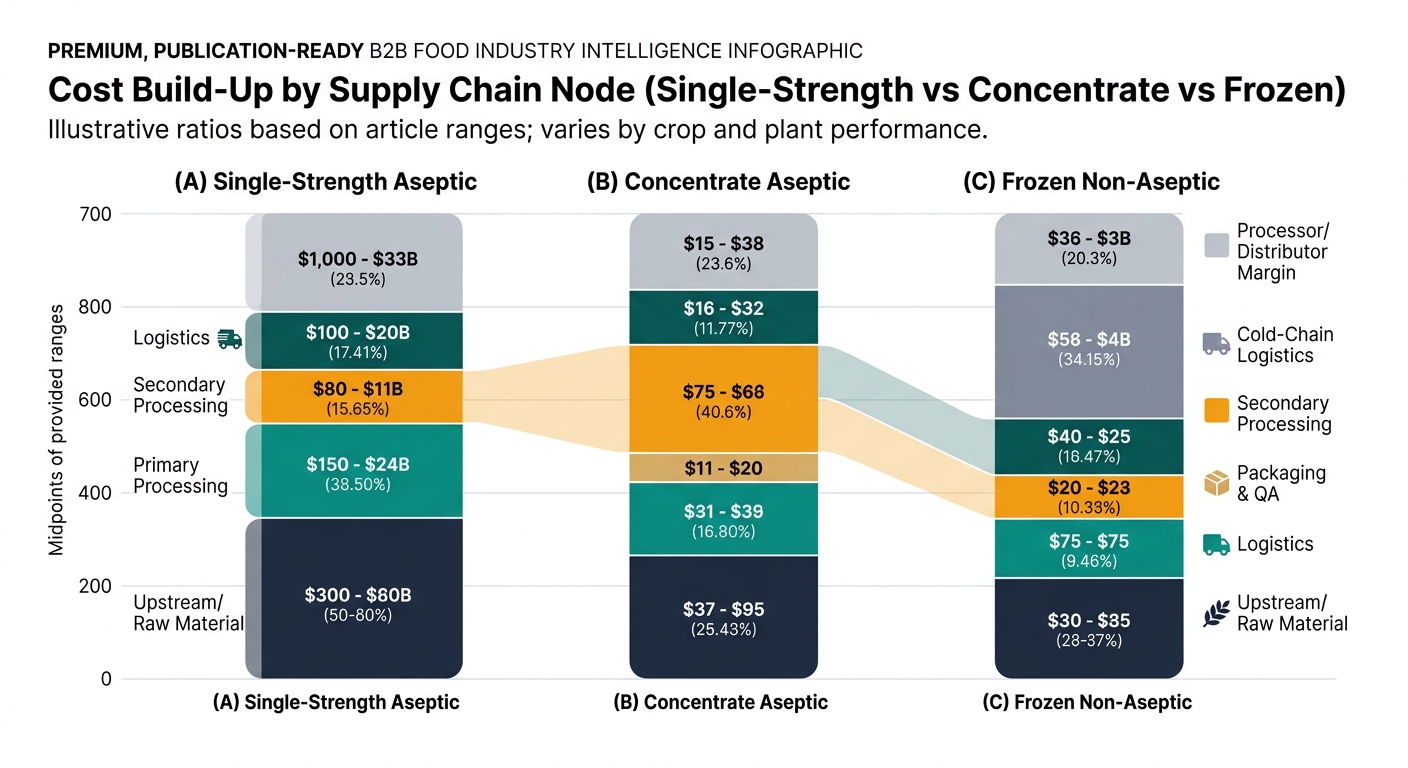
| Supply Chain Node | Cost Ratio (% of Final Cost) | Notes |
|---|---|---|
| Upstream / Raw Material (organic apples) | 40–55% | Dominated by crop yield, grade-out, and sorting waste. |
| Primary Processing | 12–18% | Wash/sort losses, water/effluent, sanitation, throughput downtime. |
| Secondary Processing | 6–10% | Standardization/blending; rework tanks and QA release cadence. |
| Packaging & QA | 10–16% | Aseptic bags/drums/totes + release testing and documentation. |
| Logistics & Distribution | 8–14% | Inland + ocean container + handling damage prevention. |
| Processor/Distributor Margin | 5–10% | Earned by spec reliability and low-hold performance. |
| Supply Chain Node | Cost Ratio (% of Final Cost) | Notes |
|---|---|---|
| Upstream / Raw Material (organic apples) | 30–45% | More solids per unit shipped, but still yield-sensitive. |
| Primary Processing | 10–16% | Similar front-end costs; sorting and sanitation remain critical. |
| Secondary Processing (concentration) | 15–25% | Evaporation energy, uptime, and fouling/downtime risk. |
| Packaging & QA | 8–14% | Aseptic integrity still required; concentrate is not “self-protecting.” |
| Logistics & Distribution | 6–12% | Lower water shipped can improve freight efficiency. |
| Processor/Distributor Margin | 5–10% | Higher technical complexity can justify margin when performance is consistent. |
| Supply Chain Node | Cost Ratio (% of Final Cost) | Notes |
|---|---|---|
| Upstream / Raw Material (organic apples) | 35–50% | Similar fruit dynamics; often different supplier set than aseptic. |
| Primary Processing | 12–18% | Similar conversion steps; freezing adds throughput constraints. |
| Secondary Processing | 6–10% | Standardization/blending still needed to hit Brix/pH/sensory. |
| Packaging & QA | 6–10% | Lower aseptic-material cost; still requires strong foreign-matter control. |
| Cold-Chain Logistics & Storage | 15–25% | Frozen warehousing, reefer transport, and temperature excursions. |
| Processor/Distributor Margin | 5–10% | Margin tied to service level and cold-chain reliability. |
Insight: Most downstream complaints (color browning, off-notes, viscosity swings) are consequences of fruit condition + oxygen exposure + heat history, not something that can be corrected after aseptic packing.
Data (validated as acceptance logic): Aseptic fruit purée specs include defined analytical targets (°Brix/pH) and quality assurance expectations; practically, that pushes control upstream into intake/sorting and process discipline rather than relying on end-of-line “fixes.” [1]
Procurement Impact: QSC reviews should treat fruit intake, sorting criteria, and oxygen/thermal controls as “critical-to-quality” controls on par with micro testing.
Insight: Apple products have an intrinsic mycotoxin exposure pathway (patulin) tied to moldy/damaged fruit; tighter end-market requirements amplify the cost of sorting and testing.
Data (validated): EU maximum levels include 25 μg/kg for solid apple products (including apple purée) for the final consumer, and 10 μg/kg for apple juice/solid apple products for infants and young children and for baby food. [2]
Procurement Impact: Patulin control is not “just a lab line item”—it drives physical decisions: incoming fruit rejection, trimming/sorting intensity, and lot segregation, all of which change yield and cost.
Insight: For imported organic ingredients, compliance is physically anchored in documentation continuity and segregation controls across handlers—not just farm certification.
Data (validated): For U.S. imports, after March 19, 2024, each shipment of organic agricultural products imported into the United States must be associated with an NOP Import Certificate issued via USDA’s Organic INTEGRITY system. [3]
Procurement Impact: Any break in lot identity (multi-origin blending without clear lot mapping, relabeling, or repacking) is a structural risk: it can force holds because the product’s “organic status” must be provable at shipment level.
(Analyzed at: Sep, 2026)
Write your next organic apple purée contract so it forces early truth during the harvest-build window: require lot-level traceability that ties each drum/tote back to defined intake lots and blending rules, and make aseptic pack integrity (sterile zone controls + seal/liner verification + defined storage temperature limits) a release condition—not a “supplier assurance” statement.
This works because 2026 supply tightness signals in Europe (WAPA/Prognosfruit pointing to a materially smaller EU apple crop) increases the temptation to blend wider and run lines harder, which is exactly when traceability and aseptic discipline fail quietly. [4] When those failures scale, the cost shows up as multi-lot holds and write-offs that can easily run into the high six figures for a mid-sized manufacturer—not because the purée was expensive, but because the lot was big and the proof chain was weak.


