INDUSTRY TRENDS

Onion Juice Supply Chain Map: Where Yield, Aseptic Integrity, and Energy Costs Lock In Total Cost and Risk

Author
Team Tridge
DATE
August 6, 2026
8 min read
onion-juice Cover
Unlock Full Data
Onion Juice Market Intelligence
Prices · Trends · Origins · Forecasts

This guide maps the onion-juice (and onion-juice concentrate) supply chain in the order it is physically built, so Purchase–Quality/Safety/Compliance teams can see where total cost and conformance risk become “structural” (yield loss, energy gates, and sterile-barrier dependence) before a drum ever arrives at receiving.

Executive Summary

  • Yield cascade is the cost engine: peel/trim + press yield + clarification loss + concentration losses compound; small losses upstream inflate $/kg solids downstream.
  • Evaporation is the fixed energy gate: removing water is inherently energy-intensive; vacuum systems reduce heat damage but don’t remove the energy reality. [1]
  • “Ambient-stable” is a sterile-barrier claim: aseptic bulk formats work only if the sterile pathway and packaging integrity hold through handling and transport. [2]
  • Bulk packaging/liners are part of food safety control: FDA guidance explicitly treats sanitary liners/closures and bulk container hygiene as control points for juice concentrates. [3]

1) How the Onion-Juice Chain Is Physically Built (and Where Costs “Harden”)

Insight

Onion juice is a high-water, high-variability agricultural input that becomes a shelf-stable industrial ingredient only after yield-heavy preprocessing, a validated lethality/hold step (and/or aseptic), and packaging integrity controls; most “unavoidable” costs are set by mass-loss (peel/trim + press cake), evaporation load (if concentrate), and packaging format (aseptic vs frozen vs chilled).

Data

Industrial supply typically flows as: processing-grade onions → washing/peeling/sizing → crushing/pressing (juice + press cake) → screening/clarification and stabilization (pasteurization/acidification and/or aseptic) → optional evaporation into concentrate (for many industrial juice concentrates, the 60–66°Brix class is common; onion concentrate specs vary by supplier and end use) → drums/totes with liners or aseptic bag-in-drum/tote → ambient or frozen distribution depending on format. Vacuum evaporation is widely used to reduce heat damage by lowering boiling temperature, but evaporation economics remain dominated by energy consumption (latent heat) and uptime. [1]

Procurement Impact

Your landed cost and conformance risk are structurally determined before product ever ships: (1) upstream onion quality and storage losses (rot/sprout/dehydration) drive extraction yield, (2) evaporation and residence time drive energy + flavor drift risk, and (3) aseptic integrity (bag, fitment, fill environment, and downstream handling) determines whether “ambient-stable” is real or only theoretical. [2]

A left-to-right (or top-to-bottom) supply chain flow showing the physical build order and where cost/risk “hardens.” Include labeled nodes: (1) Processing-grade onions + storage/sorting losses, (2) Washing/peeling/trim/sizing (foreign matter + mass loss), (3) Crushing/pressing (juice + press cake split) + screening/clarification, (4) Stabilization (pasteurization and/or aseptic system) with sterile pathway callout, (5) Optional vacuum evaporation to concentrate (~60–66°Brix class) with energy gate callout, (6) Bulk packaging formats (drum/tote; liners; aseptic bag-in-drum/tote) and distribution modes (ambient aseptic vs frozen/chilled). Add three prominent callouts anchored to the correct steps: “Yield Cascade” (mass-loss compounding), “Evaporation Energy Gate” (water removal), and “Sterile-Barrier Integrity” (ambient-stable depends on packaging + handling).

2) Where Value Accumulates: Cost & Margin by Node (Physical + Fixed Drivers)

Insight

Onion-juice economics behave like a “yield cascade”: every loss before concentration multiplies downstream because you’re paying to process, stabilize, and package only what you successfully recover.
1. Upstream / Raw Material (Processing-Grade Onions + Storage)

  • Insight: The chain starts with bulky, low-value, high-variance biomass; the biggest hidden cost is not farmgate price but usable solids delivered to the press after storage and sorting.
  • Data: Onions are seasonal; storage extends availability but increases loss risk (sprouting, rot, dehydration) and changes water/solids balance, which affects juice yield and flavor intensity. Processors often site near growing regions to avoid hauling water weight.
  • Procurement Impact: Expect “same spec, different crop” behavior: solids/yield variability at this node is what later shows up as Brix drift, sensory drift, and inconsistent concentrate yield—long before any QA test on finished drums can explain it.

2. Primary Processing (Wash/Peel/Trim/Size Reduction)

  • Insight: This is the foreign-matter and defect-removal choke point; it is also where mass-loss becomes irreversible (peel/trim waste) and where labor/water/waste handling scale costs.
  • Data: Typical operations include aggressive washing (soil/stones), peeling, trimming, and chopping/crushing into mash. Waste fraction is structurally high because outer layers and damaged tissue must be removed to protect downstream micro load and off-notes.
  • Procurement Impact: Plants with constrained peeling capacity or weak foreign-matter controls pay more later (fouling, filtration load, higher micro burden, more rework). This node is also where “odor + wastewater” constraints can cap throughput (a physical, not commercial, limit).

3. Secondary Processing (Pressing/Extraction + Screening/Clarification)

  • Insight: Pressing converts onions into two value streams—juice and press cake—and sets the single most important technical KPI: recoverable juice solids per ton of onion.
  • Data: Mechanical extraction is followed by screening/finishing; optional enzymatic aids may be used to improve yield/clarity (process-dependent). Clarification/turbidity targets vary by end use (clear juice concentrate vs more turbid “culinary base”).
  • Procurement Impact: When yield drops (watery crop, storage dehydration, rot trimming), cost per kg solids rises nonlinearly because utilities, labor, and sanitation are largely time-based while output shrinks.

4. Stabilization (Validated Kill Step and/or Aseptic Processing)

  • Insight: Onion juice is micro-supportive if untreated; shelf stability is a function of process lethality + post-process protection, not “it’s concentrated so it’s safe.”
  • Data: Industrial juice supply commonly relies on pasteurization and/or aseptic processing; aseptic systems depend on sterile product path, sterilized packaging, and controlled fill. FDA’s aseptic processing guidance emphasizes that loss of sterile-barrier integrity (e.g., filter integrity in some systems) is a process deviation that can call commercial sterility into question. [2]
  • Procurement Impact: Format choice hard-sets your verification burden: aseptic requires confidence in sterilization validation and packaging integrity; non-aseptic requires cold/frozen control and tighter shelf-life management.

5. Concentration (Vacuum Evaporation to Onion Juice Concentrate)

  • Insight: Concentration is the energy-and-time node: you are paying to remove water without cooking off onion character, while also managing fouling and viscosity limits.
  • Data: Juice concentration is typically performed in evaporators; vacuum evaporation reduces boiling temperature and can reduce heat damage, but economics are still driven by energy consumption and quality loss risk. [1]
  • Procurement Impact: This is where “cost per kg solids” is most sensitive to utilities and uptime: fouling/CIP frequency, evaporator efficiency, and run length directly translate into conversion cost and lot-to-lot flavor/color drift.

6. Packaging, QA Release, and Distribution (Drums/Totes; Ambient vs Frozen)

  • Insight: For industrial onion juice/concentrate, packaging is not a commodity add-on—it is a functional control point that protects against oxygen ingress, contamination, and handling damage.
  • Data: Common bulk formats include drums and totes with liners; aseptic bag-in-drum/bag-in-box is widely used for juices and concentrates, and industry bodies describe aseptic bags as intended for room-temperature storage/distribution when used with aseptically processed product. FDA’s bulk-transport guidance for juice concentrates explicitly discusses single-use sanitary liners/closures and the need for liner integrity to prevent product contact with the outer container. [3]
  • Procurement Impact: Packaging integrity failures show up as swelling, fermentation notes, mold/yeast excursions, or oxidized flavor—often late (at receiving or in production). Distribution mode (ambient aseptic vs frozen) structurally changes freight density, storage cost, and risk of temperature abuse.

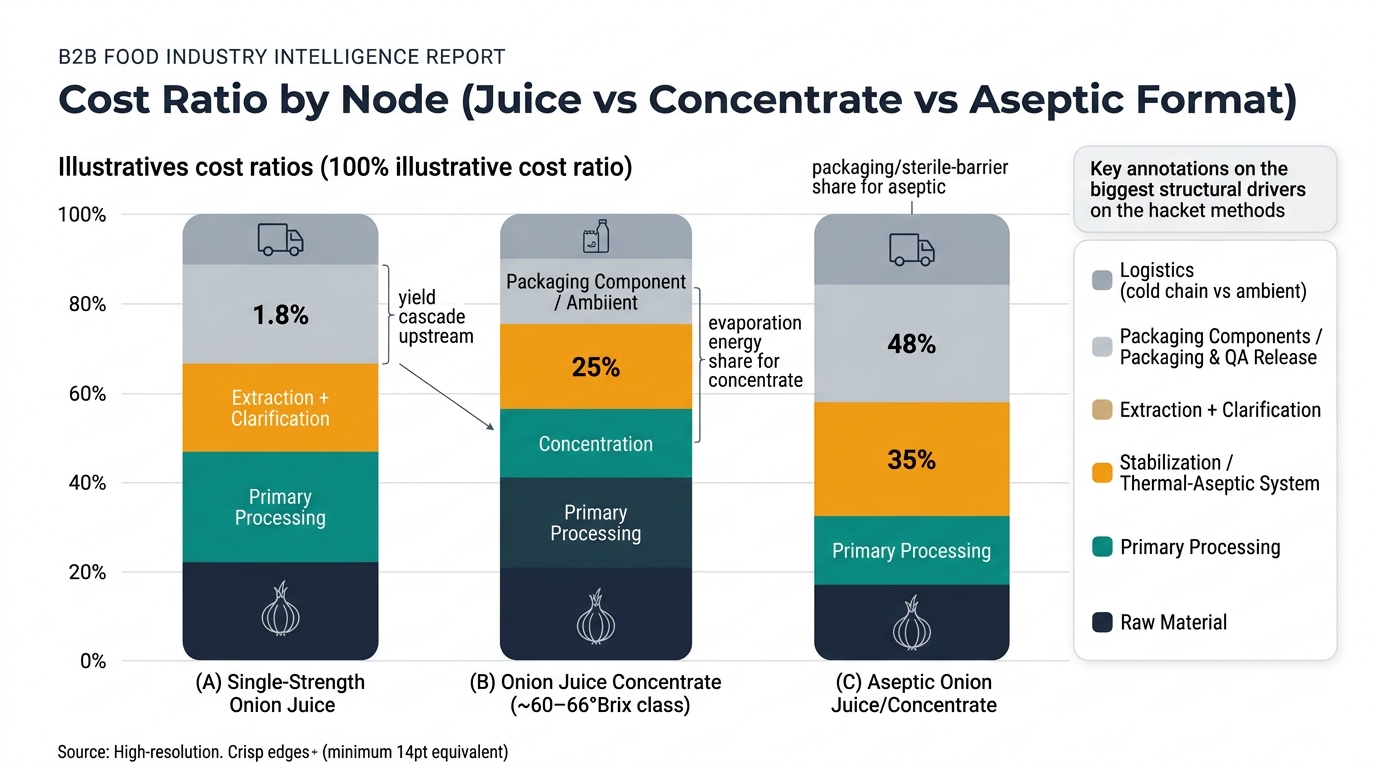
Product-Level Cost Breakdown (Illustrative Ratios)

A comparative chart visualizing the illustrative cost ratios across the three product formats presented in the article: (A) Single-Strength Onion Juice, (B) Onion Juice Concentrate (~60–66°Brix class), (C) Aseptic Onion Juice/Concentrate. Use either three 100% stacked bars or grouped bars by node. Nodes should match the tables: Raw Material; Primary Processing; Extraction + Clarification; Stabilization / Thermal-Aseptic System; Concentration (for concentrate); Packaging Components / Packaging & QA Release; Logistics (cold chain vs ambient). Include clear legend and short annotations on the biggest structural drivers: yield cascade upstream, evaporation energy share for concentrate, and packaging/sterile-barrier share for aseptic.

Note: Ratios are structural/typical for industrial ingredients and will vary by origin, energy cost, packaging format, and spec tightness; use them as a map of where cost is physically “spent,” not as a quote.

A) Single-Strength Onion Juice (Chilled or Short Ambient)

Supply Chain Node Cost Ratio (% of Final Cost) Notes
Raw Material (onions) 35% High water content makes inbound tonnage large; quality/sort losses matter.
Primary Processing 15% Washing/peeling/trim + wastewater/odor controls; labor scales with throughput.
Extraction + Clarification 15% Press yield + filtration/finisher losses drive cost per liter.
Stabilization (pasteurization) 10% Kill step + CIP; shelf-life depends on post-process hygiene.
Packaging & QA Release 10% Drums/totes, liners, COA testing, lot identity controls.
Logistics & Cold Chain 15% Chilled handling increases storage and transport cost; temperature excursions are costly.

B) Onion Juice Concentrate (Clear, ~60–66°Brix Class)

Supply Chain Node Cost Ratio (% of Final Cost) Notes
Raw Material (onions) 30% Solids delivered to the press is the true driver; storage losses amplify cost.
Primary Processing 12% Peel/trim waste + water + waste handling; foreign-matter control protects evaporators.
Extraction + Clarification 13% Yield and finisher losses cascade into higher evaporation cost per kg solids.
Concentration (vacuum evaporation) 20% Energy-intensive; fouling/CIP and residence time affect flavor/color. [1]
Packaging & QA Release (often aseptic) 10% Aseptic bags/fitments, sterile fill controls, COA release. [3]
Logistics & Distribution 15% Concentrate improves freight efficiency per unit solids; ambient possible if truly aseptic.

C) Aseptic Onion Juice/Concentrate (Bag-in-Drum or Bag-in-Tote)

Supply Chain Node Cost Ratio (% of Final Cost) Notes
Raw Material + Primary Processing 40% Same yield and mass-loss fundamentals as above; sets baseline cost.
Thermal/Aseptic Sterilization System 18% Sterilization validation, sterile product path, and downtime risk. [2]
Packaging Components 12% High-barrier aseptic bags, fitments, drum/tote handling; integrity is a control point. [4]
QA Release & Traceability 8% Lot coding, retention samples, micro release, documentation.
Logistics & Storage (ambient) 22% Lower cold-chain cost but higher handling discipline; damage/demurrage can be material.
Sourcing Window Radar
Onion Juice — Global Harvest Calendar
CHINA SEASON ACTIVE
🇨🇳 China
JAN — NOV
🇫🇷 France
JAN — DEC
🇪🇸 Spain
JAN — OCT
🇲🇽 Mexico
OCT — DEC
🇩🇪 Germany
DEC — DEC
JanFebMarAprMayJunJulAugSepOctNovDec

3) Structural Facts You Can’t “Engineer Away” (Plan Around Them)

Insight

Onion juice looks like a simple ingredient, but three structural constraints repeatedly dictate availability, conformance, and cost—regardless of supplier.

Data

  • Reality 1 — Yield is a compounding lever: Peel/trim loss + press yield + clarification loss + concentration losses stack; losing 1–2% at each step can translate into a large cost-per-solids increase by the time you reach concentrate.
  • Reality 2 — Evaporation is the fixed energy gate: Concentration requires evaporating water; even with vacuum systems designed to protect flavor, the process remains energy- and uptime-dependent. [1]
  • Reality 3 — “Ambient stable” depends on packaging integrity, not intent: Aseptic systems only work if the sterile barrier holds from filler to customer; liner/closure integrity and handling discipline are part of the control system, not just logistics. [3]

Procurement Impact

When you see repeated Brix drift, yeast/mold excursions, or shortened shelf-life, the root cause is often structural (crop solids, evaporation residence time, aseptic barrier handling) rather than “one bad lot.”

Key Insights (What to Remember Before You Look at Any Supplier List)

Onion juice is a solids business disguised as a liquid business.

Data: Most cost is driven by how many recoverable solids survive: storage/sorting → peeling/trim → press yield → clarification loss → evaporation efficiency.

Procurement Impact: If you don’t map where solids are lost, you can’t interpret why two “same Brix” concentrates behave differently in flavor, color, and micro stability.

Packaging format is a primary technical spec.

Data: Aseptic bulk formats (e.g., bag-in-drum/tote with sanitary liners/closures) are commonly used for juices and concentrates; integrity and sterile fill/transfer discipline are prerequisites for ambient distribution. [3]

Procurement Impact: Treat packaging and handling requirements as part of the product definition, because they determine shelf-life, claims risk, and receiving inspection needs.

Evaporation is where cost and quality trade off physically.

Data: Vacuum evaporation is used to reduce heat damage versus atmospheric boiling, but it is still energy-intensive and sensitive to fouling and residence time. [1]

Procurement Impact: Expect concentrate consistency to correlate with evaporator control, CIP discipline, and run stability—variables that don’t show up on a one-page COA.

4) The Bottom Line for Your Next Contract

(Analyzed at: Aug, 2026)

The highest-leverage move is to contractually lock your “format + sanitary barrier” as a controlled requirement: specify aseptic vs non-aseptic, the exact bulk pack (drum/tote), and liner/closure expectations—and treat any change as a QA-governed change control event. FDA’s bulk-transport guidance makes clear that sanitary liners/closures and their integrity are not optional details in juice concentrate logistics; they are part of how you prevent contamination during bulk handling. [3] With U.S. food manufacturing remaining energy-sensitive (evaporation-heavy products feel this disproportionately), late-discovered barrier failures can easily turn into expedited replacement freight, production downtime, and disposal that costs more than the original price delta you negotiated. [5]

Onion JuiceSupply Chain Intelligence
134 countries tracked
10
Exporters
10
Importers
$727M
Top Export Value
Top Exporters (2024)
🇹🇭
Thailand
$727M
🇳🇱
Netherlands
$293M
🇵🇱
Poland
$244M
🇹🇷
Turkey
$193M
🇵🇭
Philippines
$165M
+129 more
Top Buyers
🇺🇸 United States $1.11B🇳🇱 Netherlands $246M🇩🇪 Germany $193M🇯🇵 Japan $147M🇬🇧 United Kingdom $102M

References

  1. sciencedirect.com
  2. fda.gov
  3. fda.gov
  4. aseptic-packaging.org
  5. energy.gov

Related Contents

Subscribe
→
By subscribing you agree to with our Privacy Policy and provide consent to receive updates from our company.
Thank you! Your submission has been received!
Oops! Something went wrong while submitting the form.
Subscribe to receive the latest blog posts, updates, promotions, and announcements from Tridge.
