INDUSTRY TRENDS

Olive Oil Sourcing for Procurement Leaders: Where Cost, Quality, and Risk Actually Form (and How to Buy with Control)

Author
Team Tridge
DATE
March 13, 2026
9 min read
Olive Oil Cover
Tridge Eye Data Intelligence Solution

This report is powered by Tridge Eye Data Intelligence.

Every data point, price signal, and supply risk insight in this analysis comes from the same platform that procurement and sourcing leaders worldwide rely on daily. As you read, consider what this level of market intelligence could do for your sourcing decisions.

Explore Tridge Eye →

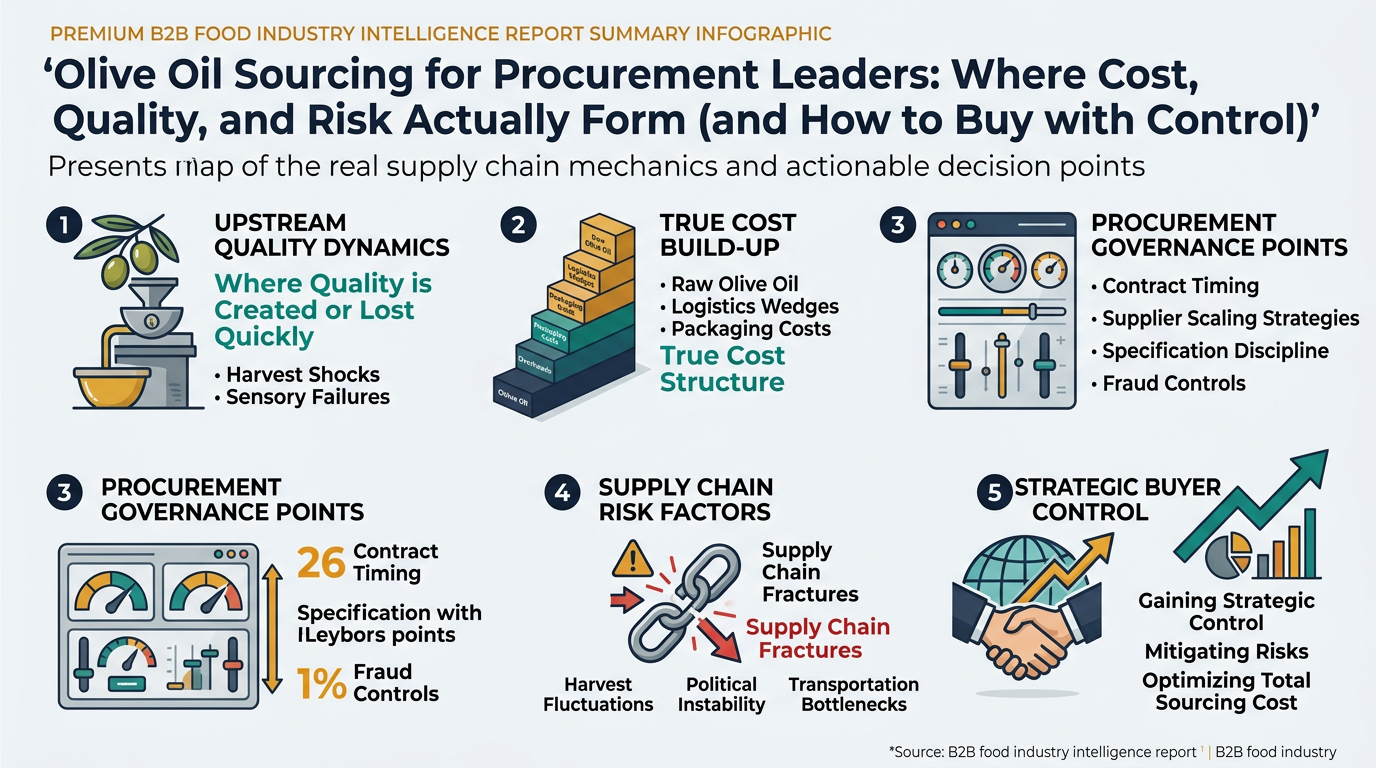
Olive oil is often treated like a commodity line item—until a harvest shock, a sensory failure, or an “unusually cheap” offer forces a fire-drill. This guide maps the real supply chain mechanics (where quality is created and lost), the true cost build-up (including packaging and logistics wedges), and the decision points procurement leaders can govern: contract timing, supplier scaling, spec discipline, and fraud controls.

Executive Summary

  • Two “centers of gravity” drive outcomes: upstream groves/mills create or destroy quality quickly; downstream blenders/bottlers standardize specs and execute most contracts.
  • EVOO is gated by chemistry and sensory: USDA grade language defines Extra Virgin as median of defects = 0 and median fruitiness > 0, with FFA ≤ 0.8%. [1]
  • Stricter programs exist: COOC certification (California) includes sensory requirements and tighter chemical limits such as peroxide value ≤ 15 and FFA ≤ 0.5%. [2]
  • Budget surprises are structural: olive oil is produced seasonally but consumed continuously; price discovery clusters around harvest outlook and stock levels.
  • Delivered cost often disconnects from headline “EVOO price”: packaging (especially glass), freight, inventory carrying cost, and quality downgrade risk can outweigh origin price moves.
  • Actionable governance beats “better negotiating”: set market-band guardrails, define downgrade/acceptance terms, tier suppliers by authenticity risk, and pre-qualify alternates before allocation hits.

Key Insights

(Analyzed at: Mar, 2026)

Olive Oil Infographic
  • Strategy: Hold
  • Reliability: Medium
  • Potential Saving: 6% ~ 12%
  • Insight: EU market commentary in early 2026 points to downward pressure on prices after two very tight seasons (2022–2024) that were driven by drought and low stocks. [3] For procurement teams, this is typically a “Hold” window: avoid over-locking 12-month coverage at today’s levels unless you have continuity risk (single-origin exposure, limited tank space, or high service penalties). Instead, target a layered coverage plan (e.g., 60–75% term, 25–40% indexed/spot) and use stricter quality release + downgrade clauses to prevent paying EVOO economics for lots that later fail sensory/oxidation.

1) What You’re Actually Buying: The Real Olive Oil Supply Chain (Ground Truth)

Olive oil procurement looks like a simple commodity buy until you map how value (and risk) is created.

A practical way to think about the flow is that olive oil has two different “centers of gravity”:

  • Upstream (groves + mills): where quality is created or lost quickly (fruit condition, time-to-mill, milling hygiene, early storage).
  • Downstream (refiners + blenders + bottlers): where specs are standardized (blends, sensory profile targets, label claims, packaging formats) and where most procurement contracts are executed.
A simplified end-to-end flow diagram with two visually distinct zones: (1) Upstream quality-creation zone (Groves/Harvest → Mills/Crushing & Malaxation → Filtration/Settling → Tank Storage) with callouts for key quality-loss points (time-to-mill delay, oxygen exposure, warm storage, poor filtration/hygiene) and outcomes (EVOO/Virgin/Lampante). (2) Downstream standardization zone (Refining → Blending → Bottling/Packing → Import/Distribution) with callouts for spec standardization, blending to sensory targets, and where contracts typically execute. Use icons for each node and a bold divider labeled 'Centers of Gravity'. Avoid any dashboard/UI visuals.

The physical flow (simplified)

  1. Groves (olives grown and harvested)
  2. Mills (crushing → malaxation → separation; filtration/settling; storage in tanks)
  3. Grading & categorization (EVOO/virgin/lampante)
  4. Refining (lampante → refined olive oil)
  5. Blending + bottling/packing (bulk to flexitanks/IBCs; retail packs; foodservice packs)
  6. Import/distribution → retail/foodservice/industrial users

Why this matters to procurement

  • Harvest is seasonal; buying is year-round. Most Northern Hemisphere supply is produced in a narrow harvest window (roughly late-year through winter), then stored and drawn down across the year.
  • Quality risk is not linear. A “small” handling mistake (delayed milling, oxygen exposure, warm storage, poor filtration discipline) can downgrade lots and change sensory outcomes—often discovered after contracting.
  • The category you buy determines the economics. EVOO is constrained by both chemical limits and sensory panel outcomes; refined/blends are more flexible and typically more stable.

2) Where the Money Goes: Cost & Margin Build-Up by Supply Chain Node

Key insight: Olive oil cost is driven by a combination of agricultural yield (kg oil per kg olives), grade outcomes (EVOO vs virgin vs lampante), and downstream standardization (refining/blending/packing). Procurement teams often over-focus on “per kg price” and under-model downgrade risk, storage losses, and packaging/logistics cost share.

2.1 Upstream / Raw Material (Groves & Harvest)

What’s distinctive here

  • Oil yield is variable by cultivar, weather, and harvest timing; alternate bearing and drought/heat can shift availability materially.
  • Harvest method (hand vs mechanical) changes cost structure and can influence fruit damage/oxidation risk.

Primary cost drivers

  • Labor (harvest) and orchard operations (irrigation/water, energy for pumping, fertilizers)
  • Yield variability (one of the biggest “hidden” cost drivers)
  • Farm-to-mill logistics and timing discipline

2.2 Primary Processing (Milling + Immediate Storage)

What’s distinctive here

  • Time-to-mill and process control heavily influence free fatty acids and defect development.
  • Early storage under inert gas and temperature control protects shelf-life; filtration vs settling decisions can change stability.

Primary cost drivers

  • Mill throughput constraints during peak harvest
  • Energy and labor
  • Filtration/handling and storage (stainless tanks, nitrogen blanketing)
  • Quality sorting losses (downgrades from EVOO to virgin/lampante)

2.3 Secondary Processing (Refining + Industrial Blending)

What’s distinctive here

  • Refining converts lampante (defective virgin oil) into neutral refined oil; this is where supply “flexibility” enters the system.
  • Blending is a core industrial capability: it standardizes sensory profile, chemical specs, and cost.

Primary cost drivers

  • Refining energy/chemicals and yield losses
  • Blending operations and QA release testing
  • Working capital (holding inventory to blend consistently across the year)

2.4 Packaging & Quality Assurance (Where Many Buyers Underestimate Cost Share)

What’s distinctive here

  • For retail formats, packaging can rival or exceed the upstream processing cost share.
  • QA is not just paperwork: EVOO classification is commonly tied to chemistry + sensory outcomes under recognized standards.
  • Some programs are intentionally stricter than baseline international norms. For example, COOC certification requires sensory evaluation and includes tighter chemical limits such as PV ≤ 15 and FFA ≤ 0.5%. [2]

Primary cost drivers

  • Glass/PET/tin, closures, labels, cartons, pallets
  • Lab testing (chemistry + authenticity screens where required)
  • Sensory panel costs for EVOO release (where used)

2.5 Logistics & Distribution (Bulk vs Packaged Changes Everything)

What’s distinctive here

  • Bulk shipments (flexitanks/IBCs/drums) are cost-efficient but expose quality to temperature/oxygen handling risk.
  • Packaged shipments raise freight per kg and damage risk.

Primary cost drivers

  • Ocean freight + inland trucking
  • Insurance, port fees, warehousing
  • Inventory carrying costs (olive oil is high value; holding cost matters)

2.6 End Markets (Importer/Distributor/Retail Margin Stack)

What’s distinctive here

  • Margin stack depends on channel (industrial vs foodservice vs retail) and brand strategy.
  • Promotional calendars in retail can delay pass-through of upstream price moves.

Primary cost drivers

  • Distributor margin, retail markup
  • Trade spend and compliance labeling overhead

Product-level cost breakdown (illustrative, normalized to 100% delivered cost)

A 3-bar stacked chart (one bar per product form) normalized to 100% delivered cost: (A) Bulk EVOO to bottler, (B) Retail bottled EVOO (glass) to U.S. DC, (C) Refined olive oil blend in foodservice format. Each bar segmented by the same nodes: Groves & Harvest, Milling & Early Storage, Refining/Blending, Packaging & QA, Logistics & Distribution, Margin Stack (Importer/Broker or Wholesale/Retail). Uses the exact ratios shown in the article tables and includes annotations highlighting that packaging share spikes in retail glass and refining/blending share spikes in refined blends.

These ratios are directional to show where cost concentrates by product form. Actual splits vary by origin, pack, lane, and market conditions.

A) Bulk Extra Virgin Olive Oil (EVOO) delivered to a bottler (flexitank/IBC)

Supply Chain Node Cost Ratio (% of Final Cost) What moves it most
Groves & harvest 50% Yield, labor, drought/heat
Milling & early storage 15% Throughput constraints, downgrade risk
Refining/blending 5% Usually minimal for true EVOO lots
Packaging & QA 5% Chemistry + sensory release (where required)
Logistics & distribution 15% Freight, insurance, inventory time
Importer/broker margin 10% Market tightness, service level

B) Retail Bottled EVOO (glass), delivered to U.S. DC

Supply Chain Node Cost Ratio (% of Final Cost) What moves it most
Groves & harvest 35% Farmgate price, yield
Milling & early storage 10% Quality sorting, storage discipline
Refining/blending 5% Blending to profile (if multi-origin)
Packaging & QA 20% Glass, closures, labels, QA
Logistics & distribution 15% Packaged freight + warehousing
Wholesale/retail margin stack 15% Channel power, promo intensity

C) Refined Olive Oil Blend (“Olive Oil” = refined + virgin), delivered in foodservice format

Supply Chain Node Cost Ratio (% of Final Cost) What moves it most
Groves & harvest 25% Lampante availability, harvest size
Milling & early storage 10% Feedstock quality
Refining/blending 20% Refining costs, blend ratios
Packaging & QA 10% Large-format packaging
Logistics & distribution 15% Weight/volume efficiency
Wholesale margin 20% Service, credit terms

3) The Structural Fact That Explains Most Budget Surprises

Olive oil is priced like an annual crop but consumed like a continuous input.

That mismatch creates predictable dynamics:

  • Price discovery clusters around harvest assessments. When production outlook shifts, bulk prices can re-rate quickly.
  • Inventory becomes a strategic weapon. Large bottlers/blenders with storage and financing can smooth supply and capture timing advantages.
  • Your contract timing matters as much as your negotiation skill. The same supplier can be “expensive” or “cheap” depending on where you are in the post-harvest drawdown.

Recent years highlighted this: drought-driven shortfalls pushed prices to record levels, with Spain frequently acting as a reference market for global pricing. [4]

4) The Critical Insight: Why “EVOO Price” and “Your Delivered Cost” Often Disconnect

Procurement teams frequently expect a clean pass-through from “origin price” to delivered cost. In olive oil, several wedges break that assumption:

  1. Grade and compliance gating (EVOO is not just chemistry; it’s sensory).
  2. USDA grade language defines Extra Virgin as virgin olive oil with median defects = 0 and median fruitiness > 0, and FFA ≤ 0.8%. [1]
  3. Downgrade risk behaves like an embedded option.
  4. If a lot misses sensory or oxidation thresholds later, it may be reclassified (or blended away), changing the economics after you “thought” you bought EVOO.
  5. Packaging and channel can dominate the variance.
  6. A 5–10% move in glass or packaged freight can matter as much as a headline move in bulk oil.
  7. Label claims and standards are not uniform across markets.
  8. In the U.S., USDA grade standards exist (widely referenced in trade), and industry/state programs can be stricter (e.g., COOC). [1] [2]
  9. Blending power changes price transmission.
  10. Large industrial blenders can manage cost and sensory targets by multi-origin blending—something single-origin programs cannot do without compromising claims.

5) Where Procurement Teams Typically Get This Wrong (and Why It’s Rational)

These are common errors when a team is strong in procurement but newer to olive oil:

  • Treating EVOO like a uniform commodity.
  • Reality: EVOO is a quality-graded product with meaningful lot-to-lot variability.
  • Over-indexing on acidity alone.
  • Acidity is one indicator; oxidation metrics (peroxide, UV absorbance) and sensory outcomes drive real performance and claims risk.
  • Using “lowest quote wins” logic without authenticity safeguards.
  • Olive oil has long-standing mislabeling/adulteration incentives; unusually low prices relative to market bands should trigger verification workflows.
  • Waiting until a disruption to qualify alternates.
  • By the time allocation hits, mills and bottlers often have already committed volumes.
  • Not separating decisions by product form.
  • Bulk EVOO for bottling, refined blends for foodservice, and premium single-origin retail should not share the same sourcing playbook.

6) How an Intelligence-Driven Service Changes the Outcome (Decision-First, Not Feature-First)

Below is how procurement decisions improve when intelligence is tied to governance and operational triggers.

Decision A: “Should we lock volume now or stay spot?”

What changes with intelligence

  • Price intelligence by origin/spec sets negotiation guardrails (what is an outlier vs market band).
  • Scenario planning ties harvest/yield signals and logistics constraints to budget ranges and recommended spot/term mix.

Operational output

  • A 3-scenario buy plan (base/best/worst) with explicit triggers:
  • Lock additional coverage if origin benchmark breaks above X for Y weeks.
  • Shift pack formats or blend strategy if lead times exceed Z.

Decision B: “Which suppliers are safe to scale?”

What changes with intelligence

  • Supplier benchmarking and scorecards quantify:
  • OTIF, lead-time variance, claims/returns, spec pass rates.
  • Quality risk intelligence links storage/handling practices to outcomes (e.g., oxidation-related failures).

Operational output

  • A ranked supplier slate with “scale limits” by risk tier (e.g., no single supplier >30% unless dual-qualified backup exists).

Decision C: “How do we reduce fraud/authenticity exposure without slowing procurement?”

What changes with intelligence

  • Fraud risk monitoring flags abnormal price offers, opaque traceability, frequent origin/blend changes.
  • Governance workflows enforce exception approvals and testing requirements for high-risk buys.

Operational output

  • A risk-tiered QA/testing plan:
  • Tier 1 suppliers: routine chemistry + periodic authenticity screens.
  • Tier 2/3 suppliers: increased lot testing + tighter documentation requirements + shorter contract terms.

7) Strategic Use Cases Procurement Leaders Can Apply Immediately

  1. Cost volatility reduction without quality drift
  2. Build should-cost ranges by origin and grade; set “walk-away” thresholds.
  3. Resilient portfolio design across origins and harvest calendars
  4. Pre-qualify alternates in at least two supplying regions; define switching triggers.
  5. Spec management that protects supply continuity
  6. Identify which spec parameters are brand-critical vs negotiable (e.g., packaging, sensory profile tightness).
  7. Contracting playbooks by product form
  8. EVOO: more emphasis on QA release terms, sensory acceptance, storage/handling clauses.
  9. Refined blends: more emphasis on indexation, blend flexibility, service levels.
  10. Executive-ready governance and auditability
  11. Document why a supplier was chosen, what risks were accepted, and what mitigations were applied.

8) Why This Matters Beyond Olive Oil (Examples from Adjacent Categories You Likely Buy)

Olive oil is a clear example of a broader pattern: when quality is graded and supply is seasonal, “price-only sourcing” creates hidden cost.

Comparable categories procurement teams often manage:

  • Cocoa / chocolate inputs: harvest concentration + quality grading + geopolitical/climate risk; price spikes propagate with lags.
  • Coffee: quality segmentation, lot variability, and strong origin concentration effects.
  • Dairy powders/butter: seasonal milk curves, inventory behavior, and spec-driven substitution.
  • Juice concentrates (e.g., orange): weather shocks and disease pressure drive supply and quality variability.

The transferable lesson: decision intelligence is most valuable where your biggest losses come from uncertainty—quality failures, allocation, and poorly timed contracting—not from negotiation mechanics alone.

9) Why This Olive Oil Example Is a Powerful Proof Point for Procurement Teams

Olive oil forces clarity on three procurement fundamentals:

  • You must manage a portfolio, not a supplier. Origin concentration and harvest volatility punish single-source strategies.
  • You must govern quality as a commercial variable. EVOO is defined by measurable chemistry and sensory outcomes; acceptance criteria must be contractually and operationally enforced. [1]
  • You must time the market with discipline. The harvest-driven price discovery cycle makes contract timing a first-order driver of total cost.

Data needed to tailor this into a decision memo for your organization

  • Product forms (bulk vs retail pack; EVOO vs virgin vs refined blend)
  • Target specs (acidity, peroxide, K232/K270, sensory requirements, shelf-life)
  • Annual volume by lane (origin → destination), pack formats, and storage constraints
  • Current supplier performance (OTIF, claims, spec pass rate) and QA testing regime
  • Contract coverage profile (spot vs term %, pricing mechanism, reopener clauses)
Tridge Eye Data Intelligence Solution

Make Faster, Data-Driven Sourcing Decisions

The insights in this report are just the starting point. Tridge Eye is the data intelligence solution that gives procurement and sourcing leaders real-time market signals, price benchmarks, and supply risk alerts — so you can act before the market moves.
Explore Tridge Eye →

References

  1. ams.usda.gov
  2. cooc.com
  3. euronews.com
  4. cnbc.com
Subscribe
By subscribing you agree to with our Privacy Policy and provide consent to receive updates from our company.
Thank you! Your submission has been received!
Oops! Something went wrong while submitting the form.
Subscribe to receive the latest blog posts, updates, promotions, and announcements from Tridge.