
INDUSTRY TRENDS

Negotiating Hungarian-Style Salami When Quotes Don’t Follow Pork: A Strategic Execution Guide for Planning & Analysis

Author
Team Tridge
DATE
July 29, 2026
9 min read
hungarian-salami Cover
Hungarian SalamiHS 160100
Powered by Tridge Eye
🇺🇦 Ukraine↓ 5.5%
$8.29/kg
Wholesale reference prices across 134 markets

This guide is written for Strategic Planning & Analysis teams who source (or oversee sourcing of) Hungarian-style salami but don’t live in cured meats every day. The core message: finished-goods pricing is not a clean pork pass-through—capacity (room-days), energy, packaging, and working capital create predictable lags you can plan around and govern.

Executive Summary

  • Price lag is structural: Dry/fermented salami production and inventory cycles commonly run weeks to months, so quotes can “echo” older input costs rather than spot pork. [1]
  • Energy is a real swing factor: In 2026, European gas and electricity have remained volatile enough to justify explicit energy reopeners/surcharges governance rather than ad hoc disputes. [2]
  • Lead time is an early warning: A +2–4 week lead-time extension with stable pork is usually a capacity signal; treat it as a continuity trigger, not just a pricing argument.
  • Format drives cost physics: Sliced MAP packs can stay flat (or rise) even when pork falls because packaging + slicing yield can offset meat deflation.

1) The Signal You’re Missing: Why Your Salami Quotes Don’t Track Pork (and Where the Alpha Is)

Upstream pork and energy can move fast; Hungarian-style salami pricing moves slow—until it doesn’t. The exploitable window is the lag: finished-goods offers often reflect meat bought weeks ago, capacity booked months ago, and packaging secured under different resin/film conditions. If you negotiate as if salami is a simple pork pass-through, you’ll either overpay during down-cycles or get caught short when the conversion bottleneck snaps prices upward.

  • Insight: The most consistent “alpha” in Hungarian salami sourcing comes from timing around three disconnects: (1) pork down, salami flat; (2) pork flat, salami up; (3) pork up, salami not yet up.
  • Data (validated framing, illustrative magnitude): Dry/fermented salami programs commonly require multi-week ripening/drying and can run up to ~90 days depending on diameter and process, which naturally delays cost pass-through. [3] A realistic planning example is that pork indices can move mid-to-high single digits over 1–2 months while finished-goods quotes barely move because product being shipped was started earlier and suppliers avoid mid-cycle list resets.
  • Procurement Impact: Your negotiation leverage is highest when you can demonstrate the supplier’s current shipments are still “old-cost” while your next 8–12 weeks of volume can be scheduled against “new-cost.” That’s when you can win either (a) a temporary price concession, or (b) a tighter index-linked clause that prevents margin expansion.
Combined annotated timeline and dual-line graph showing an illustrative pork index line (more volatile) versus a smoother, lagged salami finished-goods quote line, with an annotated production and inventory timeline underneath (pork purchase week 0; grind/stuff/ferment week 0–1; drying/ripening week 1–8/12; slicing/pack late cycle; ship week 6–12+), plus callouts for lag drivers such as room-days/capacity, shrink/weight loss, working capital, packaging/slicing yield, and list price inertia; includes disclaimer that shapes are illustrative, not actual market data.
  • Insight: Salami is a capacity-and-working-capital category disguised as a commodity meat category.
  • Data (validated mechanics): Dry sausages/salami typically target ~20–40% weight loss depending on “new dry” vs. “dry” endpoints, which ties up room capacity and creates structural shrink. [3] That means the constraint is often room-days and yield, not just meat cost.
  • Procurement Impact: When you see lead times extend (e.g., +2–4 weeks) without a parallel pork move, treat it as a capacity signal. That’s your cue to shift volume to alternates, buy time with inventory, or pay a controlled premium for guaranteed slots—rather than accepting a broad, permanent price increase.
  • Insight: Packaging and slicing yield create a second disconnect that many teams miss.
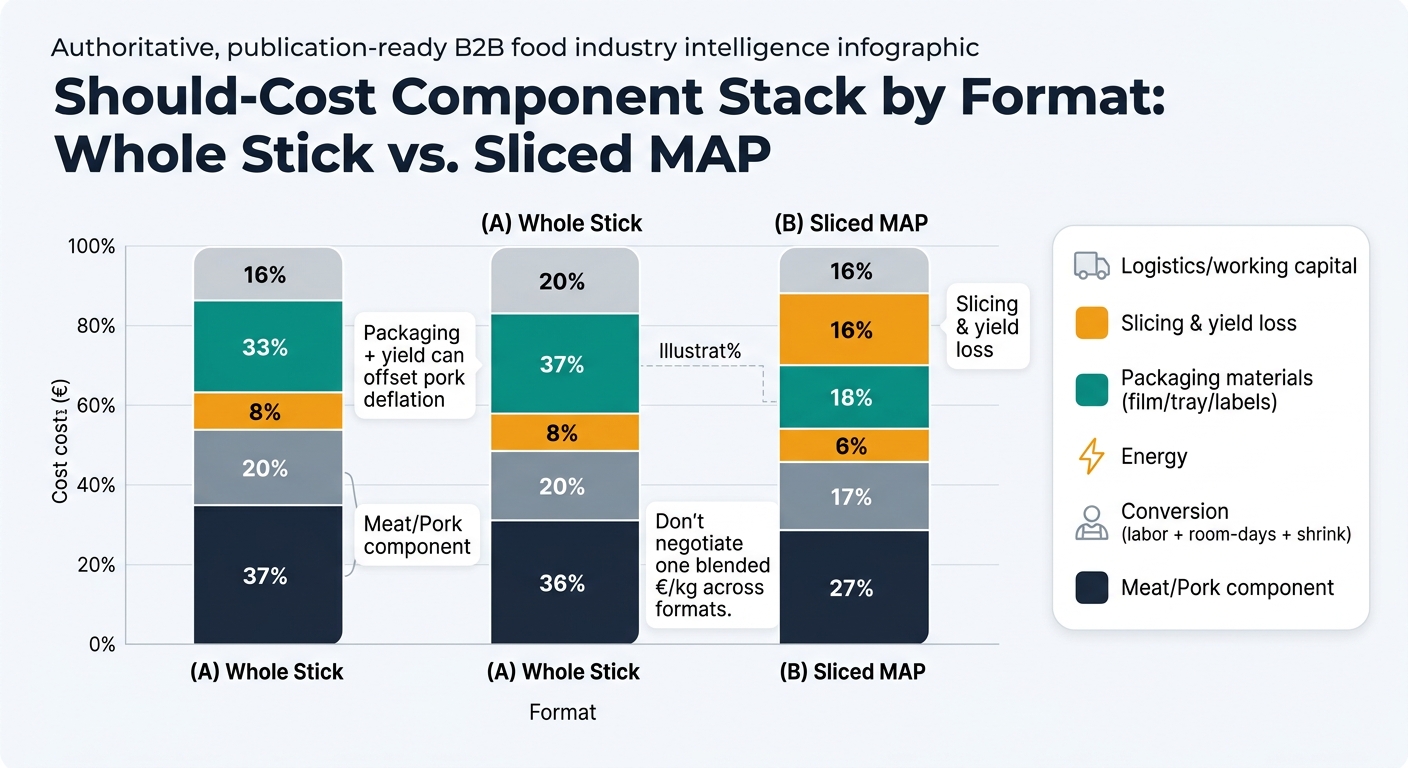
  • Data (kept directional; avoid fake precision): MAP is a real shelf-life and presentation lever, but it increases packaging material intensity and adds slicing yield loss vs. whole sticks. [4] If packaging inputs inflate while pork deflates, sliced SKUs can stay flat even when whole sticks soften.
  • Procurement Impact: Don’t negotiate one blended €/kg across formats. Split the discussion: meat component vs. conversion/packaging component, then decide where you want fixed vs. indexed exposure.
Side-by-side stacked bar chart comparing illustrative percentage cost components for whole stick versus sliced MAP Hungarian-style salami: meat/pork component, conversion (labor plus room-days plus shrink), energy, packaging materials (film/tray/labels), slicing and yield loss, and logistics/working capital; includes callouts noting that packaging plus yield can offset pork deflation and that teams should not negotiate one blended €/kg across formats; legend is consistent and color-blind safe.

Quick Win: In your next supplier call, ask for a quote structure that separates (1) pork/meat component, (2) energy/conversion adder, and (3) packaging adder. Even if they refuse formally, the conversation forces transparency and improves your BATNA (best alternative) math.

2) The 3 Mistakes That Quietly Destroy Savings (and How to Avoid Them)

Mistake #1: Treating “Hungarian salami” as one negotiable line item

  • What happens: Strategic planning sets one budget number, and sourcing pushes one price target across whole, half, and sliced SKUs.
  • Why it fails: Cost drivers differ: sliced SKUs are packaging- and yield-sensitive; whole sticks are more capacity- and shrink-sensitive. Suppliers cross-subsidize, offering a headline win on one format while recovering margin on another.
  • The hidden cost (recognizable pattern): A team that “won” a cut on whole sticks but let sliced packs creep up effectively paid more overall when retail mix shifted toward sliced, wiping out the annualized savings.

Mistake #2: Forcing annual fixed price when the real risk is capacity (and energy), not pork

  • What happens: You lock 12-month fixed pricing to de-risk budgets, assuming pork volatility is the main threat.
  • Why it fails: When capacity tightens (booked ripening rooms, labor constraints, energy repricing), suppliers protect themselves with service degradation: longer lead times, allocation, or spec-driven upcharges.
  • Reality check on energy (2026 context): European gas prices have been materially calmer than the 2022 crisis at times in 2026, but still move enough to create credible “energy narrative” leverage and occasional surcharge behavior—especially where plants are exposed to spot/short-tenor power. [2]
  • The hidden cost: You end up paying in expedites and stockouts: a missed promotion window can cost more than the pork variance you tried to eliminate.

Mistake #3: Switching suppliers for a 1–2% spot gain without valuing qualification speed

  • What happens: Teams churn suppliers quarterly when market softens.
  • Why it fails: In cured meats, the switching cost is time: QA validation, label/artwork changes, logistics setup, and ramp learning. That time is exactly what you don’t have during a disruption.
  • The hidden cost: A common pattern: a small price win is erased by (a) one delayed container that compresses shelf-life, (b) one rework/relabel event, or (c) one service miss that triggers emergency buys at a much higher premium.

Quick Win: Put a dollar value on “days-to-switch.” If Supplier A can be swapped in 10 business days and Supplier B needs 45, that difference is a real option value—treat it like insurance and budget for it.

Sourcing Window Radar
Hungarian Salami — Global Harvest Calendar
COSTA RICA SEASON ACTIVE
🇨🇷 Costa Rica
JAN — DEC
🇺🇿 Uzbekistan
JAN — DEC
🇮🇹 Italy
AUG — NOV
🇪🇸 Spain
OCT — OCT
🇦🇹 Austria
JAN — NOV
JanFebMarAprMayJunJulAugSepOctNovDec

3) What Changes When You Run the Category on Intelligence Instead of Quotes

  • Insight: The performance gap is not “better negotiation tactics”—it’s better timing, better comparables, and faster contingency decisions.
  • Data (positioned correctly as illustrative, not claimed as universal): A realistic before/after for a mid-sized North American importer (illustrative metrics):
Dimension Before (quote-driven) After (intelligence-driven)
Supplier coverage 2–3 incumbents 6–10 qualified options by format/region
Price governance One blended €/kg Component view: meat vs conversion vs packaging
Reopener discipline Ad hoc Triggered by thresholds (pork ±5%, energy ±10%, lead time +2 weeks)
Disruption response 2–3 scramble events/year 0–1 scramble events/year via pre-approved switches
Cost outcome Overpay in down-cycles Better capture vs. “index-followers”
  • Procurement Impact: Strategic planning gets tighter scenario bands and fewer mid-quarter surprises; sourcing gets defensible should-cost guardrails; operations gets earlier warning to adjust buffers; finance gets cleaner variance attribution (market vs supplier).

Quick Win: Add one KPI to your QBR: “% of volume with a pre-qualified backup by format.” It forces resilience without debating philosophy.

4) Three Situations Where You Should Change Your Playbook Immediately

Scenario A: Your renewal is in 60 days and pork is falling, but quotes aren’t

  • Insight: You’re negotiating against the supplier’s inventory lag and list-price inertia.
  • Data (validated logic): Because salami production/ripening cycles can span weeks to months, the supplier may still be shipping batches started earlier even if pork has moved recently. [3]
  • Procurement Impact: Push for a 90–120 day temporary concession or a one-time rebate tied to demonstrated pork moves, then re-set to an index-linked clause to prevent whiplash.

Scenario B: Lead times extend +2–4 weeks with no pork move

  • Insight: That’s a capacity signal (room-days, labor, or energy curtailment), not a meat-cost signal.
  • Data: In dry-cured categories, utilization changes can create step-function pricing; suppliers may prioritize higher-margin SKUs or customers.
  • Procurement Impact: Trigger your continuity plan: shift 10–20% volume to a secondary supplier, pre-book slots, and approve a controlled premium to protect service.

Scenario C: Sliced MAP prices rise while whole-stick prices hold

  • Insight: Packaging and slicing yield are driving the delta; your negotiation must split components.
  • Data: MAP systems and materials are a meaningful cost and availability variable, separate from meat. [4]
  • Procurement Impact: Rebalance the portfolio: lock whole-stick volume longer, keep sliced shorter with packaging reopeners, and consider temporary format substitution for promotions.

Quick Win: Pre-approve a “format switch lever” (e.g., move promo volume from sliced to deli-slice whole sticks) with marketing and sales before the next disruption.

5) The Same Playbook Works in Your Adjacent Categories (Use It to Standardize Governance)

  • Insight: Hungarian salami is a clean template for any category where conversion capacity and working capital create price lags.
  • Data: Similar dynamics show up in pepperoni/chorizo (curing capacity and fat/lean constraints), processed pork items (hog cycles plus labor), and packaged foods where film/tray availability drives short-term price spikes.
  • Procurement Impact: Standardize three governance elements across categories: component-based pricing, lead-time-as-capacity signal, and pre-approved switching triggers. You reduce “heroics” and replace them with repeatable decisions.

Quick Win: Reuse the same trigger policy across cured meats: pork index ±5% (price review), energy ±10% (conversion review), lead time +2 weeks (continuity action).

6) Why This Example Should Change How You Run Strategic Planning

  • Insight: The category rewards teams that manage timing and optionality—not teams that negotiate hardest once per year.
  • Data (validated underlying drivers): Most value comes from avoiding two failure modes: (1) paying yesterday’s cost when inputs fall, and (2) losing allocation when capacity tightens. Both are detectable early through lag signals (inventory age, lead times, surcharge behavior) rather than waiting for a new quote. The lag is consistent with multi-week/month production cycles in dry/fermented salami. [3]
  • Procurement Impact: Strategic planning can set clearer scenario assumptions (what moves price vs what breaks supply), define decision rights (who can switch, when), and measure resilience (backup coverage, concentration, and time-to-switch) as governance KPIs.

Quick Win: Add “time-to-switch” and “capacity risk exposure” into your quarterly planning pack alongside budget and savings.

7) The Bottom Line for Your Next Move

Use the current lag between pork movement and finished-goods offers to renegotiate a short, controlled bridge (90–120 days) that captures near-term downside while you reset the contract structure into components (meat vs conversion vs packaging) with explicit reopeners. The window exists because suppliers’ shipped cost basis is often anchored to earlier production runs, while your next production slots can be scheduled against newer input realities. Teams that execute this play typically capture a few points of savings in down-cycles and avoid the much larger cost of allocation loss when capacity tightens—without pretending they can predict the market perfectly.

Key Insights

  • Insight: The most reliable savings come from exploiting lags (inventory and production timing), not from chasing spot quotes.
  • Data (validated mechanics): Pork can move meaningfully in weeks, while salami pricing often adjusts with a multi-week/month echo because production can take up to ~90 days depending on process and diameter. [3]
  • Procurement Impact: Time renewals and reopeners to the lag; don’t accept blended pricing across formats.
  • Insight: Lead time is a pricing signal.
  • Data: +2–4 weeks lead time extension often indicates utilization stress before price increases appear.
  • Procurement Impact: Use lead-time thresholds to trigger dual-sourcing and pre-booked capacity.
  • Insight: Optionality has measurable value.
  • Data: A backup supplier that can switch in 10 days vs 45 days materially reduces stockout and expedite exposure.
  • Procurement Impact: Budget redundancy like insurance and govern it with “% volume backup-qualified by format.”

The Bottom Line for Your Next Contract

(Analyzed at: Jul, 2026)

EU pig prices in mid-2026 have been sitting around the ~€160/100 kg carcass-weight level (week-to-week moves are modest but the direction can change quickly), while European gas has been fluctuating in a band that still supports credible energy reopener conversations rather than “set-and-forget” conversion pricing. [5] The high-conviction move is to renew with component pricing and two reopeners—one tied to a pigmeat index and one tied to energy—then add a lead-time trigger that automatically shifts 10–20% of volume to a pre-qualified backup if lead times slip by two weeks. If you don’t, the typical penalty isn’t a neat 1–2% price miss; it’s paying 5–10% more via allocation loss, expediting, and promo failures when capacity tightens.

Hungarian SalamiSupply Chain Intelligence
134 countries tracked
10
Exporters
10
Importers
$962M
Top Export Value
Top Exporters (2024)
🇮🇹
Italy
$962M
🇺🇸
United States
$866M
🇪🇸
Spain
$729M
🇵🇱
Poland
$678M
🇩🇪
Germany
$676M
+129 more
Top Buyers
🇬🇧 United Kingdom $1.00B🇩🇪 Germany $619M🇧🇪 Belgium $372M🇨🇦 Canada $322M🇳🇱 Netherlands $315M

References

  1. fao.org
  2. ecb.europa.eu
  3. fao.org
  4. en.wikipedia.org
  5. indexbox.io

Related Contents

Subscribe
→
By subscribing you agree to with our Privacy Policy and provide consent to receive updates from our company.
Thank you! Your submission has been received!
Oops! Something went wrong while submitting the form.
Subscribe to receive the latest blog posts, updates, promotions, and announcements from Tridge.
