INDUSTRY TRENDS

Mozzarella Sourcing Decision Tree (2026): A Practical Framework for Procurement & Sourcing Managers

Author
Team Tridge
DATE
March 12, 2026
9 min read
mozzarella-cheese Cover
Tridge Eye Data Intelligence Solution

This report is powered by Tridge Eye Data Intelligence.

Every data point, price signal, and supply risk insight in this analysis comes from the same platform that procurement and sourcing leaders worldwide rely on daily. As you read, consider what this level of market intelligence could do for your sourcing decisions.

Explore Tridge Eye →

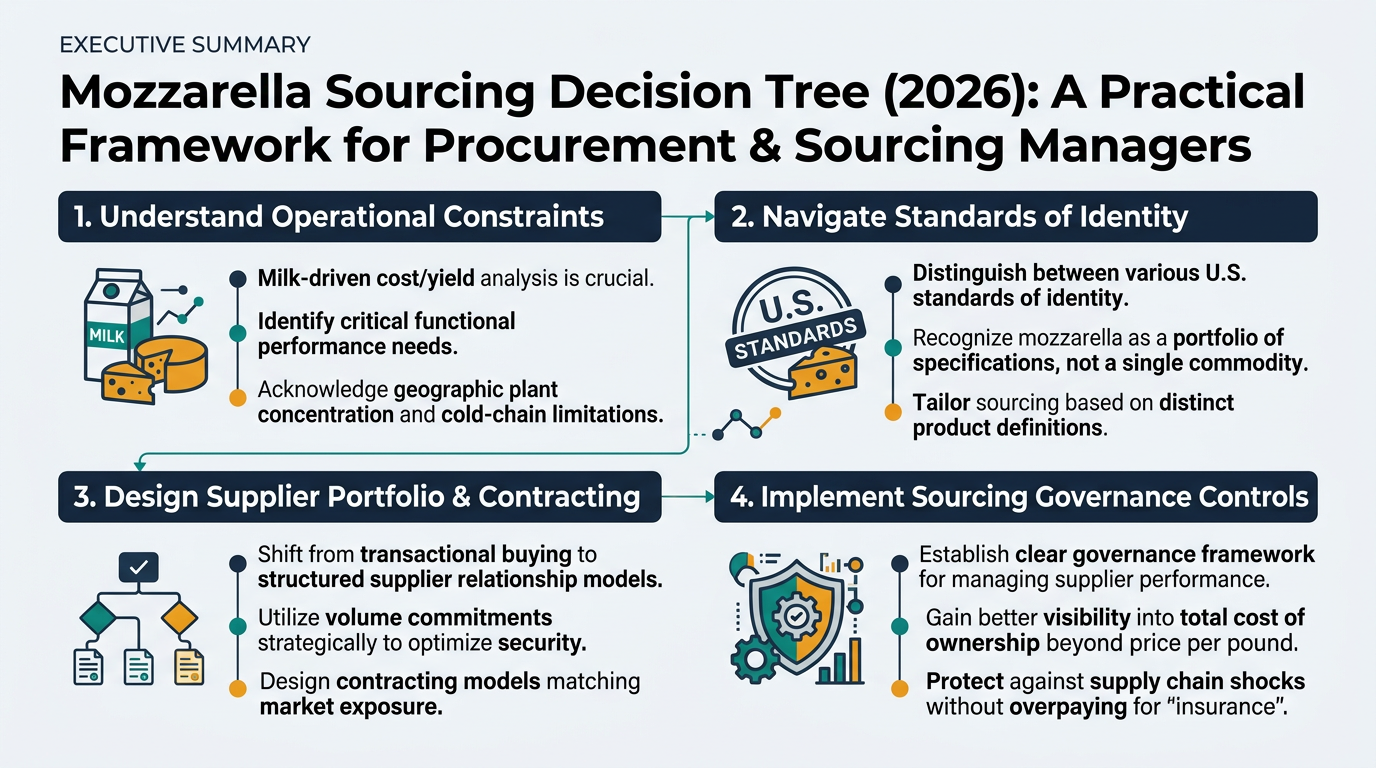
This decision-tree framework is designed for procurement and sourcing leaders who are strong at buying ingredients but don’t live in dairy every day. It translates mozzarella’s real operational constraints (milk-driven cost/yield, functional performance, plant concentration, and cold-chain limits) into clear sourcing choices—supplier portfolio design, contracting model, volume commitments, and governance controls—so you can protect continuity without overpaying for “insurance.”

Executive Summary

  • Mozzarella is not a single commodity: U.S. standards of identity distinguish mozzarella (higher moisture) from low-moisture mozzarella and low-moisture part-skim mozzarella—and these differences directly affect shelf life, lanes, and functional performance. [1]
  • Cold-chain is a cost driver, not just a QA topic: common guidance for cheese transport targets 34–40°F (1–4°C), making lane reliability and temperature documentation material to claims, rejects, and service SLAs. [2]
  • 2026 planning context (U.S.): USDA’s 2026 all-milk price forecast is lower than 2025 (downcycle signal), while exports remain a major demand lever—meaning buyers should balance near-term cost opportunity with disruption readiness. [3]
  • Best “default” governance for mid-to-high criticality: if mozzarella is a line-stopper, a primary + qualified backup with trigger-based switching usually reduces expedite/spot exposure faster than another round of unit-price-only negotiation.
  • Indexing works only with clean definitions: indexed/hybrid contracts can reduce noise, but only if freight, packaging, and make-allowance definitions are explicit and invoice validation is operationally feasible.

Key Insights

Analyzed at: Mar 2026

mozzarella-cheese Infographic
  • Strategy: Buy
  • Reliability: Medium
  • Potential Saving: 2% ~ 6%
  • Insight: With USDA projecting a lower 2026 all-milk price versus 2025 (downcycle signal) while export pull remains strong, treat Q2–Q3 2026 as a contracting “window” to (1) tighten your contract math (explicit freight/packaging pass-throughs, invoice validation) and (2) formalize backup readiness (test orders + switch triggers). The savings typically come from reduced price leakage and fewer expedites/spot buys, not from “beating the market” on base price. [3]

1) What this framework helps you decide (and why mozzarella needs structure)

The procurement decision this framework is built for

This decision tree helps you select the right mozzarella sourcing strategy across five linked choices:

  1. What spec tier to buy (fresh vs. low-moisture; whole milk vs. part-skim; functional performance)
  2. From whom (single vs. dual source; local vs. cross-region; manufacturer vs. distributor)
  3. Under what commercial model (spot, fixed, indexed, hybrid; pass-throughs)
  4. How much to commit (volume allocation, minimums, safety stock, call-offs)
  5. With what controls (QA gates, service-level KPIs, risk triggers, audit trail)

Why a structured approach matters in mozzarella

Mozzarella is often treated like a “simple commodity,” but cost and continuity outcomes are driven by a few mozzarella-specific realities:

  • Milk solids drive yield and cost: small shifts in milk composition or process capability can change conversion yield, which shows up as price differences and/or functional variability.
  • Functional specs matter as much as composition: melt, stretch, browning, oiling-off, shred integrity, clumping—these can create hidden costs (downtime, scrap, customer complaints).
  • Cold-chain and shelf-life constraints: especially for fresh mozzarella; lane reliability and temperature control are not “nice-to-have.” (Cheese transport commonly targets 34–40°F / 1–4°C; define temperature documentation and claims rules up front.) [2]
  • Supply is concentrated by plant and region: losing a single plant can force expensive spot buys and spec compromises.

Practical clarification for non-dairy buyers: in the U.S., “mozzarella” vs “low-moisture mozzarella” vs “low-moisture part-skim mozzarella” are distinct standards of identity with different moisture/fat constraints—so your spec tier is not just a preference; it affects shelf life, lanes, and substitution feasibility. [1]

Who should use this (and when)

Use this framework if you are:

  • A Procurement/Sourcing Manager inheriting mozzarella spend without deep dairy expertise
  • Preparing an RFP, renewal, or re-source
  • Facing service issues, spec drift, unexpected price resets, or single-source exposure

2) Quick-start summary for busy sourcing leaders

Trigger conditions (when you should run this decision tree)

Run it when any of these are true:

  • Annual mozzarella volume ≥ 250 MT (or mozzarella is a top-10 ingredient by spend)
  • You have single-source supply for a critical plant/line
  • You’ve had ≥ 2 supply disruptions or ≥ 3 quality escalations in the last 12 months
  • Your price mechanism is unclear (e.g., “market-based” with no transparent index)
  • You are launching a new SKU, changing format (block → shred), or changing geography

Inputs you’ll need (keep it practical)

Collect these before choosing a path:

  • Demand & operations: annual volume by site, weekly variability, seasonality, required lead time
  • Spec & application: fresh vs. low-moisture, fat/moisture targets, format (block/shred/dice), functional KPIs (melt, stretch, browning)
  • QA & customer requirements: required certifications (e.g., GFSI scheme), audit cadence, allergen controls, micro limits
  • Logistics: lanes, temperature requirements, acceptable transit time, cold storage capacity
  • Commercial: current pricing model (fixed/indexed), rebates, freight terms (FOB vs delivered), service-level penalties
  • Risk posture: maximum allowable downtime, inventory strategy, backup qualification status

Decision paths & outcomes (what you’ll end up with)

You will land in one of these sourcing outcomes:

  • Outcome 1: Dual-source + indexed/hybrid contract (best for high volume + high continuity need)
  • Outcome 2: Primary contract + qualified backup + trigger-based switching (best for moderate volume)
  • Outcome 3: Distributor-led / short-term coverage (best for urgent needs or low volume)
  • Outcome 4: Spec tiering + TCO optimization (best when quality variability is causing hidden costs)

3) The practical decision tree (use this in your next sourcing meeting)

A clean decision-tree that mirrors Section 3, starting with how critical uninterrupted supply is and branching into Path A (Continuity-first) vs Path B (Cost/efficiency-first), including key volume thresholds, supplier qualification, fresh vs low-moisture constraints, budget predictability vs volatility tolerance, index-governance readiness, and functional performance hidden-cost check, ending in four outcomes: dual-source indexed/hybrid, primary plus qualified backup with triggers, distributor-led short-term coverage, and spec tiering plus TCO.

Decision Point 1: How critical is uninterrupted supply to your operations?

  • If any single plant outage would stop production within 7 days OR mozzarella is a line-stopper ingredient → follow Path A (Continuity-first)
  • If you can tolerate ≥ 14 days disruption with inventory/reformulation options → follow Path B (Cost/efficiency-first)

Path A (Continuity-first)

Decision Point 2A: Is your annual volume high enough to justify portfolio sourcing?

  • If annual volume ≥ 1,000 MT (across all sites) OR you run multi-site manufacturing → go to Decision Point 3A
  • If annual volume 250–999 MT → go to Decision Point 4A
  • If annual volume < 250 MTRecommendation A1

Recommendation A1 (low volume but high criticality)

  • Buy via regional distributor or manufacturer-direct with strong service SLAs
  • Hold safety stock = 2–4 weeks (if shelf-life allows)
  • Pre-qualify one backup SKU/spec (even if not used routinely)

Decision Point 3A (for ≥ 1,000 MT): Can you qualify two suppliers to the same functional spec tier?

  • If YesRecommendation A2
  • If No (spec is highly unique / proprietary) → Recommendation A3

Recommendation A2 (true dual-source)

  • Set 70/30 or 60/40 allocation across two manufacturers
  • Use indexed or hybrid pricing (index + make allowance + packaging + freight)
  • Build a lane-level contingency: if Supplier 1 misses OTIF for 2 consecutive weeks, shift +10–20% volume to Supplier 2

Recommendation A3 (single-spec constraint)

  • Keep primary supplier but create a “degraded spec” emergency option
  • Contract for emergency capacity / priority production windows
  • Require site mapping (which plant(s) make your SKU) and ensure no single point of failure in packaging film or cold storage

Decision Point 4A (for 250–999 MT): What is your cold-chain and shelf-life constraint?

  • If you buy fresh mozzarella (short shelf life, high temperature sensitivity) → Recommendation A4
  • If you buy low-moisture mozzarella (blocks/shreds, longer shelf life) → Recommendation A5

Recommendation A4 (fresh)

  • Prioritize regional sourcing (shorter lanes) and tight temperature controls
  • Use shorter contract cycles (3–6 months pricing resets) but lock capacity and service terms
  • Add temperature excursion reporting and reject/credit rules

Recommendation A5 (low-moisture)

  • Use primary supplier + qualified backup
  • Hold 2–6 weeks safety stock depending on demand volatility
  • Negotiate freight and cold storage responsibilities explicitly (who pays when lanes tighten)

Path B (Cost/efficiency-first)

Decision Point 2B: How tight is your budget vs. your tolerance for price volatility?

  • If budget requires high predictability (finance variance limits; quarterly pricing) → go to Decision Point 3B
  • If you can tolerate volatility to capture dips (spot opportunities) → go to Decision Point 4B

Decision Point 3B: Do you have clean internal data to run an index-based contract?

(You can reliably track: volumes, delivered lanes, spec tiers, rebates, and invoice validation.)

  • If YesRecommendation B1
  • If NoRecommendation B2

Recommendation B1 (indexed / hybrid)

  • Move to index-linked pricing with clear pass-through definitions
  • Add governance: monthly price validation, variance thresholds, and audit-ready documentation

Recommendation B2 (fixed with guardrails)

  • Use fixed price windows (e.g., 60–90 days) with reopeners if market moves beyond a threshold
  • Add most-favored-customer style benchmarking (not a guarantee; a review mechanism)

Decision Point 4B: Is functional performance causing hidden costs?

  • If you have line downtime, shred clumping, inconsistent melt/stretch, customer complaintsRecommendation B3
  • If performance is stable and interchangeable → Recommendation B4

Recommendation B3 (spec tiering + TCO)

  • Segment mozzarella into Tier 1 (critical performance) vs Tier 2 (standard)
  • Source Tier 1 with stricter QA + dual source, Tier 2 with competitive bidding / spot flexibility
  • Track TCO: scrap, rework, downtime, yield loss from shred fines

Recommendation B4 (commodity-like sourcing)

  • Use competitive bid with 2–3 suppliers
  • Keep shorter coverage (8–16 weeks) when markets are soft; extend coverage when tightening signals appear

4) Scenario walkthroughs (3 real-world buyer paths)

Scenario A: Multi-site pizza manufacturer with high downtime cost

Profile: 3 plants, 2,500 MT/year, low-moisture (often LMPS) blocks for shredding, downtime cost is high.

  • Decision Point 1: Line-stopper within 7 days → Path A
  • Decision Point 2A: Volume ≥ 1,000 MT → Decision Point 3A
  • Decision Point 3A: Can qualify two suppliers to same functional tier → Yes
  • Final: Recommendation A2

Why this is the right landing

  • With this volume, a single-source failure is unacceptable; dual-source reduces recovery time.
  • Hybrid/indexed model reduces negotiation noise and aligns price to market drivers while preserving continuity.

Scenario B: Retail private label shredded mozzarella with cost pressure

Profile: 600 MT/year, shredded format, stable demand, finance wants predictable quarterly pricing.

  • Decision Point 1: Can tolerate 14+ days disruption with inventory → Path B
  • Decision Point 2B: Needs predictability → Decision Point 3B
  • Decision Point 3B: Data quality is moderate (rebates and freight sometimes messy) → No
  • Final: Recommendation B2

Why

  • Fixed windows with reopeners control budget variance without requiring perfect index governance on day one.
  • Shreds add packaging and handling sensitivity; contract must specify service and quality terms clearly.

Scenario C: Fresh mozzarella for foodservice (urgent, short shelf life)

Profile: 120 MT/year, fresh mozzarella logs/balls, frequent deliveries, high temperature sensitivity.

  • Decision Point 1: Disruption impacts menu quickly → Path A
  • Decision Point 2A: Volume < 250 MT → Recommendation A1
  • Operational overlay: Fresh format → emphasize regional lanes, temperature reporting, short lead times

Why

  • At this volume, manufacturer-direct dual sourcing may be inefficient; distributor + safety stock + pre-qualified backup is more practical.

5) Action matrix (pick your strategy in one glance)

A compact, scannable visual re-render of Section 5’s action matrix with columns for Buyer Profile, Key Factors, Recommended Strategy, and Expected Outcome, emphasizing thresholds (≥1,000 MT; 250–999 MT; <250 MT), fresh vs low-moisture, and retail shred, and highlighting the four strategies that match the decision-tree outcomes in a print-friendly procurement style.
Buyer Profile Key Factors Recommended Strategy Expected Outcome
High-volume industrial (≥ 1,000 MT) Line-stopper risk, multi-site, strict functional KPIs Dual-source allocation (70/30) + indexed/hybrid contract Lower outage exposure; improved price governance; faster recovery
Mid-volume manufacturer (250–999 MT) Needs continuity but limited leverage Primary + qualified backup + trigger-based switching Reduced expedite/spot buys; clearer contingency plan
Fresh mozzarella buyer (< 250 MT) Short shelf life, tight lanes, frequent drops Regional distributor/manufacturer + 2–4 weeks safety stock Fewer temperature-related rejects; better service stability
Retail shred (cost focus) Promo calendars, packaging sensitivity Fixed windows (60–90 days) + reopeners + service KPIs Better budget control; reduced invoice disputes
Quality-volatile operations Downtime/scrap from melt/stretch variability Spec tiering + TCO model + tighter QA gates Lower total cost, fewer escalations, better stakeholder alignment

6) Risk mitigation by decision path (what to watch, what to do)

For Dual-source + indexed/hybrid (Outcome 1)

Watch for (early warning signs)

  • Supplier starts missing OTIF or shorting allocations
  • Increased spec drift (moisture/fat variance, melt behavior)
  • Lane instability (reefer shortages, longer transit times)

Contingency actions

  • Pre-approved volume shift playbook (e.g., +10% within 2 weeks)
  • Maintain approved packaging/label equivalents to switch faster

Monitoring metrics & triggers

  • OTIF weekly; trigger at < 95% OTIF for 2 consecutive weeks
  • Quality: nonconformance rate; trigger at > 1.0% lots rejected
  • Price governance: invoice vs formula variance; trigger at > 0.5–1.0%

Common mistakes

  • “Dual-source on paper” without real allocations
  • Index contracts without clean definitions for freight, packaging, and make allowances

For Primary + qualified backup (Outcome 2)

Watch for

  • Backup supplier not truly ready (lead times, packaging, pallet patterns, labeling)
  • Qualification expires (audits out of date)

Contingency actions

  • Run quarterly test orders (small lots) to keep readiness real

Metrics & triggers

  • Backup readiness scorecard: audit status, lead time, MOQ, lane validation

Common mistakes

  • Waiting until disruption to discover the backup cannot meet functional performance

For Distributor-led / short-term coverage (Outcome 3)

Watch for

  • Hidden cost creep (markups, freight adders, substitutions)

Contingency actions

  • Lock substitution rules: no spec changes without approval

Metrics & triggers

  • Fill rate and substitution rate; trigger if substitutions > 2% of lines

Common mistakes

  • Accepting “equivalent mozzarella” without validating functional KPIs

For Spec tiering + TCO (Outcome 4)

Watch for

  • Stakeholder misalignment (Ops/QA vs Procurement)

Contingency actions

  • Define Tier 1 functional KPIs (melt/stretch/browning) and Tier 2 tolerances

Metrics & triggers

  • Scrap %, downtime minutes, customer complaints, yield loss from shred fines

Common mistakes

  • Optimizing unit price while ignoring downtime and rework costs

7) Key Insights you can act on this quarter

  • Strategy: Buy
  • Reliability: Medium
  • Potential Saving: 2%–6%
  • Insight: If your mozzarella is a line-stopper and annual volume is ≥ 250 MT, prioritize a primary + qualified backup (or true dual-source above 1,000 MT) and add trigger-based volume shifting plus monthly price validation. This typically reduces spot buys, expedites, and invoice leakage faster than another round of unit-price negotiation.
Tridge Eye Data Intelligence Solution

Make Faster, Data-Driven Sourcing Decisions

The insights in this report are just the starting point. Tridge Eye is the data intelligence solution that gives procurement and sourcing leaders real-time market signals, price benchmarks, and supply risk alerts — so you can act before the market moves.

Explore Tridge Eye →

References

  1. law.cornell.edu
  2. ams.usda.gov
  3. ers.usda.gov
Subscribe
By subscribing you agree to with our Privacy Policy and provide consent to receive updates from our company.
Thank you! Your submission has been received!
Oops! Something went wrong while submitting the form.
Subscribe to receive the latest blog posts, updates, promotions, and announcements from Tridge.