
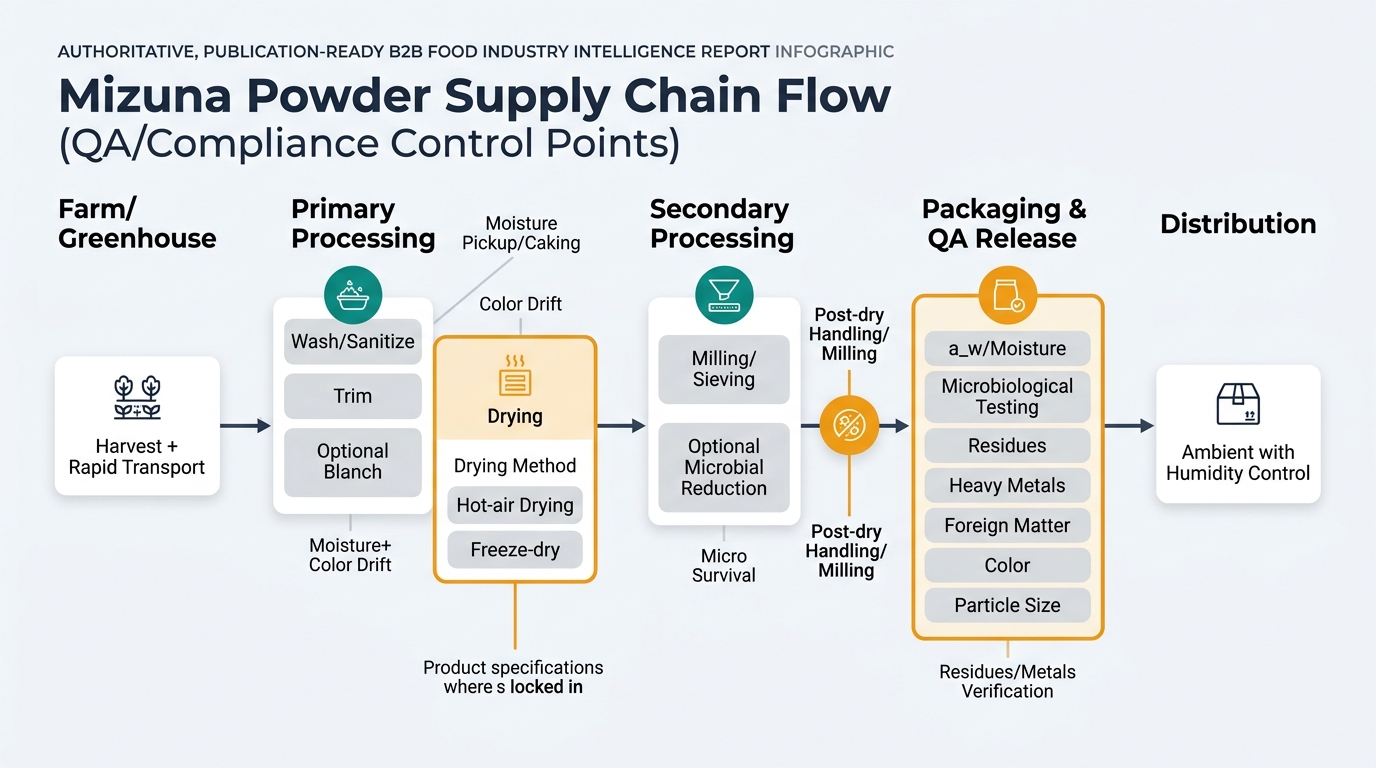
Mizuna powder looks like a simple ingredient, but for Purchase teams accountable to Quality, Safety, and Compliance, it behaves like a concentrated-risk category: dehydration amplifies both desirable attributes (color/nutrients) and exposure (residues/metals/micro). This guide maps the physical flow, highlights where specs get “locked in,” and explains which cost drivers are structural vs. negotiable.
Mizuna powder is a “water-to-solids” conversion business: most mass is removed in drying, and most quality is preserved (or lost) in drying + milling + packaging—not in the field. The chain is short on paper, but each node has hard physical constraints (fresh-leaf perishability, drying throughput, and moisture/oxygen control) that determine both cost structure and achievable specifications.
Fresh leafy vegetables are commonly high-water commodities (often ~85–95% water by weight), so processors remove most inbound mass as water during drying. In shelf-stable dried foods, water activity is a primary stability control; FDA technical guidance discusses water activity as a key stability parameter, and FDA/food safety references commonly use aw > 0.85 as a threshold in defining foods that can support pathogen growth under certain conditions, while preventive controls guidance often treats low-moisture foods as aw < 0.60.
If you’re buying mizuna powder for strict micro, color, or “no-caking” performance, the supplier’s drying method, post-dry handling, and barrier packaging are the physical levers that determine whether specs are repeatable lot-to-lot.
Mizuna powder cost is structurally dominated by (1) conversion yield (fresh-to-dry), (2) energy + throughput limits in drying, (3) QA/testing burden driven by residues/micro/metals expectations, and (4) moisture/oxygen barrier packaging that prevents caking and chlorophyll loss.
Water activity is widely used to predict stability and quality changes in dried foods; multiple technical references treat aw as a core control parameter, and low-moisture foods are commonly discussed in the context of pathogen survival risk (i.e., “dry” does not mean “pathogen-free”).
Most “unexpected” cost in mizuna powder shows up as rework, re-testing, additional microbial reduction processing, or downgraded color/sensory—each tied to a specific physical node (drying, milling heat, or packaging).
Farming cost is less about complex inputs and more about consistency: uniform leaf maturity, low soil/particulate load, and predictable harvest windows that keep the dryer fed.
Leafy greens are high moisture at harvest (commonly in the ~85–95% range across leafy vegetables), and any field variability (mud load, pest pressure) becomes amplified after dehydration because defects concentrate per kg of powder.
The “quality ceiling” is set here: high soil load increases foreign matter and potential heavy metal risk; inconsistent maturity increases color variability and bitterness/pungency swings after drying.
Drying is the economic heart of mizuna powder: it is energy-intensive, capacity-constrained, and determines color (chlorophyll retention), aroma retention, and baseline microbiological profile.
Water activity and moisture are related but not interchangeable; stability and microbial growth potential track more directly with aw than moisture %. Low-moisture foods are often discussed as aw < ~0.60 in preventive controls contexts, and aw > 0.85 is a commonly cited threshold in food safety definitions for foods that can support pathogen growth.
A supplier’s dryer type (hot-air vs. freeze-dry), dwell time, and inlet air control are the practical reasons two “same spec” powders behave differently in caking, color drift, and microbial counts.
Milling is where “specs become real”: particle size distribution, dispersibility, and heat generation (which can dull color and aroma) are controlled here.
Commercial dried-vegetable powders are commonly specified by sieve/mesh or particle size distribution ranges appropriate to the application; importantly, aw is a more predictive control for storage behavior than moisture % alone.
If you need consistent blend behavior (no specking, predictable hydration), you’re effectively buying a milling + classification capability—plus the controls that prevent post-mill moisture pickup.
Packaging is a performance input, not a commodity: mizuna powder is hygroscopic and odor-sensitive, so barrier films/liners and humidity management protect both quality and shelf life.
Low-moisture foods can still carry pathogen survival risk (e.g., Salmonella survival in dry matrices is well documented in the broader low-moisture food literature), so buyers often pair aw limits with microbiological criteria and verification. For U.S. supplement-adjacent channels, heavy metals scrutiny is often benchmarked against California Proposition 65 “safe harbor” concepts; OEHHA publishes safe harbor levels, and many enforcement settlements reference 0.5 µg/day lead exposure as a practical trigger point for warnings depending on product use directions.
Higher QA cost is structurally normal for leafy-green powders: multi-panel testing (micro + residues + metals) and robust COA methods are part of the physical cost stack, not an optional add-on.
The powder ships ambient, but the risk is moisture ingress and temperature cycling (container “sweat”), which drives caking, color loss, and odor pickup.
Dried foods rely on maintaining an appropriate aw during storage; once moisture increases, stability assumptions break, and the product may fail functional specs even if it still “looks acceptable.”
Lane design (ocean vs. air), packaging choice (foil laminate vs. basic liners), and in-container humidity mitigation directly determine complaint rates for clumping and dull color.

| Supply Chain Node | Cost Ratio (% of Final Cost) | Notes |
|---|---|---|
| Raw Material (fresh mizuna) | 18% | Yield loss makes leaf cost “levered” per kg powder; field cleanliness affects downstream QA. |
| Primary Processing (wash + drying) | 34% | Drying energy + throughput constraints are the dominant structural cost. |
| Secondary Processing (milling/sieving) | 12% | Particle size control, heat management, and rework/sieving losses. |
| Packaging & QA | 16% | Barrier packaging + routine micro/residue/metals testing burden. |
| Logistics & Distribution | 10% | Ambient freight + humidity protection; export adds documentation and handling. |
| Wholesale/Distributor Margin | 10% | Typical channel margin varies by market and service level. |
| Supply Chain Node | Cost Ratio (% of Final Cost) | Notes |
|---|---|---|
| Raw Material (fresh mizuna) | 15% | Often tighter raw spec; more trimming loss possible. |
| Primary Processing (freeze-drying) | 45% | High capex + energy + longer cycle time; capacity is the constraint. |
| Secondary Processing (milling/sieving) | 10% | More brittle material; fine powder control still costs. |
| Packaging & QA | 18% | Premium barrier packaging and tighter release criteria are common. |
| Logistics & Distribution | 7% | Higher value density; still humidity-sensitive. |
| Wholesale/Distributor Margin | 5% | Often more direct-to-manufacturer sales, lower channel layers. |
| Supply Chain Node | Cost Ratio (% of Final Cost) | Notes |
|---|---|---|
| Component Powders (incl. mizuna) | 52% | Blend economics dominated by component specs and yields. |
| Blending & Secondary Processing | 10% | Homogeneity, segregation, and dust control. |
| Packaging & QA | 20% | COA consolidation, allergen/cross-contact statements, metals/micro testing. |
| Logistics & Distribution | 8% | Multiple inbound lanes + outbound finished blend. |
| Wholesale/Distributor Margin | 10% | Depends on whether sold as branded blend or industrial ingredient. |
Mizuna powder behaves like other leafy-green powders (spinach/kale/broccoli class): dehydration concentrates both desirable attributes (color/nutrients) and compliance exposure (residues/metals), while stability depends on keeping aw low from pack-out to end use.
Low-moisture foods are explicitly recognized as a microbiological risk-management category (pathogens can survive even when they cannot grow), and dried fruits/vegetables sit within those ranked low-moisture food categories in international risk work.
Even with strong suppliers, you should expect the category to require ongoing verification: aw/moisture drift, micro variability, and contaminant panels are structural to leafy powders.
In mizuna powder, “quality” is mostly a function of drying method + post-dry moisture control + milling heat management.
Technical references consistently treat water activity as a core stability metric for dried foods, with aw > 0.85 commonly referenced in food safety definitions for growth potential, and aw < ~0.60 commonly discussed for low-moisture foods.
If a supplier cannot clearly state drying method, aw target, particle size distribution, and the test methods behind COAs, the physical chain is telling you the product will be hard to standardize in manufacturing.
(Analyzed at: Aug, 2026)
Put water activity (aw) on the COA as a release spec (not just “typical”), and contractually tie it to the exact pack-out configuration (liner type, barrier, nitrogen flush if used) and a defined humidity-control practice for ocean lanes (e.g., container desiccant or equivalent). This works because mizuna powder complaints and receiving holds are disproportionately driven by post-dry moisture pickup—aw is the best early-warning control, and packaging/lane controls are the real levers after drying. What’s at stake is usually a quiet but material TCO hit: a single caking-driven hold can trigger re-testing, rework, and schedule disruption that easily costs more than the per-kg price delta between “standard” and “high-barrier” pack-out.


