INDUSTRY TRENDS

Mixed Nut Snacks Procurement Guide (2026): Where Total Landed Cost, Food Safety Risk, and Shelf-Life Quality Really Accumulate

Author
Team Tridge
DATE
April 3, 2026
10 min read
mixed-nut-snacks Cover
Tridge Eye Data Intelligence Solution

This report is powered by Tridge Eye Data Intelligence.

Every data point, price signal, and supply risk insight in this analysis comes from the same platform that procurement and sourcing leaders worldwide rely on daily. As you read, consider what this level of market intelligence could do for your sourcing decisions.

Explore Tridge Eye →

Mixed nut snacks look simple on-shelf, but they’re one of the fastest ways for Procurement to get surprised by hidden cost, conversion bottlenecks, and quality/shelf-life failures—because you’re managing a multi-commodity BOM, multi-origin supply, and a low-moisture food safety program at the same time. This guide translates the real supply chain into procurement decisions: where TLC (total landed cost) builds, where risk concentrates, and what to negotiate (and what not to).

Executive Summary

  • Mixed nuts are a portfolio, not a commodity: Each nut has different origins, seasonality, and failure modes; your SKU cost is a blend of uncorrelated risks.
  • Origin concentration is real (and procurement-relevant): California produces about ~80% of global almond supply (commonly cited), creating structural exposure to California weather/water and logistics. [1]
  • Pistachios are highly concentrated: The U.S., Iran, and Turkey together account for ~87% of global pistachio production (FAO-style summaries commonly cited). [2]
  • Cashews are a “two-step” chain: raw nuts often originate in West Africa, while processing/export is heavily concentrated in Vietnam and India (dominant kernel export hubs). [3]
  • Delivered cost often disconnects from raw nut pricing: the biggest “surprises” are typically yield loss, QA holds/rejections, packaging barrier/MAP discipline, and logistics dwell time/heat exposure.
  • Regulatory/compliance gating is not optional: EU contaminant rules (e.g., aflatoxins) differ by product and intended use and can drive testing frequency, segregation, and rejection risk. [4]

Key Insights

(Analyzed at: Apr, 2026)

  • Strategy: Hold
  • Reliability: Medium
  • Potential Saving: 3% ~ 8%
  • Insight: If you’re buying finished retail packs or roasted/seasoned bulk, the most reliable near-term savings in 2026 typically comes less from “calling the nut market” and more from tightening TLC controls:
  • contract language that ties price moves to transparent indices/inputs,
  • yield + defect KPIs with rebates/credits, and
  • packaging/MAP (nitrogen flush + barrier film/seal integrity) governance to reduce rancidity/returns.
  • Evidence base: oxygen control (nitrogen flushing + barrier) is repeatedly shown to slow lipid oxidation in nuts and nut products, improving quality retention. [5]

1) What You’re Actually Buying: The Real Mixed-Nut Supply Chain (Ground Truth)

Mixed nut snacks look simple on-shelf, but procurement complexity comes from multi-commodity BOMs (almonds + cashews + peanuts + pistachios + walnuts/pecans, plus oil/salt/flavors) that move on different crop calendars, originate in different countries, and fail for different reasons.
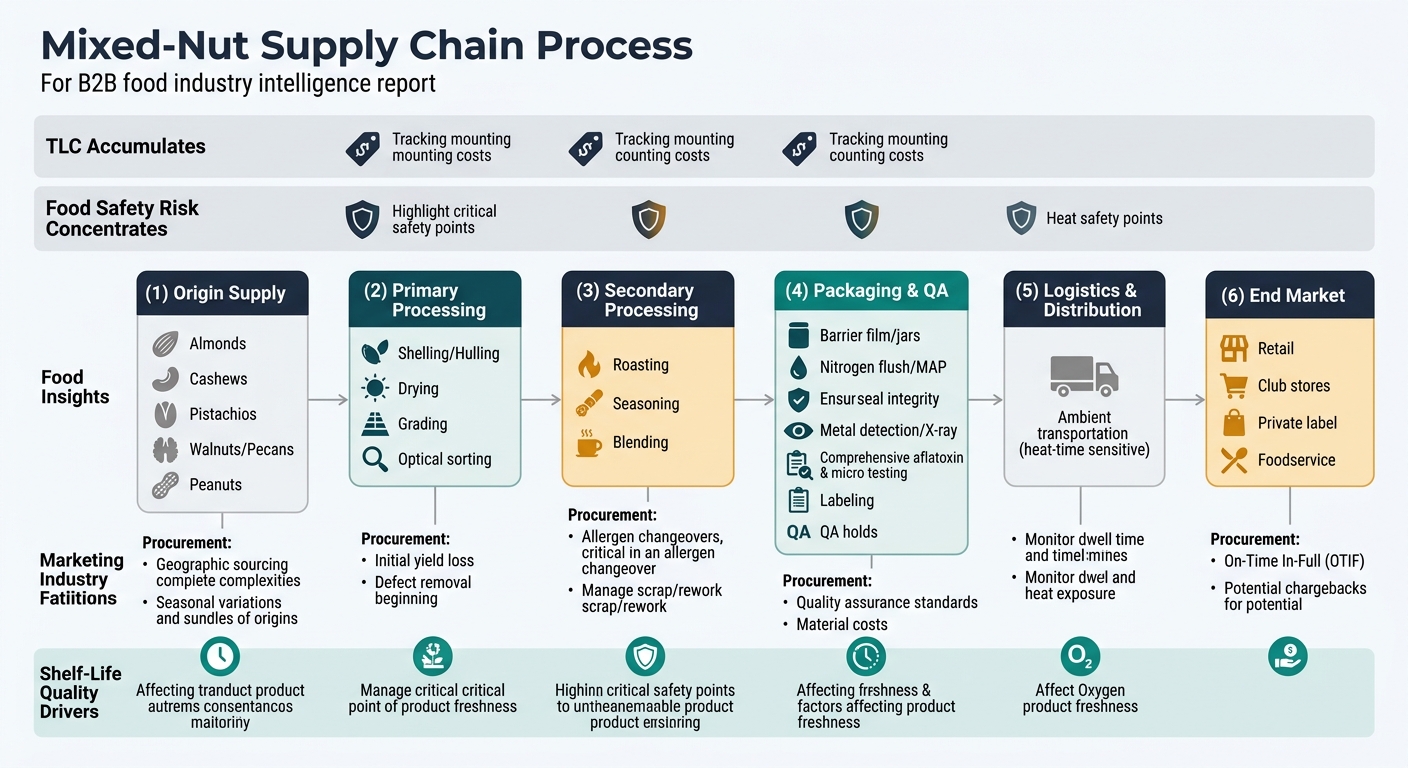
A left-to-right flow showing the real mixed-nut supply chain nodes with procurement-relevant callouts at each step: origin supply (multi-origin raw nuts) to primary processing (shelling/hulling, drying, grading, optical sorting), secondary processing (roasting, seasoning, blending), packaging & QA (barrier film/jars, nitrogen flush/MAP, seal integrity, metal detect/X-ray, aflatoxin & micro testing, labeling, QA holds), logistics & distribution (ambient but heat-time sensitive), and end market (retail/club/private label/foodservice), with overlays for where total landed cost accumulates, where food safety risk concentrates, and shelf-life quality drivers.

A practical “flow” most procurement teams are really managing:

  1. Origin supply (raw nuts)
  2. Almonds: heavily U.S./California concentrated (often the anchor ingredient for U.S. mixes).
  3. Cashews: raw supply often West Africa; processing/export dominated by Vietnam/India.
  4. Pistachios: concentrated across U.S./Turkey/Iran.
  5. Walnuts: U.S. + Chile + others; strong export orientation.
  6. Peanuts: widely grown, but food safety controls can be the gating factor.
  7. Primary processing (shelling/hulling, drying, grading, sorting)
  8. Yield loss and defect removal start here.
  9. Secondary processing (roasting, seasoning, blending)
  10. Where spec compliance (roast color, salt %, flavor adhesion) meets food safety validation.
  11. Packaging & QA (barrier film/jars, nitrogen flush, metal detect/X-ray, aflatoxin & micro testing, labeling)
  12. Shelf-life protection is often a packaging/handling problem more than a recipe problem.
  13. Logistics & distribution (ambient but heat-sensitive)
  14. Heat exposure accelerates rancidity; lead-time variability changes “delivered freshness.”
  15. End market (retail/club, private label, foodservice, industrial packs)
  16. Repricing cadence and service penalties differ widely by channel.

Key procurement reality: You’re not just sourcing “nuts”—you’re sourcing a freshness window (oxidation risk), a food safety system (validated kill-step + allergen controls), and a packaging system (oxygen barrier + sealing discipline) as much as you’re sourcing kernels.

2) Where Cost and Margin Stack Up (Node-by-Node) — and What That Means for Your Negotiation

Below is a procurement-oriented view of cost build by supply chain node. Percentages are illustrative ranges to show where cost tends to concentrate; actuals vary by nut type, grade, origin, contract coverage, and whether you’re buying bulk ingredients vs finished retail packs.

2.1 Upstream / Raw Material (Farming & Orchard Economics)

Key insight: For most mixes, raw nut cost is still the dominant driver, but it behaves differently by nut type because origin concentration differs.

What drives cost here

  • Crop size/quality shocks (weather, water availability, pests)
  • Grade/size (e.g., whole vs pieces; count per ounce for cashews)
  • Carrying cost: nuts are high value; inventory financing matters

What procurement often misses

  • A “cheap” nut can become expensive if it forces higher rejects downstream (defects, moisture, rancidity risk)

Origin concentration examples (risk lens):

  • California is commonly cited as producing about ~80% of the world’s almond supply (note: some sources also cite ~50% of global production depending on definition/year—use this as a concentration signal, not a precise planning constant). [1]
  • Pistachio production is concentrated among the U.S., Iran, and Turkey, which together account for ~87% of global production in recent FAO-style summaries. [2]

2.2 Primary Processing (Shelling, Drying, Sorting, Grading)

Key insight: This is where yield loss becomes real money—and where quality specs quietly create hidden cost.

Cost drivers

  • Shelling/hulling yield loss (breakage, splits)
  • Optical sorting and defect removal
  • Moisture control (too high = mold risk; too low = breakage)
  • Testing and compliance screening (aflatoxin/pesticide residues depending on nut/origin)

Margin mechanics

  • Processors monetize grade separation: premium whole kernels vs discounted pieces/off-grade

2.3 Secondary Processing (Roasting, Seasoning, Blending)

Key insight: Roasting is a cost + risk transformation step. It adds value, but it also becomes a food safety and consistency commitment.

Cost drivers

  • Energy (gas/electric), labor, line downtime for allergen changeovers
  • Oil (if oil-roasted), seasoning blends, inclusions (dried fruit/chocolate)
  • Scrap/rework from over-roast, seasoning fallout, blend ratio variation

Food safety reality

  • Low-moisture foods can still carry pathogens; FDA and industry guidance emphasize validated controls for Salmonella risk in low-moisture/nut-adjacent products (your exact preventive control depends on process, product, and facility). [6]

2.4 Packaging & QA (Where Shelf Life Is Won or Lost)

Key insight: For mixed nuts, packaging isn’t “just packaging.” Oxygen control is a direct driver of returns, stales, rancidity complaints, and markdowns.

Cost drivers

  • Barrier films (OTR performance), jars/closures, labels
  • Nitrogen flush / MAP discipline and seal integrity
  • Metal detection/X-ray, lot traceability, QA release holds

Why it matters

  • Lipid oxidation is a primary shelf-life failure mode; nitrogen flushing and oxygen-barrier packaging are repeatedly shown to slow oxidation and improve quality retention in nuts. [5]

2.5 Logistics & Distribution (Ambient, but Not Forgiving)

Key insight: Nuts are “ambient,” but they are heat-time sensitive. Long dwell times and hot containers shorten shelf life and increase complaint rates.

Cost drivers

  • Ocean + inland freight volatility; demurrage/detention
  • Warehousing and inventory aging
  • Claims and chargebacks from short-dated deliveries

2.6 End Markets (Where Margins Are Recovered—or Given Back)

Key insight: Your channel determines your “true” cost of failure.

  • Club/retail: high volume, strict OTIF, packaging expectations
  • Private label: faster repricing, heavier compliance documentation
  • Foodservice/industrial: different pack formats, sometimes tighter micro specs

Product-Level Cost Breakdown (Illustrative % of Final Delivered Cost)

Modeled to show where cost typically concentrates across common mixed-nut supply forms. Use as a negotiation map (where to push, where to protect). Actual ratios vary by spec, origin, and contract structure.

A set of four stacked bars (small multiples) labeled A–D showing where total landed cost builds across: (A) Bulk Raw Almond Kernels, (B) Cashew Kernels Imported, (C) Roasted & Seasoned Mixed Nuts (Bulk), (D) Finished Retail Pack Mixed Nuts. Each 100% bar is segmented by supply chain nodes—upstream raw material, primary processing, secondary processing, packaging & QA, logistics & distribution, and margin—using the article’s illustrative percentages, with a note that the ranges are illustrative and should be used as a negotiation map.

A) Bulk Raw Almond Kernels (Ingredient, delivered to roaster)

Supply Chain Node Cost Ratio (% of Final Cost) Notes
Upstream raw material 70% Farm/orchard economics dominate; grade matters.
Primary processing 18% Shelling, sorting, grading, testing.
Secondary processing 0% Not yet roasted.
Packaging & QA 3% Bulk cartons/bags, basic QA.
Logistics & distribution 7% Inland freight + warehousing.
Wholesale margin 2% Trader/handler margin varies.

B) Cashew Kernels (WW/LP grades) imported into U.S./EU

Supply Chain Node Cost Ratio (% of Final Cost) Notes
Upstream raw material 55% Raw cashew nut supply + origin logistics.
Primary processing 25% Shelling/peeling/grading is labor- and yield-intensive.
Secondary processing 0% Often sold as raw kernels to roasters/blenders.
Packaging & QA 5% Export packaging + QA release.
Logistics & distribution 12% Ocean + inland + financing time.
Wholesale margin 3% Depends on contract coverage and tightness.

C) Roasted & Seasoned Mixed Nuts (Bulk ingredient for further packing)

Supply Chain Node Cost Ratio (% of Final Cost) Notes
Upstream raw material 55% Multi-nut BOM is the main driver.
Primary processing 12% Sorting/grading still matters.
Secondary processing 18% Roasting energy/labor, seasoning, scrap/rework.
Packaging & QA 5% Bulk liners, QA testing, metal detection.
Logistics & distribution 7% Lead-time variability impacts freshness.
Manufacturer margin 3% Value-add margin for roasting/blending.

D) Finished Retail Pack Mixed Nuts (pouch/jar, private label or branded)

Supply Chain Node Cost Ratio (% of Final Cost) Notes
Upstream raw material 40% Still largest single component.
Primary processing 8% Defect removal, grading.
Secondary processing 12% Roast/season/blend.
Packaging & QA 18% Barrier film/jars, nitrogen flush, labeling, QA holds.
Logistics & distribution 10% DC handling, warehousing, shrink risk.
Commercial margin (packer + channel) 12% Brand/private label economics vary.

3) Structural Fact You Need in Your Category Strategy: “One SKU = Many Origins + Many Failure Modes”

Key insight: Mixed nuts are not one commodity—they are a portfolio of correlated and uncorrelated risks.

  • Almond price may move with a U.S. crop narrative; cashews may move with West African raw supply and Vietnam/India processing capacity.
  • Pistachios can tighten due to crop swings across a small set of origins.
  • Packaging film lead times can become the bottleneck even when nuts are available.

Why this matters: Your category strategy should explicitly separate:

  • Commodity exposure (nut inputs)
  • Conversion exposure (roasting/packing capacity and yields)
  • Compliance exposure (aflatoxin limits, pathogen controls, allergen management)

4) The Critical Insight: Why “Raw Nut Prices” and “Your Delivered Mix Cost” Disconnect

Key insight: Procurement teams often anchor on raw nut market moves, but the delivered cost is frequently driven by (a) yield loss + (b) QA holds/rejections + (c) packaging + (d) logistics time.

Common disconnect mechanisms:

  1. Yield & downgrade drift
  2. A small increase in defect rate can shift you from “whole-heavy” to “piece-heavy,” changing blend economics and sensory outcomes.
  3. Food safety gating (especially aflatoxin in certain nuts/origins)
  4. EU maximum levels for aflatoxins are set in Commission Regulation (EU) 2023/915 and differ by nut and intended use (e.g., final consumer vs sorting/physical treatment), which can drive rejection risk and add testing/segregation cost. [4]
  5. Roaster/packer capacity and changeover economics
  6. Peak season (often Q4) increases changeover pressure and lead times; service failures create chargebacks.
  7. Packaging as a cost multiplier
  8. Barrier upgrades, nitrogen flush discipline, and seal integrity can raise conversion cost but reduce returns/complaints.

5) How Procurement Teams Typically Get This Wrong (and Pay for It Later)

  1. They negotiate unit price instead of total landed cost (TLC)
  2. Missing: yield loss, QA hold time, rework/scrap, freight dwell time, and shelf-life shrink.
  3. They single-source the “blend step”
  4. One roaster/co-man becomes a single point of failure even if nuts are multi-sourced.
  5. They over-tighten specs without pricing the constraint
  6. Very tight color/size/defect tolerances can force expensive sorting and increase rejection probability.
  7. They treat compliance as a QA-only issue
  8. In practice, compliance drives supplier eligibility, lead time, and inventory strategy.
  9. They ignore packaging lead times until a label/film shortage stops shipments
  10. Packaging is often the silent constraint in private label programs.

6) What an Intelligence-Driven Approach Changes (Decision-by-Decision, Not Feature-by-Feature)

For Procurement & Sourcing Management in mixed nut snacks, the highest-leverage pairing is typically: Price intelligence & cost-driver tracking + Supplier benchmarking & peer comparison.

How this changes outcomes in practice:

Cost control:

  • Separate market movement (nuts, freight, packaging) from supplier margin movement.
  • Build a cost narrative that Finance and Commercial can accept (reduces “opinion wars”).

Risk & resilience:

  • Identify concentration risk by nut type and by processing step (roast/pack).
  • Pre-qualify alternates before disruptions force spot buying.

Governance:

  • Standardize scorecards across suppliers (OTIF, rejects, corrective action speed, audit coverage).

Trade-off to manage:

Better resilience usually means paying for at least one of:

  • dual qualification costs,
  • slightly higher conversion price,
  • higher safety stock,
  • broader specs (with sensory alignment).

7) Strategic Use Cases You Can Operationalize in 30–90 Days

Use Case A: Reduce volatility without risking stockouts

  • Decision: lock contract vs index/formula vs quarterly reprice
  • Inputs to track: nut benchmarks by type/grade, packaging film signals, freight time variability
  • Outcome metric: narrower quarterly COGS range; fewer emergency buys

Use Case B: Build a resilient supplier portfolio (multi-origin nuts + multi-site processing)

  • Decision: add a second roaster/packer vs add a second kernel origin vs both
  • Practical rule: dual-source the conversion step (roast/pack) if it’s your single biggest point of failure
  • Outcome metric: recovery time (weeks) after a disruption; % volume that can be switched within 30 days

Use Case C: Create a cross-functional supplier scorecard QA/Ops/Finance will actually use

  • Decision: keep/exit supplier; allocate volume tiers
  • Scorecard dimensions:
  • Cost/TLC, OTIF, defect/reject rate, audit/cert coverage, incident signals, lead-time distribution
  • Outcome metric: faster alignment; fewer escalations during peak season

8) Why This Matters Beyond Nuts (Examples Adjacent Categories Also Source)

The same “multi-node cost + compliance gating + packaging/logistics” pattern shows up in other procurement categories that often sit near mixed nuts in snack portfolios:

  1. Dried fruit inclusions (raisins, cranberries, mango pieces)
  2. Similar issues: moisture control, sulfite/labeling, stickiness in blending, packaging barrier needs.
  3. Chocolate inclusions / yogurt coatings
  4. Temperature sensitivity, fat bloom risk, higher conversion complexity; logistics dwell time becomes quality loss.
  5. Edible oils & seasoning systems (sunflower oil, spice blends)
  6. Small BOM share can drive big sensory outcomes; supplier changes require validation and label checks.
  7. Flexible packaging films and labels
  8. Often a shared bottleneck across snack SKUs; EPR/recycling shifts can force redesign and requalification.

Transferable lesson: If you only watch the headline commodity (nuts), you will miss the constraints that actually stop shipments (packaging, QA release, conversion capacity, logistics time).

9) Why This Mixed-Nut Example Is So Persuasive for Procurement Leaders

Mixed nut snacks are a “stress test” category because they combine:

  • multi-commodity exposure (several nuts moving differently),
  • high food safety stakes (low-moisture pathogen controls + mycotoxin limits),
  • shelf-life sensitivity (oxidation driven by oxygen + heat-time),
  • brand risk (allergen labeling and cross-contact),
  • channel penalties (OTIF, chargebacks, recalls/withdrawals).

If your team can build an intelligence-driven operating rhythm here—cost drivers, supplier benchmarks, and risk monitoring—you can replicate it across most snack and ingredient categories with measurable improvements in TLC, continuity, and governance.
Practical Next-Step Checklist (Procurement-Ready)

  1. Define scope precisely: raw kernels vs roasted/blended bulk vs finished retail packs.
  2. Map your BOM exposure: nut types + % mix + critical specs (size/grade, roast color, sodium, allergens).
  3. Quantify “hidden costs”: yield loss, rejects, QA hold days, scrap/rework, claims/returns.
  4. Benchmark suppliers on what drives outcomes: lead-time distribution, MOQ flexibility, audit/compliance coverage, incident history signals.
  5. Build a dual-sourcing plan by node: at least one alternate for (a) key nuts and (b) the roast/pack step.
  6. Align with QA/Ops on activation triggers: when to broaden specs, switch origins, or change blend ratios.
Tridge Eye Data Intelligence Solution

Make Faster, Data-Driven Sourcing Decisions

The insights in this report are just the starting point. Tridge Eye is the data intelligence solution that gives procurement and sourcing leaders real-time market signals, price benchmarks, and supply risk alerts — so you can act before the market moves.

Explore Tridge Eye →

References

  1. en.wikipedia.org (Almond)
  2. en.wikipedia.org (Pistachio)
  3. cbi.eu (Cashew supply chain reference PDF)
  4. bcz-cbl.be (Commission Regulation (EU) 2023/915 PDF)
  5. sciencedirect.com (Oxygen control / oxidation in nuts)
  6. fda.gov (Guidance on Salmonella risk measures for peanut-containing foods)
Subscribe
By subscribing you agree to with our Privacy Policy and provide consent to receive updates from our company.
Thank you! Your submission has been received!
Oops! Something went wrong while submitting the form.
Subscribe to receive the latest blog posts, updates, promotions, and announcements from Tridge.