INDUSTRY TRENDS

Maqui Berry Powder Supply Chain: Structural Cost Locks, Quality Failure Modes, and What Procurement Can Control

Author
Team Tridge
DATE
August 19, 2026
7 min read
conventional-maqui-berry-powder Cover
Unlock Full Data
Conventional Maqui Berry Powder Market Intelligence
Prices · Trends · Origins · Forecasts

Maqui powder looks like a “simple” chain (berry → dry → mill → pack), but for Quality/Safety/Compliance buyers the real story is where the chain is physically locked-in: a short wild-harvest season in southern Chile, fast stabilization needs, and dehydration + moisture/oxygen engineering that determine potency, caking, and dispute rates.

Executive Summary

  • Seasonality is real: Maqui berries are commonly collected in Chile December–March (some dossiers cite Dec–Feb), forcing inventory build and long storage exposure.
  • Dehydration drives cost: Freeze-drying is structurally expensive; literature reviews report ~600–1000 kWh per kg of water removed.
  • Stability drives governance: Anthocyanins are sensitive to oxygen, light, heat, and humidity, so packaging and storage are part of the “process,” not a logistics afterthought.
  • Route matters more than marketing: Whole-fruit freeze-dried vs. spray-dried juice/concentrate (often with carriers) changes identity, potency-per-kg, and the incoming QA panel.

1) The Physical Map: Where the Chain Is “Locked In” (and Why Costs Don’t Move Easily)

Maqui berry powder is physically constructed around one immovable reality: a seasonal, mostly wild-harvest berry supply in southern Chile/Patagonia that must be stabilized fast, then converted through energy-intensive dehydration and tight moisture/oxygen control to preserve color and anthocyanins. Harvest/collection is commonly cited as December–March in Chile (some regulatory dossiers summarize collection December–February), which forces processors to build inventory and run capacity peaks.

Insight: The maqui powder supply chain is short on paper (berry → drying → milling → pack), but cost accumulates at two “hard” nodes: (1) upstream stabilization (collection + freezing/handling) and (2) dehydration (freeze-drying or spray-drying), where energy and throughput constraints dominate.

Data: Freeze-drying is inherently high-cost and energy-intensive; published review literature reports energy use ranges ~600–1000 kWh per kg of water removed—far above simpler drying routes.

Procurement Impact: Even before any commercial terms, the chain’s physics (seasonality + dehydration bottlenecks + oxidation sensitivity) determine what “good” looks like: stable moisture/water activity, controlled oxygen exposure, and traceable lot formation from collection through packing.

Supply chain flow (ground truth):

  • Wild harvest / aggregation: hand collection → field totes → aggregation points
  • Stabilization: rapid chilling/freezing and/or immediate primary processing (pressing)
  • Conversion to powder: freeze-drying (whole fruit) or spray-drying (juice/concentrate route)
  • Milling & sieving: particle size standardization; foreign material control
  • Packaging & QA release: high-barrier liners/drums; moisture/oxygen management; COA tests
  • Export logistics: consolidated lots shipped ambient (but humidity/heat sensitive)
A left-to-right supply chain flow showing wild harvest/aggregation in southern Chile/Patagonia (seasonal Dec–Mar), stabilization (rapid chilling/freezing or primary processing/pressing), a route split into freeze-dried whole fruit vs spray-dried juice/concentrate (optionally with carriers), then milling/sieving with foreign material controls, packaging & QA release with high-barrier liners and COA, and export logistics with humidity/heat risk callouts; stabilization and dehydration are emphasized as hard cost nodes, with a legend of stability stressors (oxygen, light, heat, humidity).

Quick Win: If you only map one thing internally, map which SKU is whole-fruit freeze-dried vs. spray-dried from juice/concentrate—because that single physical choice drives potency retention, carrier expectations, and the downstream QA panel.

2) Where Cost and Margin Accumulate: Node-by-Node (What You’re Actually Paying For)

Insight: Maqui powder cost is less about “farming inputs” and more about collection logistics + stabilization speed + dehydration physics + QA/pack integrity.

Data: Anthocyanins are sensitive to oxygen, light, heat, and humidity; packaging and storage conditions materially influence stability.

Procurement Impact: Your final delivered cost largely funds three things: (1) seasonal raw material capture, (2) water removal and protection of actives, and (3) proof (testing + traceability) that the lot stayed dry, clean, and authentic.
1. Upstream / Raw Material (Wild Harvest + Aggregation)

  • Insight: This is a labor-and-logistics commodity, not a mechanized crop. Remote collection and variable berry maturity drive yield variability before processing even begins.
  • Data: Public references commonly place maqui collection in Chile in a December–March window (with some sources summarizing Dec–Feb), implying seasonal labor peaks and tight timing for stabilization.
  • Procurement Impact: Variability is structurally “baked in” at this node: berry maturity, debris load (stems/leaves), and time-to-freeze influence later reject rates and potency variability.

2. Stabilization (Freezing and/or Primary Processing Into Juice/Pomace)

  • Insight: Stabilization is the first quality gate. You are paying to slow enzymatic activity and microbial growth and to protect color compounds before dehydration.
  • Data: Anthocyanin degradation accelerates under adverse storage conditions (temperature, oxygen, light, humidity); earlier stabilization reduces downstream blending pressure.
  • Procurement Impact: A supplier with reliable freezing/primary processing capacity can form larger, more consistent lots—reducing the number of micro-lots you must qualify and release.

3. Secondary Processing (Dehydration: Freeze-Dried Whole Fruit vs Spray-Dried Juice Route)

  • Insight: Dehydration is the dominant fixed cost driver. Freeze-drying protects quality but is throughput- and energy-constrained; spray-drying is cheaper but often tied to juice/concentrate inputs and may involve carriers depending on spec.
  • Data: Freeze-drying is reported as highly energy intensive; literature reviews cite ~600–1000 kWh/kg water removed due to deep freezing plus sustained vacuum/sublimation.
  • Procurement Impact: If your spec is potency- and color-driven, this node determines whether “cheap” lots are physically capable of meeting targets without heavy blending or standardization.

4. Milling, Sieving, and Foreign Material Control

  • Insight: Milling is where powders become comparable, but it is also where metal/foreign material risk and heat exposure can be introduced if controls are weak.
  • Data: While maqui-specific milling failure rates aren’t consistently published, powder operations typically rely on magnets/metal detection and tight sieve specs to manage foreign material risk (a structural requirement for fine powders).
  • Procurement Impact: Particle size targets and foreign material controls are not “nice-to-have”—they determine blend uniformity, dissolution behavior, and downstream complaint risk.

5. Packaging, QA Release, and Storage (Protecting Actives in a Hygroscopic Powder)

  • Insight: For anthocyanin-rich powders, packaging is part of the process—not a commodity add-on. Moisture pickup drives caking, flow loss, and faster degradation.
  • Data: Review literature consistently highlights oxygen/light/heat/humidity as key anthocyanin stressors; dried powders can be stable, but stability depends on storage conditions and moisture management.
  • Procurement Impact: High-barrier liners, defined reseal rules, and defined storage limits protect potency and color—often cheaper than handling repeated nonconformances.

6. Export Logistics and Distribution (Ambient Shipping, Non-Ambient Sensitivity)

  • Insight: Powder often ships ambient, but it is humidity- and heat-sensitive—container conditions can undo good dehydration and packaging.
  • Data: Anthocyanins degrade with heat/light/oxygen, and stability is strongly influenced by environmental exposure.
  • Procurement Impact: The physical risk is not “spoilage” like fresh fruit—it’s functional loss (color/potency drift) plus caking and increased micro risk if moisture is gained in transit.

Product-Level Cost Breakdown

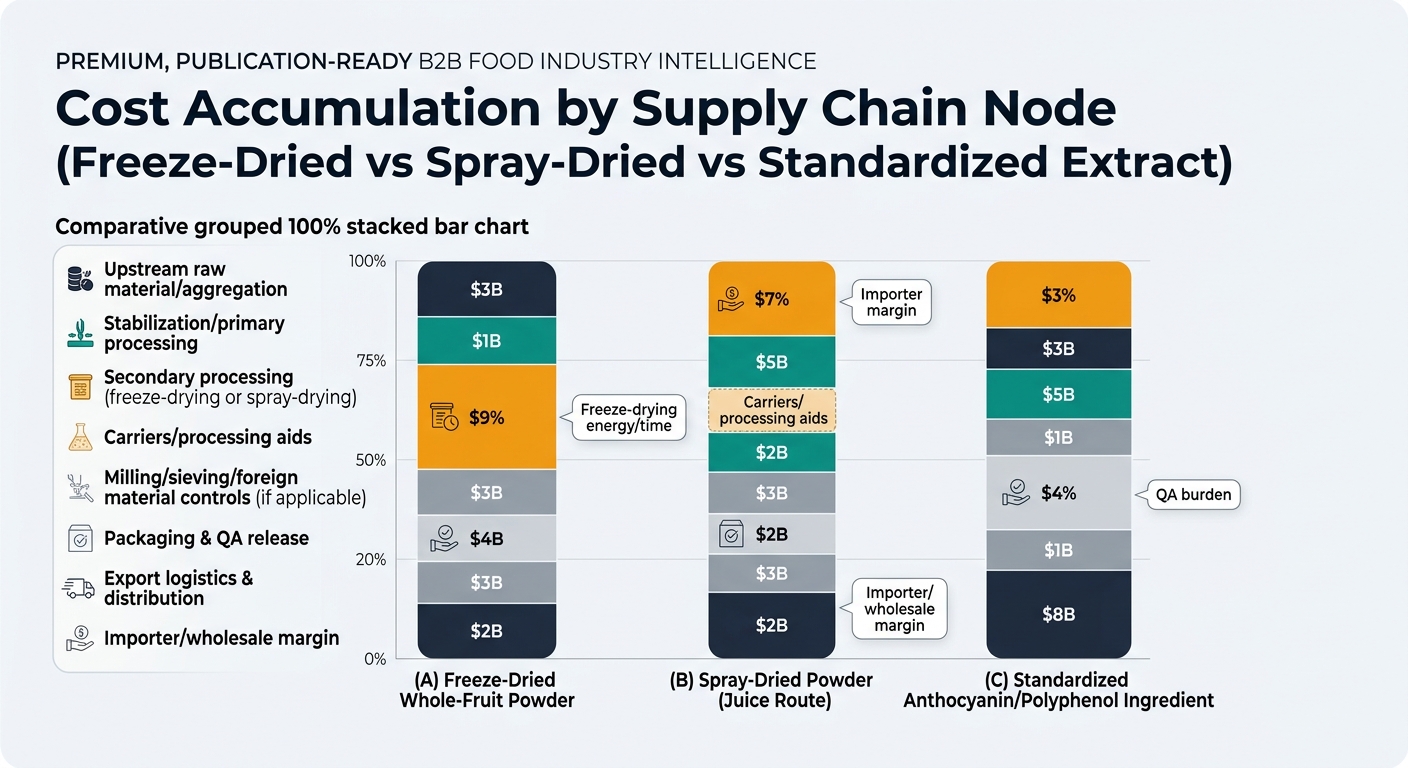
A comparative 100% stacked bar chart with three side-by-side bars for (A) Freeze-Dried Whole-Fruit Powder, (B) Spray-Dried Powder (Juice Route), and (C) Standardized Anthocyanin/Polyphenol Ingredient, segmented by supply chain nodes using the exact table percentages; includes a legend and callouts highlighting dominant drivers such as freeze-drying energy/time, importer margin in the spray-dried route, and QA burden in the standardized extract.

A) Freeze-Dried Whole-Fruit Maqui Powder (Premium Ingredient)

Supply Chain Node Cost Ratio (% of Final Cost) Notes
Upstream raw berries + aggregation 22% Labor, remote logistics, variability in usable yield.
Stabilization (freezing/primary handling) 10% Speed-to-stabilize, cold chain, lot formation.
Secondary processing (freeze-drying) 30% Energy + vacuum time; throughput bottleneck.
Milling/sieving/foreign material controls 6% Particle size, metal detection, rework losses.
Packaging & QA release 12% High-barrier liners/drums, lab testing, holds.
Export logistics & distribution 8% Consolidation, freight, humidity/heat protection.
Importer/wholesale margin 12% Working capital on seasonal inventory + handling.

B) Spray-Dried Maqui Powder (Juice/Concentrate Route; Often Lower Cost)

Supply Chain Node Cost Ratio (% of Final Cost) Notes
Upstream berries (for juice/concentrate feedstock) 18% Fruit quality still matters, but route can tolerate different inputs.
Primary processing (pressing/concentration) 14% Equipment/energy; byproduct handling (pomace).
Secondary processing (spray-drying) 16% Lower cost than freeze-drying; process control critical.
Carriers/processing aids (if applicable) 8% Common carriers in fruit spray-drying include maltodextrin/gum arabic; impacts label and potency-per-kg.
Packaging & QA release 14% Moisture control + identity/potency confirmation.
Export logistics & distribution 10% Similar physical risks in transit.
Importer/wholesale margin 20% More intermediated trade is common in commodity-like powders.

C) Standardized Maqui Anthocyanin/Polyphenol Ingredient (Extract/Standardized Powder)

Supply Chain Node Cost Ratio (% of Final Cost) Notes
Raw material + stabilization 15% Feedstock can be berries or pomace depending on processor.
Extraction/standardization 28% Solvent/processing complexity; concentration to spec.
Drying (often spray/freeze depending on format) 15% Energy + yield losses.
QA release (potency + contaminants) 18% Higher testing burden to defend standardized claims.
Packaging (high barrier) 10% Protection against oxygen/moisture; smaller pack sizes.
Export logistics & distribution 6% Higher value density reduces freight share.
Importer/wholesale margin 8% Technical selling + documentation overhead.
Unlock Full Data
Conventional Maqui Berry Powder Market Intelligence
Prices · Trends · Origins · Forecasts

3) Structural Facts You Can’t Negotiate Away (Industry Constants)

Insight: Maqui powder behaves like a “high-value botanical” structurally: seasonal upstream capture, dehydration bottlenecks, and stability constraints dominate outcomes more than farm inputs.

Data: (1) Harvest/collection is commonly referenced as Dec–Mar in Chile (some dossiers summarize Dec–Feb); (2) freeze-drying energy intensity is documented at ~600–1000 kWh/kg water removed; (3) anthocyanins are sensitive to oxygen/light/heat/humidity.

Procurement Impact: The supply chain’s physical constraints create predictable pressure points: capacity peaks, moisture control failures, and potency drift—each of which shows up as COA variability and shelf-life risk.

  • Structural reality #1 (Seasonality forces inventory build): A short collection window means processors must run hard, then hold stock. That increases working capital, storage time, and the importance of stable packaging.
  • Structural reality #2 (Dehydration capacity is the true “factory gate”): Freeze-dryers are expensive, slow, and energy-intensive; when capacity tightens, lead times and lot sizes become constrained by physics, not planning.
  • Structural reality #3 (Powder stability is moisture/oxygen engineering): Teams often use low water activity targets as a stability control for fruit powders; for maqui, anthocyanin sensitivity makes barrier packaging and dry storage non-optional.

Quick Win: Treat packaging specs (liner type, barrier class, reseal policy, max RH/temperature storage) as part of the “manufacturing spec,” not a logistics preference.

Key Insights (What to Remember When You Read Any Spec or COA)

  • Key Takeaway: The chain’s biggest fixed cost is water removal, especially freeze-drying; it’s structurally energy- and time-intensive.
  • Key Takeaway: The chain’s biggest technical fragility is anthocyanin stability, which is materially affected by oxygen, light, heat, and humidity exposure.
  • Key Takeaway: The chain’s biggest operational constraint is seasonality, which forces lot formation and inventory aging—making moisture/oxygen barrier performance and storage discipline central to delivered quality.

The Bottom Line for Your Next Contract

(Analyzed at: Aug, 2026)

Given ongoing electricity price pressure in Chile (a known theme in 2024–2026 tariff adjustments) and the fact that freeze-drying is structurally energy-heavy, treat maqui powder as an “energy-priced” ingredient: lock in route-specific contracts (freeze-dried whole fruit vs. spray-dried juice) with explicit packaging/storage controls and a defined re-test cadence at receipt. This works because you’re controlling the two biggest drivers of downstream disputes—dehydration route and post-dry moisture/oxygen exposure—before they show up as COA variability or shelf-life drift. Teams that do this typically avoid the expensive pattern of holds, rework, and expedited replacement lots; on a meaningful program, it’s common for that avoidable friction to rival a mid-single-digit percent of annual spend.

Not legal advice; consult regulatory counsel for labeling/claims. Not a substitute for audits, supplier quality oversight, or laboratory testing.

Unlock Full Data
Conventional Maqui Berry Powder Market Intelligence
Prices · Trends · Origins · Forecasts

Related Contents

Subscribe
→
By subscribing you agree to with our Privacy Policy and provide consent to receive updates from our company.
Thank you! Your submission has been received!
Oops! Something went wrong while submitting the form.
Subscribe to receive the latest blog posts, updates, promotions, and announcements from Tridge.
