INDUSTRY TRENDS

Mango Puree Supply Chain Map for Inventory & Warehouse Teams: Flow, Specs, and Landed-Cost Levers

Author
Team Tridge
DATE
July 31, 2026
7 min read
mango-puree Cover
Unlock Full Data
Mango Puree Market Intelligence
Prices · Trends · Origins · Forecasts

This guide maps how mango puree is made, packed, and moved—and highlights where cost and risk “lock in” for Inventory & Warehouse owners. The goal is to help you translate upstream realities (seasonality, processing windows, packaging integrity) into practical downstream controls (receiving checks, quarantine capacity, FEFO discipline, and smarter reorder buffers).

Executive Summary

  • Mango puree is “seasonally made, year-round consumed”—most inventory is created in a short processing window and carried for months, making working capital and FEFO structural, not optional.
  • Typical specs are real and measurable: single-strength puree is commonly traded around 14–18 °Brix with pH ~3.5–4.5, while concentrate commonly trades around 28–30 °Brix (spec sheets vary by supplier/variety). [1]
  • Aseptic integrity is binary: once a bag/drum system is compromised, you often lose the lot or incur costly disposition—so packaging and receiving discipline routinely outpay small unit-price savings. [2]
  • Frozen formats shift cost into logistics: reefer freight + cold storage structurally raise landed cost and space pressure versus ambient aseptic.
  • (Analyzed at: Jul, 2026) Export volatility tied to geopolitical/logistics disruption remains a live risk signal for processed mango flows, so inventory buffers should be based on lead-time distribution (best/likely/worst), not averages. [3]

1) How Mango Puree Physically Moves (and Where Cost “Locks In”)

Insight: Mango puree is a “seasonally made, year-round consumed” ingredient: most physical value is created in a short harvest/processing window, then carried forward as shelf-stable (aseptic) or cold-chain (frozen) inventory.

Data: Industrial mango puree is commonly standardized as single-strength puree around ~14–18 °Brix and pH ~3.5–4.5, while mango puree concentrate is commonly ~28–30 °Brix for freight/storage efficiency (exact bands vary by supplier and variety). [1]

Procurement Impact: The fixed cost-drivers you inherit downstream are largely decided upstream: fruit yield and defect rate at intake, processing uptime during peak weeks, and packaging integrity (aseptic bags/drums or frozen blocks) determine losses, holds, and usable shelf-life.
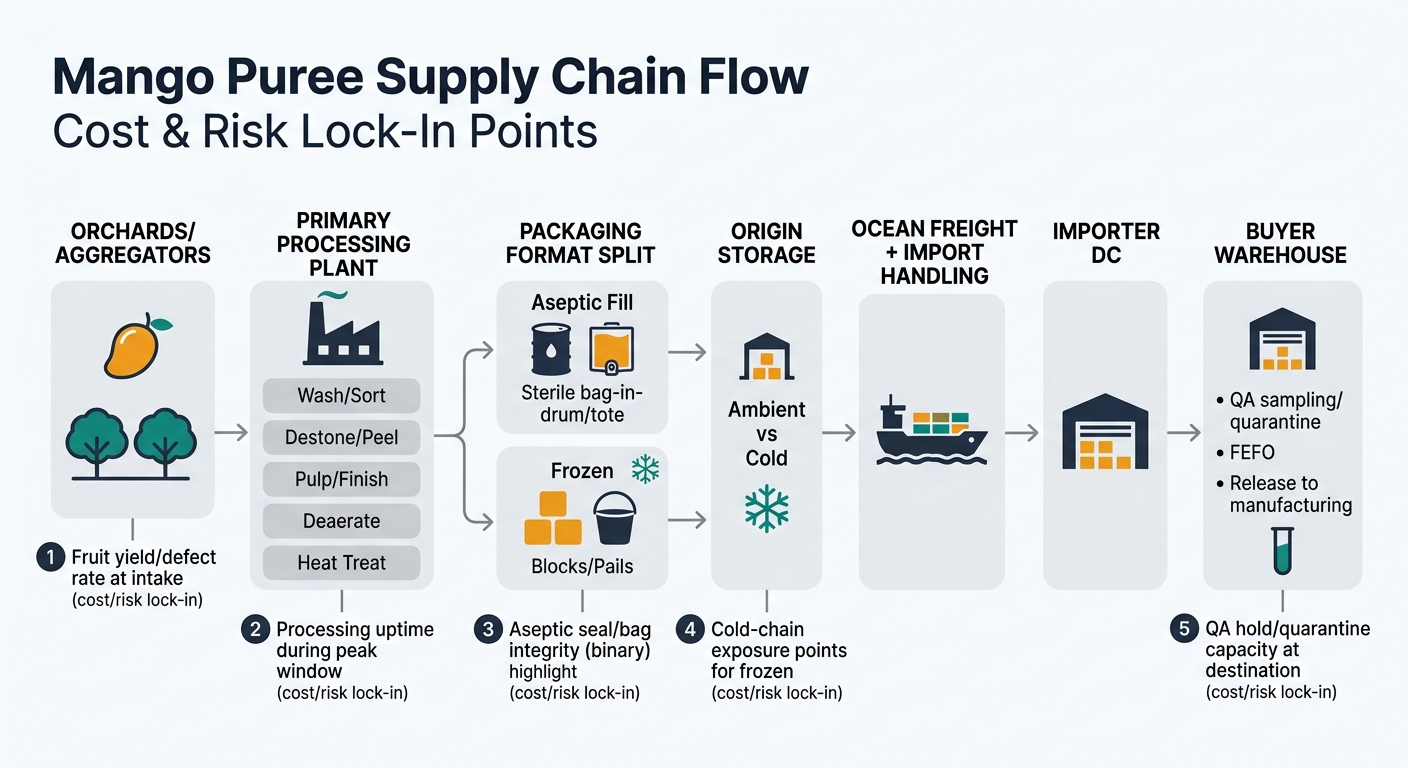
Ground-truth flow (typical export-grade chain)

  • Orchards/aggregators → fruit harvested to tight ripeness windows; sorted to processing grade.
  • Primary processing plant near origin → wash/sort → destone/peel → pulp/finish (fiber control) → deaerate (oxygen removal) → heat treat (pasteurization/UHT depending on process) → aseptic fill into sterile bags inside drums/totes, or freeze into blocks/pails.
  • Origin storage & dispatch → ambient warehouse for aseptic; cold store for frozen.
  • Ocean freight + import handling → containerized shipments; customs, inspections; importer DC.
  • Buyer warehouse → QA sampling/quarantine, FEFO, repack/usage into manufacturing.
A supply chain flow diagram for mango puree from orchards/aggregators through primary processing, packaging split (aseptic bag-in-drum/tote vs frozen blocks/pails), origin storage (ambient vs cold), ocean freight and import handling, importer DC, and buyer warehouse (QA sampling/quarantine, FEFO, release to manufacturing), with callouts showing where cost and risk lock in (yield/defects, processing uptime, aseptic integrity, cold-chain exposure, and QA hold capacity).

2) Where Money Is Made or Lost: Per-Node Cost & Margin Structure

Insight: Mango puree cost builds through yield losses, energy/utility intensity, packaging materials, and logistics handling—then margins accrue where risk is absorbed (inventory carry, compliance, and service reliability).

Data: In regulatory language, aseptic processing and packaging is the filling of a commercially sterilized cooled product into presterilized containers, followed by aseptic hermetical sealing in an atmosphere free of microorganisms—making sterile barriers, sterilization validation, and closure integrity non-optional cost centers. [2]

Procurement Impact: For inventory/warehouse teams, the “hidden” landed-cost drivers are not just freight: they’re weight/solids shipped (°Brix), packaging format (drum/tote/pail), QA hold time, and losses from oxidation, contamination risk, or damaged aseptic bags.
1. Upstream / Raw Material (Mango Farming + Aggregation)

  • Insight: The farmgate cost is only the start; the real economic lever is processable yield (sound fruit %) during a short harvest window.
  • Data: Processing-grade mangoes compete with fresh-market pull in many origins; sorting removes undersize, damaged, or overripe fruit, directly reducing puree yield per ton received.
  • Procurement Impact: Even if you buy puree (not fruit), this node dictates your downstream variability: higher defect rates upstream translate into more aggressive standardization, higher fiber variability, and higher risk of sensory drift lot-to-lot.

2. Primary Processing (Pulping/Finishing + Heat Treatment)

  • Insight: This is the “value creation” node: converting perishable fruit into a pumpable, standardized ingredient while controlling fiber, enzymatic browning, and microbiological risk.
  • Data: Export-grade lines typically include finishing (particle/fiber control) and deaeration (oxygen removal) before heat treatment; aseptic systems then fill into sterilized packaging under sterile conditions. [4]
  • Procurement Impact: This node drives the quality outcomes that cause warehouse pain later: viscosity drift (finisher settings), color oxidation (oxygen + heat history), and micro holds (process deviations) show up as longer QA quarantine and slower inventory turns.

3. Secondary Processing (Standardization + Concentration)

  • Insight: Concentration is a structural cost trade: you pay energy/capex to remove water, but you ship fewer tons and store more solids per pallet.
  • Data: Mango puree concentrate is commonly specified around 28–30 °Brix, versus single-strength puree commonly ~14–18 °Brix; this is widely reflected across commercial specifications. [5]
  • Procurement Impact: °Brix is a warehouse cost driver disguised as a spec: higher solids typically means fewer inbound pallets per ton of mango solids, but also higher viscosity (pumping/handling time) and often more critical reconstitution controls in manufacturing.

4. Packaging & QA Release (Aseptic Drums/Totes vs Frozen Packs)

  • Insight: Packaging is not a commodity detail; it is the physical “insurance policy” that preserves sterility, flavor, and shelf-life through global logistics.
  • Data: Aseptic bulk fruit products are commonly packed in sterile bags inside drums/totes; aseptic guidance emphasizes container sterilization, sterile filling, and closure integrity as core control points. [6]
  • Procurement Impact: Warehouse losses cluster here: dented drums, punctured bags, compromised seals, or poor palletization create nonconformance and write-offs. QA cost also lives here (micro testing, sensory, Brix/pH confirmation) and directly affects quarantine space and release lead time.

5. Logistics & Distribution (Origin → Import DC → Buyer Warehouse)

  • Insight: Mango puree logistics cost is a function of format (aseptic vs frozen), density/solids shipped, and handling steps (rework, relabel, inspections), not just ocean freight.
  • Data: Aseptic puree can move ambient in standard containers; frozen requires reefer capacity and cold storage throughout, structurally raising handling and storage costs.
  • Procurement Impact: Every extra touchpoint adds risk of temperature abuse (frozen), physical damage (drums), and administrative delay (inspection/holds). For inventory teams, this shows up as wider arrival-date variance and higher safety-stock pressure even when demand is stable.
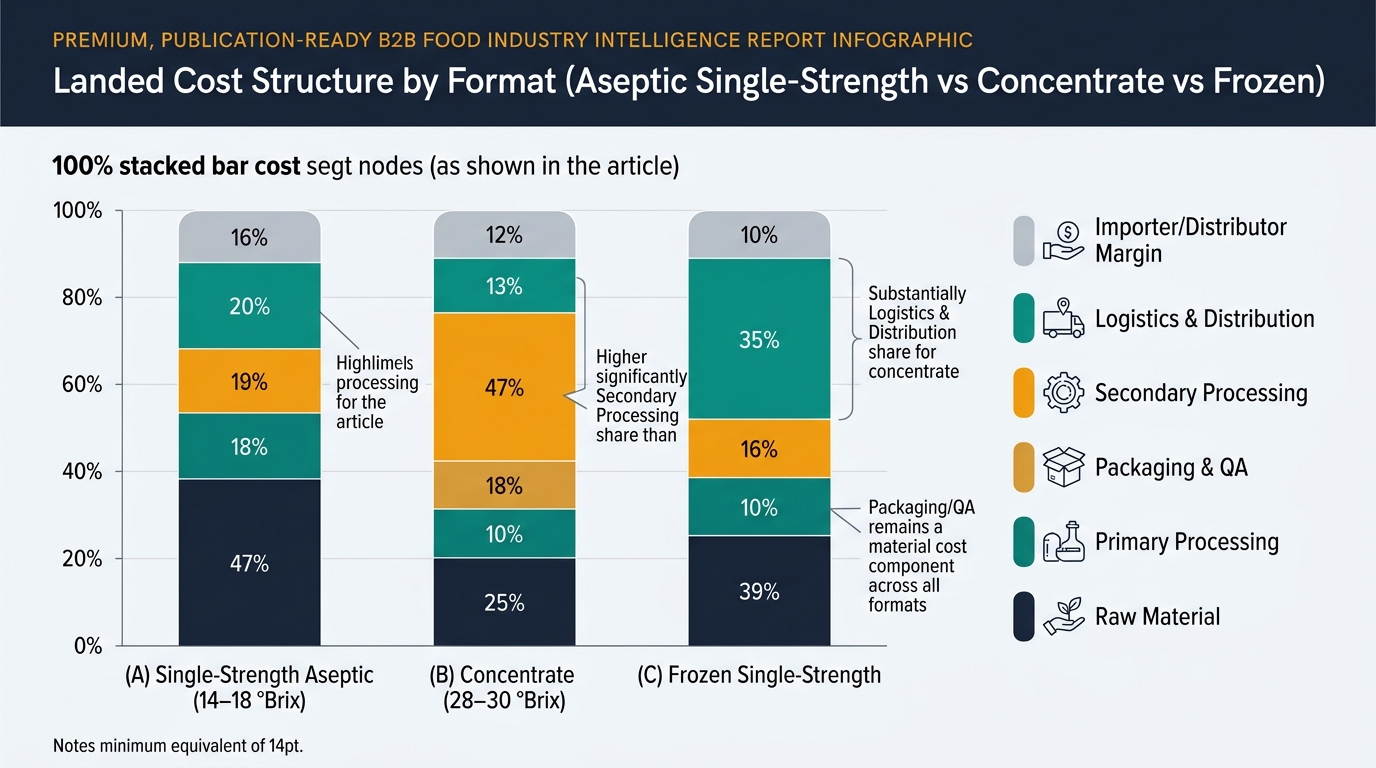
A 100% stacked bar chart comparing landed cost structure by format for (A) single-strength aseptic mango puree (14–18 °Brix), (B) mango puree concentrate (28–30 °Brix), and (C) frozen single-strength mango puree, segmented into Raw Material, Primary Processing, Secondary Processing, Packaging & QA, Logistics & Distribution, and Importer/Distributor Margin, with callouts highlighting higher secondary processing for concentrate and higher logistics for frozen.

Product-Level Cost Breakdown

A) Single-Strength Aseptic Mango Puree (14–18 °Brix)

Supply Chain Node Cost Ratio (% of Final Cost) Notes
Raw Material Cost (fruit + aggregation) 35% Yield and defect rate dominate effective fruit cost per kg puree.
Primary Processing 20% Labor, utilities, water/effluent, finishing losses, heat treatment.
Secondary Processing 5% Standardization/blending; limited concentration work.
Packaging & QA 15% Aseptic bags/drums, sterile validation, micro/sensory testing.
Logistics & Distribution 15% Inland + ocean + import handling; ambient storage cost.
Importer/Distributor Margin 10% Service, compliance, inventory carry, shrink allowance.

B) Mango Puree Concentrate (28–30 °Brix)

Supply Chain Node Cost Ratio (% of Final Cost) Notes
Raw Material Cost (fruit + aggregation) 30% More solids shipped per pallet, but fruit quality still governs yield.
Primary Processing 18% Similar front-end conversion cost before concentration.
Secondary Processing 12% Energy/capex for evaporation; higher viscosity handling.
Packaging & QA 13% Often similar pack formats; tighter spec verification common.
Logistics & Distribution 15% Lower freight per mango-solid unit offsets some added processing.
Importer/Distributor Margin 12% Higher working-capital value per drum; tighter compliance burden.

C) Frozen Mango Puree (Single-Strength)

Supply Chain Node Cost Ratio (% of Final Cost) Notes
Raw Material Cost (fruit + aggregation) 32% Similar yield dynamics; freezing can tolerate different operating patterns.
Primary Processing 18% Pulping/finishing + pasteurization; then freezing step.
Secondary Processing 3% Typically limited to blending/standardization.
Packaging & QA 12% Pails/blocks/liners; QA similar but cold-chain adds controls.
Logistics & Distribution 25% Reefer ocean + cold storage + higher handling costs.
Importer/Distributor Margin 10% Cold-chain service level + shrink/temperature risk premium.
Sourcing Window Radar
Mango Puree — Global Harvest Calendar
INDIA SEASON ACTIVE
🇮🇳 India
JAN — DEC
🇲🇽 Mexico
JAN — DEC
🇨🇴 Colombia
JAN — DEC
🇵🇪 Peru
JAN — DEC
🇨🇷 Costa Rica
JAN — DEC
JanFebMarAprMayJunJulAugSepOctNovDec

3) Structural Facts Every Inventory & Warehouse Owner Should Treat as “Physics”

Insight: Mango puree behaves like a manufactured ingredient with an agricultural clock: the chain is forced to build inventory when fruit is available, then protect that inventory through packaging integrity and storage discipline.

Data: Commercial specs commonly anchor around measurable “control knobs” such as °Brix (e.g., 14–18 for puree; 28–30 for concentrate) and pH ranges around ~3.5–4.5, reflecting standardization for stability and application fit (supplier-dependent). [1]

Procurement Impact: These realities translate into warehouse KPIs (quarantine days, write-offs, space utilization) more than sourcing KPIs—because the physical product is sensitive to time, temperature, and packaging damage.

  • Structural reality #1 — Seasonality forces inventory carry: Processing plants run hardest during harvest windows; the system is designed to pack months of supply into aseptic drums/totes (or frozen stock). That makes working capital, storage capacity, and FEFO discipline structural—not optional.
  • Structural reality #2 — Aseptic integrity is binary: Aseptic processing depends on sterile product + sterile package + sterile filling; once compromised (puncture, seal failure, improper handling), the lot often becomes unusable or requires costly disposition. [2]
  • Structural reality #3 — °Brix is a logistics multiplier: Concentrate reduces water shipped (fewer pallets/containers per unit of mango solids), but increases viscosity and handling complexity; single-strength is easier to pump/use but heavier to store and ship.

4) Key Takeaways for Inventory & Warehouse Teams (What to Watch Physically)

Insight: Most downstream surprises are physical: damaged packs, delayed QA release, and mismatch between format and storage capacity.

Data: Mango puree is routinely traded in standardized spec bands (°Brix/pH) and bulk aseptic packaging systems that rely on validated sterile processing and container sterilization. [1]

Procurement Impact: If you control receiving discipline and storage rules, you directly reduce write-offs and expedite freight by keeping usable inventory “release-ready.”

  • Key Takeaways: Aseptic drum condition and bag integrity are first-order quality controls, not cosmetic checks.
  • Key Takeaways: Quarantine time is a cost node—plan physical space and sampling throughput like you plan pallet positions.
  • Key Takeaways: Choose storage strategy around format: frozen is logistics-heavy but can protect some sensory attributes; aseptic is ambient-efficient but unforgiving to packaging failures.

5) The Bottom Line for Your Next Contract

(Analyzed at: Jul, 2026)

Write your next mango puree contract so your “deliverable” is not just product and spec, but pack integrity through receiving: drum gauge/condition tolerance, pallet pattern, corner boards/top frames, and a documented bag/fitment inspection at loading and unloading with photo evidence. This works because aseptic failures are effectively binary—once sterility is at risk, you’re paying in quarantine days, disposal, and emergency substitutions, not pennies per pound. With 2026 logistics volatility and export disruption still showing up in origin markets for processed mango (and reefer/cold-chain costs staying structurally high), the teams that lock in tighter packaging/handling SLAs and measure damage/hold rates lot-by-lot typically avoid the most expensive outcome: a “cheap” lot that never becomes usable inventory. [2]

Mango PureeSupply Chain Intelligence
163 countries tracked
10
Exporters
10
Importers
$636M
Top Export Value
Top Exporters (2024)
🇰🇷
South Korea
$636M
🇲🇽
Mexico
$416M
🇹🇭
Thailand
$355M
🇳🇱
Netherlands
$296M
🇺🇸
United States
$215M
+158 more
Top Buyers
🇺🇸 United States $2.22B🇯🇵 Japan $398M🇳🇱 Netherlands $296M🇨🇦 Canada $219M🇩🇪 Germany $174M

References

  1. iqgfoods.com
  2. law.cornell.edu
  3. newindianexpress.com
  4. sciencedirect.com
  5. 12taste.com
  6. fda.gov

Related Contents

Subscribe
→
By subscribing you agree to with our Privacy Policy and provide consent to receive updates from our company.
Thank you! Your submission has been received!
Oops! Something went wrong while submitting the form.
Subscribe to receive the latest blog posts, updates, promotions, and announcements from Tridge.
