
Low-brix apple juice concentrate (AJC) looks like a simple commodity, but the real procurement outcomes (holds, claims, audit pain, and total cost of quality) are largely predetermined by upstream fruit condition, midstream utilities/throughput constraints, and downstream aseptic integrity. This guide maps the physical flow and shows where cost and risk get “locked in,” so Purchasing–QA–Compliance teams can ask better questions before the next contract or supplier switch.
Low-brix apple juice concentrate (AJC) is built on a simple physical chain—apples → juice → clarified base → vacuum concentration to a target (lower-than-standard) Brix → aseptic packing → container logistics—but the cost structure is not simple. Fixed cost drivers accumulate early (raw apple quality/yield, water/wastewater capacity, and energy for evaporation) and then become hard to “undo” downstream. The product’s tradeable form (aseptic bag-in-drum/tote) makes it globally mobile, but it also concentrates risk into a few failure points: harvest quality, sterility control at filling, and long lead-time logistics.
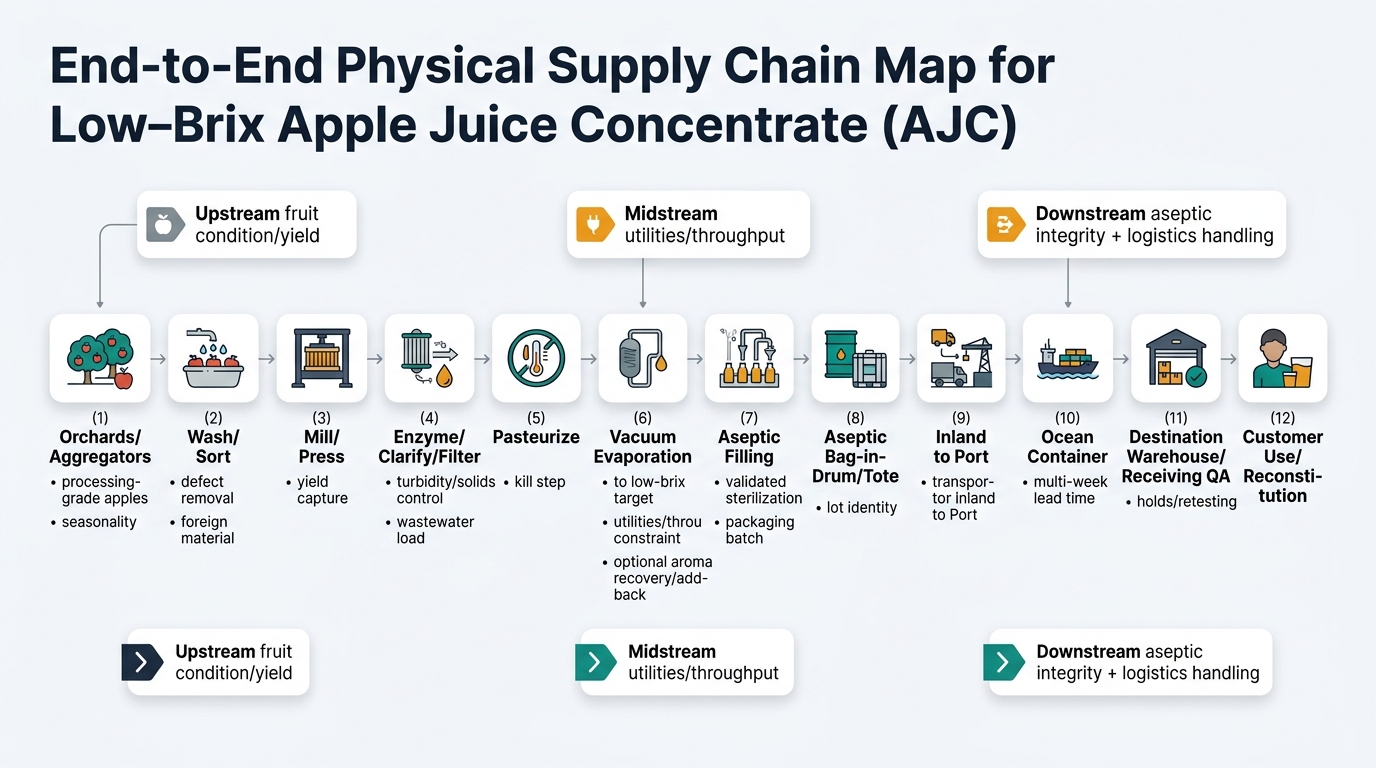
Insight: In low-brix AJC, “value add” is less about branding and more about physical transformations (yield capture, microbial stability, and spec standardization). Costs are dominated by (1) fruit-to-juice yield and defect removal, (2) utilities (energy + water + wastewater), (3) aseptic packaging materials and sterility assurance, and (4) logistics/working-capital tied up in long transit and lot release.
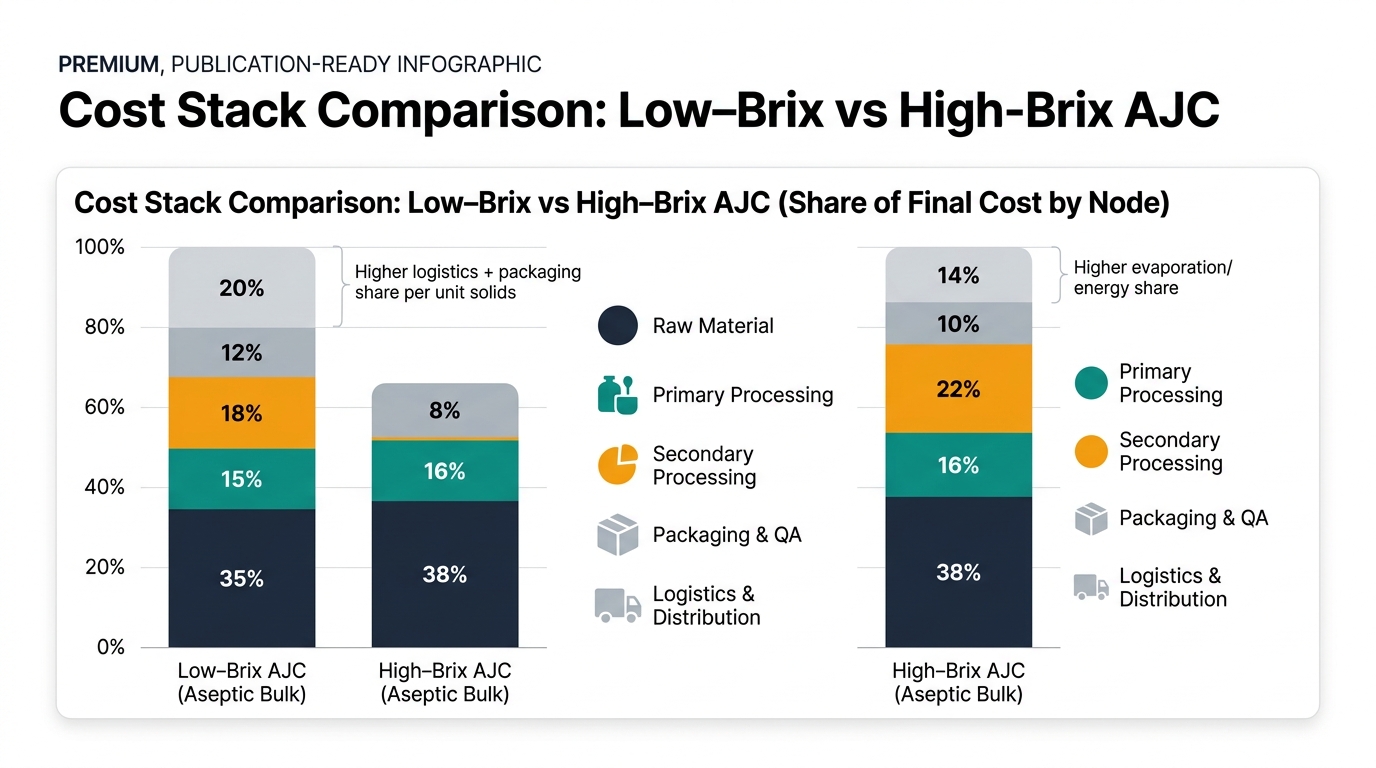
| Supply Chain Node | Cost Ratio (% of Final Cost) | Notes |
|---|---|---|
| Raw Material (processing apples) | 35% | Yield and defect load drive usable juice per ton and risk controls. |
| Primary Processing (pressing/clarification) | 15% | Enzymes, filtration, labor, wastewater capacity, downtime. |
| Secondary Processing (vacuum concentration/standardization) | 18% | Utilities (steam/electricity) + throughput constraints; optional aroma handling. |
| Packaging & QA (aseptic) | 12% | Sterile bags + drums/totes + verification testing and lot documentation. |
| Logistics & Distribution | 20% | Inland + ocean container + warehousing; low-brix ships more mass per solids. |
| Supply Chain Node | Cost Ratio (% of Final Cost) | Notes |
|---|---|---|
| Raw Material (processing apples) | 38% | Similar upstream dependence; yield remains the anchor. |
| Primary Processing (pressing/clarification) | 16% | Similar unit operations; filtration load varies by fruit condition. |
| Secondary Processing (more evaporation) | 22% | Higher evaporation load typically increases energy share. |
| Packaging & QA (aseptic) | 10% | Packaging per unit solids can be lower due to higher concentration. |
| Logistics & Distribution | 14% | Less mass shipped per unit solids generally reduces freight share. |
| Supply Chain Node | Cost Ratio (% of Final Cost) | Notes |
|---|---|---|
| Concentrate input (low- or high-brix) | 55% | Dominant cost is the upstream concentrate. |
| Reconstitution & blending operations | 10% | Water quality, blending tanks, in-line Brix control. |
| QA & release testing | 8% | Verification of Brix/acid/micro; traceability to concentrate lots. |
| Packaging (if packed) | 12% | Dependent on final format (bulk vs retail). |
| Local logistics & storage | 15% | Shorter routes but higher volume movement of finished liquid. |
(Analyzed at: Sep, 2026)
Treat 2026–2027 low-brix AJC sourcing as a two-variable contract: price and verified traceability/aseptic discipline. In the current Europe–China trade mix, EU availability signals have been volatile (e.g., reported declines in Poland’s concentrate volumes over 2022–2025 and a weaker 2026 crop estimate), which increases the odds that you’ll be offered multi-origin blends or intermediary paper that looks fine until a hold happens. [5]
Put one requirement in writing: every lot must ship with line-level aseptic pack records and a patulin control story that is auditable (not just a COA), because the FDA action level commonly referenced for patulin is 50 µg/kg and regulators expect preventive controls to be real, not cosmetic. [6]
The dollars at stake usually show up as avoidable demurrage, retesting, and downtime—often far exceeding any “won” savings on a few cents per kilo.


