Low-sodium beef jerky sourcing looks like a pricing exercise until you live through the first hold, complaint spike, or label correction. This framework is built for Purchase roles accountable for Quality/Safety/Compliance who need a repeatable way to approve (or block) suppliers, set defensible specs, and contract the right controls—without becoming a jerky-processing expert overnight.
Insight: Low-sodium beef jerky sourcing is not a single “pick a supplier” decision—it’s a linked set of decisions (spec → process capability → verification → contracting) where sodium reduction can unintentionally increase safety, shelf-life, and labeling risk if you qualify the wrong process or lock the wrong tolerances.
Data: Shelf-stable jerky is commonly controlled as an intermediate-moisture RTE product where water activity is often targeted in the ~0.70–0.85 range, and aw ≤ 0.85 is widely used as a shelf-stability boundary for products stored in an oxygen-containing environment (with steps to prevent mold growth). [2]
Procurement Impact: A “good price” supplier that can’t consistently hit validated lethality + drying controls will raise your total cost of quality (holds, rework, expedited freight, claim relabeling) and increase recall exposure—especially when sodium is constrained and you have fewer formulation levers.
Insight: You need a structured decision approach when any one constraint (low sodium claim, short timeline, private label penalties, single-source exposure) forces trade-offs between safety margin, sensory quality, and supply continuity.
Data: In the U.S., “low sodium” is defined in regulation as 140 mg sodium or less per serving/RACC criteria (21 CFR 101.61 includes additional conditions such as per-50g criteria when the RACC is small). [1]
Procurement Impact: If your sodium ceiling is fixed by a claim, you must shift risk control to process capability (kill step + drying), packaging oxygen control, and verification cadence—and you must contractually prevent “silent” ingredient or process substitutions.
Insight: The right sourcing strategy depends on which constraint is binding: volume economics, timeline, or risk tolerance under low-sodium formulation limits.
Data: FSIS provides directives/guidance and training materials that emphasize validated lethality and stabilization expectations for RTE products; jerky-specific guidance also highlights drying and shelf-stability controls. [3]
Procurement Impact: Your decision tree should force clarity on: (1) what you can’t compromise (safety/claim), (2) what you can flex (non-critical aesthetics), and (3) what you must contract (change control, verification, remedies).
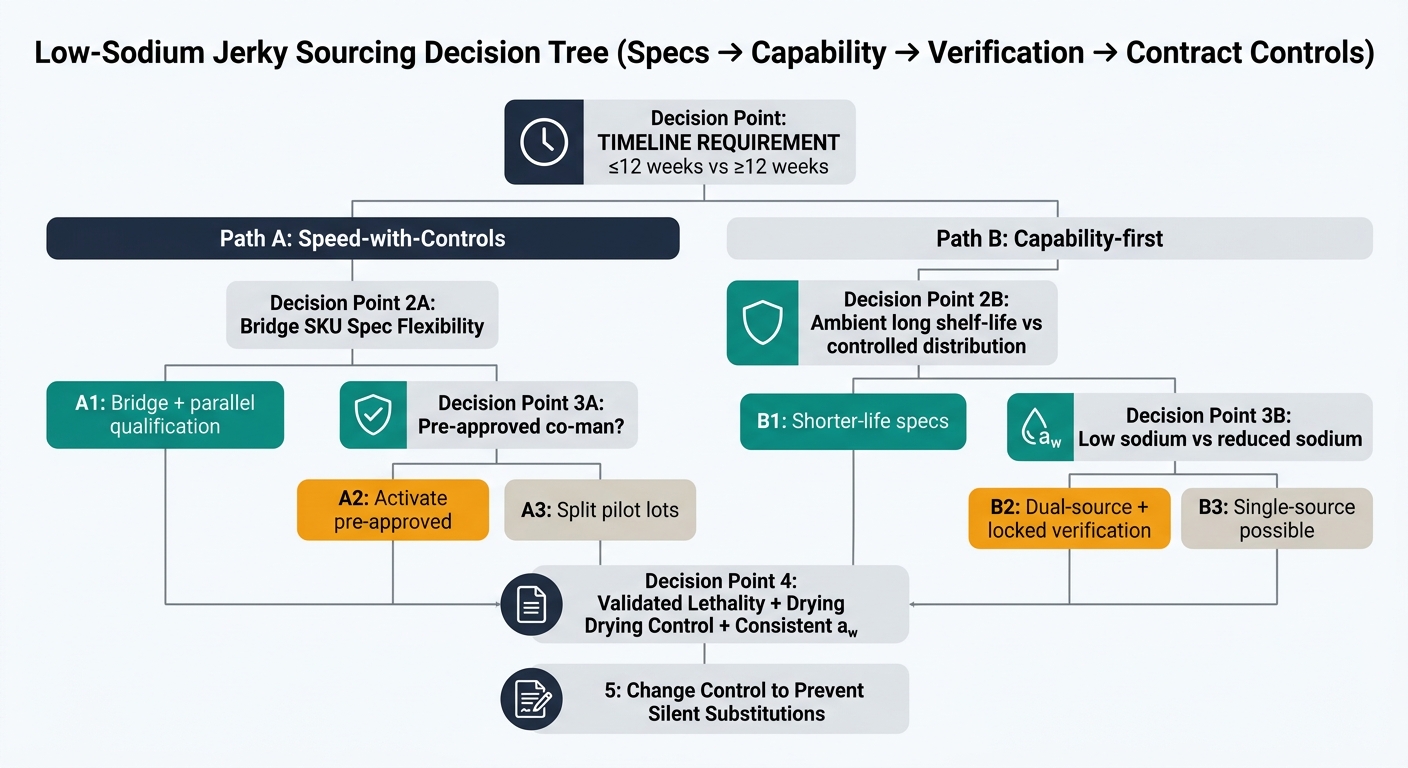
Insight: The same category can require opposite sourcing moves depending on whether your binding constraint is timeline, claim, or continuity risk.
Data: “Low sodium” is a defined claim threshold (≤140 mg/serving), and jerky commonly uses aw control (often ≤0.85 as a shelf-stability boundary under aerobic conditions) as a key stability/safety control. [1]
Procurement Impact: These walkthroughs show how to defend decisions in audits: you can point to a consistent logic that ties specs, validation, verification, and contracting.
Insight: Your sourcing strategy should be chosen by constraint, then “hardened” with the right spec and governance controls.
Data: FSIS jerky guidance and RTE verification expectations reinforce that shelf-stable jerky depends on supported process controls (including drying/shelf-stability parameters) and verification activities. [5]
Procurement Impact: This table converts the decision tree into a procurement-ready playbook you can share with QA/Ops.
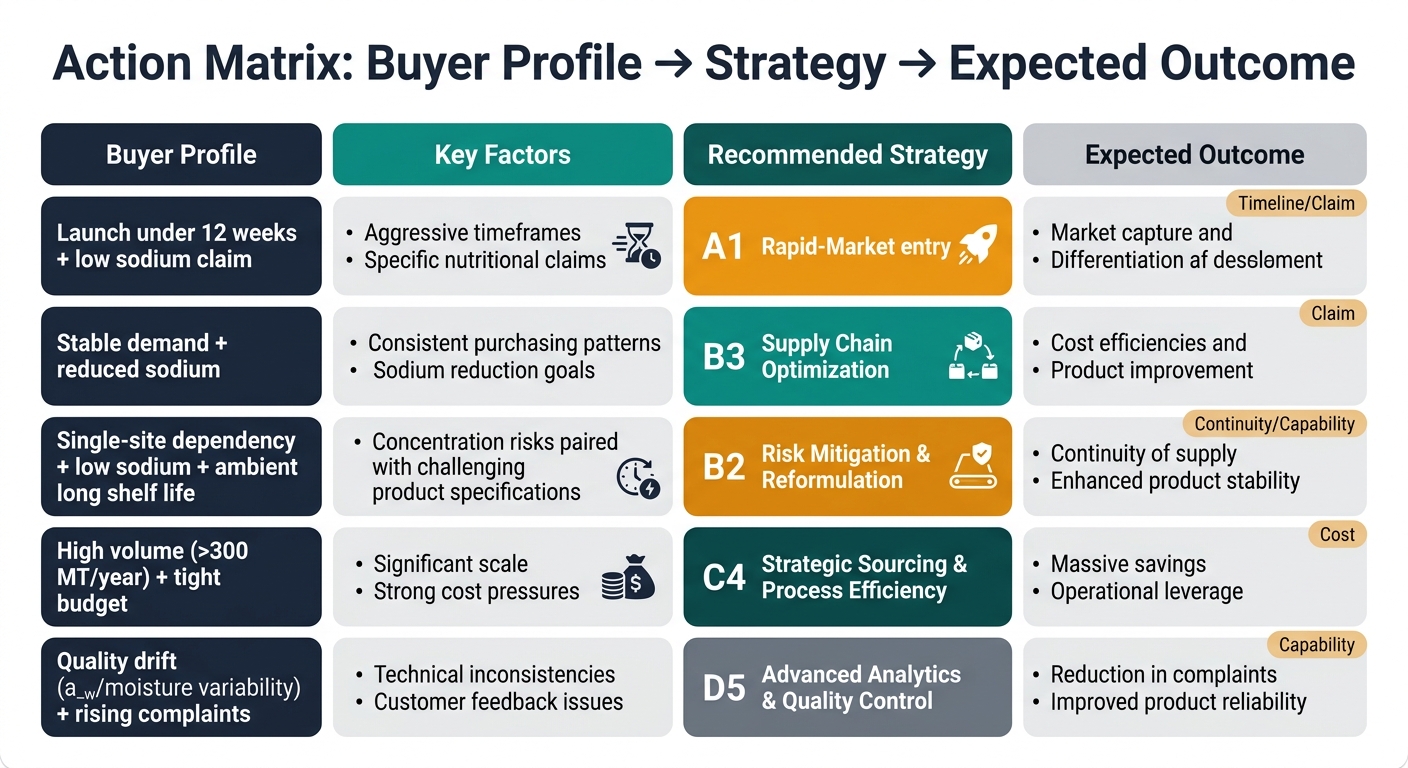
| Buyer Profile | Key Factors | Recommended Strategy | Expected Outcome |
|---|---|---|---|
| Launch under 12 weeks + low sodium claim | Timeline binds; claim binds; high penalties | Bridge supplier + parallel qualification (A1) | Ship on time with controlled risk; higher short-term CoQ spend |
| Stable demand + reduced sodium (not low sodium) | Time available; some formulation flexibility | Capability-first single-source with strict change control (B3) | Lower unit cost; manageable governance burden |
| Single-site dependency + low sodium + ambient long shelf life | Continuity risk; fewer formulation levers | Dual-source + contract verification plan (B2) | Resilience; fewer stockouts and emergency spec deviations |
| High volume (>300 MT/year) + tight budget | Scale economics; margin pressure | Dual-source with primary/secondary split + indexed pricing | Better leverage; less exposure to one supplier’s margin expansion |
| Quality drift (aw/moisture variability) + rising complaints | Process capability uncertainty | Re-qualify with capability scorecard; reduce award until stability proven | Fewer holds/returns; clearer CAPA accountability |
Insight: Low-sodium jerky failures usually show up as (1) safety margin erosion (process deviation), (2) shelf-life/texture drift (aw/moisture variability), or (3) labeling/allergen exposure from ingredient system changes.
Data: Jerky shelf stability commonly uses aw control (often ≤0.85 as a shelf-stability boundary under aerobic conditions), and FSIS materials emphasize supported lethality/stabilization decisions and verification activities. [6]
Procurement Impact: You reduce recall exposure and total cost of quality by defining early-warning metrics and hard stop triggers in the supplier management plan.
Insight: In low-sodium jerky, the best cost move is often a risk move: lock critical safety/stability controls (aw + validated process + change control) and then negotiate price on everything else.
Data: “Low sodium” is a defined claim threshold (≤140 mg/serving), and jerky commonly relies on aw control (often in the 0.70–0.85 band, with ≤0.85 used as a shelf-stability boundary under aerobic conditions) to support stability expectations. [1]
Procurement Impact: This approach reduces holds, rework, and relabel events—often the hidden drivers of total landed cost in better-for-you meat snacks.
Logical Next Step (analysis, not promotion): Most teams can’t answer—quickly and defensibly—whether a supplier’s recent operational changes (line moves, ingredient system swaps, packaging film changes, audit status shifts) are increasing risk before complaints or nonconformances spike. The procurement challenge is building a repeatable way to detect those change signals early and tie them to: (1) which specs must tighten, (2) when to shift volume, and (3) what verification evidence to demand—without slowing down launches or creating unnecessary rejects.
(Analyzed at: Jul, 2026)
With U.S. cattle inventory reported at 86.2 million head as of Jan 1, 2026, beef inputs remain structurally tight—so the “cheapest” jerky supplier is often the one that later forces holds, rework, and expedited freight when variability shows up. [4] Write your next low-sodium jerky award so aw limits + validated lethality/stabilization support + change-notification triggers are non-negotiable, then negotiate price via indexed beef mechanisms and packaging pass-throughs rather than squeezing the base tolling rate. This works because low-sodium removes formulation buffers; your real leverage is locking process capability and preventing silent changes. If you don’t, it’s common to give back several points of savings in unplanned CoQ—especially during peak weeks when you can’t afford a stop-ship.