
This guide maps lemon purée from orchard to bulk pack with a purchasing lens that’s accountable for Quality, Safety, and Compliance. The goal is to help you specify the right control points (format, physical attributes, packaging integrity, and logistics) so supplier comparisons hold up under audit—and so you don’t pay hidden cost in holds, rework, or sensory complaints.
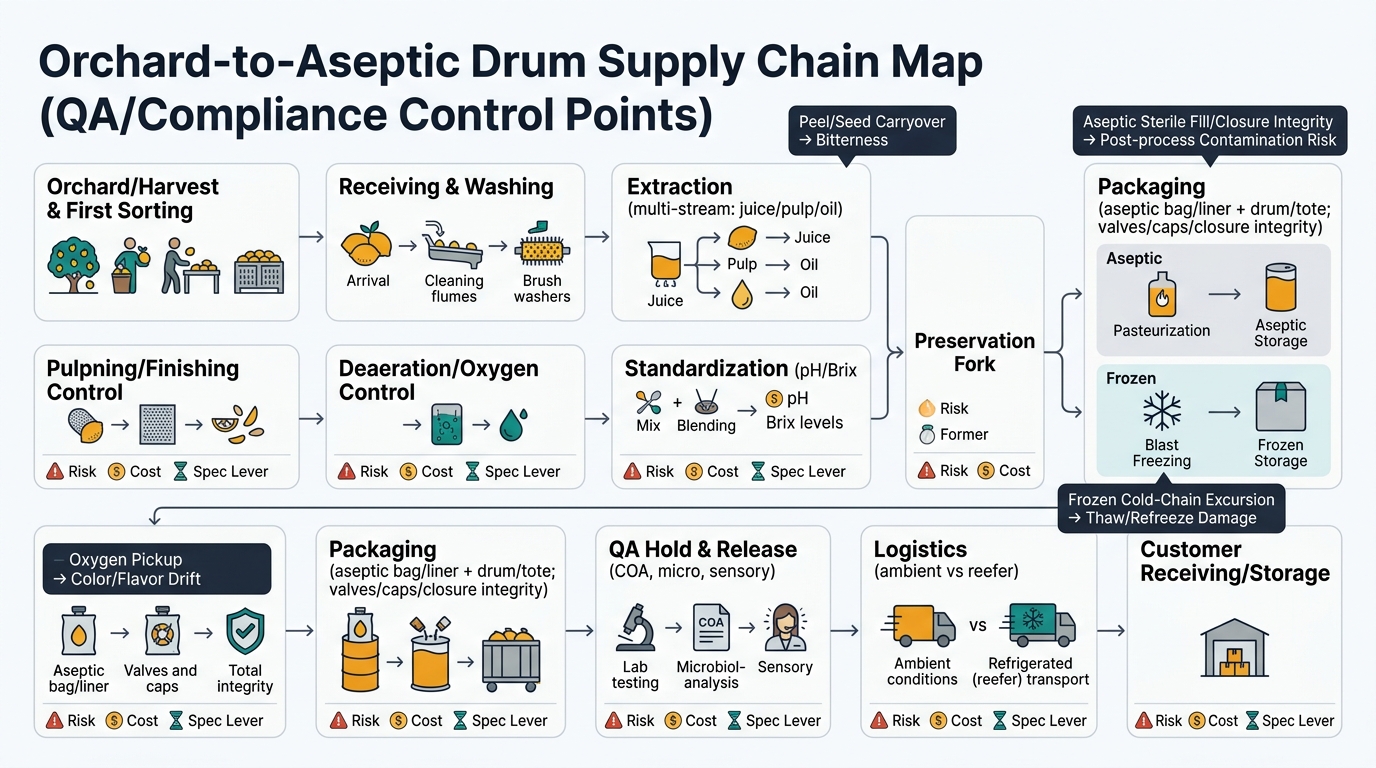
Lemon purée is not a single “commodity stream”; it is a co-product stream that competes for the same fruit, the same extraction line time, and the same packaging assets as lemon juice and peel oil. Physically, the chain is short (farm → processor → pack → ship), but the number of control points is high because small changes in peel/seed carryover, oxygen pickup, heat load, or temperature history can shift bitterness, color, and microbial stability.
Insight: The fixed cost-drivers are locked in early: fruit selection (fresh vs. processing grade), extraction/finishing yield, and preservation format (aseptic vs. frozen) determine most downstream cost and quality outcomes.
Data: Lemon juice is typically very acidic (often reported around pH ~2.2–2.7), which helps microbial inhibition—but does not eliminate spoilage risk from yeasts/molds or post-process contamination if aseptic integrity fails [1].
Procurement Impact: The “map” you need is not just origin; it’s (1) where fruit is grown, (2) where it is extracted/finished, (3) how it is preserved (aseptic/frozen), and (4) how packaging + logistics protect oxygen and temperature exposure.
Insight: Lemon purée cost is a stacked structure: agricultural cost + yield loss + preservation energy/capex + packaging + logistics. Margin tends to be earned where variability is controlled (standardization, finishing, aseptic filling) rather than where fruit is merely moved.

Data (validated directionally): Commercial lemon juice specifications commonly show low pH (<3) and a wide Brix band (example: 6–10 °Brix for single-strength pasteurized lemon juice), underscoring how “solids” and acidity are managed by blending/standardization downstream [5].
Procurement Impact: If you don’t explicitly define format (aseptic vs frozen), pulp/fiber target, and oxygen/temperature handling, suppliers will “optimize” differently—creating hidden cost in rejects, rework, and sensory drift.
| Supply Chain Node | Cost Ratio (% of Final Cost) | Notes |
|---|---|---|
| Upstream / Raw Material | 45% | Fruit cost + harvest labor + first sorting; biggest single driver. |
| Primary Processing | 12% | Washing/sanitation, extraction yield loss, finishing screens, foreign-body controls. |
| Secondary Processing | 10% | Thermal processing, de-aeration/standardization, sterile handling overhead. |
| Packaging & QA | 15% | Aseptic bags/liners, drums/totes, valves/caps, QA hold-and-release. |
| Logistics & Distribution | 8% | Ambient container + inland trucking; risk from heat exposure and physical damage. |
| Distributor/Converter Margin | 10% | Value for inventorying, breaking bulk, documentation, service levels. |
| Supply Chain Node | Cost Ratio (% of Final Cost) | Notes |
|---|---|---|
| Upstream / Raw Material | 40% | Similar fruit drivers; some specs may require tighter fruit selection. |
| Primary Processing | 12% | Similar extraction/finishing; viscosity and pulp target are key. |
| Secondary Processing | 15% | Freezing energy, freezing equipment capacity, cold handling. |
| Packaging & QA | 10% | Frozen-suitable liners/cartons; QA release often includes micro + sensory. |
| Logistics & Distribution | 15% | Reefer freight + cold storage + risk of temperature excursions. |
| Distributor/Converter Margin | 8% | Cold storage footprint and service complexity shape margin. |
| Supply Chain Node | Cost Ratio (% of Final Cost) | Notes |
|---|---|---|
| Upstream / Raw Material | 30% | Purée is still key, but diluted by added ingredients. |
| Primary Processing | 8% | Less yield pressure, but base purée quality still determines flavor. |
| Secondary Processing | 18% | Blending, heating, standardization, viscosity control, possible preservatives (market-dependent). |
| Packaging & QA | 18% | Often smaller pack sizes; higher packaging cost per kg + more QC checks. |
| Logistics & Distribution | 10% | Depends on ambient vs chilled; more handling steps. |
| Distributor/Brand/Channel Margin | 16% | More downstream value-add and channel markup. |
Insight: Lemon purée behaves like a “process-controlled” ingredient more than a “farm-controlled” ingredient: fruit variability is inevitable, but the chain’s structural constraints determine how much variability reaches you.
Data: Lemon products’ identity is strongly tied to physical transformation and texture outcomes, which makes particle-size control and finishing capability a structural differentiator between suppliers (even before you get to chemistry) [3].
Procurement Impact: If your specs ignore physical controls (pulp %, particle size, viscosity) and focus only on chemistry (pH/Brix), you will still see sensory drift and line performance issues.
The Bottom Line for Your Next Contract: (Analyzed at: Sep, 2026)
Given ongoing U.S. citrus supply sensitivity (USDA has flagged smaller expected California lemon crop in the 2025/26 outlook) and expanding HLB quarantine actions in California, treat lemon purée continuity as a governance problem, not just a price event [4].
Lock in dual-format resilience in your next contract: keep your primary supply in the format that best fits your operation, but qualify an alternate supplier (or alternate origin/packer) that matches physical specs (pulp/viscosity/particle) and pack integrity requirements—not just pH/Brix—because most avoidable failures sit in finishing, preservation, and packaging nodes. Done well, this typically pays back through fewer quarantines/leakers and fewer sensory-driven rejects, which is where a few points of landed-cost leakage usually hides.


