
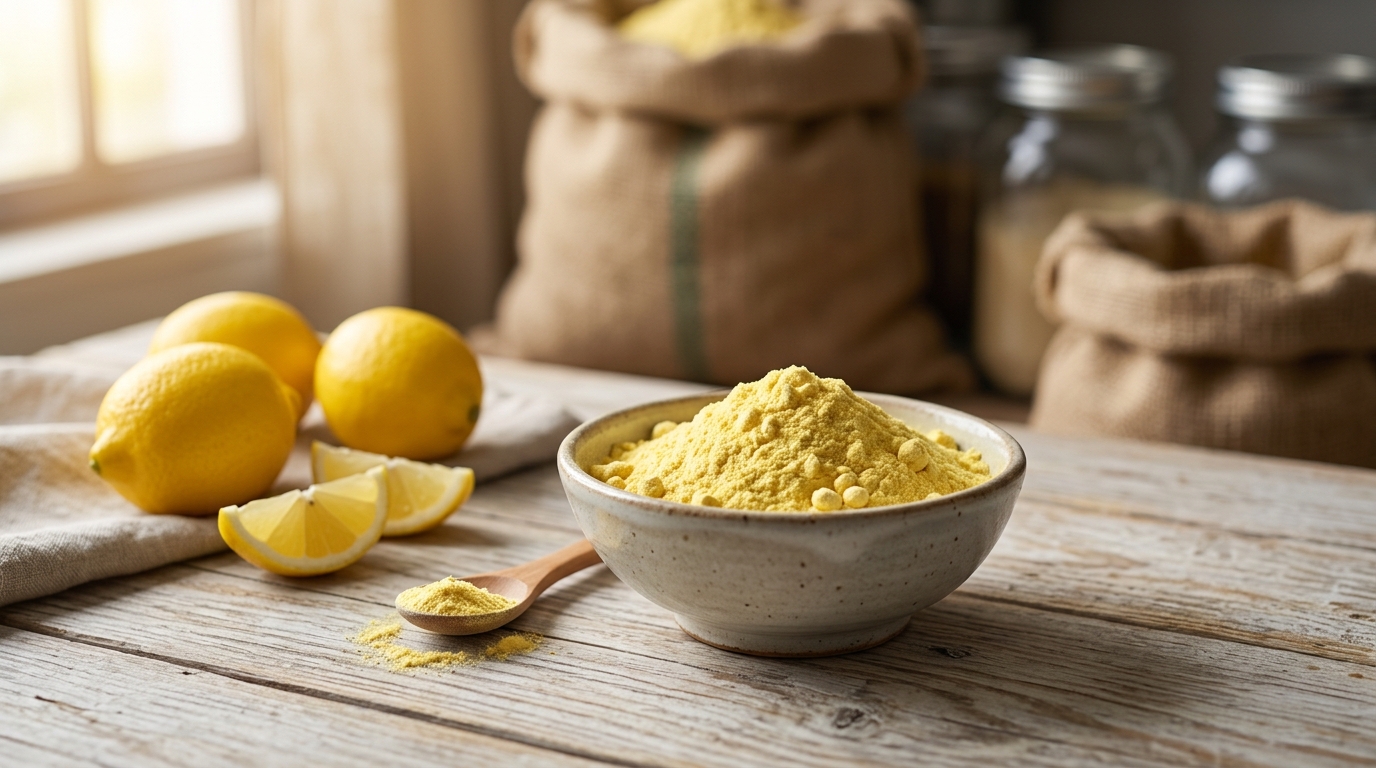
Lemon powder looks simple on a label, but for procurement and QA/Compliance it behaves like a high-governance powder: two main manufacturing routes, high moisture sensitivity, and frequent “same name, different performance” outcomes if specs are not explicit. This guide maps the physical chain, shows where costs and risks get locked in, and translates those realities into spec and supplier-approval actions you can implement without overcomplicating your workflow.
Lemon powder is not a single commodity—it is typically either milled powder from dehydrated lemon pieces/peel or spray-dried lemon juice powder (often requiring a carrier such as maltodextrin to make drying feasible and to improve flow). Those two routes create different “fixed” cost drivers: raw fruit yield and sorting losses upstream, and energy + drying capacity + carrier inputs downstream. [1]
Insight: The supply chain is best understood as two converging physical routes—(A) cut-and-dry then mill, and (B) juice-extract then concentrate/standardize then spray-dry—each producing materially different specs and compliance burdens.
Data: Typical control points that define downstream performance are set at manufacturing: moisture & water activity (caking/micro stability), titratable acidity (acid strength), carrier % (label + functionality), particle size (dispersion), and volatile oil retention (aroma).
Procurement Impact: If you don’t pin down the route and the “spec-lock” points early, you will see false equivalency: two suppliers can both say “lemon powder” while delivering different acidity, aroma, and documentation profiles—creating avoidable rework in approval, complaints, and change control.

Insight: Lemon powder’s cost build is a conversion story: you pay for water removal, yield loss, and protection of volatile aroma oils. Margins tend to concentrate where drying capacity, standardization know-how, and QA release capability sit.

Data: Drying steps are inherently energy-intensive; powders are hygroscopic and can cake or lose aroma if packaging/logistics are weak; and export-grade lots often require additional testing (residues/micro/heavy metals) that becomes a repeatable fixed overhead per batch. [2]
Procurement Impact: The “why” behind supplier quotes is usually traceable to one of three physical constraints: fruit economics (availability for processing), drying throughput/energy, or QA release/hold time.
| Supply Chain Node | Cost Ratio (% of Final Cost) | Notes |
|---|---|---|
| Raw Material (lemons/juice solids) | 25–35% | Driven by fruit diversion to processing and solids yield. |
| Primary Processing (extraction + concentration) | 12–18% | Evaporation energy + yield losses; clarification adds cost. |
| Secondary Processing (spray drying + carrier + standardization) | 25–35% | Energy + drying capacity + carrier input + rework/blending. |
| Packaging & QA Release | 8–12% | Barrier packs, lab panels, QA hold time/working capital. |
| Logistics & Distribution | 8–12% | Humidity control, warehousing, inland/ocean freight. |
| Distributor/Converter Margin | 5–12% | May include re-pack, blending, documentation handling. |
| Supply Chain Node | Cost Ratio (% of Final Cost) | Notes |
|---|---|---|
| Raw Material (lemons + sorting loss) | 30–45% | Fruit quality and reject rate matter; peel contribution changes profile. |
| Primary Processing (cutting + dehydration) | 20–30% | Dryer time/throughput and handling hygiene dominate. |
| Secondary Processing (milling + sieving + standardization) | 12–20% | Particle size control, foreign material control, blending. |
| Packaging & QA Release | 8–12% | Moisture barrier is critical; micro/residue testing. |
| Logistics & Distribution | 8–12% | Caking/odor taint risk; storage humidity control. |
| Distributor/Converter Margin | 5–10% | Often lower unless reprocessing/repacking is involved. |
| Supply Chain Node | Cost Ratio (% of Final Cost) | Notes |
|---|---|---|
| Core Inputs (lemon powder + citric acid) | 45–60% | Blend economics depend on lemon powder type and inclusion rate. |
| Secondary Processing (blending + anti-caking + sieving) | 10–18% | Homogeneity, flow agents, dust control, batch changeovers. |
| Packaging & QA Release | 8–14% | Additional label/claims control; allergen cross-contact statements matter. |
| Logistics & Distribution | 8–12% | Similar humidity sensitivity; often more stable than high-aroma grades. |
| Brand/Converter Margin | 10–20% | Value added in standardization, documentation, and pack formats. |
Insight: The lemon-powder supply chain has a few “constants” that shape availability and quality outcomes regardless of market conditions.
Data: These constants come from physics (drying and moisture), biology (seasonality and disease pressure), and governance (testing/documentation throughput).
Procurement Impact: If your specs and supplier approval workflow don’t reflect these constants, you’ll spend time chasing symptoms (failed lots, re-tests, complaints) instead of controlling root causes.
(Analyzed at: Sep, 2026)
Write your lemon-powder contract like a change-control document, not a commodity PO: require suppliers to declare process route (milled vs spray-dried), carrier type/% (if any), and moisture + water activity targetsand to ship only in an agreed high-barrier packaging configuration.
This works because the most common “surprise failures” (caking, inconsistent acidity/aroma, label surprises from carriers) are structural outcomes of drying route and moisture exposure, not random quality noise. With 2025/26 global lemon supply down to about 10.1M tons and sharp production declines in Turkey and the EU, the operational risk is that tightness shows up first as longer QA release/documentation lead times rather than a clean price signal. [3]
If you prevent one receiving hold or one line disruption per quarter, the avoided retesting, downtime, and expedited freight commonly outweighs a small unit-price premium—often landing as low single-digit percent of total landed cost without touching formula.


